WHAT PROBLEM DOES THIS STUDY ADDRESS?
Extended-release naltrexone is a helpful antagonist (i.e., opioid-blocking) medication in the treatment of opioid use disorder. Although prescribed less often than the agonist medication buprenorphine/naloxone, patients that initiate abstinence taking extended-release naltrexone show similar reductions in opioid use compared to buprenorphine/naloxone. Evidence also suggests that this medication may be particularly helpful in preventing relapse to regular opioid use early in treatment. However, it is less clear how extended-release naltrexone may impact quality of life. More research is needed, overall, on the effects of opioid use disorder medications on recovery outcomes beyond substance use. This is an important knowledge gap because it is vital for patient-centered care to address quality of life concerns as part of treatment goals. Additionally, poor quality of life is associated with worse treatment outcomes for patients with opioid use disorder, including relapse. This study measured changes in quality of life among patients with opioid use disorder over 2 years after initiating extended-release naltrexone.
HOW WAS THIS STUDY CONDUCTED?
Data for this study came from the Naltrec study, an open-label quasi-experimental trial. This was designed to compare long-term recovery between adult (ages 18-65) participants with moderate or severe opioid use disorder initially receiving buprenorphine/naloxone or methadone who subsequently self-selected into either extended-release naltrexone or continued with their opioid agonist treatment. The present study, however, focused only on 158 participants who self-selected into extended-release naltrexone. Data for the primary study were collected from 5 urban hospitals in Norway from September 2018-October 2022.
Participants were recruited from outpatient and detoxification clinics at participating hospitals. Upon study enrollment, participants underwent inpatient medically managed withdrawal after which they received their first dose of extended-release naltrexone. “Most” participants completed a detoxification program, but all had to be abstinent from opioids for 72 hours to receive extended-release naltrexone. Participants then received monthly injections of extended-release naltrexone for up to 1 year. Participants completed behavioral assessments every 3 months during the first year and again 6 months and 1 year after treatment ended.
Of note, drop-out rates were substantial. Participants completing assessments (by % of baseline sample size) were 58% at week 12, 49% at week 24, 35% at week 40, and 25% at week 52, the end of the 1-year trial. After the medication phase, follow-up rates improved somewhat, with 55% completing the 6-month follow-up and 46% completing the 1-year follow-up. Given the high drop-out rates, study findings should be interpreted with caution. The study did not report adjusting analyses for predictors of study drop-out (i.e., differences between participants who stayed in the study versus and those who dropped out), which could have mitigated the drop-out limitation to some degree, if they did do that, but this remains unclear.
The outcome of interest for this study was quality of life measured across 4 domains: physical health (for example, pain, energy, mobility, and sleep); psychological health (including positive feelings, concentration, and negative feelings); social relationships (such as relations and support); and environment (for instance, safety and home/living conditions). The authors also conducted semi-structured interviews to determine addiction severity and mental distress. These were measured to determine how these factors may have impacted the association between extended-release naltrexone treatment and quality of life. The goal of the analyses was to examine how quality of life changed over time for patients with opioid use disorders who opted for extended-release naltrexone treatment. In addition to the high drop-out rates, another limitation was the absence of a comparison group, making it difficult to attribute any changes in quality of life specifically to extended-release naltrexone treatment.
WHAT DID THIS STUDY FIND?
Participants’ quality of life increased between the start of extended-release naltrexone therapy and the 1-year follow-up (see graph below). These improvements remained stable for up to 2 years after starting treatment. Even after accounting for severity of substance use disorder and mental distress, quality of life remained improved, with one exception: environmental quality of life was not significantly better at follow-up. This suggests that although extended-release naltrexone treatment may be associated with improvements in individual quality of life indicators like health and wellbeing, it may have limited impact on contextual determinants of quality of life like living conditions.
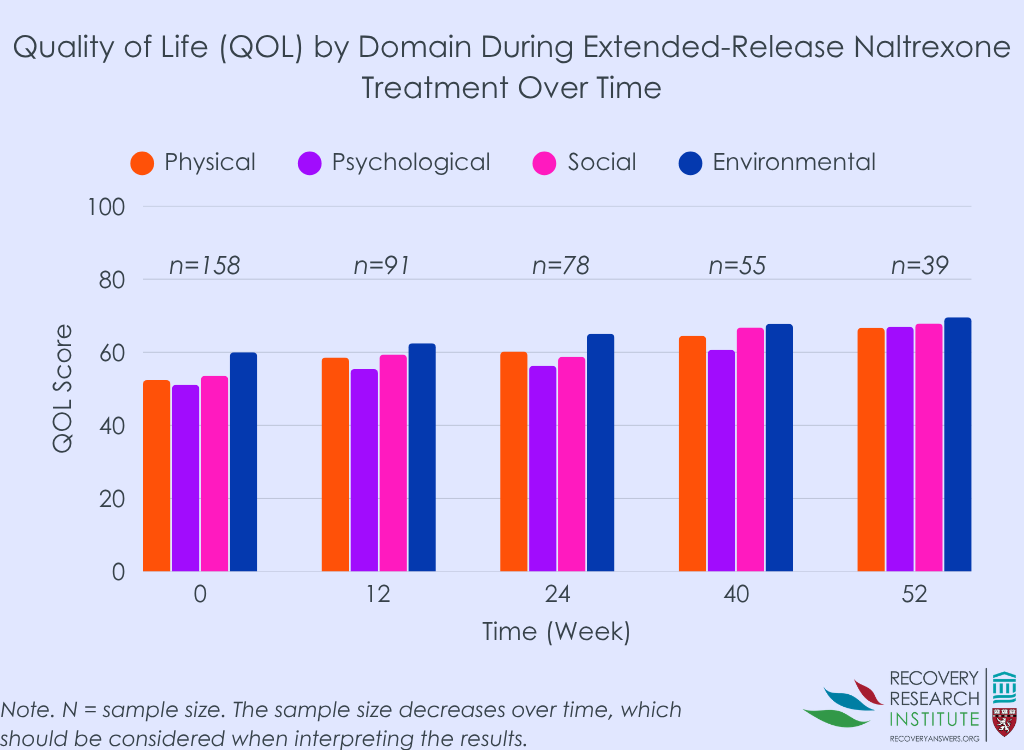
As mentioned above, however, these results should be considered with caution given the study dropout rate. It is possible that these participants staying in the study were more likely to have had positive experiences with the medication, and therefore higher quality of life. Those who discontinued extended-release naltrexone may have experienced different changes in quality of life, but these data are not available.
WHAT ARE THE IMPLICATIONS OF THE STUDY FINDINGS?
This study suggests that patients with opioid use disorder who choose extended-release naltrexone as part of their treatment may experience sustained improvements in quality of life. Such improvements may be due to patients having the ability to choose a treatment option that works best for them. This interpretation of findings is supported by research showing that patient autonomy can improve treatment adherence and treatment satisfaction. However, study results should be interpreted with caution given the high dropout rate. It is plausible that the patients who remained in the study reacted better to extended-release naltrexone treatment than those who withdrew from the study, or were otherwise very motivated, inflating the apparent quality of life gains. Other (i.e., secondary) analyses with the same primary study data somewhat support this claim: participants who discontinued extended-release naltrexone before the first follow-up reported more opioid use and lower treatment satisfaction than those who continued using extended-release naltrexone. Finally, because there was no comparison group in this study, there is no way to determine if patients receiving other opioid use disorder medications, or no medication at all, or used other methods, experienced different quality of life changes than those receiving extended-release naltrexone.
It is also worth noting that studies of agonist treatments like buprenorphine/naloxone and monthly injectable buprenorphine have documented improvements in health and well-being beyond opioid use. Further work is needed to determine how quality of life may vary among patients undergoing different types of opioid use disorder medications and other treatments.
BOTTOM LINE
Patients receiving treatment for opioid use disorders may experience improved quality of life if they incorporate extended-release naltrexone into their treatment regimen. Given the high drop-out rate in this study, however, more research is needed to examine the exact impacts of opioid use disorder medications on recovery outcomes beyond opioid use.
- For individuals and families seeking recovery: There are several FDA-approved medication options for opioid use disorder. While they are all likely to help reduce opioid use, and agonist medications like buprenorphine/naloxone and methadone likely to reduce overdose risk, studies are needed to understand their broader recovery impacts on health and well-being. This study was too limited by high drop-out rates to draw meaningful conclusions. But other work with injectable buprenorphine has shown improvements in functioning and employment rates.
- For treatment professionals and treatment systems: There are several FDA-approved medication options for opioid use disorder. While they are all likely to help reduce opioid use, and agonist medications like buprenorphine/naloxone and methadone likely to reduce overdose risk, studies are needed to understand their broader recovery impacts on health and well-being. This study was too limited by high drop-out rates to draw meaningful conclusions. But other work with injectable buprenorphine has shown improvements in functioning and employment rates.
- For scientists: The present study was limited by high attrition and the absence of a comparison group. While increases in quality of life were observed among these opioid use disorder patients self-selecting into extended-release naltrexone treatment, it is unclear if these changes were the result of extended-release naltrexone treatment. That said, other work with injectable buprenorphine has shown improvements in functioning and employment rates. More research is needed to better understand how opioid use disorder medications using different therapeutic mechanisms impact recovery beyond substance use.
- For policy makers: There are several FDA-approved medication options for opioid use disorder. While they are all likely to help reduce opioid use and overdose risk, studies are needed to understand their broader recovery impacts on health and well-being. This study was too limited by high drop-out rates to draw meaningful conclusions. But other work with injectable buprenorphine has shown improvements in functioning and employment rates. Consider funding for rigorous research on the benefits of substance use disorder medications on patient functioning and well-being.
CITATIONS
Redondo, C. L., Weimand, B., Benth, J. Š., Vederhus, J. K., Mordal, J., Enger, A., Tanum, L., & Solli, K. K. (2025). Changes in quality of life during 52 weeks of extended-release naltrexone treatment, subsequent by a 1-year post-treatment period. Drug and Alcohol Dependence, 276. doi: 10.1016/j.drugalcdep.2025.112917.