Recovery residences may help criminal justice system involved individuals gain recovery capital
Adults with criminal justice involvement can have high rates of substance use disorder, yet they often face greater barriers to accessing different elements of recovery capital when seeking support. Recovery residences may offer an important source of stability and access to recovery capital during community reentry. This study examined whether recovery capital accrued differently over time among recovery housing residents with and without recent justice system involvement.
Substance use disorders inflict tremendous personal and societal burden. However, recovery is possible, and adults in recovery can achieve numerous accomplishments across self-improvement, family engagement, civic participation, and economic domains. Reaching stable recovery, however, takes most adults multiple attempts. There are a variety of individual and system-level characteristics that can support or hinder recovery journeys. One group of individuals with higher rates of substance use disorder are adults involved in the criminal justice systems (hereafter justice-involved). Justice-involved adults are much more likely to have a substance use disorder compared to adults not involved in the justice system (35% vs. 4%), and drug-related overdose is especially elevated for adults released recently from prison due to decreased tolerance after a period of abstinence.
Recovery residences, or recovery homes, are an evidence-based strategy to simultaneously address housing insecurity and provide a safe, substance-free living environment with a readily available community of recovery-related social support. Recovery homes (e.g., sober homes, Oxford Houses, Halfway Houses) promote a range of positive outcomes, including increased abstinence, higher rates of employment, and lower rates of criminal recidivism. Some characteristics of recovery homes may be particularly beneficial for substance use and recidivism, such as being part of a larger parent organization like Oxford Houses. However, less is known about how recovery-related resources—better known as recovery capital—changes among justice-involved adults in recovery homes. This study examined recovery capital trajectories among those with and without justice-involvement living in recovery homes living in Virginia.
HOW WAS THIS STUDY CONDUCTED?
This study examined longitudinal data from 101 recovery homes within the Virginia Association of Recovery Residences network, which has about 1,000 residents at any time. This study includes data from 1,933 adults who entered one of these recovery homes between February 2020 and August 2022. The primary analysis for this study compared recovery capital between those with and without justice-involvement upon entry into these recovery homes. A resident was considered justice-involved if they reported any of the following in the last 90 days: involvement with the police, on probation, on parole, yes to “any other criminal legal system involvement.” All residents completed the REC-CAP, which measures recovery capital, barriers, and unmeet services needs. For this study, an overall recovery capital score was calculated for positive recovery capital (including measures of well-being, personal, social, and community recovery capital, and commitment to sobriety) ranging from 0 to 100, with higher scores representing more recovery capital. Residents completed the REC-CAP at baseline, 45 days, 90 days, and then at 90-day intervals thereafter. Analyses used a quasi-experimental approach that applied analytical weights to balance justice-involved and non-justice-involved residents and to account for residents who did not complete all assessment waves, helping to reduce bias from non-random program exit.
There were 1,158 residents that were justice-involved (60%), compared to 775 residents (40%) that were not. The average age of the justice-involved residents was 37 years, and the average age was 40 among non-justice-involved. Two-thirds were White (68% of justice-involved and 64% non-justice-involved). Similarly, two-thirds were male (63% of justice-involved and 66% non-justice-involved).
WHAT DID THIS STUDY FIND?
Justice-involved residents had higher needs and more barriers at baseline
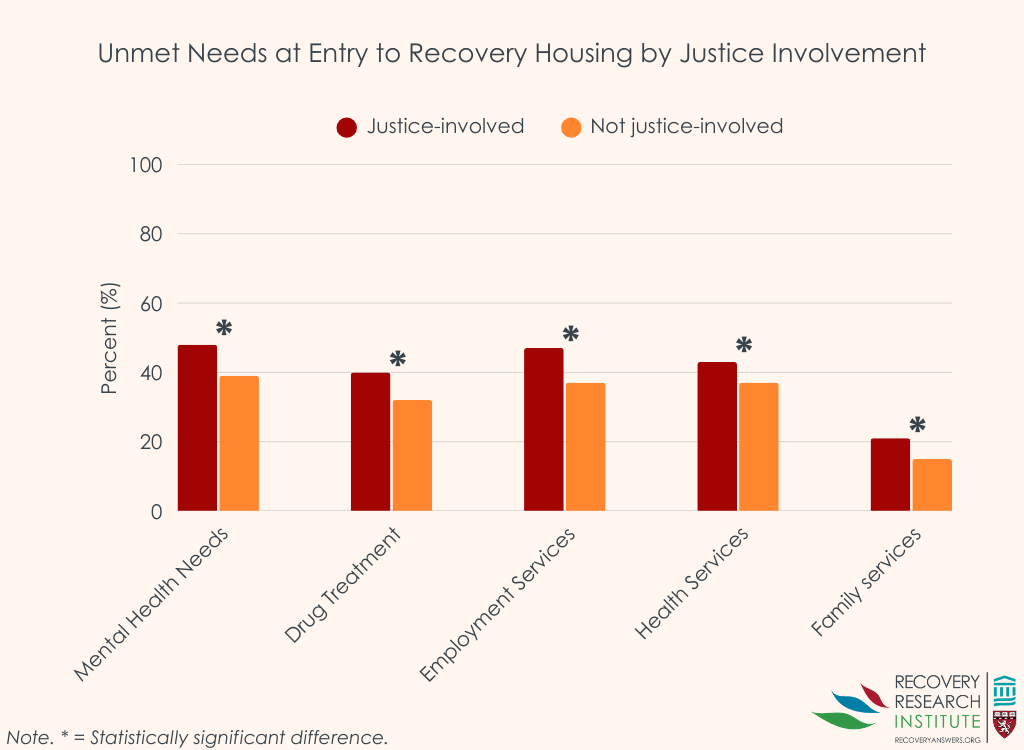
Upon entry into recovery housing, justice-involved residents reported substantially higher unmet needs across multiple service domains (see graph below).
Relative to residents without justice system involvement, justice-involved residents had more unmet mental health needs (48% vs. 39%), unmet needs for drug treatment (40% vs. 32%) and reported more need for employment services (47% vs. 37%). Justice-involved residents also were more likely to report unmet needs related to health services (43% vs. 37%), family services (21% vs. 15%), and other supports (9% vs. 6%).
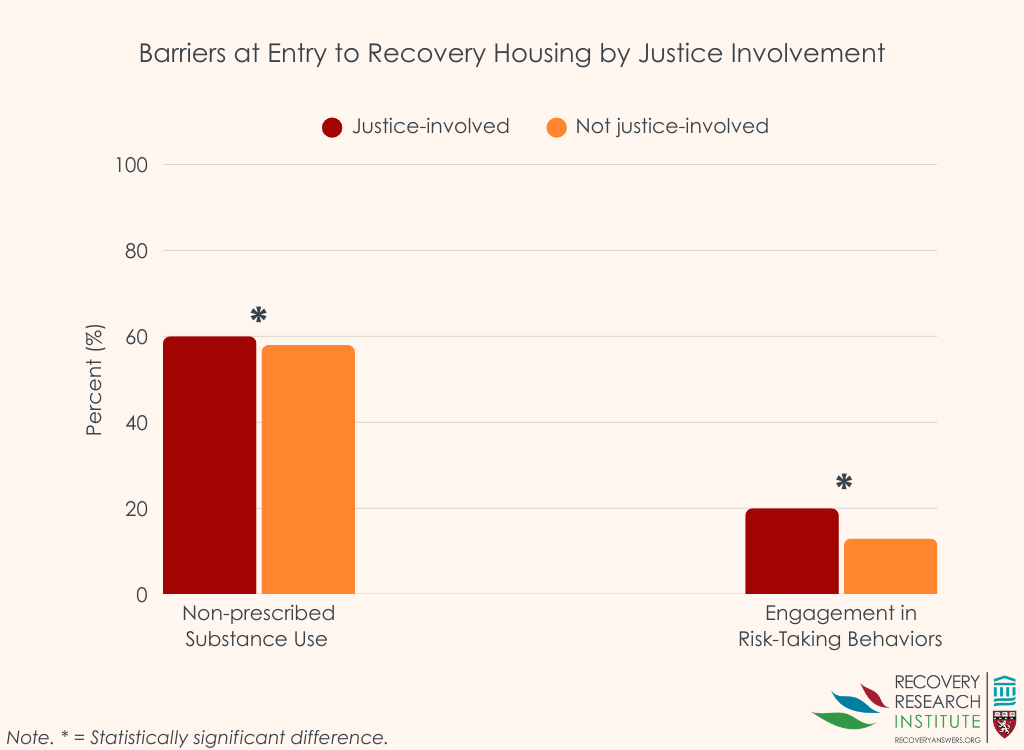
In addition to higher service needs, justice-involved residents reported more recovery-related barriers at baseline, particularly those linked to ongoing substance use and behavioral risk. Recent non-prescribed substance use was reported by over 60% of justice-involved residents, compared to 58% of non–justice-involved residents, while engagement in risk-taking behaviors such as injection drug use was notably higher (20% vs. 13%). Justice-involved residents were also more likely to report barriers related to recent instability in employment, education, or volunteering. That said, Overall Recovery Capital Scores, capturing positive recovery capital (described above), were similar between the groups at baseline (37 to 38 out of 100).
Recovery capital trajectories were similar for justice-involved and non-involved residents
Recovery capital trajectories of justice-involved recovery housing residents were similar to those of non-justice-involved recovery housing residents. Changes in recovery capital from baseline were higher at each assessment point for justice-involved residents. However, these differences were not statistically significant. Recovery capital increases for both groups of residents ranged from about 3 points after 45 days of residence to about 6 points after about 585 days (~1.6 years). Justice-involved residents did not show worse trajectories than non-justice-involved residents, despite starting with higher needs and more barriers. Although the study included estimates through later assessment points, estimates beyond approximately 1.6 years were increasingly imprecise due to small numbers of residents contributing data, limiting confidence in those point estimates.
WHAT ARE THE IMPLICATIONS OF THE STUDY FINDINGS?
Criminal justice involvement is a major barrier for adults with substance use disorders, who make up approximately 35% of the adult population involved in the criminal justice system. For adults reentering the community after incarceration, recovery residences may be a particularly important source of stability and support. Prior research has shown that justice-involved adults living in recovery residences experience improvements in substance use and employment outcomes, but less has been known about whether these settings also support growth in recovery capital, especially relative to adults without justice involvement.
In this study of recovery home residents in Virginia, recovery capital increased over time for both justice-involved and non–justice-involved adults, following similar trajectories across approximately 1.6 years of residence. Although the overall increases in recovery capital were modest in absolute terms (3–6 points on a 0–100 scale), these gains reflect gradual changes in complex and often slow-moving areas such as housing stability, social support, health, and community engagement. Importantly, these parallel patterns of growth occurred despite justice-involved adults entering recovery housing with higher service needs and more recovery-related barriers. Taken together, these findings suggest that recovery residences may help level the playing field for adults with recent justice involvement by supporting steady, incremental improvements in recovery-related resources rather than rapid or transformative change.
It is unknown how many residents did not participate, which may limit generalizability to all recovery housing residents.
Although the analytic approach used here, marginal structural modeling, helps address bias, it does not address the lack of precision at later waves, when few residents completed the REC-CAP. Estimates may be too unstable 2-3 years after baseline to reliably discern trajectories.
These findings were based on recovery home residents in Virginia, which may not generalize to other states or countries. State-level policies and practices may differentially impact those with justice involvement.
BOTTOM LINE
In this longitudinal secondary data analysis of recovery housing residents, adults with recent justice involvement (e.g., arrest, probation, or parole within the past 90 days) exhibited recovery capital trajectories similar to those of residents without justice involvement. Both groups demonstrated gains in recovery capital from 45 days after entry into the residence through approximately 1.6 years of residence. Importantly, these similar trajectories emerged despite justice-involved residents reporting higher service needs and more recovery-related barriers at the time of entry.
For individuals and families seeking recovery: If you or a loved one has recent justice involvement and is living with a substance use disorder, these findings suggest that recovery residences may offer meaningful support during reentry. Even when people enter recovery housing with greater needs and barriers, recovery residences can support gradual growth in the resources that help sustain recovery over time.
For treatment professionals and treatment systems: Connecting individuals with substance use disorder to community-based supports is vital for building long-term recovery and goal attainment, especially for adults with criminal justice involvement. Recovery residences may be uniquely suited to support recovery capital growth. The findings from this study found that despite higher needs and more barriers at residence entry, justice-involved adults showed similar, gradual gains in recovery capital to those without justice involvement. If you work in a treatment system, it would likely benefit your clients for you to know the recovery residences in your local and surrounding areas. Additionally, understanding the range of and specific structure of different recovery residences could help you recommend specific recovery residences.
For scientists: This longitudinal secondary data analysis found that recovery capital trajectories were similar for adults with and without recent justice involvement living in recovery residences in Virginia, who were entering a recovery residence. The marginal structural modeling approach helped account for bias related to non-random attrition and time-varying confounding. Future research could explore complementary analytic approaches, such as propensity score matching, to further assess robustness across methods. In addition, individuals and recovery residence programs may benefit from greater clarity about which types of structure and supports are most effective for residents with different characteristics and needs. Future studies should also examine whether these findings generalize to recovery residences in other states and explore, through qualitative research, how individuals with and without justice involvement experience recovery residences as supportive or helpful during recovery.
For policy makers: Recovery residences have been shown to support positive substance use and recovery-related outcomes. This study found that adults with recent justice involvement experienced recovery capital growth comparable to that of residents without justice involvement when both were entering recovery residences. This, despite entering recovery housing with greater barriers and service needs. These findings suggest that recovery residences may play an important role in providing access to the kinds of resources that can support recovery during community reentry. Continued investment in recovery residences, along with funding for systematic, longitudinal evaluation and research, could help better understand how these settings contribute to stronger and more responsive regional recovery ecosystems.
Substance use disorders inflict tremendous personal and societal burden. However, recovery is possible, and adults in recovery can achieve numerous accomplishments across self-improvement, family engagement, civic participation, and economic domains. Reaching stable recovery, however, takes most adults multiple attempts. There are a variety of individual and system-level characteristics that can support or hinder recovery journeys. One group of individuals with higher rates of substance use disorder are adults involved in the criminal justice systems (hereafter justice-involved). Justice-involved adults are much more likely to have a substance use disorder compared to adults not involved in the justice system (35% vs. 4%), and drug-related overdose is especially elevated for adults released recently from prison due to decreased tolerance after a period of abstinence.
Recovery residences, or recovery homes, are an evidence-based strategy to simultaneously address housing insecurity and provide a safe, substance-free living environment with a readily available community of recovery-related social support. Recovery homes (e.g., sober homes, Oxford Houses, Halfway Houses) promote a range of positive outcomes, including increased abstinence, higher rates of employment, and lower rates of criminal recidivism. Some characteristics of recovery homes may be particularly beneficial for substance use and recidivism, such as being part of a larger parent organization like Oxford Houses. However, less is known about how recovery-related resources—better known as recovery capital—changes among justice-involved adults in recovery homes. This study examined recovery capital trajectories among those with and without justice-involvement living in recovery homes living in Virginia.
HOW WAS THIS STUDY CONDUCTED?
This study examined longitudinal data from 101 recovery homes within the Virginia Association of Recovery Residences network, which has about 1,000 residents at any time. This study includes data from 1,933 adults who entered one of these recovery homes between February 2020 and August 2022. The primary analysis for this study compared recovery capital between those with and without justice-involvement upon entry into these recovery homes. A resident was considered justice-involved if they reported any of the following in the last 90 days: involvement with the police, on probation, on parole, yes to “any other criminal legal system involvement.” All residents completed the REC-CAP, which measures recovery capital, barriers, and unmeet services needs. For this study, an overall recovery capital score was calculated for positive recovery capital (including measures of well-being, personal, social, and community recovery capital, and commitment to sobriety) ranging from 0 to 100, with higher scores representing more recovery capital. Residents completed the REC-CAP at baseline, 45 days, 90 days, and then at 90-day intervals thereafter. Analyses used a quasi-experimental approach that applied analytical weights to balance justice-involved and non-justice-involved residents and to account for residents who did not complete all assessment waves, helping to reduce bias from non-random program exit.
There were 1,158 residents that were justice-involved (60%), compared to 775 residents (40%) that were not. The average age of the justice-involved residents was 37 years, and the average age was 40 among non-justice-involved. Two-thirds were White (68% of justice-involved and 64% non-justice-involved). Similarly, two-thirds were male (63% of justice-involved and 66% non-justice-involved).
WHAT DID THIS STUDY FIND?
Justice-involved residents had higher needs and more barriers at baseline
Upon entry into recovery housing, justice-involved residents reported substantially higher unmet needs across multiple service domains (see graph below).
Relative to residents without justice system involvement, justice-involved residents had more unmet mental health needs (48% vs. 39%), unmet needs for drug treatment (40% vs. 32%) and reported more need for employment services (47% vs. 37%). Justice-involved residents also were more likely to report unmet needs related to health services (43% vs. 37%), family services (21% vs. 15%), and other supports (9% vs. 6%).
In addition to higher service needs, justice-involved residents reported more recovery-related barriers at baseline, particularly those linked to ongoing substance use and behavioral risk. Recent non-prescribed substance use was reported by over 60% of justice-involved residents, compared to 58% of non–justice-involved residents, while engagement in risk-taking behaviors such as injection drug use was notably higher (20% vs. 13%). Justice-involved residents were also more likely to report barriers related to recent instability in employment, education, or volunteering. That said, Overall Recovery Capital Scores, capturing positive recovery capital (described above), were similar between the groups at baseline (37 to 38 out of 100).
Recovery capital trajectories were similar for justice-involved and non-involved residents
Recovery capital trajectories of justice-involved recovery housing residents were similar to those of non-justice-involved recovery housing residents. Changes in recovery capital from baseline were higher at each assessment point for justice-involved residents. However, these differences were not statistically significant. Recovery capital increases for both groups of residents ranged from about 3 points after 45 days of residence to about 6 points after about 585 days (~1.6 years). Justice-involved residents did not show worse trajectories than non-justice-involved residents, despite starting with higher needs and more barriers. Although the study included estimates through later assessment points, estimates beyond approximately 1.6 years were increasingly imprecise due to small numbers of residents contributing data, limiting confidence in those point estimates.
WHAT ARE THE IMPLICATIONS OF THE STUDY FINDINGS?
Criminal justice involvement is a major barrier for adults with substance use disorders, who make up approximately 35% of the adult population involved in the criminal justice system. For adults reentering the community after incarceration, recovery residences may be a particularly important source of stability and support. Prior research has shown that justice-involved adults living in recovery residences experience improvements in substance use and employment outcomes, but less has been known about whether these settings also support growth in recovery capital, especially relative to adults without justice involvement.
In this study of recovery home residents in Virginia, recovery capital increased over time for both justice-involved and non–justice-involved adults, following similar trajectories across approximately 1.6 years of residence. Although the overall increases in recovery capital were modest in absolute terms (3–6 points on a 0–100 scale), these gains reflect gradual changes in complex and often slow-moving areas such as housing stability, social support, health, and community engagement. Importantly, these parallel patterns of growth occurred despite justice-involved adults entering recovery housing with higher service needs and more recovery-related barriers. Taken together, these findings suggest that recovery residences may help level the playing field for adults with recent justice involvement by supporting steady, incremental improvements in recovery-related resources rather than rapid or transformative change.
It is unknown how many residents did not participate, which may limit generalizability to all recovery housing residents.
Although the analytic approach used here, marginal structural modeling, helps address bias, it does not address the lack of precision at later waves, when few residents completed the REC-CAP. Estimates may be too unstable 2-3 years after baseline to reliably discern trajectories.
These findings were based on recovery home residents in Virginia, which may not generalize to other states or countries. State-level policies and practices may differentially impact those with justice involvement.
BOTTOM LINE
In this longitudinal secondary data analysis of recovery housing residents, adults with recent justice involvement (e.g., arrest, probation, or parole within the past 90 days) exhibited recovery capital trajectories similar to those of residents without justice involvement. Both groups demonstrated gains in recovery capital from 45 days after entry into the residence through approximately 1.6 years of residence. Importantly, these similar trajectories emerged despite justice-involved residents reporting higher service needs and more recovery-related barriers at the time of entry.
For individuals and families seeking recovery: If you or a loved one has recent justice involvement and is living with a substance use disorder, these findings suggest that recovery residences may offer meaningful support during reentry. Even when people enter recovery housing with greater needs and barriers, recovery residences can support gradual growth in the resources that help sustain recovery over time.
For treatment professionals and treatment systems: Connecting individuals with substance use disorder to community-based supports is vital for building long-term recovery and goal attainment, especially for adults with criminal justice involvement. Recovery residences may be uniquely suited to support recovery capital growth. The findings from this study found that despite higher needs and more barriers at residence entry, justice-involved adults showed similar, gradual gains in recovery capital to those without justice involvement. If you work in a treatment system, it would likely benefit your clients for you to know the recovery residences in your local and surrounding areas. Additionally, understanding the range of and specific structure of different recovery residences could help you recommend specific recovery residences.
For scientists: This longitudinal secondary data analysis found that recovery capital trajectories were similar for adults with and without recent justice involvement living in recovery residences in Virginia, who were entering a recovery residence. The marginal structural modeling approach helped account for bias related to non-random attrition and time-varying confounding. Future research could explore complementary analytic approaches, such as propensity score matching, to further assess robustness across methods. In addition, individuals and recovery residence programs may benefit from greater clarity about which types of structure and supports are most effective for residents with different characteristics and needs. Future studies should also examine whether these findings generalize to recovery residences in other states and explore, through qualitative research, how individuals with and without justice involvement experience recovery residences as supportive or helpful during recovery.
For policy makers: Recovery residences have been shown to support positive substance use and recovery-related outcomes. This study found that adults with recent justice involvement experienced recovery capital growth comparable to that of residents without justice involvement when both were entering recovery residences. This, despite entering recovery housing with greater barriers and service needs. These findings suggest that recovery residences may play an important role in providing access to the kinds of resources that can support recovery during community reentry. Continued investment in recovery residences, along with funding for systematic, longitudinal evaluation and research, could help better understand how these settings contribute to stronger and more responsive regional recovery ecosystems.
Substance use disorders inflict tremendous personal and societal burden. However, recovery is possible, and adults in recovery can achieve numerous accomplishments across self-improvement, family engagement, civic participation, and economic domains. Reaching stable recovery, however, takes most adults multiple attempts. There are a variety of individual and system-level characteristics that can support or hinder recovery journeys. One group of individuals with higher rates of substance use disorder are adults involved in the criminal justice systems (hereafter justice-involved). Justice-involved adults are much more likely to have a substance use disorder compared to adults not involved in the justice system (35% vs. 4%), and drug-related overdose is especially elevated for adults released recently from prison due to decreased tolerance after a period of abstinence.
Recovery residences, or recovery homes, are an evidence-based strategy to simultaneously address housing insecurity and provide a safe, substance-free living environment with a readily available community of recovery-related social support. Recovery homes (e.g., sober homes, Oxford Houses, Halfway Houses) promote a range of positive outcomes, including increased abstinence, higher rates of employment, and lower rates of criminal recidivism. Some characteristics of recovery homes may be particularly beneficial for substance use and recidivism, such as being part of a larger parent organization like Oxford Houses. However, less is known about how recovery-related resources—better known as recovery capital—changes among justice-involved adults in recovery homes. This study examined recovery capital trajectories among those with and without justice-involvement living in recovery homes living in Virginia.
HOW WAS THIS STUDY CONDUCTED?
This study examined longitudinal data from 101 recovery homes within the Virginia Association of Recovery Residences network, which has about 1,000 residents at any time. This study includes data from 1,933 adults who entered one of these recovery homes between February 2020 and August 2022. The primary analysis for this study compared recovery capital between those with and without justice-involvement upon entry into these recovery homes. A resident was considered justice-involved if they reported any of the following in the last 90 days: involvement with the police, on probation, on parole, yes to “any other criminal legal system involvement.” All residents completed the REC-CAP, which measures recovery capital, barriers, and unmeet services needs. For this study, an overall recovery capital score was calculated for positive recovery capital (including measures of well-being, personal, social, and community recovery capital, and commitment to sobriety) ranging from 0 to 100, with higher scores representing more recovery capital. Residents completed the REC-CAP at baseline, 45 days, 90 days, and then at 90-day intervals thereafter. Analyses used a quasi-experimental approach that applied analytical weights to balance justice-involved and non-justice-involved residents and to account for residents who did not complete all assessment waves, helping to reduce bias from non-random program exit.
There were 1,158 residents that were justice-involved (60%), compared to 775 residents (40%) that were not. The average age of the justice-involved residents was 37 years, and the average age was 40 among non-justice-involved. Two-thirds were White (68% of justice-involved and 64% non-justice-involved). Similarly, two-thirds were male (63% of justice-involved and 66% non-justice-involved).
WHAT DID THIS STUDY FIND?
Justice-involved residents had higher needs and more barriers at baseline
Upon entry into recovery housing, justice-involved residents reported substantially higher unmet needs across multiple service domains (see graph below).
Relative to residents without justice system involvement, justice-involved residents had more unmet mental health needs (48% vs. 39%), unmet needs for drug treatment (40% vs. 32%) and reported more need for employment services (47% vs. 37%). Justice-involved residents also were more likely to report unmet needs related to health services (43% vs. 37%), family services (21% vs. 15%), and other supports (9% vs. 6%).
In addition to higher service needs, justice-involved residents reported more recovery-related barriers at baseline, particularly those linked to ongoing substance use and behavioral risk. Recent non-prescribed substance use was reported by over 60% of justice-involved residents, compared to 58% of non–justice-involved residents, while engagement in risk-taking behaviors such as injection drug use was notably higher (20% vs. 13%). Justice-involved residents were also more likely to report barriers related to recent instability in employment, education, or volunteering. That said, Overall Recovery Capital Scores, capturing positive recovery capital (described above), were similar between the groups at baseline (37 to 38 out of 100).
Recovery capital trajectories were similar for justice-involved and non-involved residents
Recovery capital trajectories of justice-involved recovery housing residents were similar to those of non-justice-involved recovery housing residents. Changes in recovery capital from baseline were higher at each assessment point for justice-involved residents. However, these differences were not statistically significant. Recovery capital increases for both groups of residents ranged from about 3 points after 45 days of residence to about 6 points after about 585 days (~1.6 years). Justice-involved residents did not show worse trajectories than non-justice-involved residents, despite starting with higher needs and more barriers. Although the study included estimates through later assessment points, estimates beyond approximately 1.6 years were increasingly imprecise due to small numbers of residents contributing data, limiting confidence in those point estimates.
WHAT ARE THE IMPLICATIONS OF THE STUDY FINDINGS?
Criminal justice involvement is a major barrier for adults with substance use disorders, who make up approximately 35% of the adult population involved in the criminal justice system. For adults reentering the community after incarceration, recovery residences may be a particularly important source of stability and support. Prior research has shown that justice-involved adults living in recovery residences experience improvements in substance use and employment outcomes, but less has been known about whether these settings also support growth in recovery capital, especially relative to adults without justice involvement.
In this study of recovery home residents in Virginia, recovery capital increased over time for both justice-involved and non–justice-involved adults, following similar trajectories across approximately 1.6 years of residence. Although the overall increases in recovery capital were modest in absolute terms (3–6 points on a 0–100 scale), these gains reflect gradual changes in complex and often slow-moving areas such as housing stability, social support, health, and community engagement. Importantly, these parallel patterns of growth occurred despite justice-involved adults entering recovery housing with higher service needs and more recovery-related barriers. Taken together, these findings suggest that recovery residences may help level the playing field for adults with recent justice involvement by supporting steady, incremental improvements in recovery-related resources rather than rapid or transformative change.
It is unknown how many residents did not participate, which may limit generalizability to all recovery housing residents.
Although the analytic approach used here, marginal structural modeling, helps address bias, it does not address the lack of precision at later waves, when few residents completed the REC-CAP. Estimates may be too unstable 2-3 years after baseline to reliably discern trajectories.
These findings were based on recovery home residents in Virginia, which may not generalize to other states or countries. State-level policies and practices may differentially impact those with justice involvement.
BOTTOM LINE
In this longitudinal secondary data analysis of recovery housing residents, adults with recent justice involvement (e.g., arrest, probation, or parole within the past 90 days) exhibited recovery capital trajectories similar to those of residents without justice involvement. Both groups demonstrated gains in recovery capital from 45 days after entry into the residence through approximately 1.6 years of residence. Importantly, these similar trajectories emerged despite justice-involved residents reporting higher service needs and more recovery-related barriers at the time of entry.
For individuals and families seeking recovery: If you or a loved one has recent justice involvement and is living with a substance use disorder, these findings suggest that recovery residences may offer meaningful support during reentry. Even when people enter recovery housing with greater needs and barriers, recovery residences can support gradual growth in the resources that help sustain recovery over time.
For treatment professionals and treatment systems: Connecting individuals with substance use disorder to community-based supports is vital for building long-term recovery and goal attainment, especially for adults with criminal justice involvement. Recovery residences may be uniquely suited to support recovery capital growth. The findings from this study found that despite higher needs and more barriers at residence entry, justice-involved adults showed similar, gradual gains in recovery capital to those without justice involvement. If you work in a treatment system, it would likely benefit your clients for you to know the recovery residences in your local and surrounding areas. Additionally, understanding the range of and specific structure of different recovery residences could help you recommend specific recovery residences.
For scientists: This longitudinal secondary data analysis found that recovery capital trajectories were similar for adults with and without recent justice involvement living in recovery residences in Virginia, who were entering a recovery residence. The marginal structural modeling approach helped account for bias related to non-random attrition and time-varying confounding. Future research could explore complementary analytic approaches, such as propensity score matching, to further assess robustness across methods. In addition, individuals and recovery residence programs may benefit from greater clarity about which types of structure and supports are most effective for residents with different characteristics and needs. Future studies should also examine whether these findings generalize to recovery residences in other states and explore, through qualitative research, how individuals with and without justice involvement experience recovery residences as supportive or helpful during recovery.
For policy makers: Recovery residences have been shown to support positive substance use and recovery-related outcomes. This study found that adults with recent justice involvement experienced recovery capital growth comparable to that of residents without justice involvement when both were entering recovery residences. This, despite entering recovery housing with greater barriers and service needs. These findings suggest that recovery residences may play an important role in providing access to the kinds of resources that can support recovery during community reentry. Continued investment in recovery residences, along with funding for systematic, longitudinal evaluation and research, could help better understand how these settings contribute to stronger and more responsive regional recovery ecosystems.