WHAT PROBLEM DOES THIS STUDY ADDRESS?
Methadone, and buprenorphine/naloxone, best known by the brand name Suboxone, have both been shown to support opioid use disorder recovery, but it is unclear whether women and men respond differently to these treatments. This matters because women and men often have different treatment needs that could affect how well a treatment works for them. For example, women with substance use problems tend to have more co-occurring mental health conditions (such as post-traumatic stress disorder) and may have more difficulty attending daily in-person methadone appointments due to childcare responsibilities. This study examined whether recovery outcomes differed between women and men enrolled in a trial comparing methadone to buprenorphine/naloxone.
HOW WAS THIS STUDY CONDUCTED?
Data came from the OPTIMA trial, an open-label, pragmatic, randomized trial comparing standard supervised in-person methadone with take-home buprenorphine/naloxone. This design allowed researchers to recruit a more representative sample and reflect real-world treatment settings. Participants were recruited from 7 partnering care centers across Canada (including hospital- and community-based clinics) between October 2017 and March 2020. Eligible participants were ages 18 to 64 with moderate to severe opioid use disorder. People were excluded if they were pregnant, had used heroin in the past month, or were currently taking opioids for pain management. After an initial visit to confirm eligibility, participants were randomly assigned to receive either methadone or buprenorphine/naloxone for 24 weeks, with the first dose given under supervision. Follow-up visits then occurred every 2 weeks for 24 weeks.
Treatment effectiveness was measured in several ways. Illicit opioid use was measured through opioid-positive urine tests (not counting prescribed medications), collected at the initial visit and at each follow-up visit. The study also measured treatment retention (taking the prescribed medication confirmed by a urine test) and severity of substance-use-related problems at 24 weeks, along with opioid craving and withdrawal symptoms throughout the study. The main analysis included all randomized participants irrespective of whether they actually received the medication to which they were assigned (i.e., “intent to treat”), using standard methods to account for missing data. A secondary sensitivity analysis was also conducted using only the data that were actually available (that is, excluding missing follow-up visits rather than treating them as opioid-positive), to check whether the main results held up under a different approach to missing data.
WHAT DID THIS STUDY FIND?
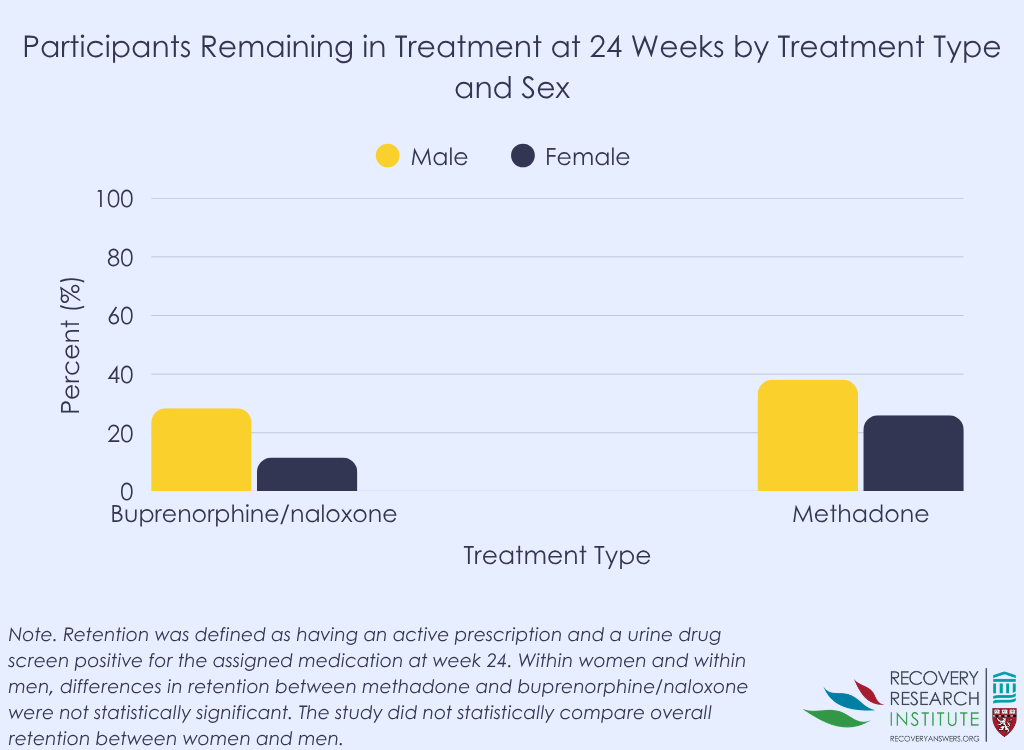
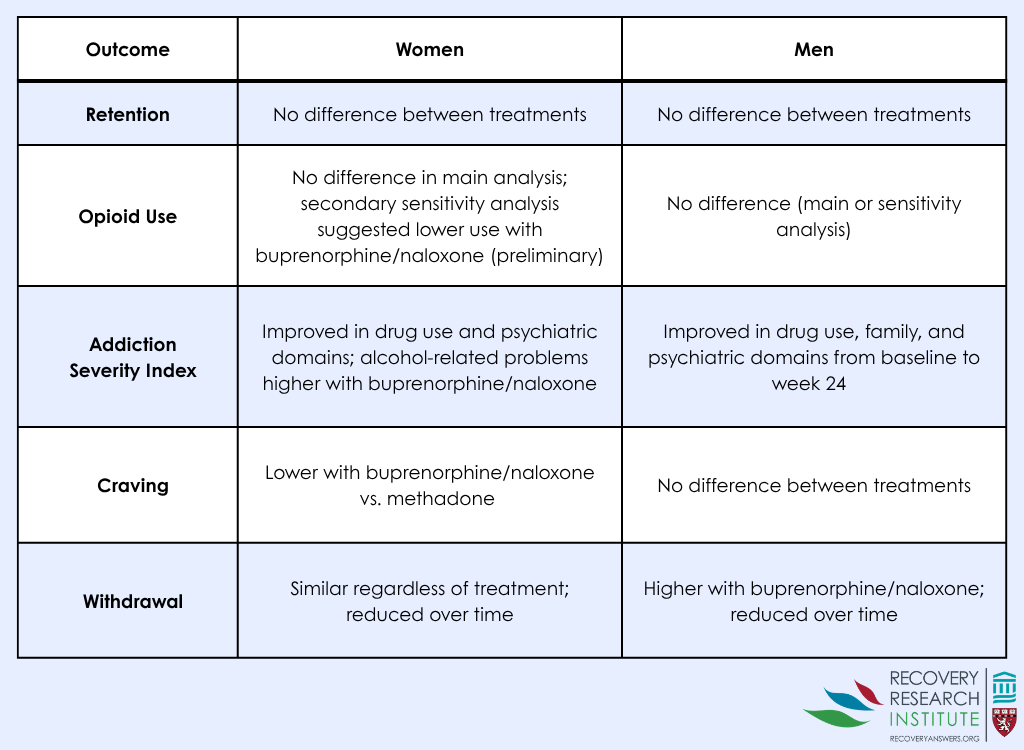
In the main analysis, there were no significant differences in illicit opioid use between participants taking methadone or buprenorphine/naloxone, for either women or men. A secondary sensitivity analysis, which used only the data actually available rather than treating missing data as opioid-positive, suggested that women taking buprenorphine/naloxone may have used illicit opioids less often than women taking methadone. Men showed no difference between treatments in either analysis. There were no significant differences between methadone and buprenorphine/naloxone in retention for either women or men, but overall treatment retention was low, i.e., only 28%-38% of men and 12%-26% of women remained in methadone or buprenorphine/naloxone treatment, respectively, at 24 weeks.
Further exploratory analyses showed that women and men differed somewhat in the areas linked to recovery. Regardless of medication, both women and men reported improvements in drug-related and mental health symptoms between their first visit and 24 weeks, but only men reported improvements in family-related problems. Opioid craving also differed by sex and treatment, with men reporting similar craving regardless of treatment while women prescribed buprenorphine/naloxone reported less craving than those prescribed methadone. In a smaller subgroup analysis, women prescribed buprenorphine/naloxone also reported more alcohol-related problems than those prescribed methadone. However, because this involved a small number of participants (i.e., 29), this finding should be interpreted cautiously and requires confirmation in future research. Finally, men prescribed buprenorphine/naloxone reported more withdrawal symptoms than those prescribed methadone, while women reported similar withdrawal symptoms regardless of treatment. However, this difference was present mainly at the start of treatment and narrowed over time. Both sexes reported fewer withdrawal symptoms as the study progressed.
WHAT ARE THE IMPLICATIONS OF THE STUDY FINDINGS?
This study suggests that both methadone and buprenorphine/naloxone may be helpful options for treating opioid use disorder in women and men. However, retention at 24 weeks appeared lower among female than male participants in both treatment groups, and the study did not collect information on why participants did not start, switched, or did not remain in their assigned treatment; therefore, firm conclusions about sex-based differences in treatment effectiveness cannot be drawn. The study cannot determine why retention appeared lower among women. One possible explanation is that female participants entered the trial with a higher prevalence of psychiatric comorbidity than male participants (60.2% versus 36.9%), which may indicate a need for more intensive, integrated mental health and substance use care. Other practical and social barriers, such as caregiving responsibilities, stigma, and unmet social-service needs, may also affect treatment engagement, but were not measured directly by the researchers. This work highlights the need for larger studies that directly assess sex- and gender-related barriers to starting, switching, and staying in medication treatment, as well as the potential value of integrated care that addresses psychiatric and social needs alongside opioid use disorder treatment.
When considering the findings of this study, several things are important to note. The researchers’ exploratory secondary analysis was not designed to detect small sex-specific treatment differences, and their ability to detect true differences between women and men was further limited given about 39% of male participants and 27% of female participants did not initiate treatment or complete the study, and the female sample (93 participants) was much smaller than the male sample (179 participants). Additionally, some findings described come from subgroups as small as 29 participants, which reduces confidence in the findings. It is unknown why participants dropped out or whether women and men faced different barriers to completing treatment, which makes it difficult to determine how treatment might need to be adapted for each group. Also, because fewer women stayed in treatment on buprenorphine/naloxone than on methadone, it is possible that women who experienced more craving dropped out earlier, which could make the buprenorphine/naloxone group appear to have lower craving simply because higher-craving participants left the study. Finally, this study does not include correction for the many statistical comparisons performed, which increases the probability that some results reflect chance rather than a true effect. Taken together, findings from this study should be interpreted with caution.
BOTTOM LINE
There were few differences between methadone and buprenorphine/naloxone in this study both for women and men, though low treatment initiation and retention make it hard to draw firm conclusions about potential sex differences. Future research should determine whether addressing sex-specific barriers can improve opioid use disorder treatment outcomes.
- For individuals and families seeking recovery: This study suggests that both methadone and buprenorphine/naloxone can be helpful treatment options for opioid use disorder regardless of one’s sex. Because many participants did not start or remain in treatment, it is important to work with treatment providers to find an approach that fits each person’s needs and circumstances.
- For treatment professionals and treatment systems: This study suggests methadone and buprenorphine/naloxone may offer similar benefits to female and male patients overall. It remains important to individualize treatment plans based on each patient’s specific needs and life circumstances.
- For scientists: This study identified several potentially important sex-specific differences, but the findings require confirmation in larger, adequately powered, confirmatory studies before informing treatment decisions.
- For policy makers: This study found no clear overall advantage of methadone or buprenorphine/naloxone for women or men. Continued support for accessible, evidence-based opioid use disorder treatment remains important while additional research examines whether treatment approaches should be tailored by sex.
CITATIONS
McAnulty, C., Bastien, G., Pek, C., McCrea, T. P., Bouthillier, A., Stewart, S. H., Socias, M. E., Le Foll, B., Jutras-Aswad, D., & OPTIMA Research Group within the Canadian Research Initiative in Substance Misuse. (2026). Sex-based effectiveness in buprenorphine/naloxone and methadone treatment for opioid use disorder: Findings from the OPTIMA trial. Drug and Alcohol Dependence. doi: 10.1016/j.drugalcdep.2026.113190.