Can an online alcohol intervention help older adults reduce drinking and cognitive decline?

Alcohol use and related health risks, including cancer, cognitive decline, and dementia, are an increasing concern among adults over 60, highlighting a critical need for accessible interventions designed specifically for this age group. This study tested whether an online alcohol intervention for older adults could reduce alcohol use and potentially improve cognitive functioning over 12 months.

Stay on the frontiers of
recovery science
with the free, monthly
Recovery Bulletin

l

WHAT PROBLEM DOES THIS STUDY ADDRESS?

Alcohol use tends to decline with age, but high-risk alcohol use and its associated health consequences remain an important public health concern among adults ages 60 and older. For example, in the US, rates of alcohol use disorder and alcohol-associated liver disease and mortality have increased among older adults, and alcohol use is associated with numerous other adverse health outcomes (e.g., cancer, unintentional injuries such as falls). Another major concern in this population is the relationship between alcohol use and cognitive decline and dementia; having alcohol use disorder is associated with more than 3 times the risk of developing dementia. Yet relatively little research has tested alcohol interventions specifically for older adults, and prior research has not examined whether a fully online alcohol intervention could both reduce drinking and protect cognitive functioning in this population. Moreover, although some evidence suggests cognitive functioning can improve following sustained abstinence from alcohol, whether reducing rather than completely stopping drinking produces similar cognitive benefits remains unclear. This study, adapted for older adults from a U.K.-based brief online alcohol intervention (Rethink My Drink), tested whether it reduced alcohol consumption and cognitive decline more than an online alcohol information booklet over 12 months.


HOW WAS THIS STUDY CONDUCTED?

This 2-arm, fully online randomized controlled trial in Australia included 888 adults ages 60-75 years (Mean age = 65 years) who screened positive for high-risk alcohol use (i.e., scored 5 or higher on the Alcohol Use Disorders Identification Test) and were randomly assigned to either Rethink My Drink (n = 448), a 4-module online intervention with an initial 4-week active engagement period adapted specifically for older adults, or an online alcohol information booklet (n = 440). The Rethink My Drink intervention was adapted for this study using focus groups with 30 older adults to improve its content and functionality and included 36 lessons focused on deciding and planning whether to cut down on drinking, making changes to drinking, and maintaining those changes. Participants in the control group received an 8-page online booklet with information about alcohol-related health effects and harms, strategies for reducing alcohol-related harm, and resources for additional help. Participants completed assessments at baseline, immediately after the 4-week intervention period, and at 12 months following baseline. The primary outcomes at 12 months were self-reported number of standard alcoholic drinks (defined in Australia as 10 grams of alcohol) consumed during the past 28 days, and overall cognitive functioning measured with computerized tests of attention, executive functioning, learning, and memory assessed using the Cambridge Neuropsychological Test Automated Battery (typically referred to as the “CANTAB”). The researchers compared changes in alcohol use and cognitive functioning over time between the 2 groups, with the primary comparison focused on whether participants assigned to Rethink My Drink improved more from baseline to 12 months than those assigned to the alcohol information booklet control group.

In this study, random assignment increases confidence that differences observed between the 2 groups were due to the intervention rather than pre-existing differences between participants. However, only 55% of participants completed the 12-month assessment, and those who were lost to follow-up tended to have more severe alcohol use and alcohol-related problems at baseline. The researchers also conducted sensitivity analyses to check whether the findings held up when missing follow-up data were estimated using participants’ available information, including characteristics associated with dropping out. While the researchers used statistical methods to account for missing data, this substantial and selective attrition reduces confidence in the findings and left the study with less statistical power than planned to detect differences in cognition. The sample was also almost entirely White and highly educated. In addition, people with neurological disorders such as dementia and Parkinson’s disease were excluded. These factors limit how confidently the findings can be generalized to the broader population of older adults.


WHAT DID THIS STUDY FIND?

Older Australian adults assigned to the Rethink My Drink online alcohol intervention reduced their alcohol consumption more than those who received an online alcohol information booklet. From baseline to 12 months, participants assigned to Rethink My Drink reduced their alcohol use by about 36 Australian standard drinks per month, while those assigned to the information booklet reduced their consumption by about 31 drinks (see figure below). Thus, the additional reduction associated with Rethink My Drink was approximately 5 drinks per month. Participants assigned to Rethink My Drink also had about 1 fewer high-risk drinking days (i.e., 4 or more drinks on 1 occasion) per month than those in the control group. These findings were based on the main analysis; results were somewhat less consistent in additional sensitivity analyses, so they should be interpreted with some caution.
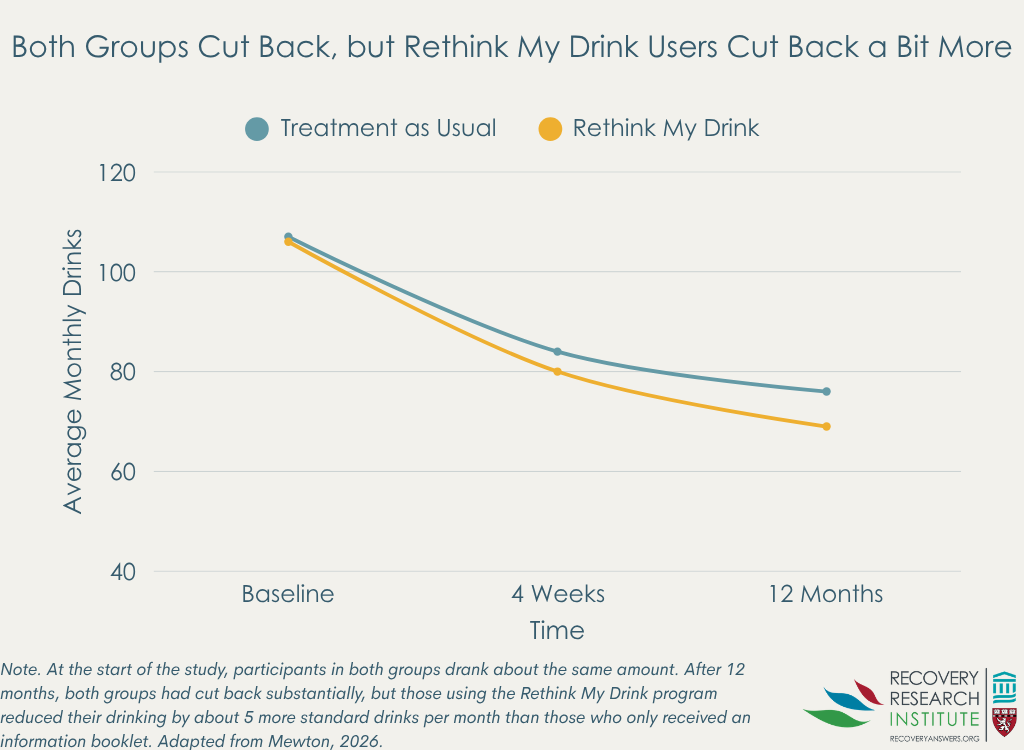
In contrast to reducing alcohol use, Rethink My Drink did not clearly improve cognitive functioning relative to the alcohol information booklet control. From baseline to 12 months, overall cognitive functioning improved somewhat among participants assigned to Rethink My Drink, but the differences between groups was not statistically significant. Importantly, high dropout left the study with less statistical power than planned to detect differences in cognitive functioning at the 12-month follow-up, so the study may have been unable to detect a small difference between groups.


WHAT ARE THE IMPLICATIONS OF THE STUDY FINDINGS?

Rethink My Drink, a brief online alcohol intervention adapted specifically for older adults, appears to be a relatively low-intensity and potentially scalable way to help older adults with high-risk alcohol use reduce their drinking. The reduction in alcohol use associated with the intervention was relatively modest compared to the control condition – about 5 drinks per month beyond the substantial reductions observed among participants who received an online alcohol information booklet alone. However, even modest individual-level reductions could have meaningful public health implications if a low-resource digital intervention can reach large numbers of older adults. Given the relationship between greater alcohol consumption and increased risk of alcohol-related disease, injury, and mortality, such reductions in drinking could potentially translate into meaningful health benefits over time, although this study did not examine these outcomes.

The substantial reductions in drinking observed in both groups may also reflect, in part, measurement reactivity, whereby repeatedly assessing drinking can itself prompt reductions among people who are already motivated to change their drinking, as has been observed in prior alcohol research. Screening and brief interventions in settings that frequently serve older adults, such as primary care, could provide opportunities to repeatedly assess alcohol use while also connecting people who want to reduce their drinking with low-threshold digital interventions like Rethink My Drink. Together, repeated assessment and scalable digital support could potentially extend alcohol reduction efforts to larger numbers of older adults with relatively little additional burden on healthcare providers. Because Rethink My Drink was developed and tested among a predominantly White, relatively highly educated sample, additional research is needed to determine whether similar benefits would be observed among more diverse populations of older adults.

At the same time, this study does not provide evidence that Rethink My Drink improved cognitive functioning in older adults. Prior research has found improvements in cognitive functioning following sustained abstinence from alcohol among individuals with alcohol use disorder, but it remains unclear whether more modest reductions in alcohol use are sufficient to produce similar cognitive benefits, particularly among older adults. High study dropout makes the null cognitive functioning finding less certain, particularly because participants with more severe alcohol use were more likely to leave the study and the trial consequently had less power than planned to detect a cognitive effect.


BOTTOM LINE

A brief online alcohol intervention (Rethink My Drink) adapted specifically for older adults ages 60 to 75 in Australia helped reduce alcohol consumption modestly more than providing alcohol information alone, although both groups substantially reduced their drinking. The intervention did not clearly improve cognitive functioning.


  • For individuals and families seeking recovery: Older adults who want to reduce their drinking may find online programs tailored to their needs to be an accessible alternative or complement to in-person support. Findings from this study suggest that even a brief online intervention offering practical strategies for changing drinking can help older adults reduce their alcohol consumption.
  • For treatment professionals and treatment systems: Screening for high-risk alcohol consumption among older adults in primary care and other healthcare settings, coupled with access to a brief digital intervention tailored to older adults, may offer a useful way to help some patients reduce their drinking with minimal clinician involvement.
  • For scientists: Future research should test Rethink My Drink and similar digital interventions in real-world implementation settings (e.g., primary care) and in more racially, ethnically, and socioeconomically diverse populations. Studies that anticipate substantial attrition and retain adequate statistical power are also needed to determine whether reducing high-risk alcohol use is associated with improvements in cognitive outcomes in older adults.
  • For policy makers: Scalable digital interventions tailored to older adults may provide a relatively low-resource approach to expanding access to alcohol reduction support, including for people who have difficulty accessing or prefer not to use in-person services. Broad dissemination of digital alcohol interventions for older adults has the potential to help reduce high-risk alcohol use at the population level and, in turn, lessen the substantial burden of alcohol-associated disease and mortality in this age group.

CITATIONS

Mewton, L., Winter, V., Hoy, N., Visontay, R., Davies, S., Kochan, N., Baillie, A., Chapman, C., Newton, N. C., Sunderland, M., Sachdev, P. S., & Teesson, M. (2026). Effect of the online Rethink My Drink alcohol intervention on alcohol use and cognition in older adults in Australia: A randomised controlled trial. The Lancet Public Health, 11(5), e318-e328. doi: 10.1016/S2468-2667(26)00056-3.



Stay on the Frontiers of
recovery science
with the free, monthly
Recovery Bulletin

l

WHAT PROBLEM DOES THIS STUDY ADDRESS?

Alcohol use tends to decline with age, but high-risk alcohol use and its associated health consequences remain an important public health concern among adults ages 60 and older. For example, in the US, rates of alcohol use disorder and alcohol-associated liver disease and mortality have increased among older adults, and alcohol use is associated with numerous other adverse health outcomes (e.g., cancer, unintentional injuries such as falls). Another major concern in this population is the relationship between alcohol use and cognitive decline and dementia; having alcohol use disorder is associated with more than 3 times the risk of developing dementia. Yet relatively little research has tested alcohol interventions specifically for older adults, and prior research has not examined whether a fully online alcohol intervention could both reduce drinking and protect cognitive functioning in this population. Moreover, although some evidence suggests cognitive functioning can improve following sustained abstinence from alcohol, whether reducing rather than completely stopping drinking produces similar cognitive benefits remains unclear. This study, adapted for older adults from a U.K.-based brief online alcohol intervention (Rethink My Drink), tested whether it reduced alcohol consumption and cognitive decline more than an online alcohol information booklet over 12 months.


HOW WAS THIS STUDY CONDUCTED?

This 2-arm, fully online randomized controlled trial in Australia included 888 adults ages 60-75 years (Mean age = 65 years) who screened positive for high-risk alcohol use (i.e., scored 5 or higher on the Alcohol Use Disorders Identification Test) and were randomly assigned to either Rethink My Drink (n = 448), a 4-module online intervention with an initial 4-week active engagement period adapted specifically for older adults, or an online alcohol information booklet (n = 440). The Rethink My Drink intervention was adapted for this study using focus groups with 30 older adults to improve its content and functionality and included 36 lessons focused on deciding and planning whether to cut down on drinking, making changes to drinking, and maintaining those changes. Participants in the control group received an 8-page online booklet with information about alcohol-related health effects and harms, strategies for reducing alcohol-related harm, and resources for additional help. Participants completed assessments at baseline, immediately after the 4-week intervention period, and at 12 months following baseline. The primary outcomes at 12 months were self-reported number of standard alcoholic drinks (defined in Australia as 10 grams of alcohol) consumed during the past 28 days, and overall cognitive functioning measured with computerized tests of attention, executive functioning, learning, and memory assessed using the Cambridge Neuropsychological Test Automated Battery (typically referred to as the “CANTAB”). The researchers compared changes in alcohol use and cognitive functioning over time between the 2 groups, with the primary comparison focused on whether participants assigned to Rethink My Drink improved more from baseline to 12 months than those assigned to the alcohol information booklet control group.

In this study, random assignment increases confidence that differences observed between the 2 groups were due to the intervention rather than pre-existing differences between participants. However, only 55% of participants completed the 12-month assessment, and those who were lost to follow-up tended to have more severe alcohol use and alcohol-related problems at baseline. The researchers also conducted sensitivity analyses to check whether the findings held up when missing follow-up data were estimated using participants’ available information, including characteristics associated with dropping out. While the researchers used statistical methods to account for missing data, this substantial and selective attrition reduces confidence in the findings and left the study with less statistical power than planned to detect differences in cognition. The sample was also almost entirely White and highly educated. In addition, people with neurological disorders such as dementia and Parkinson’s disease were excluded. These factors limit how confidently the findings can be generalized to the broader population of older adults.


WHAT DID THIS STUDY FIND?

Older Australian adults assigned to the Rethink My Drink online alcohol intervention reduced their alcohol consumption more than those who received an online alcohol information booklet. From baseline to 12 months, participants assigned to Rethink My Drink reduced their alcohol use by about 36 Australian standard drinks per month, while those assigned to the information booklet reduced their consumption by about 31 drinks (see figure below). Thus, the additional reduction associated with Rethink My Drink was approximately 5 drinks per month. Participants assigned to Rethink My Drink also had about 1 fewer high-risk drinking days (i.e., 4 or more drinks on 1 occasion) per month than those in the control group. These findings were based on the main analysis; results were somewhat less consistent in additional sensitivity analyses, so they should be interpreted with some caution.

In contrast to reducing alcohol use, Rethink My Drink did not clearly improve cognitive functioning relative to the alcohol information booklet control. From baseline to 12 months, overall cognitive functioning improved somewhat among participants assigned to Rethink My Drink, but the differences between groups was not statistically significant. Importantly, high dropout left the study with less statistical power than planned to detect differences in cognitive functioning at the 12-month follow-up, so the study may have been unable to detect a small difference between groups.


WHAT ARE THE IMPLICATIONS OF THE STUDY FINDINGS?

Rethink My Drink, a brief online alcohol intervention adapted specifically for older adults, appears to be a relatively low-intensity and potentially scalable way to help older adults with high-risk alcohol use reduce their drinking. The reduction in alcohol use associated with the intervention was relatively modest compared to the control condition – about 5 drinks per month beyond the substantial reductions observed among participants who received an online alcohol information booklet alone. However, even modest individual-level reductions could have meaningful public health implications if a low-resource digital intervention can reach large numbers of older adults. Given the relationship between greater alcohol consumption and increased risk of alcohol-related disease, injury, and mortality, such reductions in drinking could potentially translate into meaningful health benefits over time, although this study did not examine these outcomes.

The substantial reductions in drinking observed in both groups may also reflect, in part, measurement reactivity, whereby repeatedly assessing drinking can itself prompt reductions among people who are already motivated to change their drinking, as has been observed in prior alcohol research. Screening and brief interventions in settings that frequently serve older adults, such as primary care, could provide opportunities to repeatedly assess alcohol use while also connecting people who want to reduce their drinking with low-threshold digital interventions like Rethink My Drink. Together, repeated assessment and scalable digital support could potentially extend alcohol reduction efforts to larger numbers of older adults with relatively little additional burden on healthcare providers. Because Rethink My Drink was developed and tested among a predominantly White, relatively highly educated sample, additional research is needed to determine whether similar benefits would be observed among more diverse populations of older adults.

At the same time, this study does not provide evidence that Rethink My Drink improved cognitive functioning in older adults. Prior research has found improvements in cognitive functioning following sustained abstinence from alcohol among individuals with alcohol use disorder, but it remains unclear whether more modest reductions in alcohol use are sufficient to produce similar cognitive benefits, particularly among older adults. High study dropout makes the null cognitive functioning finding less certain, particularly because participants with more severe alcohol use were more likely to leave the study and the trial consequently had less power than planned to detect a cognitive effect.


BOTTOM LINE

A brief online alcohol intervention (Rethink My Drink) adapted specifically for older adults ages 60 to 75 in Australia helped reduce alcohol consumption modestly more than providing alcohol information alone, although both groups substantially reduced their drinking. The intervention did not clearly improve cognitive functioning.


  • For individuals and families seeking recovery: Older adults who want to reduce their drinking may find online programs tailored to their needs to be an accessible alternative or complement to in-person support. Findings from this study suggest that even a brief online intervention offering practical strategies for changing drinking can help older adults reduce their alcohol consumption.
  • For treatment professionals and treatment systems: Screening for high-risk alcohol consumption among older adults in primary care and other healthcare settings, coupled with access to a brief digital intervention tailored to older adults, may offer a useful way to help some patients reduce their drinking with minimal clinician involvement.
  • For scientists: Future research should test Rethink My Drink and similar digital interventions in real-world implementation settings (e.g., primary care) and in more racially, ethnically, and socioeconomically diverse populations. Studies that anticipate substantial attrition and retain adequate statistical power are also needed to determine whether reducing high-risk alcohol use is associated with improvements in cognitive outcomes in older adults.
  • For policy makers: Scalable digital interventions tailored to older adults may provide a relatively low-resource approach to expanding access to alcohol reduction support, including for people who have difficulty accessing or prefer not to use in-person services. Broad dissemination of digital alcohol interventions for older adults has the potential to help reduce high-risk alcohol use at the population level and, in turn, lessen the substantial burden of alcohol-associated disease and mortality in this age group.

CITATIONS

Mewton, L., Winter, V., Hoy, N., Visontay, R., Davies, S., Kochan, N., Baillie, A., Chapman, C., Newton, N. C., Sunderland, M., Sachdev, P. S., & Teesson, M. (2026). Effect of the online Rethink My Drink alcohol intervention on alcohol use and cognition in older adults in Australia: A randomised controlled trial. The Lancet Public Health, 11(5), e318-e328. doi: 10.1016/S2468-2667(26)00056-3.


Share this article

l

WHAT PROBLEM DOES THIS STUDY ADDRESS?

Alcohol use tends to decline with age, but high-risk alcohol use and its associated health consequences remain an important public health concern among adults ages 60 and older. For example, in the US, rates of alcohol use disorder and alcohol-associated liver disease and mortality have increased among older adults, and alcohol use is associated with numerous other adverse health outcomes (e.g., cancer, unintentional injuries such as falls). Another major concern in this population is the relationship between alcohol use and cognitive decline and dementia; having alcohol use disorder is associated with more than 3 times the risk of developing dementia. Yet relatively little research has tested alcohol interventions specifically for older adults, and prior research has not examined whether a fully online alcohol intervention could both reduce drinking and protect cognitive functioning in this population. Moreover, although some evidence suggests cognitive functioning can improve following sustained abstinence from alcohol, whether reducing rather than completely stopping drinking produces similar cognitive benefits remains unclear. This study, adapted for older adults from a U.K.-based brief online alcohol intervention (Rethink My Drink), tested whether it reduced alcohol consumption and cognitive decline more than an online alcohol information booklet over 12 months.


HOW WAS THIS STUDY CONDUCTED?

This 2-arm, fully online randomized controlled trial in Australia included 888 adults ages 60-75 years (Mean age = 65 years) who screened positive for high-risk alcohol use (i.e., scored 5 or higher on the Alcohol Use Disorders Identification Test) and were randomly assigned to either Rethink My Drink (n = 448), a 4-module online intervention with an initial 4-week active engagement period adapted specifically for older adults, or an online alcohol information booklet (n = 440). The Rethink My Drink intervention was adapted for this study using focus groups with 30 older adults to improve its content and functionality and included 36 lessons focused on deciding and planning whether to cut down on drinking, making changes to drinking, and maintaining those changes. Participants in the control group received an 8-page online booklet with information about alcohol-related health effects and harms, strategies for reducing alcohol-related harm, and resources for additional help. Participants completed assessments at baseline, immediately after the 4-week intervention period, and at 12 months following baseline. The primary outcomes at 12 months were self-reported number of standard alcoholic drinks (defined in Australia as 10 grams of alcohol) consumed during the past 28 days, and overall cognitive functioning measured with computerized tests of attention, executive functioning, learning, and memory assessed using the Cambridge Neuropsychological Test Automated Battery (typically referred to as the “CANTAB”). The researchers compared changes in alcohol use and cognitive functioning over time between the 2 groups, with the primary comparison focused on whether participants assigned to Rethink My Drink improved more from baseline to 12 months than those assigned to the alcohol information booklet control group.

In this study, random assignment increases confidence that differences observed between the 2 groups were due to the intervention rather than pre-existing differences between participants. However, only 55% of participants completed the 12-month assessment, and those who were lost to follow-up tended to have more severe alcohol use and alcohol-related problems at baseline. The researchers also conducted sensitivity analyses to check whether the findings held up when missing follow-up data were estimated using participants’ available information, including characteristics associated with dropping out. While the researchers used statistical methods to account for missing data, this substantial and selective attrition reduces confidence in the findings and left the study with less statistical power than planned to detect differences in cognition. The sample was also almost entirely White and highly educated. In addition, people with neurological disorders such as dementia and Parkinson’s disease were excluded. These factors limit how confidently the findings can be generalized to the broader population of older adults.


WHAT DID THIS STUDY FIND?

Older Australian adults assigned to the Rethink My Drink online alcohol intervention reduced their alcohol consumption more than those who received an online alcohol information booklet. From baseline to 12 months, participants assigned to Rethink My Drink reduced their alcohol use by about 36 Australian standard drinks per month, while those assigned to the information booklet reduced their consumption by about 31 drinks (see figure below). Thus, the additional reduction associated with Rethink My Drink was approximately 5 drinks per month. Participants assigned to Rethink My Drink also had about 1 fewer high-risk drinking days (i.e., 4 or more drinks on 1 occasion) per month than those in the control group. These findings were based on the main analysis; results were somewhat less consistent in additional sensitivity analyses, so they should be interpreted with some caution.

In contrast to reducing alcohol use, Rethink My Drink did not clearly improve cognitive functioning relative to the alcohol information booklet control. From baseline to 12 months, overall cognitive functioning improved somewhat among participants assigned to Rethink My Drink, but the differences between groups was not statistically significant. Importantly, high dropout left the study with less statistical power than planned to detect differences in cognitive functioning at the 12-month follow-up, so the study may have been unable to detect a small difference between groups.


WHAT ARE THE IMPLICATIONS OF THE STUDY FINDINGS?

Rethink My Drink, a brief online alcohol intervention adapted specifically for older adults, appears to be a relatively low-intensity and potentially scalable way to help older adults with high-risk alcohol use reduce their drinking. The reduction in alcohol use associated with the intervention was relatively modest compared to the control condition – about 5 drinks per month beyond the substantial reductions observed among participants who received an online alcohol information booklet alone. However, even modest individual-level reductions could have meaningful public health implications if a low-resource digital intervention can reach large numbers of older adults. Given the relationship between greater alcohol consumption and increased risk of alcohol-related disease, injury, and mortality, such reductions in drinking could potentially translate into meaningful health benefits over time, although this study did not examine these outcomes.

The substantial reductions in drinking observed in both groups may also reflect, in part, measurement reactivity, whereby repeatedly assessing drinking can itself prompt reductions among people who are already motivated to change their drinking, as has been observed in prior alcohol research. Screening and brief interventions in settings that frequently serve older adults, such as primary care, could provide opportunities to repeatedly assess alcohol use while also connecting people who want to reduce their drinking with low-threshold digital interventions like Rethink My Drink. Together, repeated assessment and scalable digital support could potentially extend alcohol reduction efforts to larger numbers of older adults with relatively little additional burden on healthcare providers. Because Rethink My Drink was developed and tested among a predominantly White, relatively highly educated sample, additional research is needed to determine whether similar benefits would be observed among more diverse populations of older adults.

At the same time, this study does not provide evidence that Rethink My Drink improved cognitive functioning in older adults. Prior research has found improvements in cognitive functioning following sustained abstinence from alcohol among individuals with alcohol use disorder, but it remains unclear whether more modest reductions in alcohol use are sufficient to produce similar cognitive benefits, particularly among older adults. High study dropout makes the null cognitive functioning finding less certain, particularly because participants with more severe alcohol use were more likely to leave the study and the trial consequently had less power than planned to detect a cognitive effect.


BOTTOM LINE

A brief online alcohol intervention (Rethink My Drink) adapted specifically for older adults ages 60 to 75 in Australia helped reduce alcohol consumption modestly more than providing alcohol information alone, although both groups substantially reduced their drinking. The intervention did not clearly improve cognitive functioning.


  • For individuals and families seeking recovery: Older adults who want to reduce their drinking may find online programs tailored to their needs to be an accessible alternative or complement to in-person support. Findings from this study suggest that even a brief online intervention offering practical strategies for changing drinking can help older adults reduce their alcohol consumption.
  • For treatment professionals and treatment systems: Screening for high-risk alcohol consumption among older adults in primary care and other healthcare settings, coupled with access to a brief digital intervention tailored to older adults, may offer a useful way to help some patients reduce their drinking with minimal clinician involvement.
  • For scientists: Future research should test Rethink My Drink and similar digital interventions in real-world implementation settings (e.g., primary care) and in more racially, ethnically, and socioeconomically diverse populations. Studies that anticipate substantial attrition and retain adequate statistical power are also needed to determine whether reducing high-risk alcohol use is associated with improvements in cognitive outcomes in older adults.
  • For policy makers: Scalable digital interventions tailored to older adults may provide a relatively low-resource approach to expanding access to alcohol reduction support, including for people who have difficulty accessing or prefer not to use in-person services. Broad dissemination of digital alcohol interventions for older adults has the potential to help reduce high-risk alcohol use at the population level and, in turn, lessen the substantial burden of alcohol-associated disease and mortality in this age group.

CITATIONS

Mewton, L., Winter, V., Hoy, N., Visontay, R., Davies, S., Kochan, N., Baillie, A., Chapman, C., Newton, N. C., Sunderland, M., Sachdev, P. S., & Teesson, M. (2026). Effect of the online Rethink My Drink alcohol intervention on alcohol use and cognition in older adults in Australia: A randomised controlled trial. The Lancet Public Health, 11(5), e318-e328. doi: 10.1016/S2468-2667(26)00056-3.


Share this article