WHAT PROBLEM DOES THIS STUDY ADDRESS?
Co-occurring post-traumatic stress disorder (PTSD) and alcohol use disorder is prevalent, particularly among military veterans, but in the US general population, it is estimated that approximately 1/3 of those with PTSD also meet the criteria for alcohol use disorder during their lifetime. When these conditions co-occur, symptoms tend to be more severe and treatments tend to be less effective. This makes it a high priority to identify treatments that can effectively target both. One such promising candidate is N-acetylcysteine (NAC), a low-cost, over-the-counter supplement with a well-established safety profile. NAC may be well-suited for targeting co-occurring PTSD and alcohol use disorder because both conditions have been linked to disruptions in glutamate (an excitatory neurotransmitter) signaling, and animal research supports NAC’s ability to regulate the glutamate system.
However, translation to clinical benefits in human trials has been mixed. For example, a small trial conducted with military veterans with co-occurring PTSD and a variety of different substance use disorders found that NAC, when added to group cognitive-behavioral therapy, reduced PTSD symptoms and cravings but not substance use. The randomized controlled trial we summarize here was similar, though it differed in a few ways. First, the trial was larger, which increases the chances of picking up a treatment effect statistically, if one is there. It also tested whether adding NAC as an adjunctive treatment to individually-delivered – as opposed to group – cognitive behavioral therapy, could reduce PTSD symptoms, alcohol use, and craving. Instead of allowing any substance use disorder co-occurring with PTSD, they focused only on alcohol use disorder co-occurring with PTSD. The interventions also were tested on a non-military veteran clinical adult sample.
HOW WAS THIS STUDY CONDUCTED?
This randomized controlled trial evaluated the utility of NAC as an adjunctive treatment for PTSD and alcohol use disorder in a sample of dually diagnosed, treatment-seeking (non-military veteran) adults. Of the 313 individuals assessed for eligibility, 182 met study met study criteria and were randomized to a NAC treatment group (n = 93) or a placebo control group (n = 89). The trial was double-blinded (meaning that neither the participants nor the study staff knew who was receiving NAC or placebo). Through the randomization process, the groups were found not to differ on any variables at the start of the trial (e.g., age, sex, race/ethnicity, alcohol use etc.). Over a 12-week period, treatment group participants received 2,400 mg of NAC per day while control group participants received a matched placebo. The NAC and placebo capsules both contained riboflavin, which was used as a biomarker for medication adherence via urinalysis. Participants in both groups also received weekly one-on-one cognitive behavioral therapy (CBT) for alcohol use disorder. The 1-hour therapy sessions covered common CBT topics including strategies for coping with alcohol cravings, handling thoughts and urges around drinking, and alcohol refusal skills. It is presumed, though not explicit, that NAC was intended to mitigate PTSD symptoms through its effects in the glutamate neural pathways. This is because there was no behavioral treatment that targeted PTSD symptoms in this study despite the fact they were targeting a population with both alcohol use disorder and PTSD. So, essentially the study tested whether adding NAC to CBT for alcohol use disorder improved both PTSD and alcohol-related outcomes.
The study’s primary outcomes were PTSD symptoms, the average number of standard drinks per drinking day, and alcohol cravings; secondary outcomes included percentage of heavy drinking days, percentage of days abstinent from alcohol, and depressive symptoms. Participants completed outcome assessments at baseline, each week during the 12-week treatment period, and at 3-, 6-, and 12-month post-treatment follow-ups.
Analyses examined whether receiving NAC resulted in larger improvements on outcomes than placebo, and also tested whether men and women responded differently to the treatments. Changes between baseline and week 12 assessments were also evaluated and, when possible, compared to established benchmarks for assessing whether clinically meaningful changes occurred during the treatment period.
WHAT DID THIS STUDY FIND?
There were no differences in alcohol outcomes between the NAC and placebo groups
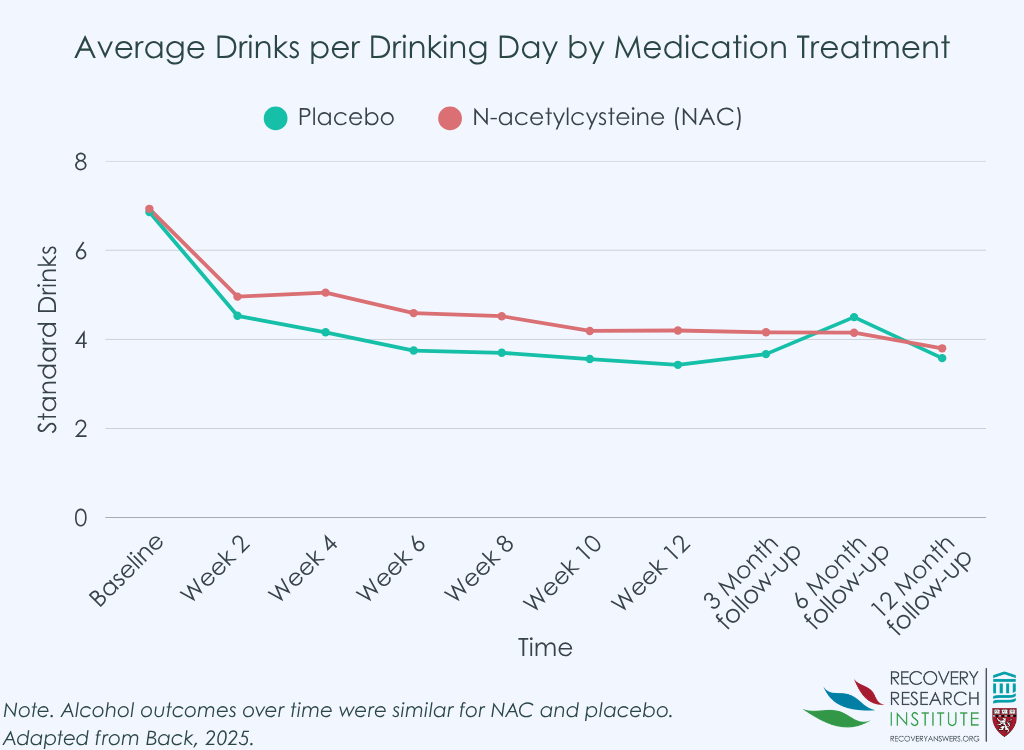
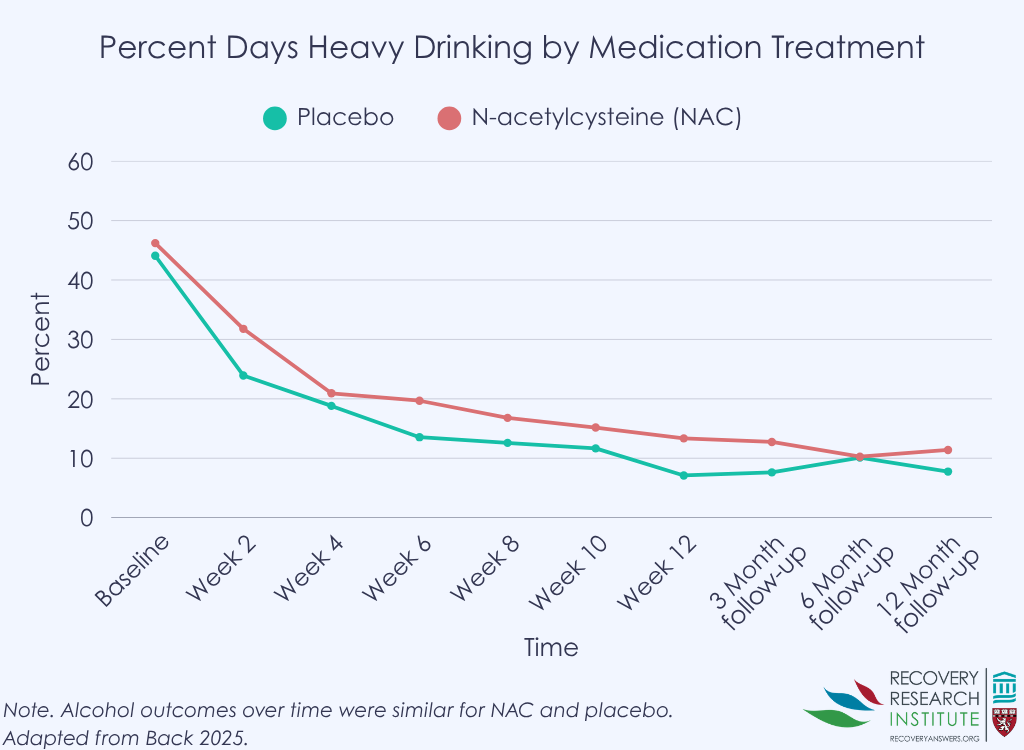
The changes during treatment and follow-ups in the average number of standard drinks per drinking day and percentage of heavy drinking days (graphs below) as well as percentage of abstinent days and alcohol cravings did not differ between the treatment and control groups. Across both groups, the average number of standard drinks per day (from 6.8 to 2.7 during treatment), percentage of heavy drinking days (from 45.3 to 10.4 during treatment), and cravings significantly decreased during treatment. Similarly, the percentage of days abstinent across both groups significantly increased by the end of treatment – from 32.3 to 65.7 – and exceeded benchmarks for clinically meaningful improvement. Benchmarks for drinks per drinking day and percentage of heavy drinking days were not included because “no other research has examined reliable change or clinically significant change” for these metrics.
There were no differences in PTSD and depressive symptoms between the NAC and placebo groups
The changes in PTSD and depressive symptoms did not differ between the treatment and control groups. Relative to established benchmarks, participants in both groups experienced significant, clinically meaningful reductions in self-reported and clinician-rated PTSD symptoms during treatment. Improvements in depressive symptoms were also significant, with the average depression score decreasing from the moderate range at baseline to the minimal range by the end of treatment.
WHAT ARE THE IMPLICATIONS OF THE STUDY FINDINGS?
When added as an adjunct to manualized individually-delivered CBT for alcohol use disorder, NAC and placebo groups had similar outcomes. Although participants across both groups experienced significant improvements in PTSD and depressive symptoms, as well as alcohol use and cravings, over the course of treatment and follow-up, they were similar across study conditions. No differences in adverse events were observed between NAC and placebo, further supporting its safety profile. While this study tested NAC, a medical intervention with uncertain effects on alcohol use, its results are consistent with large trials of the well-known empirically-supported medication naltrexone, where the placebo did just as well as the active medication when added to a combination of empirically-supported behavioral treatments.
The rather large improvements in alcohol use outcomes in both groups may be attributable to the manualized CBT targeting alcohol use disorder. However, some studies show improvements without formal addiction therapy and there was not a no-treatment control group in this study, so it remains possible that both groups improved due to factors unrelated to the treatment (e.g., participating in a study and completing assessments can improve outcomes on their own). That said, alcohol use can worsen depressive symptoms and may account for, or worsen, some PTSD symptoms (e.g., avoidance, irritability, inability to experience pleasure [anhedonia]). Thus, reduced alcohol use (due to treatment or other non-treatment factors) may have helped drive corresponding improvements in PTSD and depression symptoms. Also possible is that CBT for alcohol use disorder may have resulted in more adaptive mental health coping, overall – e.g., by directly addressing depression and PTSD symptoms that drive alcohol urges and cravings.
Other possibilities on the study’s finding that NAC did no better than placebo when added to individual CBT are worth exploring. First, NAC effects may depend on abstinence status at treatment initiation. In contrast to the present study, the previous small pilot trial mentioned above with positive findings that was conducted with veterans who had co-occurring PTSD and a range of different substance use disorders (including alcohol use disorder) required that participants were abstinent from alcohol and other drugs for at least 1 week before randomization. Another trial among adults with cocaine use disorder found that NAC significantly reduced cravings and relapse risk relative to placebo only among participants who were already abstinent for 2+ weeks before entering the trial. Taken together, the findings from these other studies suggest that NAC may be most beneficial in supporting individuals in early abstinence rather than initiating it, highlighting abstinence status as a potentially important moderator of NAC effects. However, the current study was not well-positioned to test this given the low proportion of participants who were abstinent beforehand (9%).
Second, a trial among youth with alcohol use disorder found that only participants with moderate or severe alcohol use disorder who received NAC experienced significantly greater reductions in alcohol use than those receiving placebo, suggesting that NAC effectiveness may also vary according to alcohol use disorder severity. Future NAC trials should therefore examine potential moderators, including whether its effects differ by abstinence status, alcohol use disorder severity, or other participant characteristics.
BOTTOM LINE
There was no evidence from this study that NAC yielded beneficial effects beyond placebo when added to individually-delivered CBT in adults with co-occurring PTSD and alcohol use disorder. In light of other studies’ findings, future trials should investigate whether there are subgroups for whom NAC may be most effective.
- For individuals and families seeking recovery: Individuals with co-occurring PTSD and alcohol use disorder may benefit to a greater degree than shown in this study from treatments supported by a more robust evidence base than NAC + CBT, such as integrated behavioral treatment approaches as well as medications approved by the US Food and Drug Administration for PTSD (e.g., Sertraline/Zoloft and Paroxetine/Paxil) and alcohol use disorder (e.g., Naltrexone/Vivitrol and Acamprosate/Campral).
- For treatment professionals and treatment systems: These null results along with the mixed findings of other studies indicate that NAC added to CBT should not be considered a first-line treatment for co-occurring PTSD and alcohol use disorder. Considering its affordability, accessibility, and established safety profile, it may be a low-risk, adjunctive treatment in certain subgroups (e.g., those who are already abstinent), but this needs further testing and treatment professionals should set realistic expectations regarding its potential benefits.
- For scientists: While there is strong preclinical support for glutamate regulation by NAC, further translational research is needed to determine for whom these neurobiological effects translate into meaningful clinical benefits. Future NAC trials should examine moderators of treatment effects, including pre-treatment abstinence and alcohol use disorder and PTSD severity and chronicity.
- For policy makers: Although this study did not find that NAC was any more helpful than placebo when added to CBT, investing in the evaluation of low-cost, low-risk pharmacotherapies has the potential to improve recovery outcomes while reducing the economic and public health burdens associated with substance use disorders. Furthermore, funding the development of integrated treatments that target neurobiological mechanisms shared by substance use disorders and common co-occurring conditions could lead to broader clinical impact in addition to cost savings.
CITATIONS
Back, S. E., Gray, K., Jarnecke, A. M., Saraiya, T. C., Santa Ana, E. J., Killeen, T., Joseph, J. E., Prisciandaro, J. J., Brown, D. G., Nietert, P. J., Stecker, T., Rothbaum, A., Jones, J. L., Flanagan, J. C., & Brady, K. T. (2025). N-acetylcysteine for the treatment of co-occurring posttraumatic stress disorder and alcohol use disorder: A double-blind, randomized controlled trial. Journal of Clinical Psychiatry, 86(4). doi: 10.4088/JCP.25m15803.