Co-use of cannabis and alcohol: Characteristics of cannabis use may influence heavy drinking
Prior research on co-use of alcohol and cannabis has typically treated heavy drinking as a single behavior and overlooked how specific characteristics of cannabis use may influence drinking levels. In light of the prevalence of co-use and changing landscape of recreational cannabis use, this study leveraged daily survey data from college students to examine how co-use and characteristics of cannabis use influence different types of heavy drinking.
Despite the prevalence of co-use, critical gaps in research remain. Heavy drinking is often studied as a single behavior, which may obscure differences in co-use patterns between heavy episodic drinking (4+/5+ drinks for females/males) and high-intensity drinking (8+/10+ drinks for females/males). Prior co-use research has also typically defined cannabis use as “any use,” limiting knowledge of how cannabis use characteristics—such as frequency, quantity, and forms—may influence alcohol consumption. This is particularly important in the context of the changing landscape of recreational cannabis use in the United States, in which access to different forms and compositions of cannabis have expanded dramatically.
This study sought to fill these gaps in research by examining patterns of heavy drinking levels and cannabis use in daily survey data collected from college students. First, the researchers tested whether co-use was associated with higher rates of heavy-episodic drinking and high-intensity drinking. Second, they assessed whether frequency, quantity, and forms of cannabis differed across moderate, heavy episodic, and high-intensity drinking days.
HOW WAS THIS STUDY CONDUCTED?
Full-time students aged 18-24 were recruited from 3 universities located in separate US states, each of which authors reported had a different recreational cannabis use law: “illegal”, “decriminalized”, and “legal”. There were 318 eligible students with sufficient data. The analyses were limited to alcohol use days with full data coverage (i.e., complete reporting of behaviors across all 5 daily timepoints), resulting in a total of 3,111 days.
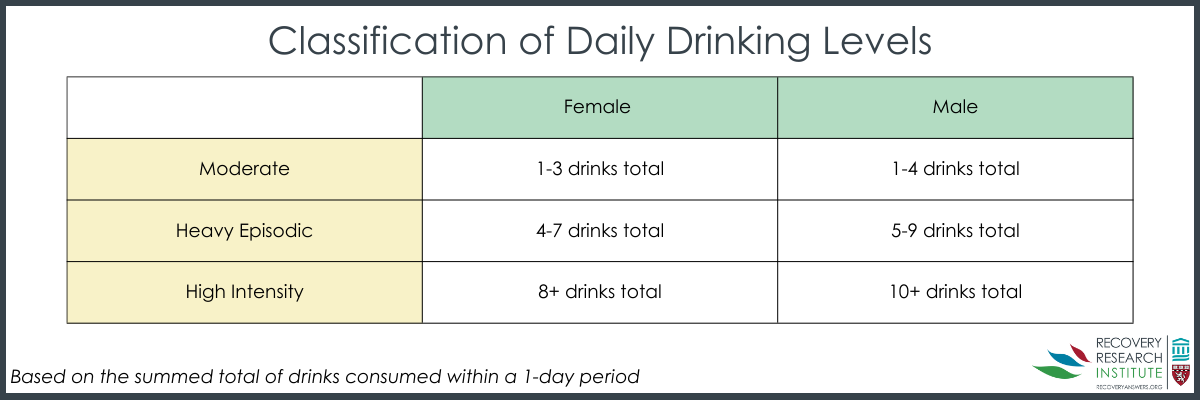
Two waves of daily surveys were administered in 28-day periods approximately 3 months apart. Due to technical difficulties during the first 2 days, data were recorded for only 54 total days. Surveys were collected each day at 9 AM, 2 PM, 5 PM, 8 PM, and 11 PM. At each timepoint, participants reported alcohol use (number of drinks consumed) and cannabis use (instances, quantity, and forms) since their most recently completed survey. Based on the summed total of drinks consumed within a 1-day period, researchers classified daily drinking levels as moderate, heavy episodic, or high intensity (see below):
Because the data were analyzed at the day-level, co-use was defined as any day during which both alcohol and cannabis were consumed.
To address their first aim, researchers examined if co-use days (vs. alcohol-only days) were differentially associated with the three drinking levels. For their second aim, researchers focused only on co-use days to examine whether the frequency of cannabis use, the forms used (type and number of types), and the amount of cannabis consumed on single-form days were related to drinking levels. Cannabis forms included flower, concentrates, and edibles. Models for both aims compared high-intensity drinking days to moderate drinking days, heavy episodic drinking days to moderate drinking days, and high-intensity drinking days to heavy episodic drinking days.
Models controlled for whether the day was a weekend or weekday, how far along the participant was in the study, age, sex, and university attended as well as person-level aggregates of the predictors to isolate day-level effects. For models focusing only on co-use days, researchers also controlled for whether alcohol or cannabis was used first.
On average, participants were approximately 20 years old. The majority were in their first four years of college (first year: 19%, second year: 27%, third year: 24%, fourth year: 25%), while 5% were in their fifth year or later. Seventy-six percent of participants were White, 10% identified as Hispanic, and 53% were female. Participants were represented roughly evenly across the three universities. Of the days analyzed by this study, 51% were co-use days and 49% were alcohol-only days.
WHAT DID THIS STUDY FIND?
Heavy drinking was more prevalent on co-use days than on alcohol-only days
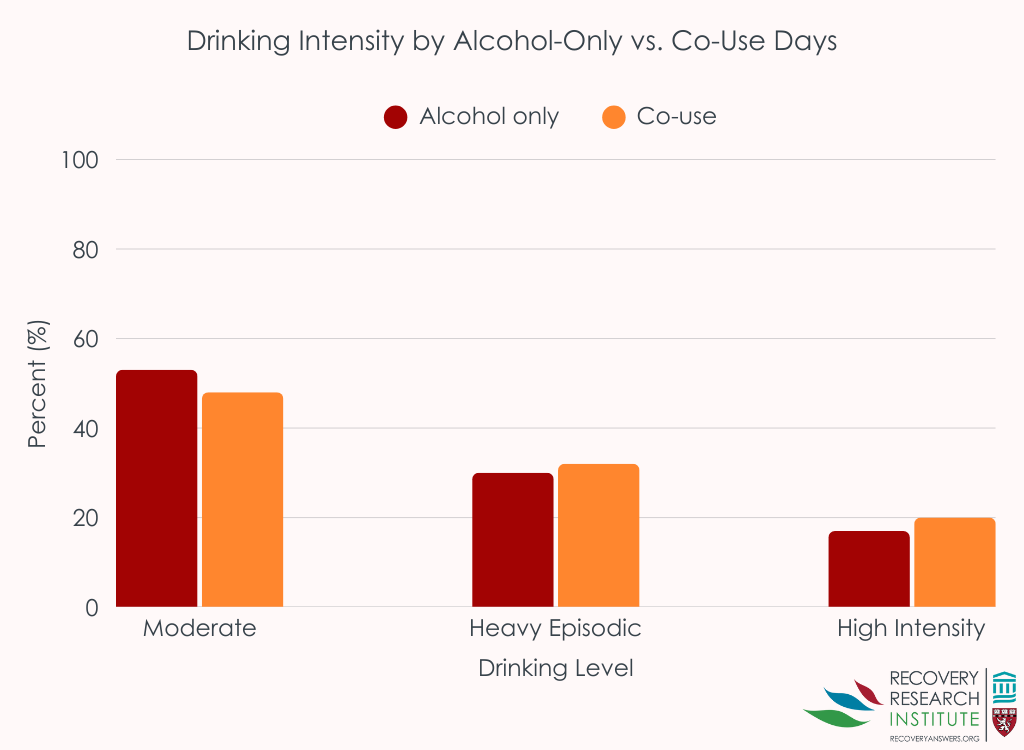
Overall, on alcohol use days, 49% were alcohol-only and 51% were co-use days. Heavy drinking was more likely to occur on days when participants also used cannabis compared to days when they only drank alcohol. As shown in the graph below, relative to moderate drinking, co-use was associated with a 33% higher likelihood of heavy episodic drinking and a 52% higher likelihood of high-intensity drinking. However, co-use was not associated with high-intensity drinking when compared directly to heavy episodic drinking.
More frequent cannabis use was associated with heavier drinking on co-use days
Relative to moderate drinking, each additional instance of cannabis use increased the likelihood of heavy episodic drinking and high-intensity drinking on co-use days. Cannabis use frequency also increased the likelihood of high-intensity drinking compared to heavy episodic drinking.
Quantity of cannabis use was associated with heavier drinking on co-use days
When only flower was used, each additional gram of cannabis consumed increased the likelihood of high-intensity drinking relative to both moderate drinking and heavy episodic drinking. When only concentrates were used, each additional hit increased the likelihood of high-intensity drinking compared to moderate drinking.
WHAT ARE THE IMPLICATIONS OF THE STUDY FINDINGS?
This study used daily survey data from college students to examine co-use patterns of alcohol and cannabis. Cannabis use was reported on 51% of the alcohol use days, underscoring the potentially high prevalence of co-use in this population. Heavy episodic drinking and high-intensity drinking were more prevalent than moderate drinking on days when participants used cannabis, suggesting, at least on co-use days, they may be complementary rather than substitutes. On co-use days specifically, each additional instance of cannabis use as well as greater quantities of flower and concentrates were associated with higher odds of these heavy drinking variables. The specific form of cannabis used and whether multiple forms were used were not associated with heavier drinking. The results highlight the value of distinguishing heavy drinking levels: although any cannabis use did not predict a greater likelihood of high-intensity drinking relative to heavy episodic drinking, more frequent cannabis use and higher quantities of flower did. Thus, high-intensity drinking on co-use days was not simply characterized by alcohol volume alone but also by more frequent and heavier quantities of cannabis use.
Because interventions that focus solely on alcohol or cannabis use would fail to address the risk of co-use, interventions that explicitly target co-use may be warranted. Including a psychoeducation component that addresses how cannabis use may increase drinking intensity and integrating protective behavioral strategies for co-use days (e.g., setting limits) could be beneficial. Since college students are less likely to seek substance use disorder treatment, opportunistic brief interventions may be well-suited for this population. Additionally, given that higher quantities of flower and concentrates predicted greater odds of high intensity drinking on co-use days, public education campaigns that address how dosing can influence alcohol consumption may be beneficial, particularly on college campuses.
The sample was comprised entirely of US college students aged 18-24, the majority of whom were White and non-Hispanic. These characteristics limit the generalizability of the findings to broader and more heterogeneous populations as well as young adults who do not attend college.
This study relied exclusively upon self-reported data, and its analyses were limited to alcohol days with full coverage (i.e., complete reporting of behaviors across all five daily timepoints). Social desirability bias may lead to participants under-reporting alcohol and cannabis use, especially those residing in states where recreational cannabis use is not legal. In addition, because prior daily survey research reported a relationship between non-compliance and substance use, limiting analyses to days with full coverage may have resulted an underestimation of heavier drinking days.
Although high-cannabidiol and high-delta-9tetrahydrocannabinol (i.e., CBD and THC, respectively) levels may influence alcohol use, this study did not measure cannabinoid composition. Future daily survey studies should therefore consider potency when investigating co-use.
BOTTOM LINE
College students used alcohol and cannabis on the same day about as often as alcohol alone, highlighting co-use as a common and important substance use pattern that warrants further investigation. Researchers found that co-use of cannabis and alcohol as well as certain cannabis characteristics were associated with heavier drinking. Relative to moderate drinking, heavy episodic drinking and high-intensity drinking were more prevalent on co-use days. More frequent cannabis use and larger quantities of flower and cannabis concentrates increased the odds of high-intensity drinking. These findings highlight the potential importance of addressing co-use in prevention and treatment.
For individuals and families seeking recovery: For people who are trying to reduce their alcohol use, it is important to consider how the consumption of cannabis and other substances may influence drinking behaviors. Being aware of which circumstances tend to be associated with co-use and having protective plans in place for them could be beneficial.
For treatment professionals and treatment systems: Screening tools should assess co-use of alcohol and cannabis when evaluating substance use risk. Helping patients identify when they are most likely to co-use and developing protective strategies for those situations can inform treatment plans.
For scientists: Investigating motives for co-use and the situational contexts in which heavier drinking occurs could inform the development of just-in-time adaptive interventions and more targeted prevention strategies. Additionally, this study should be replicated in more diverse samples and be expanded beyond college students due to potential substance use differences between young adults who are attending college and those who are not.
For policy makers: As recreational cannabis use expands and laws continue to evolve, funding additional longitudinal studies examining co-use patterns can help inform substance use prevention and treatment. At the university-level, campus officials can work to incorporate co-use psychoeducation into new student orientation and student health programs to help reduce risk.
Despite the prevalence of co-use, critical gaps in research remain. Heavy drinking is often studied as a single behavior, which may obscure differences in co-use patterns between heavy episodic drinking (4+/5+ drinks for females/males) and high-intensity drinking (8+/10+ drinks for females/males). Prior co-use research has also typically defined cannabis use as “any use,” limiting knowledge of how cannabis use characteristics—such as frequency, quantity, and forms—may influence alcohol consumption. This is particularly important in the context of the changing landscape of recreational cannabis use in the United States, in which access to different forms and compositions of cannabis have expanded dramatically.
This study sought to fill these gaps in research by examining patterns of heavy drinking levels and cannabis use in daily survey data collected from college students. First, the researchers tested whether co-use was associated with higher rates of heavy-episodic drinking and high-intensity drinking. Second, they assessed whether frequency, quantity, and forms of cannabis differed across moderate, heavy episodic, and high-intensity drinking days.
HOW WAS THIS STUDY CONDUCTED?
Full-time students aged 18-24 were recruited from 3 universities located in separate US states, each of which authors reported had a different recreational cannabis use law: “illegal”, “decriminalized”, and “legal”. There were 318 eligible students with sufficient data. The analyses were limited to alcohol use days with full data coverage (i.e., complete reporting of behaviors across all 5 daily timepoints), resulting in a total of 3,111 days.
Two waves of daily surveys were administered in 28-day periods approximately 3 months apart. Due to technical difficulties during the first 2 days, data were recorded for only 54 total days. Surveys were collected each day at 9 AM, 2 PM, 5 PM, 8 PM, and 11 PM. At each timepoint, participants reported alcohol use (number of drinks consumed) and cannabis use (instances, quantity, and forms) since their most recently completed survey. Based on the summed total of drinks consumed within a 1-day period, researchers classified daily drinking levels as moderate, heavy episodic, or high intensity (see below):
Because the data were analyzed at the day-level, co-use was defined as any day during which both alcohol and cannabis were consumed.
To address their first aim, researchers examined if co-use days (vs. alcohol-only days) were differentially associated with the three drinking levels. For their second aim, researchers focused only on co-use days to examine whether the frequency of cannabis use, the forms used (type and number of types), and the amount of cannabis consumed on single-form days were related to drinking levels. Cannabis forms included flower, concentrates, and edibles. Models for both aims compared high-intensity drinking days to moderate drinking days, heavy episodic drinking days to moderate drinking days, and high-intensity drinking days to heavy episodic drinking days.
Models controlled for whether the day was a weekend or weekday, how far along the participant was in the study, age, sex, and university attended as well as person-level aggregates of the predictors to isolate day-level effects. For models focusing only on co-use days, researchers also controlled for whether alcohol or cannabis was used first.
On average, participants were approximately 20 years old. The majority were in their first four years of college (first year: 19%, second year: 27%, third year: 24%, fourth year: 25%), while 5% were in their fifth year or later. Seventy-six percent of participants were White, 10% identified as Hispanic, and 53% were female. Participants were represented roughly evenly across the three universities. Of the days analyzed by this study, 51% were co-use days and 49% were alcohol-only days.
WHAT DID THIS STUDY FIND?
Heavy drinking was more prevalent on co-use days than on alcohol-only days
Overall, on alcohol use days, 49% were alcohol-only and 51% were co-use days. Heavy drinking was more likely to occur on days when participants also used cannabis compared to days when they only drank alcohol. As shown in the graph below, relative to moderate drinking, co-use was associated with a 33% higher likelihood of heavy episodic drinking and a 52% higher likelihood of high-intensity drinking. However, co-use was not associated with high-intensity drinking when compared directly to heavy episodic drinking.
More frequent cannabis use was associated with heavier drinking on co-use days
Relative to moderate drinking, each additional instance of cannabis use increased the likelihood of heavy episodic drinking and high-intensity drinking on co-use days. Cannabis use frequency also increased the likelihood of high-intensity drinking compared to heavy episodic drinking.
Quantity of cannabis use was associated with heavier drinking on co-use days
When only flower was used, each additional gram of cannabis consumed increased the likelihood of high-intensity drinking relative to both moderate drinking and heavy episodic drinking. When only concentrates were used, each additional hit increased the likelihood of high-intensity drinking compared to moderate drinking.
WHAT ARE THE IMPLICATIONS OF THE STUDY FINDINGS?
This study used daily survey data from college students to examine co-use patterns of alcohol and cannabis. Cannabis use was reported on 51% of the alcohol use days, underscoring the potentially high prevalence of co-use in this population. Heavy episodic drinking and high-intensity drinking were more prevalent than moderate drinking on days when participants used cannabis, suggesting, at least on co-use days, they may be complementary rather than substitutes. On co-use days specifically, each additional instance of cannabis use as well as greater quantities of flower and concentrates were associated with higher odds of these heavy drinking variables. The specific form of cannabis used and whether multiple forms were used were not associated with heavier drinking. The results highlight the value of distinguishing heavy drinking levels: although any cannabis use did not predict a greater likelihood of high-intensity drinking relative to heavy episodic drinking, more frequent cannabis use and higher quantities of flower did. Thus, high-intensity drinking on co-use days was not simply characterized by alcohol volume alone but also by more frequent and heavier quantities of cannabis use.
Because interventions that focus solely on alcohol or cannabis use would fail to address the risk of co-use, interventions that explicitly target co-use may be warranted. Including a psychoeducation component that addresses how cannabis use may increase drinking intensity and integrating protective behavioral strategies for co-use days (e.g., setting limits) could be beneficial. Since college students are less likely to seek substance use disorder treatment, opportunistic brief interventions may be well-suited for this population. Additionally, given that higher quantities of flower and concentrates predicted greater odds of high intensity drinking on co-use days, public education campaigns that address how dosing can influence alcohol consumption may be beneficial, particularly on college campuses.
The sample was comprised entirely of US college students aged 18-24, the majority of whom were White and non-Hispanic. These characteristics limit the generalizability of the findings to broader and more heterogeneous populations as well as young adults who do not attend college.
This study relied exclusively upon self-reported data, and its analyses were limited to alcohol days with full coverage (i.e., complete reporting of behaviors across all five daily timepoints). Social desirability bias may lead to participants under-reporting alcohol and cannabis use, especially those residing in states where recreational cannabis use is not legal. In addition, because prior daily survey research reported a relationship between non-compliance and substance use, limiting analyses to days with full coverage may have resulted an underestimation of heavier drinking days.
Although high-cannabidiol and high-delta-9tetrahydrocannabinol (i.e., CBD and THC, respectively) levels may influence alcohol use, this study did not measure cannabinoid composition. Future daily survey studies should therefore consider potency when investigating co-use.
BOTTOM LINE
College students used alcohol and cannabis on the same day about as often as alcohol alone, highlighting co-use as a common and important substance use pattern that warrants further investigation. Researchers found that co-use of cannabis and alcohol as well as certain cannabis characteristics were associated with heavier drinking. Relative to moderate drinking, heavy episodic drinking and high-intensity drinking were more prevalent on co-use days. More frequent cannabis use and larger quantities of flower and cannabis concentrates increased the odds of high-intensity drinking. These findings highlight the potential importance of addressing co-use in prevention and treatment.
For individuals and families seeking recovery: For people who are trying to reduce their alcohol use, it is important to consider how the consumption of cannabis and other substances may influence drinking behaviors. Being aware of which circumstances tend to be associated with co-use and having protective plans in place for them could be beneficial.
For treatment professionals and treatment systems: Screening tools should assess co-use of alcohol and cannabis when evaluating substance use risk. Helping patients identify when they are most likely to co-use and developing protective strategies for those situations can inform treatment plans.
For scientists: Investigating motives for co-use and the situational contexts in which heavier drinking occurs could inform the development of just-in-time adaptive interventions and more targeted prevention strategies. Additionally, this study should be replicated in more diverse samples and be expanded beyond college students due to potential substance use differences between young adults who are attending college and those who are not.
For policy makers: As recreational cannabis use expands and laws continue to evolve, funding additional longitudinal studies examining co-use patterns can help inform substance use prevention and treatment. At the university-level, campus officials can work to incorporate co-use psychoeducation into new student orientation and student health programs to help reduce risk.
Despite the prevalence of co-use, critical gaps in research remain. Heavy drinking is often studied as a single behavior, which may obscure differences in co-use patterns between heavy episodic drinking (4+/5+ drinks for females/males) and high-intensity drinking (8+/10+ drinks for females/males). Prior co-use research has also typically defined cannabis use as “any use,” limiting knowledge of how cannabis use characteristics—such as frequency, quantity, and forms—may influence alcohol consumption. This is particularly important in the context of the changing landscape of recreational cannabis use in the United States, in which access to different forms and compositions of cannabis have expanded dramatically.
This study sought to fill these gaps in research by examining patterns of heavy drinking levels and cannabis use in daily survey data collected from college students. First, the researchers tested whether co-use was associated with higher rates of heavy-episodic drinking and high-intensity drinking. Second, they assessed whether frequency, quantity, and forms of cannabis differed across moderate, heavy episodic, and high-intensity drinking days.
HOW WAS THIS STUDY CONDUCTED?
Full-time students aged 18-24 were recruited from 3 universities located in separate US states, each of which authors reported had a different recreational cannabis use law: “illegal”, “decriminalized”, and “legal”. There were 318 eligible students with sufficient data. The analyses were limited to alcohol use days with full data coverage (i.e., complete reporting of behaviors across all 5 daily timepoints), resulting in a total of 3,111 days.
Two waves of daily surveys were administered in 28-day periods approximately 3 months apart. Due to technical difficulties during the first 2 days, data were recorded for only 54 total days. Surveys were collected each day at 9 AM, 2 PM, 5 PM, 8 PM, and 11 PM. At each timepoint, participants reported alcohol use (number of drinks consumed) and cannabis use (instances, quantity, and forms) since their most recently completed survey. Based on the summed total of drinks consumed within a 1-day period, researchers classified daily drinking levels as moderate, heavy episodic, or high intensity (see below):
Because the data were analyzed at the day-level, co-use was defined as any day during which both alcohol and cannabis were consumed.
To address their first aim, researchers examined if co-use days (vs. alcohol-only days) were differentially associated with the three drinking levels. For their second aim, researchers focused only on co-use days to examine whether the frequency of cannabis use, the forms used (type and number of types), and the amount of cannabis consumed on single-form days were related to drinking levels. Cannabis forms included flower, concentrates, and edibles. Models for both aims compared high-intensity drinking days to moderate drinking days, heavy episodic drinking days to moderate drinking days, and high-intensity drinking days to heavy episodic drinking days.
Models controlled for whether the day was a weekend or weekday, how far along the participant was in the study, age, sex, and university attended as well as person-level aggregates of the predictors to isolate day-level effects. For models focusing only on co-use days, researchers also controlled for whether alcohol or cannabis was used first.
On average, participants were approximately 20 years old. The majority were in their first four years of college (first year: 19%, second year: 27%, third year: 24%, fourth year: 25%), while 5% were in their fifth year or later. Seventy-six percent of participants were White, 10% identified as Hispanic, and 53% were female. Participants were represented roughly evenly across the three universities. Of the days analyzed by this study, 51% were co-use days and 49% were alcohol-only days.
WHAT DID THIS STUDY FIND?
Heavy drinking was more prevalent on co-use days than on alcohol-only days
Overall, on alcohol use days, 49% were alcohol-only and 51% were co-use days. Heavy drinking was more likely to occur on days when participants also used cannabis compared to days when they only drank alcohol. As shown in the graph below, relative to moderate drinking, co-use was associated with a 33% higher likelihood of heavy episodic drinking and a 52% higher likelihood of high-intensity drinking. However, co-use was not associated with high-intensity drinking when compared directly to heavy episodic drinking.
More frequent cannabis use was associated with heavier drinking on co-use days
Relative to moderate drinking, each additional instance of cannabis use increased the likelihood of heavy episodic drinking and high-intensity drinking on co-use days. Cannabis use frequency also increased the likelihood of high-intensity drinking compared to heavy episodic drinking.
Quantity of cannabis use was associated with heavier drinking on co-use days
When only flower was used, each additional gram of cannabis consumed increased the likelihood of high-intensity drinking relative to both moderate drinking and heavy episodic drinking. When only concentrates were used, each additional hit increased the likelihood of high-intensity drinking compared to moderate drinking.
WHAT ARE THE IMPLICATIONS OF THE STUDY FINDINGS?
This study used daily survey data from college students to examine co-use patterns of alcohol and cannabis. Cannabis use was reported on 51% of the alcohol use days, underscoring the potentially high prevalence of co-use in this population. Heavy episodic drinking and high-intensity drinking were more prevalent than moderate drinking on days when participants used cannabis, suggesting, at least on co-use days, they may be complementary rather than substitutes. On co-use days specifically, each additional instance of cannabis use as well as greater quantities of flower and concentrates were associated with higher odds of these heavy drinking variables. The specific form of cannabis used and whether multiple forms were used were not associated with heavier drinking. The results highlight the value of distinguishing heavy drinking levels: although any cannabis use did not predict a greater likelihood of high-intensity drinking relative to heavy episodic drinking, more frequent cannabis use and higher quantities of flower did. Thus, high-intensity drinking on co-use days was not simply characterized by alcohol volume alone but also by more frequent and heavier quantities of cannabis use.
Because interventions that focus solely on alcohol or cannabis use would fail to address the risk of co-use, interventions that explicitly target co-use may be warranted. Including a psychoeducation component that addresses how cannabis use may increase drinking intensity and integrating protective behavioral strategies for co-use days (e.g., setting limits) could be beneficial. Since college students are less likely to seek substance use disorder treatment, opportunistic brief interventions may be well-suited for this population. Additionally, given that higher quantities of flower and concentrates predicted greater odds of high intensity drinking on co-use days, public education campaigns that address how dosing can influence alcohol consumption may be beneficial, particularly on college campuses.
The sample was comprised entirely of US college students aged 18-24, the majority of whom were White and non-Hispanic. These characteristics limit the generalizability of the findings to broader and more heterogeneous populations as well as young adults who do not attend college.
This study relied exclusively upon self-reported data, and its analyses were limited to alcohol days with full coverage (i.e., complete reporting of behaviors across all five daily timepoints). Social desirability bias may lead to participants under-reporting alcohol and cannabis use, especially those residing in states where recreational cannabis use is not legal. In addition, because prior daily survey research reported a relationship between non-compliance and substance use, limiting analyses to days with full coverage may have resulted an underestimation of heavier drinking days.
Although high-cannabidiol and high-delta-9tetrahydrocannabinol (i.e., CBD and THC, respectively) levels may influence alcohol use, this study did not measure cannabinoid composition. Future daily survey studies should therefore consider potency when investigating co-use.
BOTTOM LINE
College students used alcohol and cannabis on the same day about as often as alcohol alone, highlighting co-use as a common and important substance use pattern that warrants further investigation. Researchers found that co-use of cannabis and alcohol as well as certain cannabis characteristics were associated with heavier drinking. Relative to moderate drinking, heavy episodic drinking and high-intensity drinking were more prevalent on co-use days. More frequent cannabis use and larger quantities of flower and cannabis concentrates increased the odds of high-intensity drinking. These findings highlight the potential importance of addressing co-use in prevention and treatment.
For individuals and families seeking recovery: For people who are trying to reduce their alcohol use, it is important to consider how the consumption of cannabis and other substances may influence drinking behaviors. Being aware of which circumstances tend to be associated with co-use and having protective plans in place for them could be beneficial.
For treatment professionals and treatment systems: Screening tools should assess co-use of alcohol and cannabis when evaluating substance use risk. Helping patients identify when they are most likely to co-use and developing protective strategies for those situations can inform treatment plans.
For scientists: Investigating motives for co-use and the situational contexts in which heavier drinking occurs could inform the development of just-in-time adaptive interventions and more targeted prevention strategies. Additionally, this study should be replicated in more diverse samples and be expanded beyond college students due to potential substance use differences between young adults who are attending college and those who are not.
For policy makers: As recreational cannabis use expands and laws continue to evolve, funding additional longitudinal studies examining co-use patterns can help inform substance use prevention and treatment. At the university-level, campus officials can work to incorporate co-use psychoeducation into new student orientation and student health programs to help reduce risk.