WHAT PROBLEM DOES THIS STUDY ADDRESS?
Developing supportive relationships is important in recovery, particularly with peers who share similar lived experiences. Participating in recovery communities and other recovery supports can help individuals build supportive peer relationships. One such example is The Phoenix, a sober- active community that offers free fitness-based activities and engaging social events. Although studies have not tested whether The Phoenix directly improves recovery outcomes, a recent study conducted with Phoenix members found that those who had been involved in the community the longest felt most supported by their social networks, with fellow members, mentors, and peers identified as their most crucial sources of support.
A proposed core component of The Phoenix’s program model is creating a psychologically safe community, defined as an environment in which individuals feel comfortable being open, authentic, and vulnerable with others without fear of judgment or negative consequences. The Phoenix seeks to cultivate psychological safety through community standards that prohibit threatening behavior, violence, discrimination, harassment, unwelcome advances, and other inappropriate conduct or language. Psychological safety may be especially important in recovery communities because such an environment can help form the foundation for improvements in other important areas such as mental and physical health. This study examined whether Phoenix event attendance was associated with greater perceived psychological safety, and whether in turn psychological safety is related to emotional experiences and other recovery outcomes.
HOW WAS THIS STUDY CONDUCTED?
Data were collected from The Phoenix members to examine associations between attendance at Phoenix events, psychological safety, and changes in short-term and intermediate recovery outcomes. New members were invited via email to complete a program evaluation survey 3 months after attending their first Phoenix event. A total of 294 members completed the survey out of 2,267 that were emailed the survey, yielding a 13% response rate. The analytic sample included 204 respondents with complete survey data. Because only a small portion of new Phoenix members participated in the study, its findings may not be representative of the population, and it is possible that new members who felt more connected or experienced greater benefits from the events were more likely to complete the survey.
The survey measured 6 outcomes related to recovery—hope, connection, empowerment, motivation to stay sober, mental health, and physical health—using a “thentest” design in which participants rated how they felt immediately before attending their first Phoenix event as well as how they felt at the time of the survey. This yielded a retrospective baseline and a 3-month follow-up measure of each outcome, and changes were calculated by subtracting the baseline from the follow-up response. Participants only rated their sense of psychological safety during Phoenix events at the time of the survey as it could not be assessed prior to participation. The survey also asked participants if they identified as being in recovery, and if so, whether they identified as being new to recovery or in long-term recovery, though these distinctions of recovery duration were not explicitly defined. Note also that the survey did not assess for substance use. Demographic and event attendance data were obtained through program records. Mean differences in psychological safety and recovery-related outcomes were examined across demographic groups and recovery statuses.
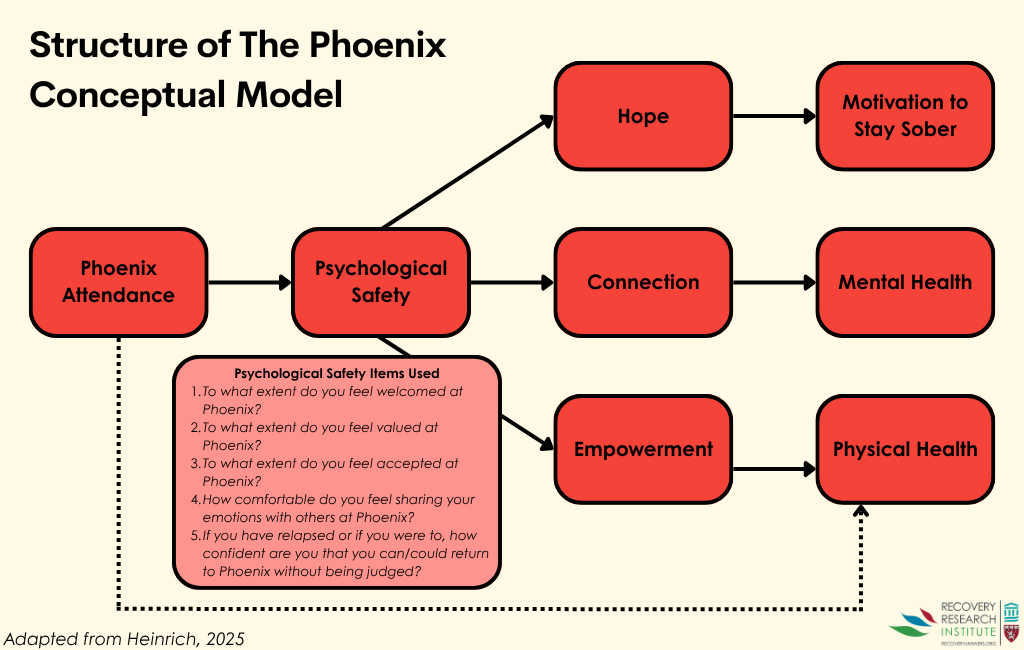
As shown in the graphic below, a model tested whether psychological safety explained associations between the number of events attended and changes in hope, connection, and empowerment, and in turn, subsequent changes in sobriety motivation, mental health, and physical health.
Because individuals new to recovery had more “hope” than those in long-term recovery, recovery status was controlled for statistically in the models estimating hope. While the paper also noted that the path to physical health controlled for recovery status, there were no significant differences on physical health for people at different recovery stages.
WHAT DID THIS STUDY FIND?
Overall, participants reported high levels of psychological safety, reflecting that they felt valued, accepted without judgement, and emotionally safe when attending events at The Phoenix. Psychological safety did not differ across demographic groups or recovery statuses, indicating that participants experienced similar levels regardless of their age, gender, sexual orientation, or recovery status. Likewise, changes in the 6 recovery outcomes were largely consistent among demographic groups and recovery statuses, with the only significant difference being that participants who were newer to recovery had larger increases in hope compared to those in long-term recovery.
Attending more Phoenix events was associated with a higher sense of psychological safety, which in turn was associated with increased hope, connection, and empowerment, and those changes subsequently predicted improvements in sobriety motivation, mental health, and physical health. Phoenix attendance was directly associated – in addition to the indirect association – with improvements in physical health, but not mental health or sobriety motivation. The variables included in the model explained a substantial proportion of the variance in motivation to stay sober (25%), mental health (39%), and physical health (35%), indicating that the relationships in the model may play important roles in predicting those recovery outcomes. It is important to note, however, that the paper did not test formal mediation – that is, whether the effect of Phoenix event attendance on recovery outcomes (motivation, mental health, physical health) was explained by psychological safety. That said, such an explanation is implied in that the model showed significant relationships between the variables in the expected direction.
WHAT ARE THE IMPLICATIONS OF THE STUDY FINDINGS?
The results of this study suggest that The Phoenix may help foster a sense of psychological safety. Unknown is whether The Phoenix does this more or less than other recovery supportive communities – an area for future research. Although event attendance was only directly associated with physical health improvements, it was indirectly associated with sobriety motivation and mental health through psychological safety and related improvements in hope and connection. Thus, the notion of psychological safety may be an underlying mechanism within this community and might be worthy of future recovery investigation to understand its role. Moreover, psychological safety ratings were consistent across demographic groups and recovery statuses, suggesting that The Phoenix’s community standards may support a similarly safe and inclusive experience across survey respondents.
One limitation is that from a face validity perspective some of the measures did not seem to measure their intended target. The questions that were measuring hope, for example, asked participants to respond to the statement “There are a lot of activities I enjoy doing sober” and “I can have fun without using drugs or alcohol”. Future work examining The Phoenix and related groups may wish to use validated scales measuring the construct of hope.
Another limitation is that only a small proportion of individuals invited to take the survey completed it (only 13% of people who were sent the survey), thus a more representative sample is needed to generalize these conclusions for new Phoenix members as a whole. Taken together, these findings suggest that recovery outcomes may be influenced by access to supportive peer relationships in a psychologically safe environment.
BOTTOM LINE
While there are significant limitations in the research, Phoenix event attendance was associated with psychological safety which was, in turn, associated with other relevant recovery outcomes. These findings highlight psychological safety as a potentially important mechanism linking participation in recovery communities to improved outcomes.
- For individuals and families seeking recovery: Individuals in recovery may benefit from being part of a community where they feel safe, accepted, and genuinely connected to their peers. The NewForm app, developed by The Phoenix, allows individuals to register for in-person activities and participate in virtual activities (e.g., cross-fit, run clubs, yoga, and various interest groups) that are intended to support recovery and wellbeing. It may help people at all stages of recovery find safe and supportive online and in-person communities built around shared interests and activities.
- For treatment professionals and treatment systems: These findings suggest providers may wish to connect patients with recovery communities and other supports that promote feelings of safety and belonging like The Phoenix. That said, it is difficult to know from this small, highly selective sample of respondents whether these findings generalize to the real-world experiences of participating in The Phoenix or whether The Phoenix fosters perceptions of psychological safety to a greater or lesser extent than other recovery support services. Additional research is needed to increase confidence in these findings.
- For scientists: These findings should be replicated in a larger, more representative sample of new Phoenix members to improve generalizability. Longitudinal studies over longer periods are also needed to better establish temporal ordering and reduce reliance on cross-sectional pathways. In addition, further work is needed to establish the reliability and validity of the original psychological safety measure used in this study. Finally, qualitative research could provide important contextual insight into how psychological safety operates as a mechanism in recovery settings.
- For policy makers: Policy makers should consider the potential value of recovery communities like The Phoenix and other community-based recovery supports that help individuals build supportive relationships in psychologically safe environments. Expanding access to these resources could represent a strong value proposition by improving recovery outcomes and reducing unnecessary healthcare utilization.
CITATIONS
Heinrich, K. M., Wyker, B., Collinson, B., Eddie, D., Best, D., & Hillios, J. (2025). Psychological safety mediates attendance and recovery-related outcomes within the Phoenix: A sober-active community. Frontiers in Public Health, 13. doi: 10.3389/fpubh.2025.1458026.