Can therapy and peer support add to the benefits of medications for opioid use disorder?

Medications for opioid use disorder are a first-line treatment, and many clinics also offer counseling or peer support. This study tested whether adding brief cognitive behavioral therapy, peer recovery support, or both to buprenorphine treatment at U.S. community health centers improved opioid abstinence.

Stay on the frontiers of
recovery science
with the free, monthly
Recovery Bulletin

l

WHAT PROBLEM DOES THIS STUDY ADDRESS?

Opioid use disorder is a major cause of death and disability, and medications such as buprenorphine (often prescribed in formulation with naloxone known by the brand name Suboxone), methadone, and naltrexone are first-line treatments. Guidelines recommend add-on psychosocial treatment for many people, but it is unclear which add-ons help. Evidence for cognitive behavioral therapy alongside medication is mixed, and few rigorous studies have tested peer recovery support in this context. This study tested whether adding brief cognitive behavioral therapy, peer recovery support, or both to buprenorphine treatment improved outcomes compared to buprenorphine alone.


HOW WAS THIS STUDY CONDUCTED?

In this randomized controlled trial, 340 adults who had recently started (within the past month) office-based buprenorphine at 5 community health centers in the U.S. were randomly assigned to 1 of 4 groups: 1) usual buprenorphine care, 2) usual buprenorphine care plus cognitive behavioral therapy, 3) usual buprenorphine care plus peer recovery support, or 4) usual buprenorphine care plus both cognitive behavioral therapy and peer recovery support. Buprenorphine could be prescribed in any formulation (i.e., sublingual, such as Suboxone film or Zubsolv tablets, or extended-release injectable, such as Sublocade or Brixadi). Opioid abstinence was the primary outcome, which was assessed via urinalysis at baseline, 3, 6, 9, and 12 months. Medication for opioid use disorder retention was also assessed. Because tests were done about every 3 months, they show opioid use at those moments, not between visits. Retention was based on pharmacy records of buprenorphine prescriptions. Many participants skipped drug tests, especially later in the year, so only about two-thirds (217 of 340) had enough drug test results to be included in the main analysis.

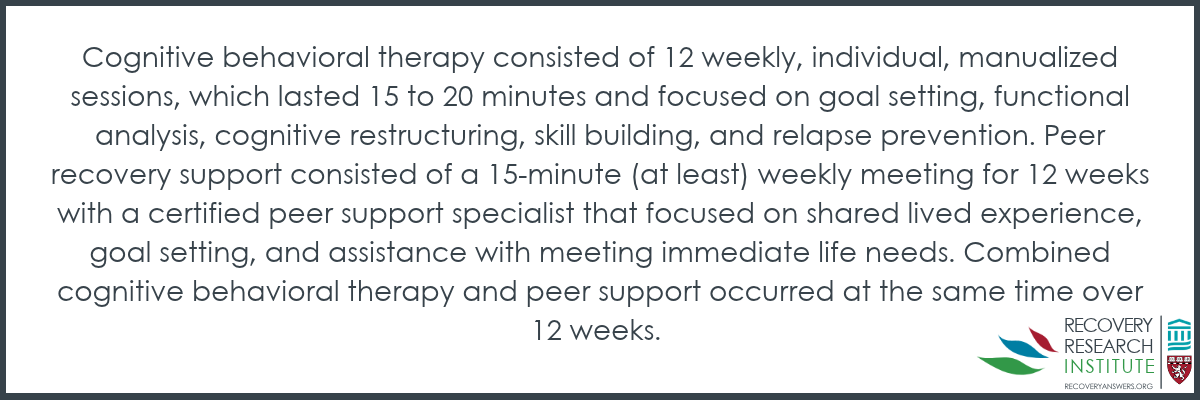
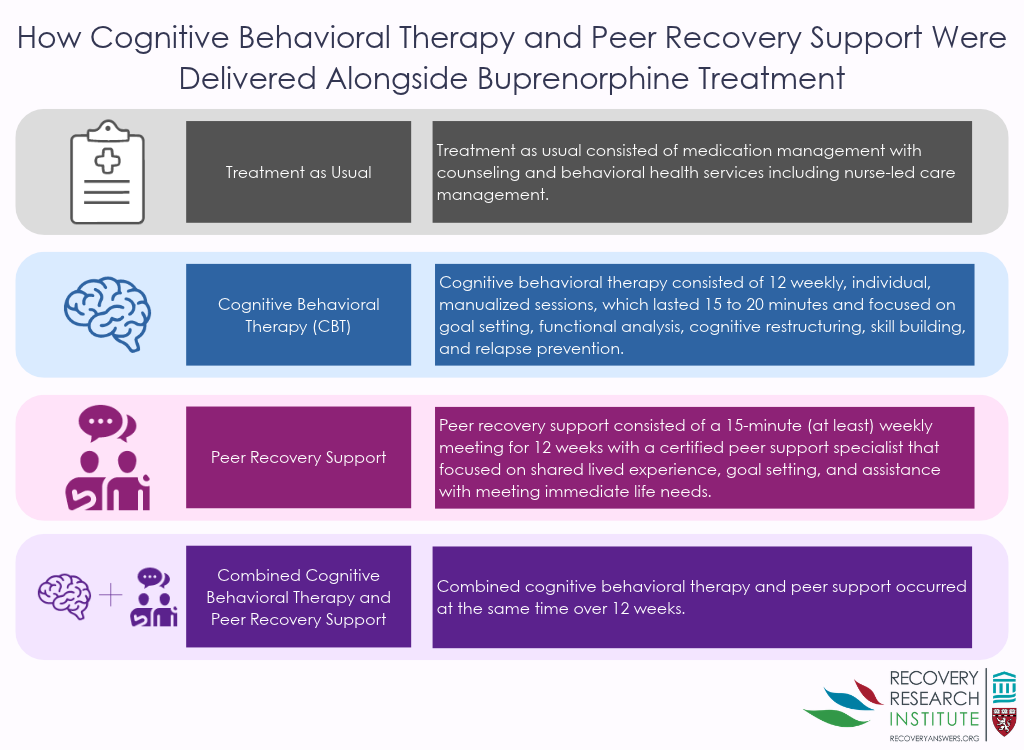
As shown in the figure below, usual medication care was a nurse-led clinic program that pairs buprenorphine visits with counseling and other behavioral health support. Cognitive behavioral therapy consisted of 12 weekly, individual, manualized sessions, which lasted 15 to 20 minutes and focused on goal setting, functional analysis, cognitive restructuring, skill building, and relapse prevention. Peer recovery support consisted of a 15-minute (at least) weekly meeting for 12 weeks with a certified peer support specialist that focused on shared lived experience, goal setting, and assistance with meeting immediate life needs. Combined cognitive behavioral therapy and peer support occurred at the same time over 12 weeks.
WHAT DID THIS STUDY FIND?

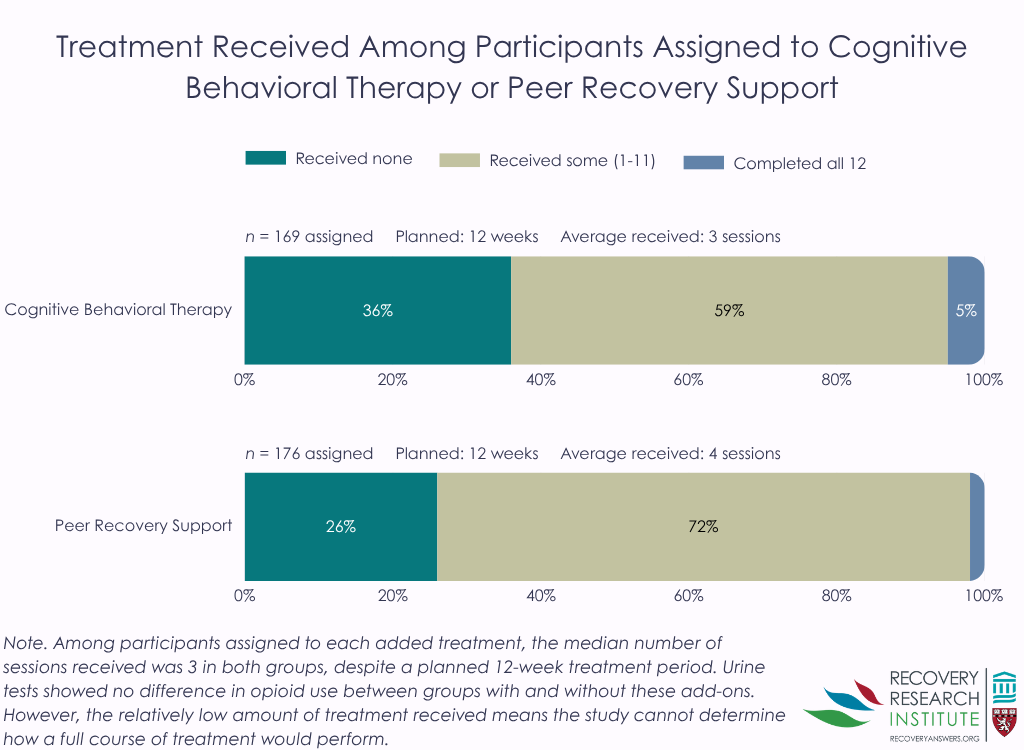
Most participants received only a small portion of the added treatments (see figure below). On average, people assigned to cognitive behavioral therapy completed 3 of 12 sessions, and 1 in 3 attended none. People assigned to peer support averaged engaging with their assigned peer 4 of 12 weeks. Only 5% completed all of the cognitive behavioral therapy sessions and 2% completed all 12 weeks of peer support. The low amount of treatment received, which the researchers partly attributed to COVID-19 restrictions and barriers such as transportation, makes it hard to know how a full course would perform. Overall, people who were offered cognitive behavioral therapy, peer support, or both were no more likely to have opioid-free drug tests at any of the 4 follow-up visits than people who received usual buprenorphine care alone. Because many drug tests were missing, the study cannot rule out small benefits or harms. Staying on buprenorphine, quality of life, emergency department visits, overdoses, and satisfaction with care also did not differ by condition in any consistent way. Two isolated differences appeared among many comparisons (slightly more family and social problems over time among people assigned peer support), but these may have been due to chance.

WHAT ARE THE IMPLICATIONS OF THE STUDY FINDINGS?

This study found no added benefit from assignment to 12 weeks of brief cognitive behavioral therapy, peer recovery support, or both, on top of usual buprenorphine care in the first months of treatment. Because most people received only a fraction of the planned sessions and many drug tests were missing, the results should be viewed cautiously. Possible explanations include no benefit of cognitive behavioral therapy and peer support, the strength of the usual clinic care, the low amount of treatment, and the early stage of treatment when added supports may matter less than they do once people are more stable. The study also found no consistent differences in other measured outcomes, including non-opioid drug use, quality of life, emergency department visits, and overdoses. However, added services could still matter for outcomes it did not measure or over a longer time, such as housing stability, connection to community recovery supports, or long-term recovery beyond one year. It is also a lot to ask of people who already receive counseling and other behavioral health support through their clinic to attend more sessions, which may help explain the low attendance. Earlier research suggests that added services have helped most when usual medication care was limited, but have added little when medication care already included substantial support. Even in rigorous trials of buprenorphine, more than half of participants (57% in one large trial) returned to regular opioid use within 6 months, which underscores the need to find ways to improve on what the medication alone can offer. Future research should examine when and for whom added services help, including at later stages of treatment. It should also explore how patients receiving buprenorphine feel about add-on interventions, for example, through interviews, to find ways of making added services more appealing and easier to use.


BOTTOM LINE

Adding brief cognitive behavioral therapy or peer recovery support to usual buprenorphine care did not improve opioid abstinence in this trial. However, low participation in the services to which participants were randomly assigned, and substantial missing data mean the results are not conclusive.


  • For individuals and families seeking recovery: In this study, counseling or peer support added in the first months of buprenorphine treatment for opioid use disorder did not improve opioid use, but few people attended most sessions, so it does not mean these supports have no value. Individuals seeking treatment would likely benefit from talking to their care team about which supports best fit their needs and goals.
  • For treatment professionals and treatment systems: Brief cognitive behavioral therapy or peer support added in the first months of buprenorphine treatment did not improve opioid use or treatment retention in this study, and few patients completed the planned sessions to which they were assigned. Getting patients to attend more services on top of the counseling and medication visits they already receive may be difficult. Clinicians may want to treat the early weeks as a time to stabilize on medication and address barriers to attendance. Added services may be worth revisiting once patients are more settled, although this study did not test that.
  • For scientists: This randomized controlled trial found no statistically significant additional benefit of adjunctive psychosocial interventions compared to treatment as usual. This trial was underpowered relative to its plan, and many individuals skipped their opioid drug tests, the study’s primary outcome. Future work could test telehealth delivery, later stages of treatment, long-acting buprenorphine and dosing, and strategies to improve session attendance. Further attention should also be given to understanding how and why some individuals receiving medications and structured medication management did not consistently engage in additional psychosocial interventions. Future research might also use latent profile analysis to identify subgroups of adults receiving different combinations of services and examine for whom, and under what circumstances, additional psychosocial interventions provide the greatest benefit.
  • For policy makers: This study does not support requiring or expanding add-on counseling or peer support to improve drug-confirmed abstinence early in buprenorphine treatment, particularly where usual care already includes counseling and medication management. Continued access to buprenorphine remains the priority. These results should also be weighed alongside possible benefits of cognitive behavioral therapy and peer support that this study did not measure, or could not detect in its first-year window.

CITATIONS

Lent, M. R., Hurstak, E. E., Lynch, K. G., Loscalzo, E., Mazur, K., Lugo, H. L., & Dugosh, K. L. (2026). Adjunctive Psychosocial Interventions and Opioid Abstinence Among Patients Receiving Buprenorphine: A Randomized Clinical Trial. JAMA Network Open, 9(6). doi: 10.1001/jamanetworkopen.2026.19826.



Stay on the Frontiers of
recovery science
with the free, monthly
Recovery Bulletin

l

WHAT PROBLEM DOES THIS STUDY ADDRESS?

Opioid use disorder is a major cause of death and disability, and medications such as buprenorphine (often prescribed in formulation with naloxone known by the brand name Suboxone), methadone, and naltrexone are first-line treatments. Guidelines recommend add-on psychosocial treatment for many people, but it is unclear which add-ons help. Evidence for cognitive behavioral therapy alongside medication is mixed, and few rigorous studies have tested peer recovery support in this context. This study tested whether adding brief cognitive behavioral therapy, peer recovery support, or both to buprenorphine treatment improved outcomes compared to buprenorphine alone.


HOW WAS THIS STUDY CONDUCTED?

In this randomized controlled trial, 340 adults who had recently started (within the past month) office-based buprenorphine at 5 community health centers in the U.S. were randomly assigned to 1 of 4 groups: 1) usual buprenorphine care, 2) usual buprenorphine care plus cognitive behavioral therapy, 3) usual buprenorphine care plus peer recovery support, or 4) usual buprenorphine care plus both cognitive behavioral therapy and peer recovery support. Buprenorphine could be prescribed in any formulation (i.e., sublingual, such as Suboxone film or Zubsolv tablets, or extended-release injectable, such as Sublocade or Brixadi). Opioid abstinence was the primary outcome, which was assessed via urinalysis at baseline, 3, 6, 9, and 12 months. Medication for opioid use disorder retention was also assessed. Because tests were done about every 3 months, they show opioid use at those moments, not between visits. Retention was based on pharmacy records of buprenorphine prescriptions. Many participants skipped drug tests, especially later in the year, so only about two-thirds (217 of 340) had enough drug test results to be included in the main analysis.

As shown in the figure below, usual medication care was a nurse-led clinic program that pairs buprenorphine visits with counseling and other behavioral health support. Cognitive behavioral therapy consisted of 12 weekly, individual, manualized sessions, which lasted 15 to 20 minutes and focused on goal setting, functional analysis, cognitive restructuring, skill building, and relapse prevention. Peer recovery support consisted of a 15-minute (at least) weekly meeting for 12 weeks with a certified peer support specialist that focused on shared lived experience, goal setting, and assistance with meeting immediate life needs. Combined cognitive behavioral therapy and peer support occurred at the same time over 12 weeks.


WHAT DID THIS STUDY FIND?

Most participants received only a small portion of the added treatments (see figure below). On average, people assigned to cognitive behavioral therapy completed 3 of 12 sessions, and 1 in 3 attended none. People assigned to peer support averaged engaging with their assigned peer 4 of 12 weeks. Only 5% completed all of the cognitive behavioral therapy sessions and 2% completed all 12 weeks of peer support. The low amount of treatment received, which the researchers partly attributed to COVID-19 restrictions and barriers such as transportation, makes it hard to know how a full course would perform. Overall, people who were offered cognitive behavioral therapy, peer support, or both were no more likely to have opioid-free drug tests at any of the 4 follow-up visits than people who received usual buprenorphine care alone. Because many drug tests were missing, the study cannot rule out small benefits or harms. Staying on buprenorphine, quality of life, emergency department visits, overdoses, and satisfaction with care also did not differ by condition in any consistent way. Two isolated differences appeared among many comparisons (slightly more family and social problems over time among people assigned peer support), but these may have been due to chance.


WHAT ARE THE IMPLICATIONS OF THE STUDY FINDINGS?

This study found no added benefit from assignment to 12 weeks of brief cognitive behavioral therapy, peer recovery support, or both, on top of usual buprenorphine care in the first months of treatment. Because most people received only a fraction of the planned sessions and many drug tests were missing, the results should be viewed cautiously. Possible explanations include no benefit of cognitive behavioral therapy and peer support, the strength of the usual clinic care, the low amount of treatment, and the early stage of treatment when added supports may matter less than they do once people are more stable. The study also found no consistent differences in other measured outcomes, including non-opioid drug use, quality of life, emergency department visits, and overdoses. However, added services could still matter for outcomes it did not measure or over a longer time, such as housing stability, connection to community recovery supports, or long-term recovery beyond one year. It is also a lot to ask of people who already receive counseling and other behavioral health support through their clinic to attend more sessions, which may help explain the low attendance. Earlier research suggests that added services have helped most when usual medication care was limited, but have added little when medication care already included substantial support. Even in rigorous trials of buprenorphine, more than half of participants (57% in one large trial) returned to regular opioid use within 6 months, which underscores the need to find ways to improve on what the medication alone can offer. Future research should examine when and for whom added services help, including at later stages of treatment. It should also explore how patients receiving buprenorphine feel about add-on interventions, for example, through interviews, to find ways of making added services more appealing and easier to use.


BOTTOM LINE

Adding brief cognitive behavioral therapy or peer recovery support to usual buprenorphine care did not improve opioid abstinence in this trial. However, low participation in the services to which participants were randomly assigned, and substantial missing data mean the results are not conclusive.


  • For individuals and families seeking recovery: In this study, counseling or peer support added in the first months of buprenorphine treatment for opioid use disorder did not improve opioid use, but few people attended most sessions, so it does not mean these supports have no value. Individuals seeking treatment would likely benefit from talking to their care team about which supports best fit their needs and goals.
  • For treatment professionals and treatment systems: Brief cognitive behavioral therapy or peer support added in the first months of buprenorphine treatment did not improve opioid use or treatment retention in this study, and few patients completed the planned sessions to which they were assigned. Getting patients to attend more services on top of the counseling and medication visits they already receive may be difficult. Clinicians may want to treat the early weeks as a time to stabilize on medication and address barriers to attendance. Added services may be worth revisiting once patients are more settled, although this study did not test that.
  • For scientists: This randomized controlled trial found no statistically significant additional benefit of adjunctive psychosocial interventions compared to treatment as usual. This trial was underpowered relative to its plan, and many individuals skipped their opioid drug tests, the study’s primary outcome. Future work could test telehealth delivery, later stages of treatment, long-acting buprenorphine and dosing, and strategies to improve session attendance. Further attention should also be given to understanding how and why some individuals receiving medications and structured medication management did not consistently engage in additional psychosocial interventions. Future research might also use latent profile analysis to identify subgroups of adults receiving different combinations of services and examine for whom, and under what circumstances, additional psychosocial interventions provide the greatest benefit.
  • For policy makers: This study does not support requiring or expanding add-on counseling or peer support to improve drug-confirmed abstinence early in buprenorphine treatment, particularly where usual care already includes counseling and medication management. Continued access to buprenorphine remains the priority. These results should also be weighed alongside possible benefits of cognitive behavioral therapy and peer support that this study did not measure, or could not detect in its first-year window.

CITATIONS

Lent, M. R., Hurstak, E. E., Lynch, K. G., Loscalzo, E., Mazur, K., Lugo, H. L., & Dugosh, K. L. (2026). Adjunctive Psychosocial Interventions and Opioid Abstinence Among Patients Receiving Buprenorphine: A Randomized Clinical Trial. JAMA Network Open, 9(6). doi: 10.1001/jamanetworkopen.2026.19826.


Share this article

l

WHAT PROBLEM DOES THIS STUDY ADDRESS?

Opioid use disorder is a major cause of death and disability, and medications such as buprenorphine (often prescribed in formulation with naloxone known by the brand name Suboxone), methadone, and naltrexone are first-line treatments. Guidelines recommend add-on psychosocial treatment for many people, but it is unclear which add-ons help. Evidence for cognitive behavioral therapy alongside medication is mixed, and few rigorous studies have tested peer recovery support in this context. This study tested whether adding brief cognitive behavioral therapy, peer recovery support, or both to buprenorphine treatment improved outcomes compared to buprenorphine alone.


HOW WAS THIS STUDY CONDUCTED?

In this randomized controlled trial, 340 adults who had recently started (within the past month) office-based buprenorphine at 5 community health centers in the U.S. were randomly assigned to 1 of 4 groups: 1) usual buprenorphine care, 2) usual buprenorphine care plus cognitive behavioral therapy, 3) usual buprenorphine care plus peer recovery support, or 4) usual buprenorphine care plus both cognitive behavioral therapy and peer recovery support. Buprenorphine could be prescribed in any formulation (i.e., sublingual, such as Suboxone film or Zubsolv tablets, or extended-release injectable, such as Sublocade or Brixadi). Opioid abstinence was the primary outcome, which was assessed via urinalysis at baseline, 3, 6, 9, and 12 months. Medication for opioid use disorder retention was also assessed. Because tests were done about every 3 months, they show opioid use at those moments, not between visits. Retention was based on pharmacy records of buprenorphine prescriptions. Many participants skipped drug tests, especially later in the year, so only about two-thirds (217 of 340) had enough drug test results to be included in the main analysis.

As shown in the figure below, usual medication care was a nurse-led clinic program that pairs buprenorphine visits with counseling and other behavioral health support. Cognitive behavioral therapy consisted of 12 weekly, individual, manualized sessions, which lasted 15 to 20 minutes and focused on goal setting, functional analysis, cognitive restructuring, skill building, and relapse prevention. Peer recovery support consisted of a 15-minute (at least) weekly meeting for 12 weeks with a certified peer support specialist that focused on shared lived experience, goal setting, and assistance with meeting immediate life needs. Combined cognitive behavioral therapy and peer support occurred at the same time over 12 weeks.


WHAT DID THIS STUDY FIND?

Most participants received only a small portion of the added treatments (see figure below). On average, people assigned to cognitive behavioral therapy completed 3 of 12 sessions, and 1 in 3 attended none. People assigned to peer support averaged engaging with their assigned peer 4 of 12 weeks. Only 5% completed all of the cognitive behavioral therapy sessions and 2% completed all 12 weeks of peer support. The low amount of treatment received, which the researchers partly attributed to COVID-19 restrictions and barriers such as transportation, makes it hard to know how a full course would perform. Overall, people who were offered cognitive behavioral therapy, peer support, or both were no more likely to have opioid-free drug tests at any of the 4 follow-up visits than people who received usual buprenorphine care alone. Because many drug tests were missing, the study cannot rule out small benefits or harms. Staying on buprenorphine, quality of life, emergency department visits, overdoses, and satisfaction with care also did not differ by condition in any consistent way. Two isolated differences appeared among many comparisons (slightly more family and social problems over time among people assigned peer support), but these may have been due to chance.


WHAT ARE THE IMPLICATIONS OF THE STUDY FINDINGS?

This study found no added benefit from assignment to 12 weeks of brief cognitive behavioral therapy, peer recovery support, or both, on top of usual buprenorphine care in the first months of treatment. Because most people received only a fraction of the planned sessions and many drug tests were missing, the results should be viewed cautiously. Possible explanations include no benefit of cognitive behavioral therapy and peer support, the strength of the usual clinic care, the low amount of treatment, and the early stage of treatment when added supports may matter less than they do once people are more stable. The study also found no consistent differences in other measured outcomes, including non-opioid drug use, quality of life, emergency department visits, and overdoses. However, added services could still matter for outcomes it did not measure or over a longer time, such as housing stability, connection to community recovery supports, or long-term recovery beyond one year. It is also a lot to ask of people who already receive counseling and other behavioral health support through their clinic to attend more sessions, which may help explain the low attendance. Earlier research suggests that added services have helped most when usual medication care was limited, but have added little when medication care already included substantial support. Even in rigorous trials of buprenorphine, more than half of participants (57% in one large trial) returned to regular opioid use within 6 months, which underscores the need to find ways to improve on what the medication alone can offer. Future research should examine when and for whom added services help, including at later stages of treatment. It should also explore how patients receiving buprenorphine feel about add-on interventions, for example, through interviews, to find ways of making added services more appealing and easier to use.


BOTTOM LINE

Adding brief cognitive behavioral therapy or peer recovery support to usual buprenorphine care did not improve opioid abstinence in this trial. However, low participation in the services to which participants were randomly assigned, and substantial missing data mean the results are not conclusive.


  • For individuals and families seeking recovery: In this study, counseling or peer support added in the first months of buprenorphine treatment for opioid use disorder did not improve opioid use, but few people attended most sessions, so it does not mean these supports have no value. Individuals seeking treatment would likely benefit from talking to their care team about which supports best fit their needs and goals.
  • For treatment professionals and treatment systems: Brief cognitive behavioral therapy or peer support added in the first months of buprenorphine treatment did not improve opioid use or treatment retention in this study, and few patients completed the planned sessions to which they were assigned. Getting patients to attend more services on top of the counseling and medication visits they already receive may be difficult. Clinicians may want to treat the early weeks as a time to stabilize on medication and address barriers to attendance. Added services may be worth revisiting once patients are more settled, although this study did not test that.
  • For scientists: This randomized controlled trial found no statistically significant additional benefit of adjunctive psychosocial interventions compared to treatment as usual. This trial was underpowered relative to its plan, and many individuals skipped their opioid drug tests, the study’s primary outcome. Future work could test telehealth delivery, later stages of treatment, long-acting buprenorphine and dosing, and strategies to improve session attendance. Further attention should also be given to understanding how and why some individuals receiving medications and structured medication management did not consistently engage in additional psychosocial interventions. Future research might also use latent profile analysis to identify subgroups of adults receiving different combinations of services and examine for whom, and under what circumstances, additional psychosocial interventions provide the greatest benefit.
  • For policy makers: This study does not support requiring or expanding add-on counseling or peer support to improve drug-confirmed abstinence early in buprenorphine treatment, particularly where usual care already includes counseling and medication management. Continued access to buprenorphine remains the priority. These results should also be weighed alongside possible benefits of cognitive behavioral therapy and peer support that this study did not measure, or could not detect in its first-year window.

CITATIONS

Lent, M. R., Hurstak, E. E., Lynch, K. G., Loscalzo, E., Mazur, K., Lugo, H. L., & Dugosh, K. L. (2026). Adjunctive Psychosocial Interventions and Opioid Abstinence Among Patients Receiving Buprenorphine: A Randomized Clinical Trial. JAMA Network Open, 9(6). doi: 10.1001/jamanetworkopen.2026.19826.


Share this article