l
Methamphetamine use disorder can be difficult to treat, and craving triggered by drug and other conditioned cues is a common pathway back to use. Research on theories of how addiction develops has increasingly pointed to the role of learned drug associations, including memory processes supported by the hippocampus, in maintaining craving over time.
Brain stimulation therapies, like transcranial magnetic stimulation, deliver targeted magnetic pulses that stimulate certain neurons in the brain (see here for a video on the procedure when targeting depression). This helps stimulate underactive brain regions or calm overactive brain regions. There are several types of noninvasive brain stimulation treatments like these, to target various areas of the brain in different ways. This study examined whether delivering a noninvasive form of deep brain stimulation, called transcranial temporal interference stimulation, to the hippocampus shortly after drug cue exposure could weaken craving and improve related cognitive functioning as well as mental health symptoms.
This was a randomized sham-controlled pilot trial involving 40 adult men with methamphetamine use disorder recruited in China, with 38 completing the study. Participants were assigned to either active stimulation or a sham condition over 10 consecutive days. Before each session, they were exposed to methamphetamine-related cues and then received either 20 minutes of active stimulation targeted to the hippocampus or a brief sham procedure designed to mimic, but not deliver, the real treatment. Researchers assessed cue-triggered craving, broader self-reported craving, cognitive performance, emotional symptoms, and side effects at baseline, shortly after treatment ended, and again 1 month later. Of note, somewhat curiously, the sample had been abstinent from methamphetamine for an average of about 6 months. This could have implications for measuring change, as craving at this point is often significantly diminished. Also, in studies with smaller samples like the one here, randomization does not always produce equal groups from the outset as it is intended to. In this study, groups appeared generally similar at baseline, although the sham condition may have had slightly greater scores on a measure of impulsivity. All these limitations taken together, the study should be interpreted with some caution.
Cue-triggered craving fell after the active treatment stimulation
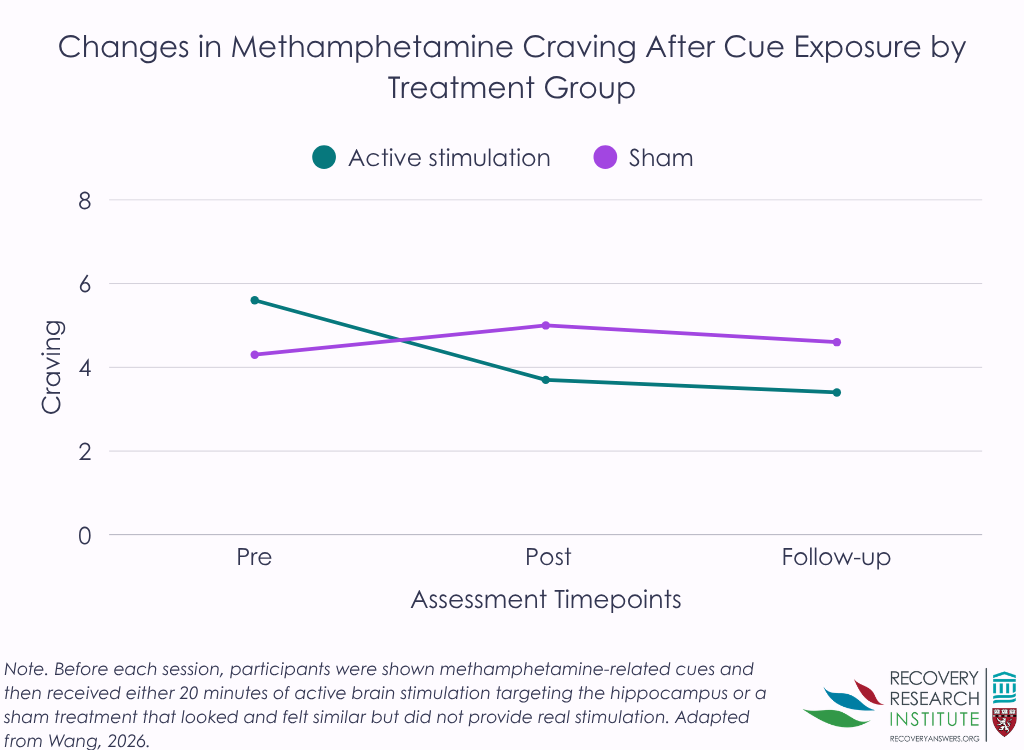
People who received active stimulation reported substantially less craving after viewing methamphetamine-related cues at the end of treatment, and this benefit was still evident 1 month later (see graph below). The magnitude of the reduction was large at both time points, suggesting the intervention meaningfully reduced cue-triggered craving. In contrast, participants in the sham group showed little change over time. No stimulation-related adverse effects were reported.
Broader craving improved right after treatment, but the effect was less durable
On a second craving measure reflecting more general craving severity, the active group improved immediately after treatment. However, that difference was not clearly maintained 1 month later, which suggests the strongest and most lasting effect may have been specifically for cue-triggered craving.
Cognitive performance improved, but emotional symptoms did not
Participants receiving active stimulation showed better scores on a brief cognitive screening measure after treatment. In contrast, the study did not find meaningful changes in depression, anxiety, or impulsivity in either group and the improvement in cognition did not appear to explain the reduction in craving.
Important cautions when interpreting these findings
This was an early-stage study with a small sample, and 2 participants in the active group did not complete treatment. All participants were men, which limits generalizability to women or broader treatment populations. In addition, because all participants viewed methamphetamine-related cues before receiving stimulation, and there were not effects on craving more generally, the results are best understood as the intervention helping address cue-induced craving. Importantly, participants had been abstinent from methamphetamine for approximately 6 months on average at study entry. As a result, it remains unclear whether similar effects would be observed among people who are actively using methamphetamine or who are earlier in recovery.
The findings suggest that noninvasive stimulation approaches capable of reaching deeper brain regions may represent a promising new direction for reducing methamphetamine craving among people with already established patterns of complete abstinence who are in early remission. This idea builds on a growing body of research suggesting that drug-associated memories can become temporarily more modifiable after cue exposure, creating an opportunity to weaken their influence on future craving. Consistent with this possibility, previous studies have found that memory-retrieval interventions can reduce craving and relapse risk among people with methamphetamine use disorder, while other neuromodulation approaches have shown potential for reducing craving across a range of substance use disorders.
At the same time, the current trial was small and preliminary, and participants were in early sustained abstinent remission, and it remains unclear whether the observed benefits resulted from the stimulation itself, the combination of cue exposure and stimulation, or the specific timing of stimulation after cue exposure. The findings also do not establish whether this approach improves long-term outcomes or work on people who are just entering treatment to try and stop use rather than among people who are already in early abstinent remission. Larger and more diverse trials are needed to determine whether the effects replicate, persist over longer follow-up periods, improve real-world recovery outcomes, and offer advantages over existing craving-focused interventions at different stages of recovery. Finally, the study did not report the extent to which participants engaged in other kinds of recovery support services during and following the intervention. This could affect outcomes.
In this small pilot trial among individuals with 6 months of continuous methamphetamine abstinence on average, noninvasive stimulation aimed at the hippocampus appeared to reduce cue-triggered methamphetamine craving, with benefits that lasted at least 1 month. The findings are promising, but different and larger studies with other samples at various stages of recovery (e.g., those starting treatment) are needed before this approach can be considered a reliable treatment option.
Wang, D., Du, Z., Wen, X., Li, Q., Liu, Y., Tang, J., Shui, C., Yu, P., Yang, L., Tu, P., Liu, X., Yuan, C., Yu, D., Ma, T., & Yuan, K. (2026). Hippocampal transcranial temporal interference stimulation reduced craving in methamphetamine use disorder. Addictive Behaviors, 174. doi: 10.1016/j.addbeh.2025.108581.

l
Methamphetamine use disorder can be difficult to treat, and craving triggered by drug and other conditioned cues is a common pathway back to use. Research on theories of how addiction develops has increasingly pointed to the role of learned drug associations, including memory processes supported by the hippocampus, in maintaining craving over time.
Brain stimulation therapies, like transcranial magnetic stimulation, deliver targeted magnetic pulses that stimulate certain neurons in the brain (see here for a video on the procedure when targeting depression). This helps stimulate underactive brain regions or calm overactive brain regions. There are several types of noninvasive brain stimulation treatments like these, to target various areas of the brain in different ways. This study examined whether delivering a noninvasive form of deep brain stimulation, called transcranial temporal interference stimulation, to the hippocampus shortly after drug cue exposure could weaken craving and improve related cognitive functioning as well as mental health symptoms.
This was a randomized sham-controlled pilot trial involving 40 adult men with methamphetamine use disorder recruited in China, with 38 completing the study. Participants were assigned to either active stimulation or a sham condition over 10 consecutive days. Before each session, they were exposed to methamphetamine-related cues and then received either 20 minutes of active stimulation targeted to the hippocampus or a brief sham procedure designed to mimic, but not deliver, the real treatment. Researchers assessed cue-triggered craving, broader self-reported craving, cognitive performance, emotional symptoms, and side effects at baseline, shortly after treatment ended, and again 1 month later. Of note, somewhat curiously, the sample had been abstinent from methamphetamine for an average of about 6 months. This could have implications for measuring change, as craving at this point is often significantly diminished. Also, in studies with smaller samples like the one here, randomization does not always produce equal groups from the outset as it is intended to. In this study, groups appeared generally similar at baseline, although the sham condition may have had slightly greater scores on a measure of impulsivity. All these limitations taken together, the study should be interpreted with some caution.
Cue-triggered craving fell after the active treatment stimulation
People who received active stimulation reported substantially less craving after viewing methamphetamine-related cues at the end of treatment, and this benefit was still evident 1 month later (see graph below). The magnitude of the reduction was large at both time points, suggesting the intervention meaningfully reduced cue-triggered craving. In contrast, participants in the sham group showed little change over time. No stimulation-related adverse effects were reported.

Broader craving improved right after treatment, but the effect was less durable
On a second craving measure reflecting more general craving severity, the active group improved immediately after treatment. However, that difference was not clearly maintained 1 month later, which suggests the strongest and most lasting effect may have been specifically for cue-triggered craving.
Cognitive performance improved, but emotional symptoms did not
Participants receiving active stimulation showed better scores on a brief cognitive screening measure after treatment. In contrast, the study did not find meaningful changes in depression, anxiety, or impulsivity in either group and the improvement in cognition did not appear to explain the reduction in craving.
Important cautions when interpreting these findings
This was an early-stage study with a small sample, and 2 participants in the active group did not complete treatment. All participants were men, which limits generalizability to women or broader treatment populations. In addition, because all participants viewed methamphetamine-related cues before receiving stimulation, and there were not effects on craving more generally, the results are best understood as the intervention helping address cue-induced craving. Importantly, participants had been abstinent from methamphetamine for approximately 6 months on average at study entry. As a result, it remains unclear whether similar effects would be observed among people who are actively using methamphetamine or who are earlier in recovery.
The findings suggest that noninvasive stimulation approaches capable of reaching deeper brain regions may represent a promising new direction for reducing methamphetamine craving among people with already established patterns of complete abstinence who are in early remission. This idea builds on a growing body of research suggesting that drug-associated memories can become temporarily more modifiable after cue exposure, creating an opportunity to weaken their influence on future craving. Consistent with this possibility, previous studies have found that memory-retrieval interventions can reduce craving and relapse risk among people with methamphetamine use disorder, while other neuromodulation approaches have shown potential for reducing craving across a range of substance use disorders.
At the same time, the current trial was small and preliminary, and participants were in early sustained abstinent remission, and it remains unclear whether the observed benefits resulted from the stimulation itself, the combination of cue exposure and stimulation, or the specific timing of stimulation after cue exposure. The findings also do not establish whether this approach improves long-term outcomes or work on people who are just entering treatment to try and stop use rather than among people who are already in early abstinent remission. Larger and more diverse trials are needed to determine whether the effects replicate, persist over longer follow-up periods, improve real-world recovery outcomes, and offer advantages over existing craving-focused interventions at different stages of recovery. Finally, the study did not report the extent to which participants engaged in other kinds of recovery support services during and following the intervention. This could affect outcomes.
In this small pilot trial among individuals with 6 months of continuous methamphetamine abstinence on average, noninvasive stimulation aimed at the hippocampus appeared to reduce cue-triggered methamphetamine craving, with benefits that lasted at least 1 month. The findings are promising, but different and larger studies with other samples at various stages of recovery (e.g., those starting treatment) are needed before this approach can be considered a reliable treatment option.
Wang, D., Du, Z., Wen, X., Li, Q., Liu, Y., Tang, J., Shui, C., Yu, P., Yang, L., Tu, P., Liu, X., Yuan, C., Yu, D., Ma, T., & Yuan, K. (2026). Hippocampal transcranial temporal interference stimulation reduced craving in methamphetamine use disorder. Addictive Behaviors, 174. doi: 10.1016/j.addbeh.2025.108581.

l
Methamphetamine use disorder can be difficult to treat, and craving triggered by drug and other conditioned cues is a common pathway back to use. Research on theories of how addiction develops has increasingly pointed to the role of learned drug associations, including memory processes supported by the hippocampus, in maintaining craving over time.
Brain stimulation therapies, like transcranial magnetic stimulation, deliver targeted magnetic pulses that stimulate certain neurons in the brain (see here for a video on the procedure when targeting depression). This helps stimulate underactive brain regions or calm overactive brain regions. There are several types of noninvasive brain stimulation treatments like these, to target various areas of the brain in different ways. This study examined whether delivering a noninvasive form of deep brain stimulation, called transcranial temporal interference stimulation, to the hippocampus shortly after drug cue exposure could weaken craving and improve related cognitive functioning as well as mental health symptoms.
This was a randomized sham-controlled pilot trial involving 40 adult men with methamphetamine use disorder recruited in China, with 38 completing the study. Participants were assigned to either active stimulation or a sham condition over 10 consecutive days. Before each session, they were exposed to methamphetamine-related cues and then received either 20 minutes of active stimulation targeted to the hippocampus or a brief sham procedure designed to mimic, but not deliver, the real treatment. Researchers assessed cue-triggered craving, broader self-reported craving, cognitive performance, emotional symptoms, and side effects at baseline, shortly after treatment ended, and again 1 month later. Of note, somewhat curiously, the sample had been abstinent from methamphetamine for an average of about 6 months. This could have implications for measuring change, as craving at this point is often significantly diminished. Also, in studies with smaller samples like the one here, randomization does not always produce equal groups from the outset as it is intended to. In this study, groups appeared generally similar at baseline, although the sham condition may have had slightly greater scores on a measure of impulsivity. All these limitations taken together, the study should be interpreted with some caution.
Cue-triggered craving fell after the active treatment stimulation
People who received active stimulation reported substantially less craving after viewing methamphetamine-related cues at the end of treatment, and this benefit was still evident 1 month later (see graph below). The magnitude of the reduction was large at both time points, suggesting the intervention meaningfully reduced cue-triggered craving. In contrast, participants in the sham group showed little change over time. No stimulation-related adverse effects were reported.

Broader craving improved right after treatment, but the effect was less durable
On a second craving measure reflecting more general craving severity, the active group improved immediately after treatment. However, that difference was not clearly maintained 1 month later, which suggests the strongest and most lasting effect may have been specifically for cue-triggered craving.
Cognitive performance improved, but emotional symptoms did not
Participants receiving active stimulation showed better scores on a brief cognitive screening measure after treatment. In contrast, the study did not find meaningful changes in depression, anxiety, or impulsivity in either group and the improvement in cognition did not appear to explain the reduction in craving.
Important cautions when interpreting these findings
This was an early-stage study with a small sample, and 2 participants in the active group did not complete treatment. All participants were men, which limits generalizability to women or broader treatment populations. In addition, because all participants viewed methamphetamine-related cues before receiving stimulation, and there were not effects on craving more generally, the results are best understood as the intervention helping address cue-induced craving. Importantly, participants had been abstinent from methamphetamine for approximately 6 months on average at study entry. As a result, it remains unclear whether similar effects would be observed among people who are actively using methamphetamine or who are earlier in recovery.
The findings suggest that noninvasive stimulation approaches capable of reaching deeper brain regions may represent a promising new direction for reducing methamphetamine craving among people with already established patterns of complete abstinence who are in early remission. This idea builds on a growing body of research suggesting that drug-associated memories can become temporarily more modifiable after cue exposure, creating an opportunity to weaken their influence on future craving. Consistent with this possibility, previous studies have found that memory-retrieval interventions can reduce craving and relapse risk among people with methamphetamine use disorder, while other neuromodulation approaches have shown potential for reducing craving across a range of substance use disorders.
At the same time, the current trial was small and preliminary, and participants were in early sustained abstinent remission, and it remains unclear whether the observed benefits resulted from the stimulation itself, the combination of cue exposure and stimulation, or the specific timing of stimulation after cue exposure. The findings also do not establish whether this approach improves long-term outcomes or work on people who are just entering treatment to try and stop use rather than among people who are already in early abstinent remission. Larger and more diverse trials are needed to determine whether the effects replicate, persist over longer follow-up periods, improve real-world recovery outcomes, and offer advantages over existing craving-focused interventions at different stages of recovery. Finally, the study did not report the extent to which participants engaged in other kinds of recovery support services during and following the intervention. This could affect outcomes.
In this small pilot trial among individuals with 6 months of continuous methamphetamine abstinence on average, noninvasive stimulation aimed at the hippocampus appeared to reduce cue-triggered methamphetamine craving, with benefits that lasted at least 1 month. The findings are promising, but different and larger studies with other samples at various stages of recovery (e.g., those starting treatment) are needed before this approach can be considered a reliable treatment option.
Wang, D., Du, Z., Wen, X., Li, Q., Liu, Y., Tang, J., Shui, C., Yu, P., Yang, L., Tu, P., Liu, X., Yuan, C., Yu, D., Ma, T., & Yuan, K. (2026). Hippocampal transcranial temporal interference stimulation reduced craving in methamphetamine use disorder. Addictive Behaviors, 174. doi: 10.1016/j.addbeh.2025.108581.
151 Merrimac St., 4th Floor. Boston, MA 02114