An antidepressant may reduce methamphetamine use, but treatment challenges remain

Methamphetamine use is a major public health concern, yet no medications are currently FDA-approved for treating methamphetamine use disorder. This study investigated whether a generic antidepressant called mirtazapine could safely help people reduce their methamphetamine use in outpatient treatment.

Stay on the frontiers of
recovery science
with the free, monthly
Recovery Bulletin

l

WHAT PROBLEM DOES THIS STUDY ADDRESS?

Methamphetamine use is a leading cause of drug-related death in the United States. People with methamphetamine use disorder face higher risks of heart problems, psychosis, injuries, and suicide. Despite this, there are currently no FDA-approved pharmacotherapies for treating methamphetamine use disorder. Previous clinical trials suggested that an antidepressant called mirtazapine may be helpful in reducing methamphetamine use. Unlike common antidepressants such as SSRIs, mirtazapine works by blocking certain serotonin and norepinephrine receptors in the brain, which is thought to dampen methamphetamine’s effects on the brain’s dopamine reward system and may also ease the sleep and anxiety problems common in methamphetamine use disorder. In these earlier studies, people taking mirtazapine were somewhat less likely to have a methamphetamine-positive drug test than those taking placebo. However, both were small, early-stage studies at a single site (60 and 120 participants). They also enrolled only men and transgender women who have sex with men, and excluded people with depression. This study tested whether mirtazapine would reduce methamphetamine use more than placebo, and whether it was safe, in a larger and more varied group of people receiving outpatient care.


HOW WAS THIS STUDY CONDUCTED?

This was a large, randomized trial at 6 public outpatient alcohol and other drug clinics in Australia. Participants had moderate to severe methamphetamine use disorder, used on about 24 of 28 days before the study, and had used for about 21 years on average. The 339 adults who started treatment averaged 42 years old, and about 4 in 10 were women. About half had symptoms of co-occurring depression. People taking other antidepressants or who had recently attempted suicide were excluded. Participants were randomized to receive either 30 mg of mirtazapine per day, or a matching placebo tablet (172 received mirtazapine and 167 placebo, and the groups were similar on age, sex, depression symptoms, how often they used methamphetamine, and whether they injected the drug at the start of treatment). This study used a double-blind approach, meaning that neither participants nor the study team knew who received the medication or the placebo. All participants were instructed to take their assigned trial medication orally on a daily basis for 12 weeks. The trial medication was provided in a special bottle that allowed researchers to track the percentage of days the medication bottle was opened during the intervention, providing an estimate of medication use, though opening the bottle did not confirm the tablet was taken.

Clinicians could discontinue the trial medication due to adverse reactions or offer the participant a 15-mg ‘rescue’ dose (i.e., half of the 30-mg tablet), and participants could also choose to stop the trial medication at any point. All participants were encouraged to remain in the trial and complete outcome assessments, regardless of whether they stopped taking the trial medication.

The primary outcome was the change in self-reported days of methamphetamine use in the past 28 days, confirmed with monthly oral fluid samples. The self-reported outcome was assessed using the timeline follow-back method, in which researchers provide participants with a calendar to help them identify specific days of substance use in the past 28 days. The primary outcome was assessed at baseline, and weeks 4, 8, and 12, with week 12 being the primary end point. Safety was assessed by asking participants about side effects at each visit.


WHAT DID THIS STUDY FIND?

Mirtazapine was associated with a greater reduction in days of methamphetamine use than placebo

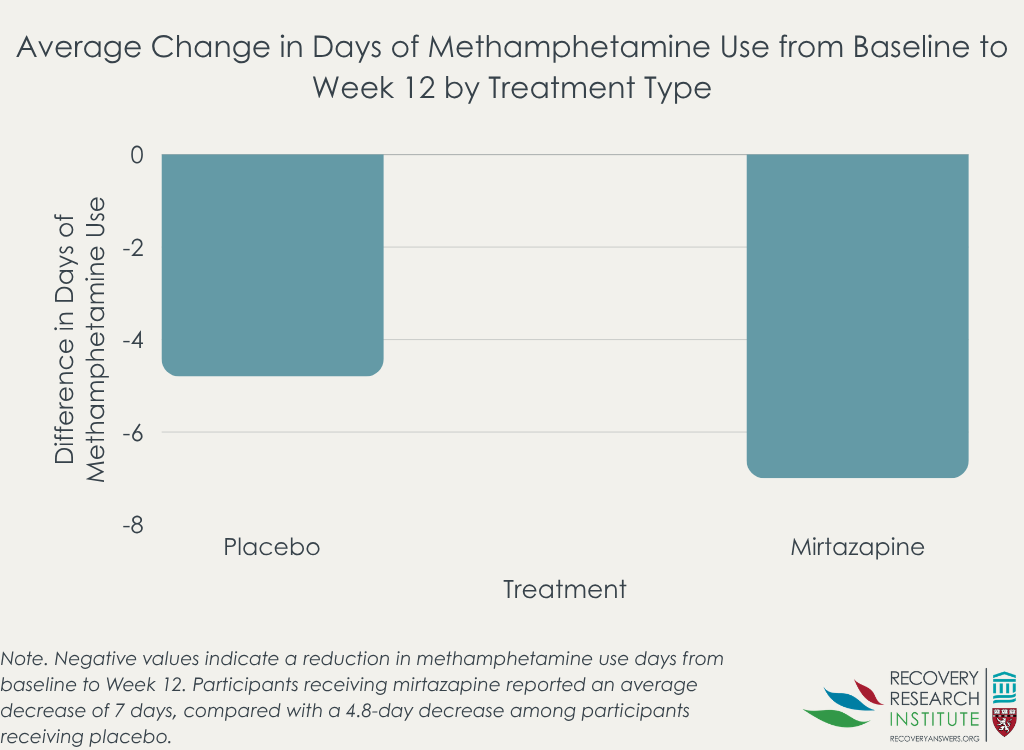
At the 12-week end point, participants who received mirtazapine reduced their methamphetamine use by an estimated 7 days of 28 days, compared with a 5-day reduction with placebo. Thus, mirtazapine led to about 2 fewer days of use per month than placebo (roughly 8 fewer days of use out of every 100). The difference was not clear at weeks 4 or 8, and participants still used on many days by week 12. Compared to placebo, mirtazapine did not clearly improve oral fluid drug test results for methamphetamine, nor did it improve depression, sleep, HIV risk behavior, or quality of life.
Several study elements increase confidence that the results reflect an actual advantage for mirtazapine, albeit a modest one. Attrition was relatively low (14% had no week 12 data), and similar across groups. To test this, the researchers ran the analysis again after filling in the missing results with statistical estimates, based on each person’s other information and their earlier answers (such as age, sex, depression, and past methamphetamine use). They also repeated the analysis adjusting for differences in participants’ starting characteristics. The benefit of mirtazapine held up in both cases. A follow-up analysis that statistically estimated the missing outcomes gave a similar result, although this cannot fully rule out bias if people who dropped out differed in ways the study did not measure. Results were mainly based on self-report. Self-report matched recent oral fluid tests reasonably well, but oral fluid tests did not show a clear difference between groups. Statistical checks that accounted for missing data provided a similar result.

Many participants did not take the medication every day, and side effects were common

Median medication adherence, measured by how often the pill bottle was opened, was 52% of days overall (and 62% of days when counting only the time before participants stopped the medication). This suggests that many participants did not take their tablets every day. Overall, roughly 1 in 4 people on mirtazapine and 1 in 5 on placebo stopped taking the medication. Stopping for medication-related reasons, such as side effects or feeling it was not helping, was somewhat more common with mirtazapine (23% vs 15%), but this difference could be due to chance. Among participants who discontinued the trial medication, 6 participants in the mirtazapine group received the 15-mg rescue dose compared to 2 participants in the placebo group. Relative to participants in the placebo group, more people in the mirtazapine group reported excessive drowsiness (47% vs. 33%) and weight gain (10% vs 3%). There were no unexpected safety concerns, and no serious health events were judged to be caused by the medication.


WHAT ARE THE IMPLICATIONS OF THE STUDY FINDINGS?

While other medications for methamphetamine use disorder are being explored, including those commonly used for treating ADHD and other substance use disorders, there are currently no approved pharmacotherapies for this disorder. In this phase 3, double-blind, placebo-controlled, randomized clinical trial, 12 weeks of mirtazapine led to a greater reduction in methamphetamine use days than placebo among a diverse group of individuals with methamphetamine use disorder. While the overall treatment effect was relatively modest (i.e., an approximately 2-day per month reduction in methamphetamine use with mirtazapine compared to placebo), the modest improvement in clinical outcomes is noteworthy in light of the lack of approved medications for methamphetamine use disorder. There were no unexpected safety concerns over 12 weeks, and the authors suggest that, because it is a low-cost generic drug, mirtazapine could be easy to prescribe. Participants receiving mirtazapine did however report more drowsiness and weight gain, and about 1 in 4 participants taking mirtazapine stopped the drug, often because of side effects or feeling it was not helping.

Importantly, the researchers analyzed all available data from baseline to week 12 and included all participants who received the trial medication, regardless of whether they stopped taking the trial medication or received the rescue dose prior to the week 12 endpoint. Low medication adherence and high discontinuance rates, both of which would have limited participant exposure to mirtazapine, may have diluted the observed treatment effect. For example, if a participant stopped taking mirtazapine at week 6, their later assessment outcomes may have still contributed to the mirtazapine group even though they were no longer receiving the medication, which could potentially make the effects of the drug appear weaker. At the same time, including all participant data may help reflect the how mirtazapine may perform in everyday treatment, although the trial’s monitoring and payments for visits were more than most clinics provide. The treatment may not achieve its intended effect if people stop taking it because they cannot tolerate it; this is also important to know when considering treatment with mirtazapine. Overall, the current results may be more reflective of the effect of mirtazapine under real-world conditions rather than the efficacy of the drug with full medication adherence.


BOTTOM LINE

Mirtazapine may modestly reduce methamphetamine use, but the benefit was small, most people still used often, and side effects and stopping the medication were common. More research is needed before mirtazapine can be considered a reliable treatment for methamphetamine use disorder.


  • For individuals and families seeking recovery: This study suggests that a generic antidepressant called mirtazapine is relatively safe and may help some people with methamphetamine use disorder reduce methamphetamine use, though the effect was small and it is not FDA approved for this purpose. Drowsiness and weight gain were common. People interested should discuss risks and benefits with a prescriber.
  • For treatment professionals and treatment systems: Mirtazapine may a helpful option to discuss with patients, but expect a modest benefit and plan for drowsiness, weight gain, and stopping. The study provided scheduled visits and safety checks and excluded people on antidepressants or with recent suicide attempts, so caution is warranted when prescribing under these conditions.
  • For scientists: Mirtazapine may help reduce methamphetamine use, but future trials are needed to test how much of the benefit is retained with better adherence, whether effects last after treatment ends, and why oral fluid tests and secondary outcomes showed no clear difference and to determine how to optimize treatment adherence and tolerability. Given the modest benefit observed in this trial, future research could also examine whether mirtazapine provides additional benefit when combined with established behavioral interventions.
  • For policy makers: Given there are no approved pharmacotherapies for methamphetamine use disorder, the modest benefit observed in this trial supports continued investment in clinical trials investigating potential medications, including mirtazapine. Funding could support larger confirmatory studies, longer follow-up, and comparisons of the effect of mirtazapine alone vs. mirtazapine combined with behavioral interventions.

CITATIONS

McKetin, R., Shoptaw, S., Saunders, L., Nguyen, L., Clare, P. J., Dore, G. J., Turner, A., Dean, O. M., Kelly, P. J., Arunogiri, S., Koeijers, J., Degan, T. J., Degenhardt, L., Farrell, M., Goodman-Meza, D., Sinclair, B., Reid, D., Cordaro, F., Hill, H., Lundin, R., … Berk, M. (2026). Mirtazapine for methamphetamine use disorder: A randomized clinical trial. JAMA Psychiatry, 83(6), 581–589. doi: 10.1001/jamapsychiatry.2026.0159.



Stay on the Frontiers of
recovery science
with the free, monthly
Recovery Bulletin

l

WHAT PROBLEM DOES THIS STUDY ADDRESS?

Methamphetamine use is a leading cause of drug-related death in the United States. People with methamphetamine use disorder face higher risks of heart problems, psychosis, injuries, and suicide. Despite this, there are currently no FDA-approved pharmacotherapies for treating methamphetamine use disorder. Previous clinical trials suggested that an antidepressant called mirtazapine may be helpful in reducing methamphetamine use. Unlike common antidepressants such as SSRIs, mirtazapine works by blocking certain serotonin and norepinephrine receptors in the brain, which is thought to dampen methamphetamine’s effects on the brain’s dopamine reward system and may also ease the sleep and anxiety problems common in methamphetamine use disorder. In these earlier studies, people taking mirtazapine were somewhat less likely to have a methamphetamine-positive drug test than those taking placebo. However, both were small, early-stage studies at a single site (60 and 120 participants). They also enrolled only men and transgender women who have sex with men, and excluded people with depression. This study tested whether mirtazapine would reduce methamphetamine use more than placebo, and whether it was safe, in a larger and more varied group of people receiving outpatient care.


HOW WAS THIS STUDY CONDUCTED?

This was a large, randomized trial at 6 public outpatient alcohol and other drug clinics in Australia. Participants had moderate to severe methamphetamine use disorder, used on about 24 of 28 days before the study, and had used for about 21 years on average. The 339 adults who started treatment averaged 42 years old, and about 4 in 10 were women. About half had symptoms of co-occurring depression. People taking other antidepressants or who had recently attempted suicide were excluded. Participants were randomized to receive either 30 mg of mirtazapine per day, or a matching placebo tablet (172 received mirtazapine and 167 placebo, and the groups were similar on age, sex, depression symptoms, how often they used methamphetamine, and whether they injected the drug at the start of treatment). This study used a double-blind approach, meaning that neither participants nor the study team knew who received the medication or the placebo. All participants were instructed to take their assigned trial medication orally on a daily basis for 12 weeks. The trial medication was provided in a special bottle that allowed researchers to track the percentage of days the medication bottle was opened during the intervention, providing an estimate of medication use, though opening the bottle did not confirm the tablet was taken.

Clinicians could discontinue the trial medication due to adverse reactions or offer the participant a 15-mg ‘rescue’ dose (i.e., half of the 30-mg tablet), and participants could also choose to stop the trial medication at any point. All participants were encouraged to remain in the trial and complete outcome assessments, regardless of whether they stopped taking the trial medication.

The primary outcome was the change in self-reported days of methamphetamine use in the past 28 days, confirmed with monthly oral fluid samples. The self-reported outcome was assessed using the timeline follow-back method, in which researchers provide participants with a calendar to help them identify specific days of substance use in the past 28 days. The primary outcome was assessed at baseline, and weeks 4, 8, and 12, with week 12 being the primary end point. Safety was assessed by asking participants about side effects at each visit.


WHAT DID THIS STUDY FIND?

Mirtazapine was associated with a greater reduction in days of methamphetamine use than placebo

At the 12-week end point, participants who received mirtazapine reduced their methamphetamine use by an estimated 7 days of 28 days, compared with a 5-day reduction with placebo. Thus, mirtazapine led to about 2 fewer days of use per month than placebo (roughly 8 fewer days of use out of every 100). The difference was not clear at weeks 4 or 8, and participants still used on many days by week 12. Compared to placebo, mirtazapine did not clearly improve oral fluid drug test results for methamphetamine, nor did it improve depression, sleep, HIV risk behavior, or quality of life.

Several study elements increase confidence that the results reflect an actual advantage for mirtazapine, albeit a modest one. Attrition was relatively low (14% had no week 12 data), and similar across groups. To test this, the researchers ran the analysis again after filling in the missing results with statistical estimates, based on each person’s other information and their earlier answers (such as age, sex, depression, and past methamphetamine use). They also repeated the analysis adjusting for differences in participants’ starting characteristics. The benefit of mirtazapine held up in both cases. A follow-up analysis that statistically estimated the missing outcomes gave a similar result, although this cannot fully rule out bias if people who dropped out differed in ways the study did not measure. Results were mainly based on self-report. Self-report matched recent oral fluid tests reasonably well, but oral fluid tests did not show a clear difference between groups. Statistical checks that accounted for missing data provided a similar result.

Many participants did not take the medication every day, and side effects were common

Median medication adherence, measured by how often the pill bottle was opened, was 52% of days overall (and 62% of days when counting only the time before participants stopped the medication). This suggests that many participants did not take their tablets every day. Overall, roughly 1 in 4 people on mirtazapine and 1 in 5 on placebo stopped taking the medication. Stopping for medication-related reasons, such as side effects or feeling it was not helping, was somewhat more common with mirtazapine (23% vs 15%), but this difference could be due to chance. Among participants who discontinued the trial medication, 6 participants in the mirtazapine group received the 15-mg rescue dose compared to 2 participants in the placebo group. Relative to participants in the placebo group, more people in the mirtazapine group reported excessive drowsiness (47% vs. 33%) and weight gain (10% vs 3%). There were no unexpected safety concerns, and no serious health events were judged to be caused by the medication.


WHAT ARE THE IMPLICATIONS OF THE STUDY FINDINGS?

While other medications for methamphetamine use disorder are being explored, including those commonly used for treating ADHD and other substance use disorders, there are currently no approved pharmacotherapies for this disorder. In this phase 3, double-blind, placebo-controlled, randomized clinical trial, 12 weeks of mirtazapine led to a greater reduction in methamphetamine use days than placebo among a diverse group of individuals with methamphetamine use disorder. While the overall treatment effect was relatively modest (i.e., an approximately 2-day per month reduction in methamphetamine use with mirtazapine compared to placebo), the modest improvement in clinical outcomes is noteworthy in light of the lack of approved medications for methamphetamine use disorder. There were no unexpected safety concerns over 12 weeks, and the authors suggest that, because it is a low-cost generic drug, mirtazapine could be easy to prescribe. Participants receiving mirtazapine did however report more drowsiness and weight gain, and about 1 in 4 participants taking mirtazapine stopped the drug, often because of side effects or feeling it was not helping.

Importantly, the researchers analyzed all available data from baseline to week 12 and included all participants who received the trial medication, regardless of whether they stopped taking the trial medication or received the rescue dose prior to the week 12 endpoint. Low medication adherence and high discontinuance rates, both of which would have limited participant exposure to mirtazapine, may have diluted the observed treatment effect. For example, if a participant stopped taking mirtazapine at week 6, their later assessment outcomes may have still contributed to the mirtazapine group even though they were no longer receiving the medication, which could potentially make the effects of the drug appear weaker. At the same time, including all participant data may help reflect the how mirtazapine may perform in everyday treatment, although the trial’s monitoring and payments for visits were more than most clinics provide. The treatment may not achieve its intended effect if people stop taking it because they cannot tolerate it; this is also important to know when considering treatment with mirtazapine. Overall, the current results may be more reflective of the effect of mirtazapine under real-world conditions rather than the efficacy of the drug with full medication adherence.


BOTTOM LINE

Mirtazapine may modestly reduce methamphetamine use, but the benefit was small, most people still used often, and side effects and stopping the medication were common. More research is needed before mirtazapine can be considered a reliable treatment for methamphetamine use disorder.


  • For individuals and families seeking recovery: This study suggests that a generic antidepressant called mirtazapine is relatively safe and may help some people with methamphetamine use disorder reduce methamphetamine use, though the effect was small and it is not FDA approved for this purpose. Drowsiness and weight gain were common. People interested should discuss risks and benefits with a prescriber.
  • For treatment professionals and treatment systems: Mirtazapine may a helpful option to discuss with patients, but expect a modest benefit and plan for drowsiness, weight gain, and stopping. The study provided scheduled visits and safety checks and excluded people on antidepressants or with recent suicide attempts, so caution is warranted when prescribing under these conditions.
  • For scientists: Mirtazapine may help reduce methamphetamine use, but future trials are needed to test how much of the benefit is retained with better adherence, whether effects last after treatment ends, and why oral fluid tests and secondary outcomes showed no clear difference and to determine how to optimize treatment adherence and tolerability. Given the modest benefit observed in this trial, future research could also examine whether mirtazapine provides additional benefit when combined with established behavioral interventions.
  • For policy makers: Given there are no approved pharmacotherapies for methamphetamine use disorder, the modest benefit observed in this trial supports continued investment in clinical trials investigating potential medications, including mirtazapine. Funding could support larger confirmatory studies, longer follow-up, and comparisons of the effect of mirtazapine alone vs. mirtazapine combined with behavioral interventions.

CITATIONS

McKetin, R., Shoptaw, S., Saunders, L., Nguyen, L., Clare, P. J., Dore, G. J., Turner, A., Dean, O. M., Kelly, P. J., Arunogiri, S., Koeijers, J., Degan, T. J., Degenhardt, L., Farrell, M., Goodman-Meza, D., Sinclair, B., Reid, D., Cordaro, F., Hill, H., Lundin, R., … Berk, M. (2026). Mirtazapine for methamphetamine use disorder: A randomized clinical trial. JAMA Psychiatry, 83(6), 581–589. doi: 10.1001/jamapsychiatry.2026.0159.


Share this article

l

WHAT PROBLEM DOES THIS STUDY ADDRESS?

Methamphetamine use is a leading cause of drug-related death in the United States. People with methamphetamine use disorder face higher risks of heart problems, psychosis, injuries, and suicide. Despite this, there are currently no FDA-approved pharmacotherapies for treating methamphetamine use disorder. Previous clinical trials suggested that an antidepressant called mirtazapine may be helpful in reducing methamphetamine use. Unlike common antidepressants such as SSRIs, mirtazapine works by blocking certain serotonin and norepinephrine receptors in the brain, which is thought to dampen methamphetamine’s effects on the brain’s dopamine reward system and may also ease the sleep and anxiety problems common in methamphetamine use disorder. In these earlier studies, people taking mirtazapine were somewhat less likely to have a methamphetamine-positive drug test than those taking placebo. However, both were small, early-stage studies at a single site (60 and 120 participants). They also enrolled only men and transgender women who have sex with men, and excluded people with depression. This study tested whether mirtazapine would reduce methamphetamine use more than placebo, and whether it was safe, in a larger and more varied group of people receiving outpatient care.


HOW WAS THIS STUDY CONDUCTED?

This was a large, randomized trial at 6 public outpatient alcohol and other drug clinics in Australia. Participants had moderate to severe methamphetamine use disorder, used on about 24 of 28 days before the study, and had used for about 21 years on average. The 339 adults who started treatment averaged 42 years old, and about 4 in 10 were women. About half had symptoms of co-occurring depression. People taking other antidepressants or who had recently attempted suicide were excluded. Participants were randomized to receive either 30 mg of mirtazapine per day, or a matching placebo tablet (172 received mirtazapine and 167 placebo, and the groups were similar on age, sex, depression symptoms, how often they used methamphetamine, and whether they injected the drug at the start of treatment). This study used a double-blind approach, meaning that neither participants nor the study team knew who received the medication or the placebo. All participants were instructed to take their assigned trial medication orally on a daily basis for 12 weeks. The trial medication was provided in a special bottle that allowed researchers to track the percentage of days the medication bottle was opened during the intervention, providing an estimate of medication use, though opening the bottle did not confirm the tablet was taken.

Clinicians could discontinue the trial medication due to adverse reactions or offer the participant a 15-mg ‘rescue’ dose (i.e., half of the 30-mg tablet), and participants could also choose to stop the trial medication at any point. All participants were encouraged to remain in the trial and complete outcome assessments, regardless of whether they stopped taking the trial medication.

The primary outcome was the change in self-reported days of methamphetamine use in the past 28 days, confirmed with monthly oral fluid samples. The self-reported outcome was assessed using the timeline follow-back method, in which researchers provide participants with a calendar to help them identify specific days of substance use in the past 28 days. The primary outcome was assessed at baseline, and weeks 4, 8, and 12, with week 12 being the primary end point. Safety was assessed by asking participants about side effects at each visit.


WHAT DID THIS STUDY FIND?

Mirtazapine was associated with a greater reduction in days of methamphetamine use than placebo

At the 12-week end point, participants who received mirtazapine reduced their methamphetamine use by an estimated 7 days of 28 days, compared with a 5-day reduction with placebo. Thus, mirtazapine led to about 2 fewer days of use per month than placebo (roughly 8 fewer days of use out of every 100). The difference was not clear at weeks 4 or 8, and participants still used on many days by week 12. Compared to placebo, mirtazapine did not clearly improve oral fluid drug test results for methamphetamine, nor did it improve depression, sleep, HIV risk behavior, or quality of life.

Several study elements increase confidence that the results reflect an actual advantage for mirtazapine, albeit a modest one. Attrition was relatively low (14% had no week 12 data), and similar across groups. To test this, the researchers ran the analysis again after filling in the missing results with statistical estimates, based on each person’s other information and their earlier answers (such as age, sex, depression, and past methamphetamine use). They also repeated the analysis adjusting for differences in participants’ starting characteristics. The benefit of mirtazapine held up in both cases. A follow-up analysis that statistically estimated the missing outcomes gave a similar result, although this cannot fully rule out bias if people who dropped out differed in ways the study did not measure. Results were mainly based on self-report. Self-report matched recent oral fluid tests reasonably well, but oral fluid tests did not show a clear difference between groups. Statistical checks that accounted for missing data provided a similar result.

Many participants did not take the medication every day, and side effects were common

Median medication adherence, measured by how often the pill bottle was opened, was 52% of days overall (and 62% of days when counting only the time before participants stopped the medication). This suggests that many participants did not take their tablets every day. Overall, roughly 1 in 4 people on mirtazapine and 1 in 5 on placebo stopped taking the medication. Stopping for medication-related reasons, such as side effects or feeling it was not helping, was somewhat more common with mirtazapine (23% vs 15%), but this difference could be due to chance. Among participants who discontinued the trial medication, 6 participants in the mirtazapine group received the 15-mg rescue dose compared to 2 participants in the placebo group. Relative to participants in the placebo group, more people in the mirtazapine group reported excessive drowsiness (47% vs. 33%) and weight gain (10% vs 3%). There were no unexpected safety concerns, and no serious health events were judged to be caused by the medication.


WHAT ARE THE IMPLICATIONS OF THE STUDY FINDINGS?

While other medications for methamphetamine use disorder are being explored, including those commonly used for treating ADHD and other substance use disorders, there are currently no approved pharmacotherapies for this disorder. In this phase 3, double-blind, placebo-controlled, randomized clinical trial, 12 weeks of mirtazapine led to a greater reduction in methamphetamine use days than placebo among a diverse group of individuals with methamphetamine use disorder. While the overall treatment effect was relatively modest (i.e., an approximately 2-day per month reduction in methamphetamine use with mirtazapine compared to placebo), the modest improvement in clinical outcomes is noteworthy in light of the lack of approved medications for methamphetamine use disorder. There were no unexpected safety concerns over 12 weeks, and the authors suggest that, because it is a low-cost generic drug, mirtazapine could be easy to prescribe. Participants receiving mirtazapine did however report more drowsiness and weight gain, and about 1 in 4 participants taking mirtazapine stopped the drug, often because of side effects or feeling it was not helping.

Importantly, the researchers analyzed all available data from baseline to week 12 and included all participants who received the trial medication, regardless of whether they stopped taking the trial medication or received the rescue dose prior to the week 12 endpoint. Low medication adherence and high discontinuance rates, both of which would have limited participant exposure to mirtazapine, may have diluted the observed treatment effect. For example, if a participant stopped taking mirtazapine at week 6, their later assessment outcomes may have still contributed to the mirtazapine group even though they were no longer receiving the medication, which could potentially make the effects of the drug appear weaker. At the same time, including all participant data may help reflect the how mirtazapine may perform in everyday treatment, although the trial’s monitoring and payments for visits were more than most clinics provide. The treatment may not achieve its intended effect if people stop taking it because they cannot tolerate it; this is also important to know when considering treatment with mirtazapine. Overall, the current results may be more reflective of the effect of mirtazapine under real-world conditions rather than the efficacy of the drug with full medication adherence.


BOTTOM LINE

Mirtazapine may modestly reduce methamphetamine use, but the benefit was small, most people still used often, and side effects and stopping the medication were common. More research is needed before mirtazapine can be considered a reliable treatment for methamphetamine use disorder.


  • For individuals and families seeking recovery: This study suggests that a generic antidepressant called mirtazapine is relatively safe and may help some people with methamphetamine use disorder reduce methamphetamine use, though the effect was small and it is not FDA approved for this purpose. Drowsiness and weight gain were common. People interested should discuss risks and benefits with a prescriber.
  • For treatment professionals and treatment systems: Mirtazapine may a helpful option to discuss with patients, but expect a modest benefit and plan for drowsiness, weight gain, and stopping. The study provided scheduled visits and safety checks and excluded people on antidepressants or with recent suicide attempts, so caution is warranted when prescribing under these conditions.
  • For scientists: Mirtazapine may help reduce methamphetamine use, but future trials are needed to test how much of the benefit is retained with better adherence, whether effects last after treatment ends, and why oral fluid tests and secondary outcomes showed no clear difference and to determine how to optimize treatment adherence and tolerability. Given the modest benefit observed in this trial, future research could also examine whether mirtazapine provides additional benefit when combined with established behavioral interventions.
  • For policy makers: Given there are no approved pharmacotherapies for methamphetamine use disorder, the modest benefit observed in this trial supports continued investment in clinical trials investigating potential medications, including mirtazapine. Funding could support larger confirmatory studies, longer follow-up, and comparisons of the effect of mirtazapine alone vs. mirtazapine combined with behavioral interventions.

CITATIONS

McKetin, R., Shoptaw, S., Saunders, L., Nguyen, L., Clare, P. J., Dore, G. J., Turner, A., Dean, O. M., Kelly, P. J., Arunogiri, S., Koeijers, J., Degan, T. J., Degenhardt, L., Farrell, M., Goodman-Meza, D., Sinclair, B., Reid, D., Cordaro, F., Hill, H., Lundin, R., … Berk, M. (2026). Mirtazapine for methamphetamine use disorder: A randomized clinical trial. JAMA Psychiatry, 83(6), 581–589. doi: 10.1001/jamapsychiatry.2026.0159.


Share this article