Opioid use disorder medications and recovery residences

  • Home
  • Research
  • Opioid use disorder medications and recovery residences

Recovery residences like Oxford Houses are helpful, cost-effective resources in the substance use disorder continuum of care. Medications like buprenorphine/naloxone (Suboxone) reduce opioid use and overdose risk, but many recovery residences have traditionally not allowed individuals taking these medications. This study examined whether receiving medication for opioid use disorder was associated with retention and changes in recovery capital among residents of recovery housing.

Stay on the frontiers of
recovery science
with the free, monthly
Recovery Bulletin

l

WHAT PROBLEM DOES THIS STUDY ADDRESS?

Recovery residences, or drug-free housing that provide structured recovery resources, are an important part of the substance use disorder continuum of care. Recovery residences are thought to work by creating structure and support around key elements of recovery capital, such as housing stability, mutual assistance, shared recovery experience, engagement in recovery support services, social connectivity, and occupational and recreational assistance. Research suggests that participation in a recovery residence is associated with reduced chances of relapse and improved recovery outcomes.

Opioid use disorder medications like methadone, buprenorphine, and naltrexone are effective but some recovery residences have traditionally not accepted individuals receiving these medications. In theory, because medications for opioid use disorder reduce relapse risk, they may actually help people stay engaged in recovery residences. This study explored if people receiving medications for opioid use disorder were more likely to be retained in recovery residences as well as recovery capital accumulation.


HOW WAS THIS STUDY CONDUCTED?

This was an observational study of recovery residences in Virginia, USA with the goal of determining whether recovery residents receiving medications for opioid use disorder had better retention rates, program completion, and improvements in recovery capital compared to those not receiving medication for opioid use disorder. Recovery residents, some of whom were receiving medications for opioid use disorder (509) and a much larger group not receiving medication for opioid use disorder (8,785), completed a baseline survey within 72 hours of admission at the recovery residence, followed by surveys between 45 and 90 days later, and every 90 days thereafter.

Retention was measured by whether a resident completed a scheduled check-in survey at each assessment point, which the researchers used as an indicator that the person was still living in the recovery residence. If someone missed a survey, this was not automatically counted as leaving the program; the researchers treated it as unknown status rather than confirmed dropout, since they did not have direct records of exactly when residents moved out. Recovery capital was defined as a composite of the Assessment of Recovery Capital measure, Recovery Group Participation Scale, and the Commitment to Sobriety Scale. The researchers statistically adjusted for other factors that could influence the comparison, including age, gender, race/ethnicity, housing need, non-prescription drug use, criminal legal system exposure, meaningful activities, regardless of whether these factors happened to differ between groups.

In the first model, the authors examined differences in outcomes based on medications for opioid use disorder status. Residents’ medication status was reassessed at each follow-up visit, with the statistical models accounting for residents starting, stopping, or changing medications over the course of the study, rather than assuming status stayed fixed from baseline. In the second model, the researchers looked at differences between the four different types of medications for opioid use disorder: methadone, sublingual buprenorphine, extended-release buprenorphine, and naltrexone. Among the 509 residents utilizing medication, most were taking sublingual buprenorphine (61%), followed by methadone (22%), naltrexone (9%), and extended-release buprenorphine (8%). This means the naltrexone and extended-release buprenorphine findings are based on much smaller groups than the buprenorphine and methadone findings, which should be kept in mind when interpreting differences between medications. In the third model, they examined change in recovery capital over time using longitudinal modeling, comparing residents with and without medication for opioid use disorder overall. In a fourth model, the researchers repeated this comparison separately for each of the 4 medication types, to see whether recovery capital changed differently depending on which medication a resident was taking. In these models, the authors only included 5,333 recovery residents who had more than 1 assessment.


WHAT DID THIS STUDY FIND?

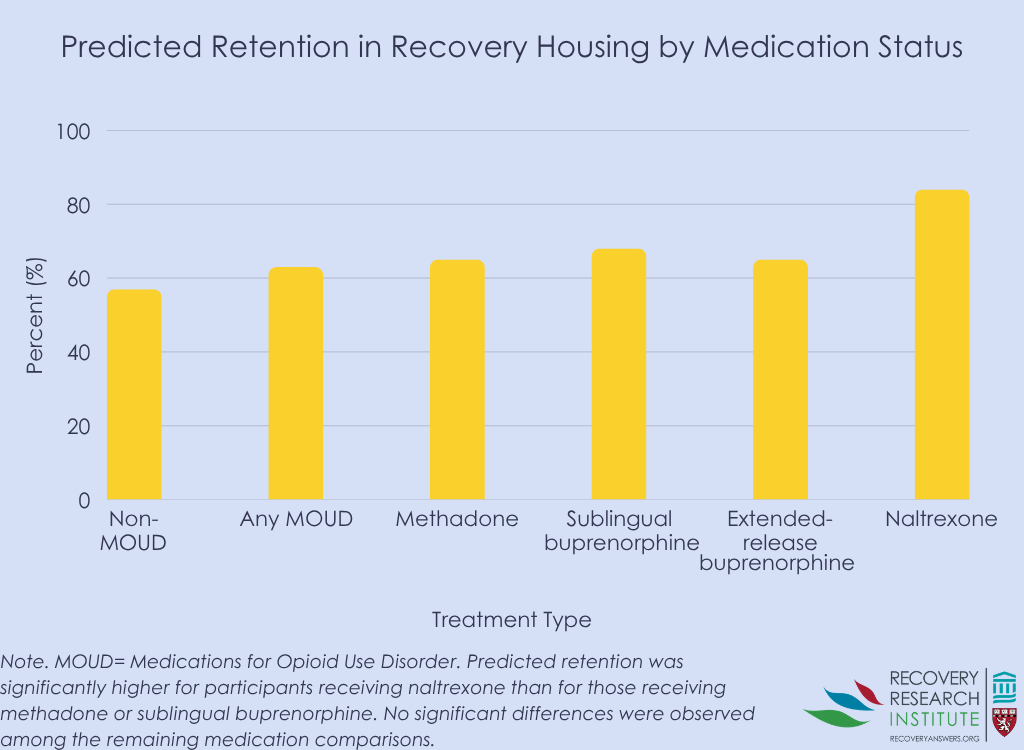
After adjustment for measured differences between groups, residents receiving medication for opioid use disorder had a predicted 63% overall probability of retention, compared with 57% among residents not receiving medication, a difference that was statistically significant. Those taking naltrexone were more likely to remain in a recovery residence (84%) compared to those taking methadone (65%), sublingual buprenorphine (68%), and extended-release buprenorphine (65%). The naltrexone retention outcomes were statistically significantly higher than those for methadone and sublingual buprenorphine, but not extended-release buprenorphine. Analyses did not compare specific medications to no medication, however.

In the researchers’ longitudinal models, residents receiving medication for opioid use disorder showed greater increases in overall recovery capital scores than residents not receiving medication at the second and third post-baseline assessments, though the size of this effect was relatively small. Medication-specific analyses suggested greater early increases for buprenorphine than for naltrexone at selected assessments, but these findings did not establish a consistent overall ranking of the medications. The recovery capital analysis excluded residents with only one assessment, and the number of participants included at each subsequent time point declined sharply over time, making later outcomes increasingly uncertain.

WHAT ARE THE IMPLICATIONS OF THE STUDY FINDINGS?

Residents receiving medication for opioid use disorder had a modestly higher probability of retention than residents not receiving medication with a difference of 6 percentage points. Naltrexone had the highest numerical probability among the four medications, but the study design cannot establish that naltrexone caused better retention or that it outperformed extended-release buprenorphine. Medication selection was not random, and the groups may have differed in unmeasured ways, including opioid use disorder severity, treatment history, detoxification status, motivation, and readiness for abstinence. For example, participants taking buprenorphine formulations may have had more severe opioid use disorder than those taking naltrexone, which would explain their lower retention in treatment. Alternatively, many who are taking naltrexone may have already demonstrated high levels of motivation for and commitment to abstinence, given that naltrexone initiation requires a period free from opioid use to avoid precipitated withdrawal. This is important because randomized clinical evidence generally finds stronger treatment retention with methadone and buprenorphine than with naltrexone, given that initial period of abstinence can be hard for some to establish. But this study examined individuals already taking naltrexone, making the difficulty starting the medication a non-issue.


BOTTOM LINE

In this study, recovery housing residents receiving medication for opioid use disorder had a modestly higher probability of retention than residents not receiving medication. Naltrexone was associated with the highest medication-specific retention; significantly higher than methadone and sublingual buprenorphine, though not significantly different from extended-release buprenorphine. However, because starting naltrexone requires first completing detoxification, residents who chose naltrexone may have already had greater motivation for abstinence than residents on other medications, a difference the study could not measure or statistically control for. As such, the observed retention advantage may partly reflect who chooses naltrexone rather than an effect of the medication itself.


  • For individuals and families seeking recovery: For people taking or considering medication for opioid use disorder, this study provides preliminary reassurance that medication use is not associated with poorer recovery residence retention and is instead associated with a modestly higher predicted probability of retention. Naltrexone showed the strongest association with retention, but this may partly reflect who chooses naltrexone rather than the medication itself. Prospective residents may wish to ask how a residence supports medication use, stores medications, coordinates with outside prescribers, and addresses medication-related stigma.
  • For treatment professionals and treatment systems: Studies consistently demonstrate that taking medications for opioid use disorder improve recovery outcomes. In this study, residents receiving medication had a modestly higher probability of retention. Treatment systems should ensure that recovery residence policies and staff practices do not create unnecessary barriers for residents receiving empirically-supported medications.
  • For scientists: This study found a modest association between medication for opioid use disorder and a higher adjusted probability of recovery residence retention. Future studies should directly measure and control statistically for opioid use disorder severity, detoxification and treatment history, motivation, medication continuity, residence characteristics, and reasons for missing assessments, and should prospectively test whether medication type or medication-supportive residence practices affect retention.
  • For policy makers: This study found that opioid use disorder medication use was associated with a modestly higher adjusted predicted probability of retention. Policies that increase access to medication for opioid disorder among people in recovery residences are likely to improve retention and ultimately recovery outcomes.

CITATIONS

Sondhi, A., Best, D., Leidi, A., Belanger, M., Best, J., Bunaciu, A., & White, W. (2026). The impact of medications for opioid use disorder (MOUD) on retention and recovery capital in recovery housing: An exploratory causal inference analysis. International Journal of Drug Policy, 151. doi: 10.1016/j.drugpo.2026.105218.



Stay on the Frontiers of
recovery science
with the free, monthly
Recovery Bulletin

l

WHAT PROBLEM DOES THIS STUDY ADDRESS?

Recovery residences, or drug-free housing that provide structured recovery resources, are an important part of the substance use disorder continuum of care. Recovery residences are thought to work by creating structure and support around key elements of recovery capital, such as housing stability, mutual assistance, shared recovery experience, engagement in recovery support services, social connectivity, and occupational and recreational assistance. Research suggests that participation in a recovery residence is associated with reduced chances of relapse and improved recovery outcomes.

Opioid use disorder medications like methadone, buprenorphine, and naltrexone are effective but some recovery residences have traditionally not accepted individuals receiving these medications. In theory, because medications for opioid use disorder reduce relapse risk, they may actually help people stay engaged in recovery residences. This study explored if people receiving medications for opioid use disorder were more likely to be retained in recovery residences as well as recovery capital accumulation.


HOW WAS THIS STUDY CONDUCTED?

This was an observational study of recovery residences in Virginia, USA with the goal of determining whether recovery residents receiving medications for opioid use disorder had better retention rates, program completion, and improvements in recovery capital compared to those not receiving medication for opioid use disorder. Recovery residents, some of whom were receiving medications for opioid use disorder (509) and a much larger group not receiving medication for opioid use disorder (8,785), completed a baseline survey within 72 hours of admission at the recovery residence, followed by surveys between 45 and 90 days later, and every 90 days thereafter.

Retention was measured by whether a resident completed a scheduled check-in survey at each assessment point, which the researchers used as an indicator that the person was still living in the recovery residence. If someone missed a survey, this was not automatically counted as leaving the program; the researchers treated it as unknown status rather than confirmed dropout, since they did not have direct records of exactly when residents moved out. Recovery capital was defined as a composite of the Assessment of Recovery Capital measure, Recovery Group Participation Scale, and the Commitment to Sobriety Scale. The researchers statistically adjusted for other factors that could influence the comparison, including age, gender, race/ethnicity, housing need, non-prescription drug use, criminal legal system exposure, meaningful activities, regardless of whether these factors happened to differ between groups.

In the first model, the authors examined differences in outcomes based on medications for opioid use disorder status. Residents’ medication status was reassessed at each follow-up visit, with the statistical models accounting for residents starting, stopping, or changing medications over the course of the study, rather than assuming status stayed fixed from baseline. In the second model, the researchers looked at differences between the four different types of medications for opioid use disorder: methadone, sublingual buprenorphine, extended-release buprenorphine, and naltrexone. Among the 509 residents utilizing medication, most were taking sublingual buprenorphine (61%), followed by methadone (22%), naltrexone (9%), and extended-release buprenorphine (8%). This means the naltrexone and extended-release buprenorphine findings are based on much smaller groups than the buprenorphine and methadone findings, which should be kept in mind when interpreting differences between medications. In the third model, they examined change in recovery capital over time using longitudinal modeling, comparing residents with and without medication for opioid use disorder overall. In a fourth model, the researchers repeated this comparison separately for each of the 4 medication types, to see whether recovery capital changed differently depending on which medication a resident was taking. In these models, the authors only included 5,333 recovery residents who had more than 1 assessment.


WHAT DID THIS STUDY FIND?

After adjustment for measured differences between groups, residents receiving medication for opioid use disorder had a predicted 63% overall probability of retention, compared with 57% among residents not receiving medication, a difference that was statistically significant. Those taking naltrexone were more likely to remain in a recovery residence (84%) compared to those taking methadone (65%), sublingual buprenorphine (68%), and extended-release buprenorphine (65%). The naltrexone retention outcomes were statistically significantly higher than those for methadone and sublingual buprenorphine, but not extended-release buprenorphine. Analyses did not compare specific medications to no medication, however.

In the researchers’ longitudinal models, residents receiving medication for opioid use disorder showed greater increases in overall recovery capital scores than residents not receiving medication at the second and third post-baseline assessments, though the size of this effect was relatively small. Medication-specific analyses suggested greater early increases for buprenorphine than for naltrexone at selected assessments, but these findings did not establish a consistent overall ranking of the medications. The recovery capital analysis excluded residents with only one assessment, and the number of participants included at each subsequent time point declined sharply over time, making later outcomes increasingly uncertain.


WHAT ARE THE IMPLICATIONS OF THE STUDY FINDINGS?

Residents receiving medication for opioid use disorder had a modestly higher probability of retention than residents not receiving medication with a difference of 6 percentage points. Naltrexone had the highest numerical probability among the four medications, but the study design cannot establish that naltrexone caused better retention or that it outperformed extended-release buprenorphine. Medication selection was not random, and the groups may have differed in unmeasured ways, including opioid use disorder severity, treatment history, detoxification status, motivation, and readiness for abstinence. For example, participants taking buprenorphine formulations may have had more severe opioid use disorder than those taking naltrexone, which would explain their lower retention in treatment. Alternatively, many who are taking naltrexone may have already demonstrated high levels of motivation for and commitment to abstinence, given that naltrexone initiation requires a period free from opioid use to avoid precipitated withdrawal. This is important because randomized clinical evidence generally finds stronger treatment retention with methadone and buprenorphine than with naltrexone, given that initial period of abstinence can be hard for some to establish. But this study examined individuals already taking naltrexone, making the difficulty starting the medication a non-issue.


BOTTOM LINE

In this study, recovery housing residents receiving medication for opioid use disorder had a modestly higher probability of retention than residents not receiving medication. Naltrexone was associated with the highest medication-specific retention; significantly higher than methadone and sublingual buprenorphine, though not significantly different from extended-release buprenorphine. However, because starting naltrexone requires first completing detoxification, residents who chose naltrexone may have already had greater motivation for abstinence than residents on other medications, a difference the study could not measure or statistically control for. As such, the observed retention advantage may partly reflect who chooses naltrexone rather than an effect of the medication itself.


  • For individuals and families seeking recovery: For people taking or considering medication for opioid use disorder, this study provides preliminary reassurance that medication use is not associated with poorer recovery residence retention and is instead associated with a modestly higher predicted probability of retention. Naltrexone showed the strongest association with retention, but this may partly reflect who chooses naltrexone rather than the medication itself. Prospective residents may wish to ask how a residence supports medication use, stores medications, coordinates with outside prescribers, and addresses medication-related stigma.
  • For treatment professionals and treatment systems: Studies consistently demonstrate that taking medications for opioid use disorder improve recovery outcomes. In this study, residents receiving medication had a modestly higher probability of retention. Treatment systems should ensure that recovery residence policies and staff practices do not create unnecessary barriers for residents receiving empirically-supported medications.
  • For scientists: This study found a modest association between medication for opioid use disorder and a higher adjusted probability of recovery residence retention. Future studies should directly measure and control statistically for opioid use disorder severity, detoxification and treatment history, motivation, medication continuity, residence characteristics, and reasons for missing assessments, and should prospectively test whether medication type or medication-supportive residence practices affect retention.
  • For policy makers: This study found that opioid use disorder medication use was associated with a modestly higher adjusted predicted probability of retention. Policies that increase access to medication for opioid disorder among people in recovery residences are likely to improve retention and ultimately recovery outcomes.

CITATIONS

Sondhi, A., Best, D., Leidi, A., Belanger, M., Best, J., Bunaciu, A., & White, W. (2026). The impact of medications for opioid use disorder (MOUD) on retention and recovery capital in recovery housing: An exploratory causal inference analysis. International Journal of Drug Policy, 151. doi: 10.1016/j.drugpo.2026.105218.


Share this article

l

WHAT PROBLEM DOES THIS STUDY ADDRESS?

Recovery residences, or drug-free housing that provide structured recovery resources, are an important part of the substance use disorder continuum of care. Recovery residences are thought to work by creating structure and support around key elements of recovery capital, such as housing stability, mutual assistance, shared recovery experience, engagement in recovery support services, social connectivity, and occupational and recreational assistance. Research suggests that participation in a recovery residence is associated with reduced chances of relapse and improved recovery outcomes.

Opioid use disorder medications like methadone, buprenorphine, and naltrexone are effective but some recovery residences have traditionally not accepted individuals receiving these medications. In theory, because medications for opioid use disorder reduce relapse risk, they may actually help people stay engaged in recovery residences. This study explored if people receiving medications for opioid use disorder were more likely to be retained in recovery residences as well as recovery capital accumulation.


HOW WAS THIS STUDY CONDUCTED?

This was an observational study of recovery residences in Virginia, USA with the goal of determining whether recovery residents receiving medications for opioid use disorder had better retention rates, program completion, and improvements in recovery capital compared to those not receiving medication for opioid use disorder. Recovery residents, some of whom were receiving medications for opioid use disorder (509) and a much larger group not receiving medication for opioid use disorder (8,785), completed a baseline survey within 72 hours of admission at the recovery residence, followed by surveys between 45 and 90 days later, and every 90 days thereafter.

Retention was measured by whether a resident completed a scheduled check-in survey at each assessment point, which the researchers used as an indicator that the person was still living in the recovery residence. If someone missed a survey, this was not automatically counted as leaving the program; the researchers treated it as unknown status rather than confirmed dropout, since they did not have direct records of exactly when residents moved out. Recovery capital was defined as a composite of the Assessment of Recovery Capital measure, Recovery Group Participation Scale, and the Commitment to Sobriety Scale. The researchers statistically adjusted for other factors that could influence the comparison, including age, gender, race/ethnicity, housing need, non-prescription drug use, criminal legal system exposure, meaningful activities, regardless of whether these factors happened to differ between groups.

In the first model, the authors examined differences in outcomes based on medications for opioid use disorder status. Residents’ medication status was reassessed at each follow-up visit, with the statistical models accounting for residents starting, stopping, or changing medications over the course of the study, rather than assuming status stayed fixed from baseline. In the second model, the researchers looked at differences between the four different types of medications for opioid use disorder: methadone, sublingual buprenorphine, extended-release buprenorphine, and naltrexone. Among the 509 residents utilizing medication, most were taking sublingual buprenorphine (61%), followed by methadone (22%), naltrexone (9%), and extended-release buprenorphine (8%). This means the naltrexone and extended-release buprenorphine findings are based on much smaller groups than the buprenorphine and methadone findings, which should be kept in mind when interpreting differences between medications. In the third model, they examined change in recovery capital over time using longitudinal modeling, comparing residents with and without medication for opioid use disorder overall. In a fourth model, the researchers repeated this comparison separately for each of the 4 medication types, to see whether recovery capital changed differently depending on which medication a resident was taking. In these models, the authors only included 5,333 recovery residents who had more than 1 assessment.


WHAT DID THIS STUDY FIND?

After adjustment for measured differences between groups, residents receiving medication for opioid use disorder had a predicted 63% overall probability of retention, compared with 57% among residents not receiving medication, a difference that was statistically significant. Those taking naltrexone were more likely to remain in a recovery residence (84%) compared to those taking methadone (65%), sublingual buprenorphine (68%), and extended-release buprenorphine (65%). The naltrexone retention outcomes were statistically significantly higher than those for methadone and sublingual buprenorphine, but not extended-release buprenorphine. Analyses did not compare specific medications to no medication, however.

In the researchers’ longitudinal models, residents receiving medication for opioid use disorder showed greater increases in overall recovery capital scores than residents not receiving medication at the second and third post-baseline assessments, though the size of this effect was relatively small. Medication-specific analyses suggested greater early increases for buprenorphine than for naltrexone at selected assessments, but these findings did not establish a consistent overall ranking of the medications. The recovery capital analysis excluded residents with only one assessment, and the number of participants included at each subsequent time point declined sharply over time, making later outcomes increasingly uncertain.


WHAT ARE THE IMPLICATIONS OF THE STUDY FINDINGS?

Residents receiving medication for opioid use disorder had a modestly higher probability of retention than residents not receiving medication with a difference of 6 percentage points. Naltrexone had the highest numerical probability among the four medications, but the study design cannot establish that naltrexone caused better retention or that it outperformed extended-release buprenorphine. Medication selection was not random, and the groups may have differed in unmeasured ways, including opioid use disorder severity, treatment history, detoxification status, motivation, and readiness for abstinence. For example, participants taking buprenorphine formulations may have had more severe opioid use disorder than those taking naltrexone, which would explain their lower retention in treatment. Alternatively, many who are taking naltrexone may have already demonstrated high levels of motivation for and commitment to abstinence, given that naltrexone initiation requires a period free from opioid use to avoid precipitated withdrawal. This is important because randomized clinical evidence generally finds stronger treatment retention with methadone and buprenorphine than with naltrexone, given that initial period of abstinence can be hard for some to establish. But this study examined individuals already taking naltrexone, making the difficulty starting the medication a non-issue.


BOTTOM LINE

In this study, recovery housing residents receiving medication for opioid use disorder had a modestly higher probability of retention than residents not receiving medication. Naltrexone was associated with the highest medication-specific retention; significantly higher than methadone and sublingual buprenorphine, though not significantly different from extended-release buprenorphine. However, because starting naltrexone requires first completing detoxification, residents who chose naltrexone may have already had greater motivation for abstinence than residents on other medications, a difference the study could not measure or statistically control for. As such, the observed retention advantage may partly reflect who chooses naltrexone rather than an effect of the medication itself.


  • For individuals and families seeking recovery: For people taking or considering medication for opioid use disorder, this study provides preliminary reassurance that medication use is not associated with poorer recovery residence retention and is instead associated with a modestly higher predicted probability of retention. Naltrexone showed the strongest association with retention, but this may partly reflect who chooses naltrexone rather than the medication itself. Prospective residents may wish to ask how a residence supports medication use, stores medications, coordinates with outside prescribers, and addresses medication-related stigma.
  • For treatment professionals and treatment systems: Studies consistently demonstrate that taking medications for opioid use disorder improve recovery outcomes. In this study, residents receiving medication had a modestly higher probability of retention. Treatment systems should ensure that recovery residence policies and staff practices do not create unnecessary barriers for residents receiving empirically-supported medications.
  • For scientists: This study found a modest association between medication for opioid use disorder and a higher adjusted probability of recovery residence retention. Future studies should directly measure and control statistically for opioid use disorder severity, detoxification and treatment history, motivation, medication continuity, residence characteristics, and reasons for missing assessments, and should prospectively test whether medication type or medication-supportive residence practices affect retention.
  • For policy makers: This study found that opioid use disorder medication use was associated with a modestly higher adjusted predicted probability of retention. Policies that increase access to medication for opioid disorder among people in recovery residences are likely to improve retention and ultimately recovery outcomes.

CITATIONS

Sondhi, A., Best, D., Leidi, A., Belanger, M., Best, J., Bunaciu, A., & White, W. (2026). The impact of medications for opioid use disorder (MOUD) on retention and recovery capital in recovery housing: An exploratory causal inference analysis. International Journal of Drug Policy, 151. doi: 10.1016/j.drugpo.2026.105218.


Share this article