Buprenorphine is associated with reduction in overdose risk, even in the era of fentanyl

  • Home
  • Research
  • Buprenorphine is associated with reduction in overdose risk, even in the era of fentanyl

Despite buprenorphine’s proven effectiveness in treating opioid use disorder and reducing opioid overdose risk, some providers have voiced concerns about prescribing buprenorphine in the fentanyl era, given the need for higher doses to counter fentanyl’s potency. This study evaluated whether buprenorphine reduced opioid overdose during a period of fentanyl proliferation.

Stay on the frontiers of
recovery science
with the free, monthly
Recovery Bulletin

l

WHAT PROBLEM DOES THIS STUDY ADDRESS?

Buprenorphine, a partial opioid agonist often prescribed as buprenorphine/naloxone and known by the brand name Suboxone, is an important and life-saving medication for opioid use disorder.

Buprenorphine partially binds to the same receptors as other opioids like heroin, largely blocking other opioids from binding to the receptors and preventing the drug effects commonly associated with more potent opioids. It can both help prevent withdrawal and suppress cravings, and randomized controlled trials have demonstrated that taking buprenorphine is associated with a greater likelihood of opioid abstinence over time. However, as fentanyl has become more prevalent over the past decade, some providers have voiced hesitation about prescribing buprenorphine, citing concerns about increased risks of severe precipitated withdrawal. Another concern pertains to added risk for respiratory depression when buprenorphine at higher doses, in addition to fentanyl (perhaps unknowingly), are used simultaneously, despite the fact that buprenorphine has ceiling effects on euphoria and respiratory depression. The current study attempted to evaluate buprenorphine effectiveness as a tool for overdose prevention during a period of particularly high fentanyl prevalence.


HOW WAS THIS STUDY CONDUCTED?

This study was a retrospective cohort study of adults in Rhode Island who initiated buprenorphine between October 1, 2016 and September 30, 2022. The study combined individual, day-level data from several large statewide sources such as the Rhode Island Department of Health and the Department of Behavioral Healthcare, Developmental Disabilities, and Hospitals. The study identified patients starting buprenorphine – i.e., no buprenorphine prescription for the prior 6 months followed by a buprenorphine prescription during the study period – and used data from various sources to evaluate both ongoing buprenorphine treatment engagement and any experience of non-fatal or fatal opioid overdose. This means that the study is unable to ascertain whether the individual actually took the buprenorphine at all or took it as prescribed. Also, while buprenorphine is often prescribed as a buprenorphine/naloxone film (i.e., Suboxone), and one could assume the vast majority of buprenorphine prescriptions were in this formulation, the study refers only to buprenorphine. While buprenorphine prescriptions could be in their injectable format (e.g., as Sublocade or Brixadi), analyses that examined the effects of buprenorphine dose excluded these injectables due to differences in dosing approaches.

The variable of most interest in the study was whether or not individuals had an active buprenorphine prescription, which was retroactively coded based on prescription fill dates and day’s supply. Notably, the study could not determine whether patients took the medication as prescribed. The primary outcome was fatal or non-fatal overdose, which was determined by Emergency Medical Services Information Systems data or data from the Office of the State Medical Examiner. The researchers also summarized active prescriptions, and corresponding dose, on days of non-fatal and fatal overdoses, in addition to substances contributing to cause of death as determined by the Office of the State Medical Examiner. The researchers then used a complex statistical approach to compare risk of non-fatal or fatal opioid overdose on days with, compared to days without, an active buprenorphine prescription. To isolate the effect of buprenorphine prescription on overdose outcomes, these analyses controlled statistically for age group, sex assigned at birth, distance from home to pharmacy (per ZIP code centroids), and year of treatment initiation, each determined using the patient’s first buprenorphine prescription. It also controlled for active opioid prescription other than buprenorphine (yes/no) and an active benzodiazepine prescription (yes/no) on each day of the 365-day follow-up period, defined using prescription drug monitoring program (PDMP) data, over time.


WHAT DID THIS STUDY FIND?

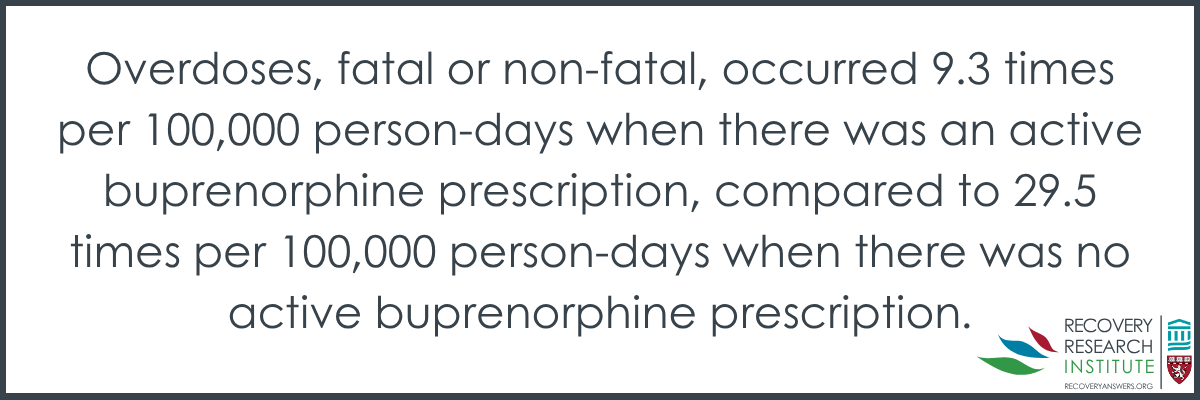
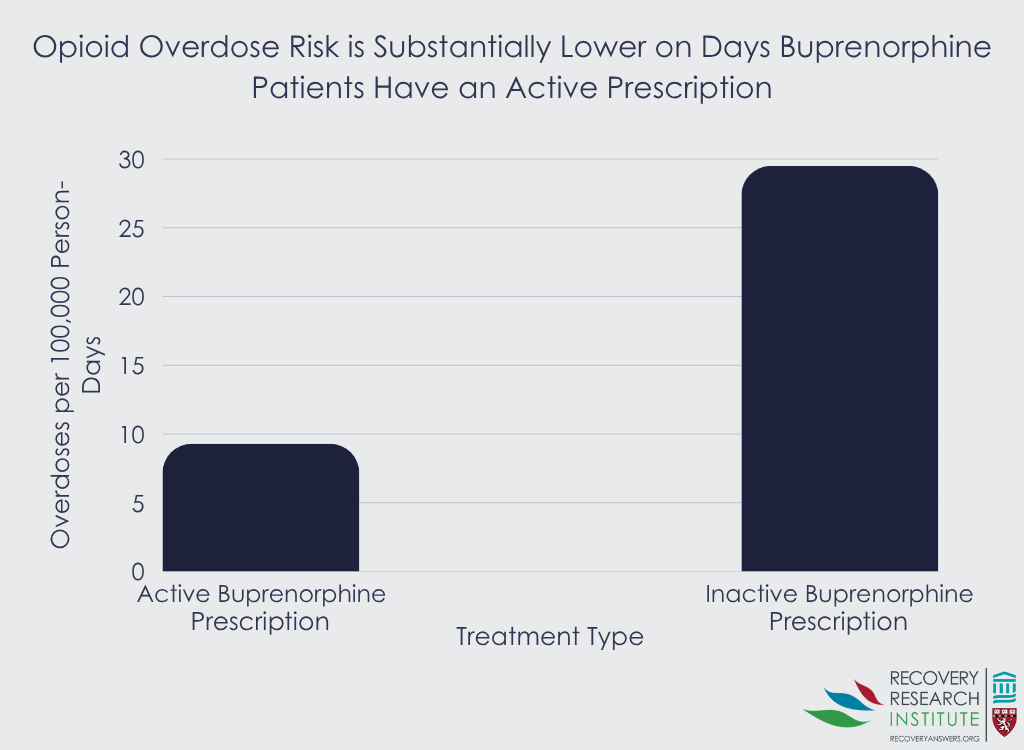
Overall, 8,676 adults in Rhode Island initiated buprenorphine treatment for opioid use disorder between October 2016 and September 2022. Across all patients, there were active buprenorphine prescriptions on approximately half of the total follow up days. Of all the patients, 411 (4.7%) experienced either a fatal or non-fatal overdose. Overdoses, fatal or non-fatal, occurred 9.3 times per 100,000 person-days when there was an active buprenorphine prescription, compared to 29.5 times per 100,000 person-days when there was no active buprenorphine prescription (see graph below). Overall, 72.8% of non-fatal opioid overdose events and 83.6% of fatal opioid overdose events occurred on a day the patient did not have an active buprenorphine prescription. These effects were confirmed with complex analyses that controlled for the group of variables mentioned above (e.g., demographic characteristics and other opioid or any benzodiazepine active prescription).
Among those who experienced a fatal overdose, fentanyl was the most common major substance contributing to the cause of death (88.1%), followed by cocaine (46.3%), alcohol (17.9%), buprenorphine (13.4%), benzodiazepines (9.0%), methadone (7.5%), amphetamine (7.5%), and methamphetamine (4.5%). In all cases in which buprenorphine was listed as a cause of death, at least one major substance contributing to cause of death was identified.

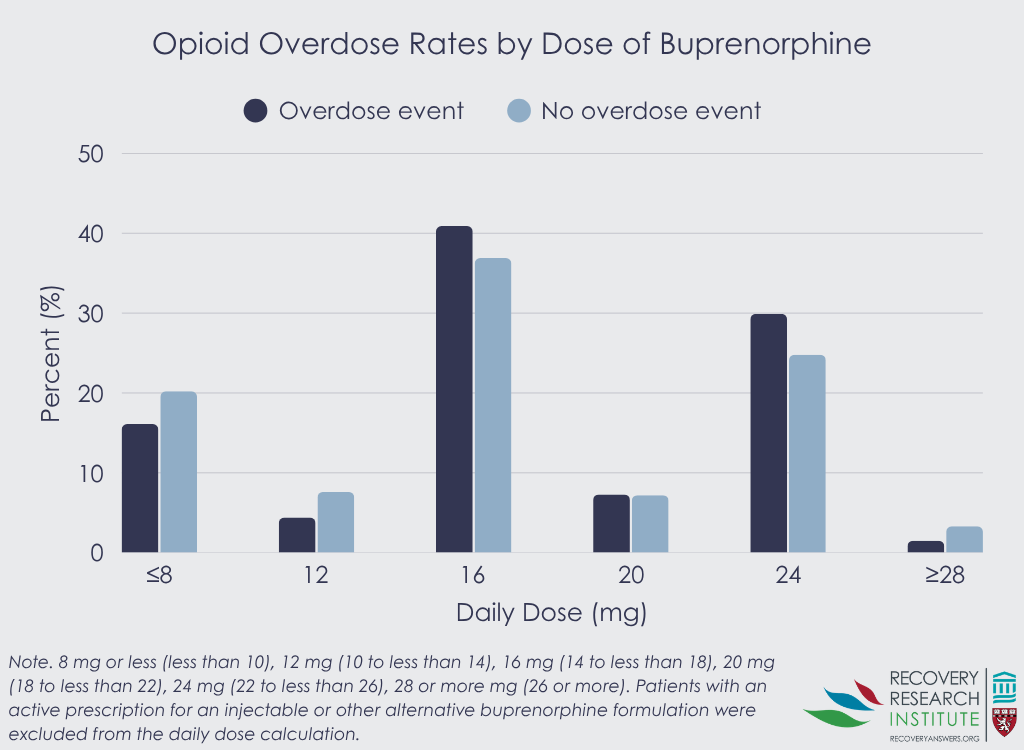
Importantly, as shown in the graph below, on days with a buprenorphine prescription, buprenorphine doses were not higher on days with any overdose, fatal or non-fatal (versus no overdose). In other words, for overdose days, the breakdown of different doses was the same as the breakdown of different doses on non-overdose days. This suggests, consistent with documented “ceiling effects” of buprenorphine, that higher doses are unlikely to increase overdose risk. However, given the small number of overdoses even in a large sample like the one in this study, an even larger sample is needed to adequately measure differences in buprenorphine dosing (e.g., 24 vs. 16 mg) on overdose risk.

WHAT ARE THE IMPLICATIONS OF THE STUDY FINDINGS?

Despite concerns that buprenorphine may lead to greater risk of precipitated withdrawal and respiratory depression among those exposed to a more potent opioid-based drug supply with a higher likelihood of containing fentanyl, this study found that those who have an active buprenorphine prescription were less likely to experience a fatal or non-fatal overdose compared to those who do not have one. It also found that dosage breakdowns were the same on overdose and non-overdose days. While this is consistent with buprenorphine’s well known “ceiling effects”, it is intended to help address a common misconception about increased risk at higher buprenorphine doses.

All that said, it is important to be clear about the limitations of the study. Specifically, the study was unable to assess for actual fentanyl exposure, so it does not specifically address the concerns that have been voiced by providers about higher buprenorphine doses and the potential for greater risk when combined with fentanyl. Also, as noted above, whether participants took buprenorphine as prescribed cannot be determined. Despite these limitations, in keeping with prior research findings, it does suggest that, on average, people prescribed buprenorphine were broadly better off over the course of a year compared to people who were not actively prescribed buprenorphine, even during a time period where fentanyl was more prevalent in the drug supply.

One additional note is that across 8,676 adults prescribed buprenorphine, there were only active buprenorphine prescriptions for approximately half of the days during the study period, highlighting challenges with buprenorphine treatment retention and adherence. Studies show only 20% of buprenorphine patients remain in treatment for 6 or more months, a benchmark for long-term overdose risk reduction. It is possible that some discontinue buprenorphine to initiate methadone, which is a full agonist and provides greater suppression of cravings and withdrawal symptoms. Indeed, 12% of patients in the current study transitioned to methadone at some point during the year following initiation of buprenorphine, possibly because they experienced persistent withdrawal symptoms even at high buprenorphine doses. Overall, during a time with large amounts of fentanyl in the drug supply, buprenorphine remains a life-saving prescription for many with opioid use disorder.


BOTTOM LINE

Even during a time period with large amounts of fentanyl in the drug supply, having an active buprenorphine prescription is associated with lower likelihood of experiencing a fatal or non-fatal overdose compared to those who do not have an active buprenorphine prescription. Future studies may help address the current study limitations, including lack of clarity on whether participants took buprenorphine as prescribed, and actual observed fentanyl exposure.


  • For individuals and families seeking recovery: If you or a loved one are looking to make a change to your opioid use, buprenorphine may be a good option for you, even if you use or have used fentanyl in the past. It is important to note that buprenorphine initiation (i.e., when formulated with naloxone and commonly prescribed as under the brand name, “Suboxone”) can lead to rapid onset of withdrawal symptoms, particularly if opioids have been used recently. It is important to initiate buprenorphine under medical care. Speak to a medical provider to learn more.
  • For treatment professionals and treatment systems: Despite concerns, a buprenorphine prescription saves lives, even during periods of high fentanyl exposure, and is far safer than the alternative: not having a buprenorphine prescription. Treatment providers may consider prescribing buprenorphine as a treatment for opioid use disorder without fear of an increased risk of overdose.
  • For scientists: Although this study provides compelling archival data evidence for the impact of an active buprenorphine prescription on risk for fatal and non-fatal overdose, more research is needed to understand risk under methodological conditions that allow for recording of actual use, rather than under an active prescription. Further, treatment retention remains a major problem with buprenorphine, and more work is necessary to increase retention. Finally, future work may need larger samples to examine the association between buprenorphine dose and overdose risk.
  • For policy makers: From a public health perspective, having an active buprenorphine prescription results in approximately 60% fewer overdoses. Policy that increases availability and uptake of buprenorphine is likely to make a major impact on reducing opioid overdoses in the United States. More research funding may also be useful in helping to identify approaches to increasing treatment retention.

CITATIONS

Chambers, L. C., Hallowell, B. D., Zullo, A. R., Rodriguez, M., Khan, M. A., Berk, J., Gaither, R., Daly, M., Wightman, R. S., & Beaudoin, F. L. (2026). Risk of opioid overdose during buprenorphine treatment for opioid use disorder in the fentanyl era. Addictive Behaviors, 175. doi: 10.1016/j.addbeh.2026.108603.


Stay on the Frontiers of
recovery science
with the free, monthly
Recovery Bulletin

l

WHAT PROBLEM DOES THIS STUDY ADDRESS?

Buprenorphine, a partial opioid agonist often prescribed as buprenorphine/naloxone and known by the brand name Suboxone, is an important and life-saving medication for opioid use disorder.

Buprenorphine partially binds to the same receptors as other opioids like heroin, largely blocking other opioids from binding to the receptors and preventing the drug effects commonly associated with more potent opioids. It can both help prevent withdrawal and suppress cravings, and randomized controlled trials have demonstrated that taking buprenorphine is associated with a greater likelihood of opioid abstinence over time. However, as fentanyl has become more prevalent over the past decade, some providers have voiced hesitation about prescribing buprenorphine, citing concerns about increased risks of severe precipitated withdrawal. Another concern pertains to added risk for respiratory depression when buprenorphine at higher doses, in addition to fentanyl (perhaps unknowingly), are used simultaneously, despite the fact that buprenorphine has ceiling effects on euphoria and respiratory depression. The current study attempted to evaluate buprenorphine effectiveness as a tool for overdose prevention during a period of particularly high fentanyl prevalence.


HOW WAS THIS STUDY CONDUCTED?

This study was a retrospective cohort study of adults in Rhode Island who initiated buprenorphine between October 1, 2016 and September 30, 2022. The study combined individual, day-level data from several large statewide sources such as the Rhode Island Department of Health and the Department of Behavioral Healthcare, Developmental Disabilities, and Hospitals. The study identified patients starting buprenorphine – i.e., no buprenorphine prescription for the prior 6 months followed by a buprenorphine prescription during the study period – and used data from various sources to evaluate both ongoing buprenorphine treatment engagement and any experience of non-fatal or fatal opioid overdose. This means that the study is unable to ascertain whether the individual actually took the buprenorphine at all or took it as prescribed. Also, while buprenorphine is often prescribed as a buprenorphine/naloxone film (i.e., Suboxone), and one could assume the vast majority of buprenorphine prescriptions were in this formulation, the study refers only to buprenorphine. While buprenorphine prescriptions could be in their injectable format (e.g., as Sublocade or Brixadi), analyses that examined the effects of buprenorphine dose excluded these injectables due to differences in dosing approaches.

The variable of most interest in the study was whether or not individuals had an active buprenorphine prescription, which was retroactively coded based on prescription fill dates and day’s supply. Notably, the study could not determine whether patients took the medication as prescribed. The primary outcome was fatal or non-fatal overdose, which was determined by Emergency Medical Services Information Systems data or data from the Office of the State Medical Examiner. The researchers also summarized active prescriptions, and corresponding dose, on days of non-fatal and fatal overdoses, in addition to substances contributing to cause of death as determined by the Office of the State Medical Examiner. The researchers then used a complex statistical approach to compare risk of non-fatal or fatal opioid overdose on days with, compared to days without, an active buprenorphine prescription. To isolate the effect of buprenorphine prescription on overdose outcomes, these analyses controlled statistically for age group, sex assigned at birth, distance from home to pharmacy (per ZIP code centroids), and year of treatment initiation, each determined using the patient’s first buprenorphine prescription. It also controlled for active opioid prescription other than buprenorphine (yes/no) and an active benzodiazepine prescription (yes/no) on each day of the 365-day follow-up period, defined using prescription drug monitoring program (PDMP) data, over time.


WHAT DID THIS STUDY FIND?

Overall, 8,676 adults in Rhode Island initiated buprenorphine treatment for opioid use disorder between October 2016 and September 2022. Across all patients, there were active buprenorphine prescriptions on approximately half of the total follow up days. Of all the patients, 411 (4.7%) experienced either a fatal or non-fatal overdose. Overdoses, fatal or non-fatal, occurred 9.3 times per 100,000 person-days when there was an active buprenorphine prescription, compared to 29.5 times per 100,000 person-days when there was no active buprenorphine prescription (see graph below). Overall, 72.8% of non-fatal opioid overdose events and 83.6% of fatal opioid overdose events occurred on a day the patient did not have an active buprenorphine prescription. These effects were confirmed with complex analyses that controlled for the group of variables mentioned above (e.g., demographic characteristics and other opioid or any benzodiazepine active prescription).

Among those who experienced a fatal overdose, fentanyl was the most common major substance contributing to the cause of death (88.1%), followed by cocaine (46.3%), alcohol (17.9%), buprenorphine (13.4%), benzodiazepines (9.0%), methadone (7.5%), amphetamine (7.5%), and methamphetamine (4.5%). In all cases in which buprenorphine was listed as a cause of death, at least one major substance contributing to cause of death was identified.

Importantly, as shown in the graph below, on days with a buprenorphine prescription, buprenorphine doses were not higher on days with any overdose, fatal or non-fatal (versus no overdose). In other words, for overdose days, the breakdown of different doses was the same as the breakdown of different doses on non-overdose days. This suggests, consistent with documented “ceiling effects” of buprenorphine, that higher doses are unlikely to increase overdose risk. However, given the small number of overdoses even in a large sample like the one in this study, an even larger sample is needed to adequately measure differences in buprenorphine dosing (e.g., 24 vs. 16 mg) on overdose risk.


WHAT ARE THE IMPLICATIONS OF THE STUDY FINDINGS?

Despite concerns that buprenorphine may lead to greater risk of precipitated withdrawal and respiratory depression among those exposed to a more potent opioid-based drug supply with a higher likelihood of containing fentanyl, this study found that those who have an active buprenorphine prescription were less likely to experience a fatal or non-fatal overdose compared to those who do not have one. It also found that dosage breakdowns were the same on overdose and non-overdose days. While this is consistent with buprenorphine’s well known “ceiling effects”, it is intended to help address a common misconception about increased risk at higher buprenorphine doses.

All that said, it is important to be clear about the limitations of the study. Specifically, the study was unable to assess for actual fentanyl exposure, so it does not specifically address the concerns that have been voiced by providers about higher buprenorphine doses and the potential for greater risk when combined with fentanyl. Also, as noted above, whether participants took buprenorphine as prescribed cannot be determined. Despite these limitations, in keeping with prior research findings, it does suggest that, on average, people prescribed buprenorphine were broadly better off over the course of a year compared to people who were not actively prescribed buprenorphine, even during a time period where fentanyl was more prevalent in the drug supply.

One additional note is that across 8,676 adults prescribed buprenorphine, there were only active buprenorphine prescriptions for approximately half of the days during the study period, highlighting challenges with buprenorphine treatment retention and adherence. Studies show only 20% of buprenorphine patients remain in treatment for 6 or more months, a benchmark for long-term overdose risk reduction. It is possible that some discontinue buprenorphine to initiate methadone, which is a full agonist and provides greater suppression of cravings and withdrawal symptoms. Indeed, 12% of patients in the current study transitioned to methadone at some point during the year following initiation of buprenorphine, possibly because they experienced persistent withdrawal symptoms even at high buprenorphine doses. Overall, during a time with large amounts of fentanyl in the drug supply, buprenorphine remains a life-saving prescription for many with opioid use disorder.


BOTTOM LINE

Even during a time period with large amounts of fentanyl in the drug supply, having an active buprenorphine prescription is associated with lower likelihood of experiencing a fatal or non-fatal overdose compared to those who do not have an active buprenorphine prescription. Future studies may help address the current study limitations, including lack of clarity on whether participants took buprenorphine as prescribed, and actual observed fentanyl exposure.


  • For individuals and families seeking recovery: If you or a loved one are looking to make a change to your opioid use, buprenorphine may be a good option for you, even if you use or have used fentanyl in the past. It is important to note that buprenorphine initiation (i.e., when formulated with naloxone and commonly prescribed as under the brand name, “Suboxone”) can lead to rapid onset of withdrawal symptoms, particularly if opioids have been used recently. It is important to initiate buprenorphine under medical care. Speak to a medical provider to learn more.
  • For treatment professionals and treatment systems: Despite concerns, a buprenorphine prescription saves lives, even during periods of high fentanyl exposure, and is far safer than the alternative: not having a buprenorphine prescription. Treatment providers may consider prescribing buprenorphine as a treatment for opioid use disorder without fear of an increased risk of overdose.
  • For scientists: Although this study provides compelling archival data evidence for the impact of an active buprenorphine prescription on risk for fatal and non-fatal overdose, more research is needed to understand risk under methodological conditions that allow for recording of actual use, rather than under an active prescription. Further, treatment retention remains a major problem with buprenorphine, and more work is necessary to increase retention. Finally, future work may need larger samples to examine the association between buprenorphine dose and overdose risk.
  • For policy makers: From a public health perspective, having an active buprenorphine prescription results in approximately 60% fewer overdoses. Policy that increases availability and uptake of buprenorphine is likely to make a major impact on reducing opioid overdoses in the United States. More research funding may also be useful in helping to identify approaches to increasing treatment retention.

CITATIONS

Chambers, L. C., Hallowell, B. D., Zullo, A. R., Rodriguez, M., Khan, M. A., Berk, J., Gaither, R., Daly, M., Wightman, R. S., & Beaudoin, F. L. (2026). Risk of opioid overdose during buprenorphine treatment for opioid use disorder in the fentanyl era. Addictive Behaviors, 175. doi: 10.1016/j.addbeh.2026.108603.


Share this article

l

WHAT PROBLEM DOES THIS STUDY ADDRESS?

Buprenorphine, a partial opioid agonist often prescribed as buprenorphine/naloxone and known by the brand name Suboxone, is an important and life-saving medication for opioid use disorder.

Buprenorphine partially binds to the same receptors as other opioids like heroin, largely blocking other opioids from binding to the receptors and preventing the drug effects commonly associated with more potent opioids. It can both help prevent withdrawal and suppress cravings, and randomized controlled trials have demonstrated that taking buprenorphine is associated with a greater likelihood of opioid abstinence over time. However, as fentanyl has become more prevalent over the past decade, some providers have voiced hesitation about prescribing buprenorphine, citing concerns about increased risks of severe precipitated withdrawal. Another concern pertains to added risk for respiratory depression when buprenorphine at higher doses, in addition to fentanyl (perhaps unknowingly), are used simultaneously, despite the fact that buprenorphine has ceiling effects on euphoria and respiratory depression. The current study attempted to evaluate buprenorphine effectiveness as a tool for overdose prevention during a period of particularly high fentanyl prevalence.


HOW WAS THIS STUDY CONDUCTED?

This study was a retrospective cohort study of adults in Rhode Island who initiated buprenorphine between October 1, 2016 and September 30, 2022. The study combined individual, day-level data from several large statewide sources such as the Rhode Island Department of Health and the Department of Behavioral Healthcare, Developmental Disabilities, and Hospitals. The study identified patients starting buprenorphine – i.e., no buprenorphine prescription for the prior 6 months followed by a buprenorphine prescription during the study period – and used data from various sources to evaluate both ongoing buprenorphine treatment engagement and any experience of non-fatal or fatal opioid overdose. This means that the study is unable to ascertain whether the individual actually took the buprenorphine at all or took it as prescribed. Also, while buprenorphine is often prescribed as a buprenorphine/naloxone film (i.e., Suboxone), and one could assume the vast majority of buprenorphine prescriptions were in this formulation, the study refers only to buprenorphine. While buprenorphine prescriptions could be in their injectable format (e.g., as Sublocade or Brixadi), analyses that examined the effects of buprenorphine dose excluded these injectables due to differences in dosing approaches.

The variable of most interest in the study was whether or not individuals had an active buprenorphine prescription, which was retroactively coded based on prescription fill dates and day’s supply. Notably, the study could not determine whether patients took the medication as prescribed. The primary outcome was fatal or non-fatal overdose, which was determined by Emergency Medical Services Information Systems data or data from the Office of the State Medical Examiner. The researchers also summarized active prescriptions, and corresponding dose, on days of non-fatal and fatal overdoses, in addition to substances contributing to cause of death as determined by the Office of the State Medical Examiner. The researchers then used a complex statistical approach to compare risk of non-fatal or fatal opioid overdose on days with, compared to days without, an active buprenorphine prescription. To isolate the effect of buprenorphine prescription on overdose outcomes, these analyses controlled statistically for age group, sex assigned at birth, distance from home to pharmacy (per ZIP code centroids), and year of treatment initiation, each determined using the patient’s first buprenorphine prescription. It also controlled for active opioid prescription other than buprenorphine (yes/no) and an active benzodiazepine prescription (yes/no) on each day of the 365-day follow-up period, defined using prescription drug monitoring program (PDMP) data, over time.


WHAT DID THIS STUDY FIND?

Overall, 8,676 adults in Rhode Island initiated buprenorphine treatment for opioid use disorder between October 2016 and September 2022. Across all patients, there were active buprenorphine prescriptions on approximately half of the total follow up days. Of all the patients, 411 (4.7%) experienced either a fatal or non-fatal overdose. Overdoses, fatal or non-fatal, occurred 9.3 times per 100,000 person-days when there was an active buprenorphine prescription, compared to 29.5 times per 100,000 person-days when there was no active buprenorphine prescription (see graph below). Overall, 72.8% of non-fatal opioid overdose events and 83.6% of fatal opioid overdose events occurred on a day the patient did not have an active buprenorphine prescription. These effects were confirmed with complex analyses that controlled for the group of variables mentioned above (e.g., demographic characteristics and other opioid or any benzodiazepine active prescription).

Among those who experienced a fatal overdose, fentanyl was the most common major substance contributing to the cause of death (88.1%), followed by cocaine (46.3%), alcohol (17.9%), buprenorphine (13.4%), benzodiazepines (9.0%), methadone (7.5%), amphetamine (7.5%), and methamphetamine (4.5%). In all cases in which buprenorphine was listed as a cause of death, at least one major substance contributing to cause of death was identified.

Importantly, as shown in the graph below, on days with a buprenorphine prescription, buprenorphine doses were not higher on days with any overdose, fatal or non-fatal (versus no overdose). In other words, for overdose days, the breakdown of different doses was the same as the breakdown of different doses on non-overdose days. This suggests, consistent with documented “ceiling effects” of buprenorphine, that higher doses are unlikely to increase overdose risk. However, given the small number of overdoses even in a large sample like the one in this study, an even larger sample is needed to adequately measure differences in buprenorphine dosing (e.g., 24 vs. 16 mg) on overdose risk.


WHAT ARE THE IMPLICATIONS OF THE STUDY FINDINGS?

Despite concerns that buprenorphine may lead to greater risk of precipitated withdrawal and respiratory depression among those exposed to a more potent opioid-based drug supply with a higher likelihood of containing fentanyl, this study found that those who have an active buprenorphine prescription were less likely to experience a fatal or non-fatal overdose compared to those who do not have one. It also found that dosage breakdowns were the same on overdose and non-overdose days. While this is consistent with buprenorphine’s well known “ceiling effects”, it is intended to help address a common misconception about increased risk at higher buprenorphine doses.

All that said, it is important to be clear about the limitations of the study. Specifically, the study was unable to assess for actual fentanyl exposure, so it does not specifically address the concerns that have been voiced by providers about higher buprenorphine doses and the potential for greater risk when combined with fentanyl. Also, as noted above, whether participants took buprenorphine as prescribed cannot be determined. Despite these limitations, in keeping with prior research findings, it does suggest that, on average, people prescribed buprenorphine were broadly better off over the course of a year compared to people who were not actively prescribed buprenorphine, even during a time period where fentanyl was more prevalent in the drug supply.

One additional note is that across 8,676 adults prescribed buprenorphine, there were only active buprenorphine prescriptions for approximately half of the days during the study period, highlighting challenges with buprenorphine treatment retention and adherence. Studies show only 20% of buprenorphine patients remain in treatment for 6 or more months, a benchmark for long-term overdose risk reduction. It is possible that some discontinue buprenorphine to initiate methadone, which is a full agonist and provides greater suppression of cravings and withdrawal symptoms. Indeed, 12% of patients in the current study transitioned to methadone at some point during the year following initiation of buprenorphine, possibly because they experienced persistent withdrawal symptoms even at high buprenorphine doses. Overall, during a time with large amounts of fentanyl in the drug supply, buprenorphine remains a life-saving prescription for many with opioid use disorder.


BOTTOM LINE

Even during a time period with large amounts of fentanyl in the drug supply, having an active buprenorphine prescription is associated with lower likelihood of experiencing a fatal or non-fatal overdose compared to those who do not have an active buprenorphine prescription. Future studies may help address the current study limitations, including lack of clarity on whether participants took buprenorphine as prescribed, and actual observed fentanyl exposure.


  • For individuals and families seeking recovery: If you or a loved one are looking to make a change to your opioid use, buprenorphine may be a good option for you, even if you use or have used fentanyl in the past. It is important to note that buprenorphine initiation (i.e., when formulated with naloxone and commonly prescribed as under the brand name, “Suboxone”) can lead to rapid onset of withdrawal symptoms, particularly if opioids have been used recently. It is important to initiate buprenorphine under medical care. Speak to a medical provider to learn more.
  • For treatment professionals and treatment systems: Despite concerns, a buprenorphine prescription saves lives, even during periods of high fentanyl exposure, and is far safer than the alternative: not having a buprenorphine prescription. Treatment providers may consider prescribing buprenorphine as a treatment for opioid use disorder without fear of an increased risk of overdose.
  • For scientists: Although this study provides compelling archival data evidence for the impact of an active buprenorphine prescription on risk for fatal and non-fatal overdose, more research is needed to understand risk under methodological conditions that allow for recording of actual use, rather than under an active prescription. Further, treatment retention remains a major problem with buprenorphine, and more work is necessary to increase retention. Finally, future work may need larger samples to examine the association between buprenorphine dose and overdose risk.
  • For policy makers: From a public health perspective, having an active buprenorphine prescription results in approximately 60% fewer overdoses. Policy that increases availability and uptake of buprenorphine is likely to make a major impact on reducing opioid overdoses in the United States. More research funding may also be useful in helping to identify approaches to increasing treatment retention.

CITATIONS

Chambers, L. C., Hallowell, B. D., Zullo, A. R., Rodriguez, M., Khan, M. A., Berk, J., Gaither, R., Daly, M., Wightman, R. S., & Beaudoin, F. L. (2026). Risk of opioid overdose during buprenorphine treatment for opioid use disorder in the fentanyl era. Addictive Behaviors, 175. doi: 10.1016/j.addbeh.2026.108603.


Share this article