Not all young adults “mature out” of risky drinking and even less so in recent years

  • Home
  • Research
  • Not all young adults “mature out” of risky drinking and even less so in recent years

Heavy drinking during young adulthood can increase risk for alcohol use disorder. While many young adults, on average, “mature out” of risky patterns of alcohol use, there may be more nuance to drinking patterns. This study examining drinking trajectories among young adults identified 8 classes of alcohol use trajectories across young adulthood that were broadly characterized by stability, movement toward lower risk drinking, and movement towards higher risk drinking. Members of the higher risk drinking classes were more likely to be men, identify as White, have parents with higher education, and to report symptoms of alcohol use disorder at age 35.

Stay on the frontiers of
recovery science
with the free, monthly
Recovery Bulletin

l

WHAT PROBLEM DOES THIS STUDY ADDRESS?

Heavy drinking during young adulthood is associated with the development of symptoms of alcohol use disorder. Prior research suggests that, on average, people follow a pattern of alcohol use that involves an increase in alcohol use during the transition to adulthood that peaks in the early to mid-20s and then subsequently decreases, which is commonly referred to as “maturing out” of heavy or risky drinking. Of course, patterns of alcohol use are nuanced, with many young adults who never increase drinking and others who consistently drink in a risky way and may or may not develop alcohol use disorder. Understanding these patterns, how they have changed over time, and the demographic factors that may influence them are important for tailoring contemporary prevention and intervention efforts to this age group. This study examined trajectories of alcohol use among young adults, along with demographic factors that may be associated with them and whether certain trajectories are more likely to result in symptoms of alcohol use disorder.


HOW WAS THIS STUDY CONDUCTED?

The researchers in this study analyzed drinking trajectories, the demographic factors that may influence them, and associations with symptoms of alcohol use disorder among participants of an ongoing, national study – Monitoring the Future. In this study, the same group of participants were surveyed annually from 1976 to 2020 about drug and alcohol use, symptoms of alcohol use disorder, and demographic information. Data on alcohol use and symptoms of alcohol use disorder among participants between the ages of 18-35, collected across eight waves were included in the current analyses. For each survey, alcohol use among participants aged 18-30, collected during the first seven waves, was categorized in 3 ways: abstinence (no alcohol use reported in the past 12 months), higher risk (daily alcohol use in the past 30 days or binge drinking in the past 2 weeks, as defined by consuming more than 5 drinks in a row), and lower risk (no daily alcohol use or binge drinking, but alcohol use in the last 12 months). Statistical analyses were conducted to identify subgroups, or “classes,” based on the patterns of alcohol use reported in the surveys. Associations between class membership, sociodemographic predictors, and symptoms of alcohol use disorder at age 35 were also analyzed. Sociodemographic predictors included: sex; ethnicity and race (combined into a single variable for “ethno-racial” identity); birth cohort (6 cohort groups based on the year they were in 12th grade); and parental education (highest level completed by each parent, with responses ranging from 1, reflecting grade school or less, to 6, graduate or professional school). Symptoms of alcohol use disorder at age 35 were assessed using items based on 8 of the 11 criterion from the Diagnostic and Statistical Manual of Mental Disorders (DSM), reflecting the presence of symptoms but not necessarily meeting full criteria for an alcohol use disorder. Participants were asked if and how much they experienced symptoms over the last 5 years and could respond to each item with “no,” “a little,” “some,” or “a lot.” Responses of “no” indicated no presence of symptoms, while any of the other responses were counted as 1 and summed to create a total symptom count. Counts of 2 or more were categorized as the presence of alcohol use disorder symptoms.

Of note, this study did not consider the number of drinks consumed beyond binge drinking. Accordingly, when reporting daily alcohol use, the number of drinks could vary considerably. This is important considering prior research showing that the frequency of alcohol consumption was a better predictor of alcohol use harms in younger adults, but more drinks on a given day was a better predictor of consequences in older adults. Additionally, there are many other potential influences on alcohol use during early adulthood, such as social networks, familial factor, and community factors, that were not included in the current study, as is common since it is not possible to include every possible factor in an individual study.


WHAT DID THIS STUDY FIND?

Eight classes of alcohol use were identified based on patterns of use and stability or movement between risk levels across the ages of 18-30 (e.g., movement toward higher or lower risk drinking). The first 3 classes accounted for the majority of the sample (54%) and were characterized by stable risk levels: Stable Lower Risk Drinking (28%), Stable Higher Risk Drinking (19%) and Stable Abstinence (7%). The next 2 classes accounted for 19% of the sample and were characterized by movement into higher risk levels: Lower Risk Drinking to Higher Risk Drinking (12%) and Abstinence to Lower Risk Drinking (7%). The last 3 classes accounted for 27% of the sample and were characterized by movement into lower risk levels: Higher Risk Drinking to Lower Risk Drinking (19%), Higher Risk Drinking to Lower Risk Drinking to Abstinence (2%), and Lower Risk Drinking to Abstinence (6%).

The results of the birth cohort analyses showed that participants from more recent cohorts (i.e., those who are younger/were in 12th grade more recently – for example, after 1990) were less likely than earlier birth cohorts to be a member of the classes characterized by movement into lower risk drinking and more likely to be a member of the classes characterized by higher risk drinking. However, participants from recent cohorts were also more likely to be a member of a Stable Abstinence class.

The opposite pattern was observed for participants in earlier birth cohorts (i.e., those who are older/were in 12th grade longer ago – for example, before 1990), with those participants being more likely than recent cohorts to be a member of the classes characterized by movement into lower risk drinking.

For sex, men were more likely than women to be a member of the classes characterized by stability and movement into higher risk drinking and less likely to be a member of classes characterized by lower risk drinking.

Participants who identified as White were more likely than other race/ethnicities to be a member of the highest risk class (i.e., Stable Higher Risk Drinking) and were less likely to be a member of any of the classes that involved abstinence. Participants who identified as Black or Other were more likely to be members of classes that were characterized by lower risk drinking or abstinence.

For parental education, participants who reported their parents had lower levels of education were more likely than those who reported their parents had higher levels of education to be members of classes that were characterized by stable abstinence or movement into abstinence. Participants who reported their parents had higher levels of education were more likely to be members of classes that were characterized by stable higher risk drinking and movement away from abstinence.

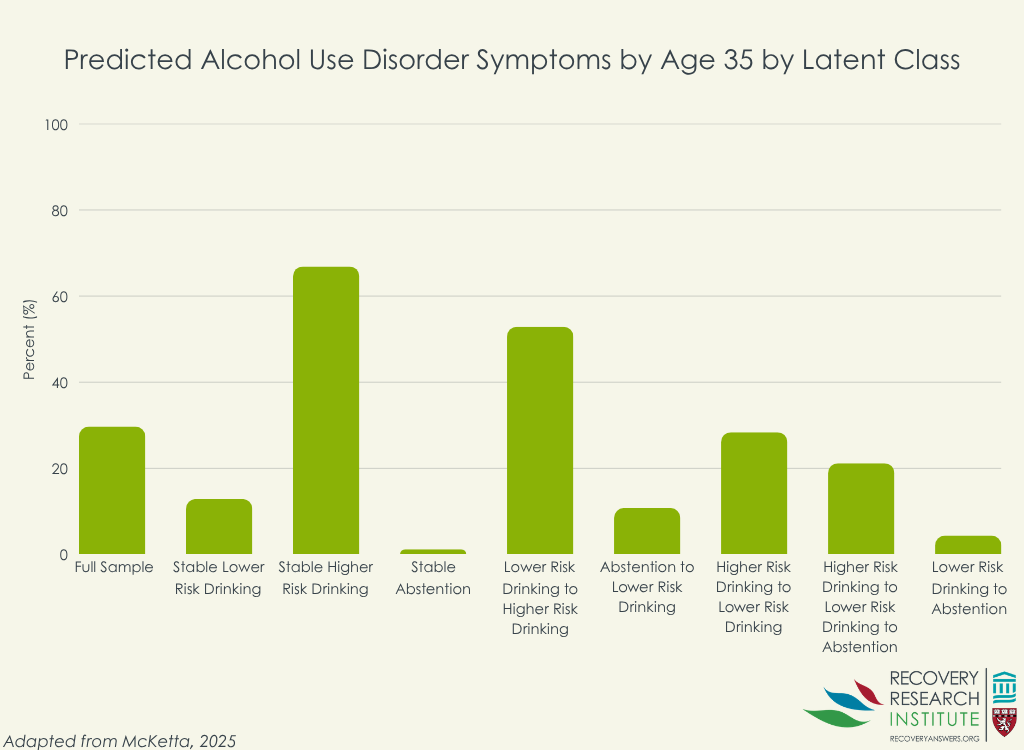
As shown in the graph below, participants in the two classes with higher-risk drinking patterns at the end of the study were the most likely to report symptoms of alcohol use disorder at age 35. The class characterized by stable higher-risk drinking had a 67% probability of alcohol use disorder symptoms, whereas the class characterized by movement from lower- to higher-risk drinking had a 53% probability. On the other hand, participants in the two classes characterized by abstinence at the end of the study were the least likely to report symptoms of alcohol use disorder at age 35. The class characterized by stable abstinence had a 1% probability of alcohol use disorder symptoms, whereas the class characterized by movement from lower-risk drinking to abstinence had a 4% likelihood.

WHAT ARE THE IMPLICATIONS OF THE STUDY FINDINGS?

This study identified 8 classes of alcohol use trajectories across young adulthood that were broadly characterized by 3 patterns: stability (of drinking pattern or abstinence), movement toward lower risk drinking, and movement towards higher risk drinking. These results highlight crucial nuances and challenge the common belief notion that young adults “will grow out of it”. Instead, results suggest that the patterns are much more nuanced, and that early screening and tailoring of prevention and intervention efforts for different age groups can be beneficial. After all, alcohol use disorder is the most common type of substance use disorder and has its onset typically during the late-adolescent and emerging adult years. Interestingly, more recent cohorts were more likely to continue with, or enter into, high-risk drinking or to abstain than cohorts from before 1990. Future research is needed, however, to tease out the effects of drinking quantity versus frequency, since these patterns also vary across age groups, and to test how other factors may influence patterns of alcohol use. The results of the demographic associations showed that members of the higher risk drinking classes were more likely to be men, identify as White, and have parents with higher education, which are broadly consistent with prior studies. Finally, the study provided additional evidence that risky drinking is associated with the development of alcohol use disorder symptoms, suggesting that risky alcohol use during this life stage may be a useful target for early intervention.


BOTTOM LINE

Among young adults, trajectories of alcohol use can vary from stability, movement from low risk drinking to high risk drinking, and movement from high risk drinking to low risk drinking. Young adults who were part of the higher risk drinking categories were more likely to be men, identify as White, have parents with higher education, and to report symptoms of alcohol use disorder at age 35. These findings provide nuance to the common notion that young adults “mature out” of risky alcohol use and support the need to tailor prevention and intervention among this age group, particularly for certain demographic groups who are at higher risk.


  • For individuals and families seeking recovery: Risky alcohol use patterns during young adulthood may not simply resolve over time, and there are substantial variations between individuals that can include stability, movement toward higher risk drinking and movement toward lower risk drinking. Individuals and families may benefit from recognizing that early patterns of risky alcohol use can persist or change in different directions, and from seeking support early when concerns arise.
  • For treatment professionals and treatment systems: These findings support the importance of early screening and tailoring prevention and intervention efforts based on patterns of alcohol use across young adulthood. Focusing on individuals from certain demographic groups and those who engage in higher risk drinking may especially help identify those who could benefit from early intervention to prevent the development of alcohol use disorder symptoms.
  • For scientists: Because the study did not disentangle the effects of drinking quantity versus frequency, future research that examines these components separately would help clarify how different patterns of alcohol use develop over time. Additional research that tests how other factors influence trajectories of alcohol use would help deepen understanding of how these influences change trajectories over time.
  • For policy makers: These findings suggest that prevention and intervention efforts targeting young adults may need to account for multiple trajectories of alcohol use rather than assuming that risky drinking will decline over time. Policies that support early screening, targeted prevention for higher risk groups among young adults may help reduce rates of alcohol use disorder.

CITATIONS

McKetta, S., Espinoza, P., Keyes, K., & Jager, J. (2026). Maturing out or in? Demographic determinants of young adult drinking trajectories and midlife alcohol use disorder risks. Alcohol: Clinical and Experimental Research, 50(2). doi: 10.1111/acer.70226.


Stay on the Frontiers of
recovery science
with the free, monthly
Recovery Bulletin

l

WHAT PROBLEM DOES THIS STUDY ADDRESS?

Heavy drinking during young adulthood is associated with the development of symptoms of alcohol use disorder. Prior research suggests that, on average, people follow a pattern of alcohol use that involves an increase in alcohol use during the transition to adulthood that peaks in the early to mid-20s and then subsequently decreases, which is commonly referred to as “maturing out” of heavy or risky drinking. Of course, patterns of alcohol use are nuanced, with many young adults who never increase drinking and others who consistently drink in a risky way and may or may not develop alcohol use disorder. Understanding these patterns, how they have changed over time, and the demographic factors that may influence them are important for tailoring contemporary prevention and intervention efforts to this age group. This study examined trajectories of alcohol use among young adults, along with demographic factors that may be associated with them and whether certain trajectories are more likely to result in symptoms of alcohol use disorder.


HOW WAS THIS STUDY CONDUCTED?

The researchers in this study analyzed drinking trajectories, the demographic factors that may influence them, and associations with symptoms of alcohol use disorder among participants of an ongoing, national study – Monitoring the Future. In this study, the same group of participants were surveyed annually from 1976 to 2020 about drug and alcohol use, symptoms of alcohol use disorder, and demographic information. Data on alcohol use and symptoms of alcohol use disorder among participants between the ages of 18-35, collected across eight waves were included in the current analyses. For each survey, alcohol use among participants aged 18-30, collected during the first seven waves, was categorized in 3 ways: abstinence (no alcohol use reported in the past 12 months), higher risk (daily alcohol use in the past 30 days or binge drinking in the past 2 weeks, as defined by consuming more than 5 drinks in a row), and lower risk (no daily alcohol use or binge drinking, but alcohol use in the last 12 months). Statistical analyses were conducted to identify subgroups, or “classes,” based on the patterns of alcohol use reported in the surveys. Associations between class membership, sociodemographic predictors, and symptoms of alcohol use disorder at age 35 were also analyzed. Sociodemographic predictors included: sex; ethnicity and race (combined into a single variable for “ethno-racial” identity); birth cohort (6 cohort groups based on the year they were in 12th grade); and parental education (highest level completed by each parent, with responses ranging from 1, reflecting grade school or less, to 6, graduate or professional school). Symptoms of alcohol use disorder at age 35 were assessed using items based on 8 of the 11 criterion from the Diagnostic and Statistical Manual of Mental Disorders (DSM), reflecting the presence of symptoms but not necessarily meeting full criteria for an alcohol use disorder. Participants were asked if and how much they experienced symptoms over the last 5 years and could respond to each item with “no,” “a little,” “some,” or “a lot.” Responses of “no” indicated no presence of symptoms, while any of the other responses were counted as 1 and summed to create a total symptom count. Counts of 2 or more were categorized as the presence of alcohol use disorder symptoms.

Of note, this study did not consider the number of drinks consumed beyond binge drinking. Accordingly, when reporting daily alcohol use, the number of drinks could vary considerably. This is important considering prior research showing that the frequency of alcohol consumption was a better predictor of alcohol use harms in younger adults, but more drinks on a given day was a better predictor of consequences in older adults. Additionally, there are many other potential influences on alcohol use during early adulthood, such as social networks, familial factor, and community factors, that were not included in the current study, as is common since it is not possible to include every possible factor in an individual study.


WHAT DID THIS STUDY FIND?

Eight classes of alcohol use were identified based on patterns of use and stability or movement between risk levels across the ages of 18-30 (e.g., movement toward higher or lower risk drinking). The first 3 classes accounted for the majority of the sample (54%) and were characterized by stable risk levels: Stable Lower Risk Drinking (28%), Stable Higher Risk Drinking (19%) and Stable Abstinence (7%). The next 2 classes accounted for 19% of the sample and were characterized by movement into higher risk levels: Lower Risk Drinking to Higher Risk Drinking (12%) and Abstinence to Lower Risk Drinking (7%). The last 3 classes accounted for 27% of the sample and were characterized by movement into lower risk levels: Higher Risk Drinking to Lower Risk Drinking (19%), Higher Risk Drinking to Lower Risk Drinking to Abstinence (2%), and Lower Risk Drinking to Abstinence (6%).

The results of the birth cohort analyses showed that participants from more recent cohorts (i.e., those who are younger/were in 12th grade more recently – for example, after 1990) were less likely than earlier birth cohorts to be a member of the classes characterized by movement into lower risk drinking and more likely to be a member of the classes characterized by higher risk drinking. However, participants from recent cohorts were also more likely to be a member of a Stable Abstinence class.

The opposite pattern was observed for participants in earlier birth cohorts (i.e., those who are older/were in 12th grade longer ago – for example, before 1990), with those participants being more likely than recent cohorts to be a member of the classes characterized by movement into lower risk drinking.

For sex, men were more likely than women to be a member of the classes characterized by stability and movement into higher risk drinking and less likely to be a member of classes characterized by lower risk drinking.

Participants who identified as White were more likely than other race/ethnicities to be a member of the highest risk class (i.e., Stable Higher Risk Drinking) and were less likely to be a member of any of the classes that involved abstinence. Participants who identified as Black or Other were more likely to be members of classes that were characterized by lower risk drinking or abstinence.

For parental education, participants who reported their parents had lower levels of education were more likely than those who reported their parents had higher levels of education to be members of classes that were characterized by stable abstinence or movement into abstinence. Participants who reported their parents had higher levels of education were more likely to be members of classes that were characterized by stable higher risk drinking and movement away from abstinence.

As shown in the graph below, participants in the two classes with higher-risk drinking patterns at the end of the study were the most likely to report symptoms of alcohol use disorder at age 35. The class characterized by stable higher-risk drinking had a 67% probability of alcohol use disorder symptoms, whereas the class characterized by movement from lower- to higher-risk drinking had a 53% probability. On the other hand, participants in the two classes characterized by abstinence at the end of the study were the least likely to report symptoms of alcohol use disorder at age 35. The class characterized by stable abstinence had a 1% probability of alcohol use disorder symptoms, whereas the class characterized by movement from lower-risk drinking to abstinence had a 4% likelihood.


WHAT ARE THE IMPLICATIONS OF THE STUDY FINDINGS?

This study identified 8 classes of alcohol use trajectories across young adulthood that were broadly characterized by 3 patterns: stability (of drinking pattern or abstinence), movement toward lower risk drinking, and movement towards higher risk drinking. These results highlight crucial nuances and challenge the common belief notion that young adults “will grow out of it”. Instead, results suggest that the patterns are much more nuanced, and that early screening and tailoring of prevention and intervention efforts for different age groups can be beneficial. After all, alcohol use disorder is the most common type of substance use disorder and has its onset typically during the late-adolescent and emerging adult years. Interestingly, more recent cohorts were more likely to continue with, or enter into, high-risk drinking or to abstain than cohorts from before 1990. Future research is needed, however, to tease out the effects of drinking quantity versus frequency, since these patterns also vary across age groups, and to test how other factors may influence patterns of alcohol use. The results of the demographic associations showed that members of the higher risk drinking classes were more likely to be men, identify as White, and have parents with higher education, which are broadly consistent with prior studies. Finally, the study provided additional evidence that risky drinking is associated with the development of alcohol use disorder symptoms, suggesting that risky alcohol use during this life stage may be a useful target for early intervention.


BOTTOM LINE

Among young adults, trajectories of alcohol use can vary from stability, movement from low risk drinking to high risk drinking, and movement from high risk drinking to low risk drinking. Young adults who were part of the higher risk drinking categories were more likely to be men, identify as White, have parents with higher education, and to report symptoms of alcohol use disorder at age 35. These findings provide nuance to the common notion that young adults “mature out” of risky alcohol use and support the need to tailor prevention and intervention among this age group, particularly for certain demographic groups who are at higher risk.


  • For individuals and families seeking recovery: Risky alcohol use patterns during young adulthood may not simply resolve over time, and there are substantial variations between individuals that can include stability, movement toward higher risk drinking and movement toward lower risk drinking. Individuals and families may benefit from recognizing that early patterns of risky alcohol use can persist or change in different directions, and from seeking support early when concerns arise.
  • For treatment professionals and treatment systems: These findings support the importance of early screening and tailoring prevention and intervention efforts based on patterns of alcohol use across young adulthood. Focusing on individuals from certain demographic groups and those who engage in higher risk drinking may especially help identify those who could benefit from early intervention to prevent the development of alcohol use disorder symptoms.
  • For scientists: Because the study did not disentangle the effects of drinking quantity versus frequency, future research that examines these components separately would help clarify how different patterns of alcohol use develop over time. Additional research that tests how other factors influence trajectories of alcohol use would help deepen understanding of how these influences change trajectories over time.
  • For policy makers: These findings suggest that prevention and intervention efforts targeting young adults may need to account for multiple trajectories of alcohol use rather than assuming that risky drinking will decline over time. Policies that support early screening, targeted prevention for higher risk groups among young adults may help reduce rates of alcohol use disorder.

CITATIONS

McKetta, S., Espinoza, P., Keyes, K., & Jager, J. (2026). Maturing out or in? Demographic determinants of young adult drinking trajectories and midlife alcohol use disorder risks. Alcohol: Clinical and Experimental Research, 50(2). doi: 10.1111/acer.70226.


Share this article

l

WHAT PROBLEM DOES THIS STUDY ADDRESS?

Heavy drinking during young adulthood is associated with the development of symptoms of alcohol use disorder. Prior research suggests that, on average, people follow a pattern of alcohol use that involves an increase in alcohol use during the transition to adulthood that peaks in the early to mid-20s and then subsequently decreases, which is commonly referred to as “maturing out” of heavy or risky drinking. Of course, patterns of alcohol use are nuanced, with many young adults who never increase drinking and others who consistently drink in a risky way and may or may not develop alcohol use disorder. Understanding these patterns, how they have changed over time, and the demographic factors that may influence them are important for tailoring contemporary prevention and intervention efforts to this age group. This study examined trajectories of alcohol use among young adults, along with demographic factors that may be associated with them and whether certain trajectories are more likely to result in symptoms of alcohol use disorder.


HOW WAS THIS STUDY CONDUCTED?

The researchers in this study analyzed drinking trajectories, the demographic factors that may influence them, and associations with symptoms of alcohol use disorder among participants of an ongoing, national study – Monitoring the Future. In this study, the same group of participants were surveyed annually from 1976 to 2020 about drug and alcohol use, symptoms of alcohol use disorder, and demographic information. Data on alcohol use and symptoms of alcohol use disorder among participants between the ages of 18-35, collected across eight waves were included in the current analyses. For each survey, alcohol use among participants aged 18-30, collected during the first seven waves, was categorized in 3 ways: abstinence (no alcohol use reported in the past 12 months), higher risk (daily alcohol use in the past 30 days or binge drinking in the past 2 weeks, as defined by consuming more than 5 drinks in a row), and lower risk (no daily alcohol use or binge drinking, but alcohol use in the last 12 months). Statistical analyses were conducted to identify subgroups, or “classes,” based on the patterns of alcohol use reported in the surveys. Associations between class membership, sociodemographic predictors, and symptoms of alcohol use disorder at age 35 were also analyzed. Sociodemographic predictors included: sex; ethnicity and race (combined into a single variable for “ethno-racial” identity); birth cohort (6 cohort groups based on the year they were in 12th grade); and parental education (highest level completed by each parent, with responses ranging from 1, reflecting grade school or less, to 6, graduate or professional school). Symptoms of alcohol use disorder at age 35 were assessed using items based on 8 of the 11 criterion from the Diagnostic and Statistical Manual of Mental Disorders (DSM), reflecting the presence of symptoms but not necessarily meeting full criteria for an alcohol use disorder. Participants were asked if and how much they experienced symptoms over the last 5 years and could respond to each item with “no,” “a little,” “some,” or “a lot.” Responses of “no” indicated no presence of symptoms, while any of the other responses were counted as 1 and summed to create a total symptom count. Counts of 2 or more were categorized as the presence of alcohol use disorder symptoms.

Of note, this study did not consider the number of drinks consumed beyond binge drinking. Accordingly, when reporting daily alcohol use, the number of drinks could vary considerably. This is important considering prior research showing that the frequency of alcohol consumption was a better predictor of alcohol use harms in younger adults, but more drinks on a given day was a better predictor of consequences in older adults. Additionally, there are many other potential influences on alcohol use during early adulthood, such as social networks, familial factor, and community factors, that were not included in the current study, as is common since it is not possible to include every possible factor in an individual study.


WHAT DID THIS STUDY FIND?

Eight classes of alcohol use were identified based on patterns of use and stability or movement between risk levels across the ages of 18-30 (e.g., movement toward higher or lower risk drinking). The first 3 classes accounted for the majority of the sample (54%) and were characterized by stable risk levels: Stable Lower Risk Drinking (28%), Stable Higher Risk Drinking (19%) and Stable Abstinence (7%). The next 2 classes accounted for 19% of the sample and were characterized by movement into higher risk levels: Lower Risk Drinking to Higher Risk Drinking (12%) and Abstinence to Lower Risk Drinking (7%). The last 3 classes accounted for 27% of the sample and were characterized by movement into lower risk levels: Higher Risk Drinking to Lower Risk Drinking (19%), Higher Risk Drinking to Lower Risk Drinking to Abstinence (2%), and Lower Risk Drinking to Abstinence (6%).

The results of the birth cohort analyses showed that participants from more recent cohorts (i.e., those who are younger/were in 12th grade more recently – for example, after 1990) were less likely than earlier birth cohorts to be a member of the classes characterized by movement into lower risk drinking and more likely to be a member of the classes characterized by higher risk drinking. However, participants from recent cohorts were also more likely to be a member of a Stable Abstinence class.

The opposite pattern was observed for participants in earlier birth cohorts (i.e., those who are older/were in 12th grade longer ago – for example, before 1990), with those participants being more likely than recent cohorts to be a member of the classes characterized by movement into lower risk drinking.

For sex, men were more likely than women to be a member of the classes characterized by stability and movement into higher risk drinking and less likely to be a member of classes characterized by lower risk drinking.

Participants who identified as White were more likely than other race/ethnicities to be a member of the highest risk class (i.e., Stable Higher Risk Drinking) and were less likely to be a member of any of the classes that involved abstinence. Participants who identified as Black or Other were more likely to be members of classes that were characterized by lower risk drinking or abstinence.

For parental education, participants who reported their parents had lower levels of education were more likely than those who reported their parents had higher levels of education to be members of classes that were characterized by stable abstinence or movement into abstinence. Participants who reported their parents had higher levels of education were more likely to be members of classes that were characterized by stable higher risk drinking and movement away from abstinence.

As shown in the graph below, participants in the two classes with higher-risk drinking patterns at the end of the study were the most likely to report symptoms of alcohol use disorder at age 35. The class characterized by stable higher-risk drinking had a 67% probability of alcohol use disorder symptoms, whereas the class characterized by movement from lower- to higher-risk drinking had a 53% probability. On the other hand, participants in the two classes characterized by abstinence at the end of the study were the least likely to report symptoms of alcohol use disorder at age 35. The class characterized by stable abstinence had a 1% probability of alcohol use disorder symptoms, whereas the class characterized by movement from lower-risk drinking to abstinence had a 4% likelihood.


WHAT ARE THE IMPLICATIONS OF THE STUDY FINDINGS?

This study identified 8 classes of alcohol use trajectories across young adulthood that were broadly characterized by 3 patterns: stability (of drinking pattern or abstinence), movement toward lower risk drinking, and movement towards higher risk drinking. These results highlight crucial nuances and challenge the common belief notion that young adults “will grow out of it”. Instead, results suggest that the patterns are much more nuanced, and that early screening and tailoring of prevention and intervention efforts for different age groups can be beneficial. After all, alcohol use disorder is the most common type of substance use disorder and has its onset typically during the late-adolescent and emerging adult years. Interestingly, more recent cohorts were more likely to continue with, or enter into, high-risk drinking or to abstain than cohorts from before 1990. Future research is needed, however, to tease out the effects of drinking quantity versus frequency, since these patterns also vary across age groups, and to test how other factors may influence patterns of alcohol use. The results of the demographic associations showed that members of the higher risk drinking classes were more likely to be men, identify as White, and have parents with higher education, which are broadly consistent with prior studies. Finally, the study provided additional evidence that risky drinking is associated with the development of alcohol use disorder symptoms, suggesting that risky alcohol use during this life stage may be a useful target for early intervention.


BOTTOM LINE

Among young adults, trajectories of alcohol use can vary from stability, movement from low risk drinking to high risk drinking, and movement from high risk drinking to low risk drinking. Young adults who were part of the higher risk drinking categories were more likely to be men, identify as White, have parents with higher education, and to report symptoms of alcohol use disorder at age 35. These findings provide nuance to the common notion that young adults “mature out” of risky alcohol use and support the need to tailor prevention and intervention among this age group, particularly for certain demographic groups who are at higher risk.


  • For individuals and families seeking recovery: Risky alcohol use patterns during young adulthood may not simply resolve over time, and there are substantial variations between individuals that can include stability, movement toward higher risk drinking and movement toward lower risk drinking. Individuals and families may benefit from recognizing that early patterns of risky alcohol use can persist or change in different directions, and from seeking support early when concerns arise.
  • For treatment professionals and treatment systems: These findings support the importance of early screening and tailoring prevention and intervention efforts based on patterns of alcohol use across young adulthood. Focusing on individuals from certain demographic groups and those who engage in higher risk drinking may especially help identify those who could benefit from early intervention to prevent the development of alcohol use disorder symptoms.
  • For scientists: Because the study did not disentangle the effects of drinking quantity versus frequency, future research that examines these components separately would help clarify how different patterns of alcohol use develop over time. Additional research that tests how other factors influence trajectories of alcohol use would help deepen understanding of how these influences change trajectories over time.
  • For policy makers: These findings suggest that prevention and intervention efforts targeting young adults may need to account for multiple trajectories of alcohol use rather than assuming that risky drinking will decline over time. Policies that support early screening, targeted prevention for higher risk groups among young adults may help reduce rates of alcohol use disorder.

CITATIONS

McKetta, S., Espinoza, P., Keyes, K., & Jager, J. (2026). Maturing out or in? Demographic determinants of young adult drinking trajectories and midlife alcohol use disorder risks. Alcohol: Clinical and Experimental Research, 50(2). doi: 10.1111/acer.70226.


Share this article