Recovery community center participation associated with holistic improvements
Recovery community centers, also known as peer recovery support centers, are peer-operated spaces offering community and services for people in or seeking recovery. Over the past decade, they have increased in popularity, yet little is known about how such centers impact different outcomes. This study examined this in relation to daily meaning and recovery identity.
Recovery community centers are peer-operated spaces offering community services for people in or seeking recovery from a substance use disorder. The centers serve as a hub to build recovery capital, or the resources needed to establish and maintain recovery, through resources such as peer coaching, mutual-help groups, advocacy, and life skills training. Their numbers are increasing nationally, with a recent study demonstrating that more than half of surveyed recovery community centers have opened in the last 5 years. Given their relatively recent proliferation, little is known about how recovery community center participation actually impacts recovery outcomes. This study examined the extent to which perceived helpfulness of recovery community centers was associated with daily meaning and recovery identity.
HOW WAS THIS STUDY CONDUCTED?
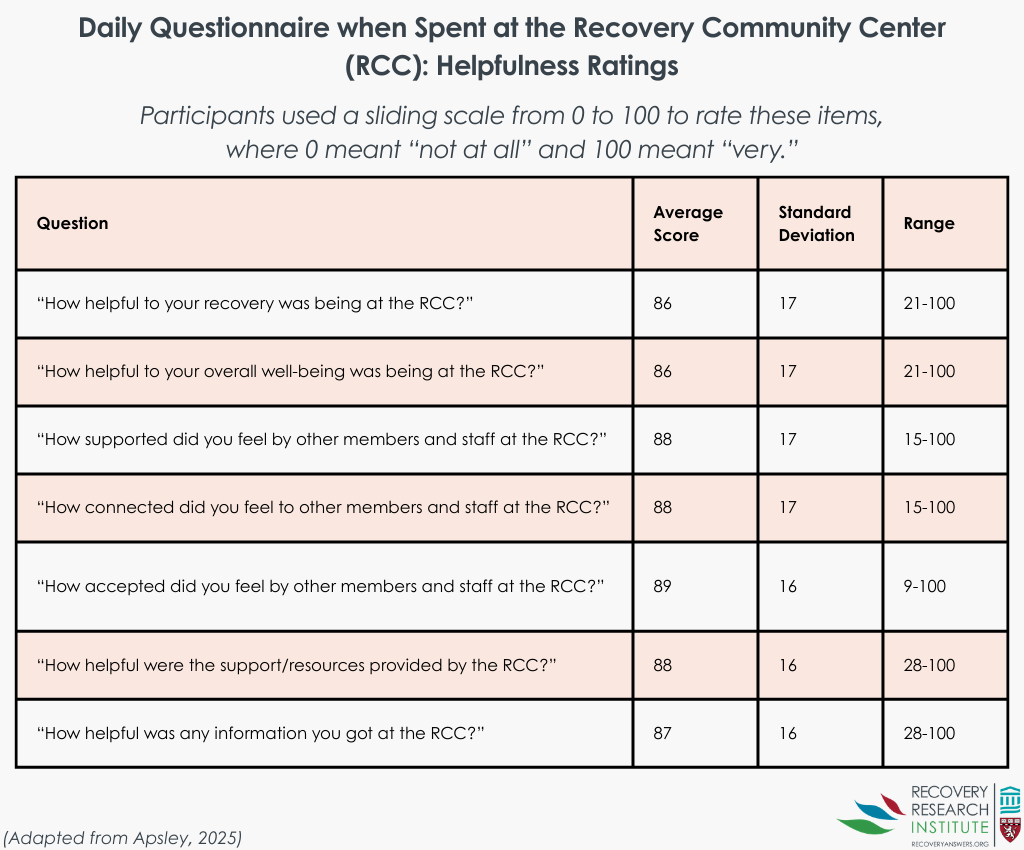
The current study was a naturalistic daily diary design among 88 recovery community center attendees. Attendees of recovery community centers were recruited from 6 different recovery community centers in Pennsylvania. After completing a baseline survey, participants completed a 10-minute survey each day for 10 days. The surveys asked participants whether they had spent any time at a recovery community center, and, if so, participants answered 7 questions about the helpfulness of their time at the recovery community center (see graphic below).
Participants also answered questions each day about how meaningful their day had been (e.g., “My day has been meaningful”; “My day has been gratifying”) and their recovery identity (e.g., “I kept recovery central to my day”; “I was grateful to be in recovery”). The researchers wanted to better understand the degree to which attendee’s perception of the helpfulness of recovery community centers each day was associated with the amount of meaning they reported and the strength of their recovery identity. The authors used two types of statistical models: one examining these questions at the level of the day (e.g., does higher recovery community center helpfulness on a given day predict higher daily meaningfulness and recovery identity) and one at the level of the person (e.g., do those who have overall higher perceptions of recovery community center helpfulness also have higher overall meaningfulness and recovery identity). Additional models tested whether helpfulness was associated with recovery experiences, even when accounting for that recovery experience the prior day. This type of approach can help make the case that recovery community center helpfulness is actually leading to enhanced meaning and recovery identity rather than the other way around.
There were no treatments applied. Although the researchers initially recruited 94 participants, 6 did not attend a recovery community center for the duration of the 10-day study and their data were omitted. The sample was, on average, 43 years of age, and 56% were female. Participants were primarily White (78%); 16% were Black, and 67% identified as another race. The sample was diverse in terms of time spent in recovery: 36% had been in recovery for less than a year, 33% between 1 and 5 years, and 31% for greater than 5 years. About half (47%) of the sample were employed full time, whereas 30.7% were unemployed. Seven in 10 (68%) had an annual household income of less than $50,000.
WHAT DID THIS STUDY FIND?
Greater perceived recovery community center helpfulness was associated with higher meaning and recovery identity
Participants visited recovery community centers on almost 1/3 of days during the study (30.9%). The researchers found that helpfulness significantly varied day to day. Those who reported higher perceived recovery community center helpfulness overall also reported greater overall meaning and greater overall recovery identity. Further, reporting higher perceived recovery community center helpfulness on a given day was associated with greater overall meaning and greater overall recovery identity on that day. These results were identical when controlling for the previous days outcome, helping make the case that helpfulness is causing greater recovery meaning and identity, rather than the other way around.
WHAT ARE THE IMPLICATIONS OF THE STUDY FINDINGS?
Among individuals who engage with recovery community centers, those who find their engagement helpful are also likely to experience higher meaning in life and stronger recovery identity. These two factors, in turn may help protect against future relapses and disorder recurrence as they might be considered recovery resilience factors. The study also showed that perceived helpfulness was not consistent across days, suggesting that helpfulness may fluctuate depending on what resources are available on any given day, and how and with what the attendees engage. This might suggest that the effectiveness of recovery community centers may depend upon individual component parts, such as the mutual-help groups on a given day, or other resources the participants access, rather than the recovery community center as a whole. As a result, the impact of recovery community centers on recovery outcomes may be amplified when the needs and wants of recovery community center attendees are considered.
It is worth nothing that this sample may have been higher functioning than other recovery community center samples. For example, 31% of this sample was in recovery for 5+ years, compared to 20% of a separate sample of recovery community center members from 31 programs in New England. Similarly, about half were employed full-time compared to 20% of the New England sample. Having more recovery capital – as was the case for the current sample – may be naturally associated with higher levels of recovery meaning and identity. It is possible that in samples with lower recovery capital, perceived recovery community center helpfulness would have even higher associations with meaning and recovery identity.
The authors recruited people who were already engaging with recovery community centers, and who volunteered to participate in the study. They may be more likely to report high perceived helpfulness of recovery community centers. While higher perceived helpfulness may be associated with greater meaning and recovery identity in this particular sample, more work is needed to determine whether these findings would generalize to a broader recovery population who may be new to recovery community centers.
The sample is quite small and variability in the estimates may mean that additional sampling or different samples may yield different results.
BOTTOM LINE
This study suggests that perceiving recovery community centers as more helpful is associated with greater perceived daily meaning and recovery identity. These two factors, in turn, may help protect against future relapse and disorder recurrence as they might be considered as resilience factors. Future research is needed to determine whether, how, and to what degree, recovery community center participation is helpful, especially to individuals in early recovery.
For individuals and families seeking recovery: If you are a person in recovery, finding and engaging in helpful activities at recovery community center may give you a sense of purpose and bolster your recovery identity. These two factors in turn may help protect against future relapse and disorder recurrence as they might be considered resilience factors. The resources available through recovery community centers are diverse, and some may be more helpful for you than others. Finding the ones that are useful for you may help increase the chance that recovery community centers bolster your recovery.
For treatment professionals and treatment systems: Recovery community centers may be a valuable resource for your patients experiencing substance use disorder by increasing their daily experience of meaning and bolstering their recovery identity. Working with patients to engage in recovery community centers, particularly assisting patients find the resources and activities that they deem helpful, may increase their recovery success over time.
For scientists: This study lays the groundwork for important studies illuminating efficacy of recovery support services by better understanding an important moderator, perceived recovery community center helpfulness. More research is needed to understand how helpfulness might impact substance-related outcomes or long-term recovery outcomes, in addition to day-level meaning and recovery identity. Further, identifying empirical approaches to bolstering the helpfulness of recovery community center resources may increase attendee’s meaning and recovery identities, potentially serving to bolster the chances of long-term remission and enhance recovery.
For policy makers: Though more research is needed, initial studies suggest recovery community centers may be useful resources for people in recovery. Consistent funding is necessary to operate and maintain recovery community centers. Funding would also help scientists better study and understand recovery community centers to test and ultimately, to improve, their utility.
Recovery community centers are peer-operated spaces offering community services for people in or seeking recovery from a substance use disorder. The centers serve as a hub to build recovery capital, or the resources needed to establish and maintain recovery, through resources such as peer coaching, mutual-help groups, advocacy, and life skills training. Their numbers are increasing nationally, with a recent study demonstrating that more than half of surveyed recovery community centers have opened in the last 5 years. Given their relatively recent proliferation, little is known about how recovery community center participation actually impacts recovery outcomes. This study examined the extent to which perceived helpfulness of recovery community centers was associated with daily meaning and recovery identity.
HOW WAS THIS STUDY CONDUCTED?
The current study was a naturalistic daily diary design among 88 recovery community center attendees. Attendees of recovery community centers were recruited from 6 different recovery community centers in Pennsylvania. After completing a baseline survey, participants completed a 10-minute survey each day for 10 days. The surveys asked participants whether they had spent any time at a recovery community center, and, if so, participants answered 7 questions about the helpfulness of their time at the recovery community center (see graphic below).
Participants also answered questions each day about how meaningful their day had been (e.g., “My day has been meaningful”; “My day has been gratifying”) and their recovery identity (e.g., “I kept recovery central to my day”; “I was grateful to be in recovery”). The researchers wanted to better understand the degree to which attendee’s perception of the helpfulness of recovery community centers each day was associated with the amount of meaning they reported and the strength of their recovery identity. The authors used two types of statistical models: one examining these questions at the level of the day (e.g., does higher recovery community center helpfulness on a given day predict higher daily meaningfulness and recovery identity) and one at the level of the person (e.g., do those who have overall higher perceptions of recovery community center helpfulness also have higher overall meaningfulness and recovery identity). Additional models tested whether helpfulness was associated with recovery experiences, even when accounting for that recovery experience the prior day. This type of approach can help make the case that recovery community center helpfulness is actually leading to enhanced meaning and recovery identity rather than the other way around.
There were no treatments applied. Although the researchers initially recruited 94 participants, 6 did not attend a recovery community center for the duration of the 10-day study and their data were omitted. The sample was, on average, 43 years of age, and 56% were female. Participants were primarily White (78%); 16% were Black, and 67% identified as another race. The sample was diverse in terms of time spent in recovery: 36% had been in recovery for less than a year, 33% between 1 and 5 years, and 31% for greater than 5 years. About half (47%) of the sample were employed full time, whereas 30.7% were unemployed. Seven in 10 (68%) had an annual household income of less than $50,000.
WHAT DID THIS STUDY FIND?
Greater perceived recovery community center helpfulness was associated with higher meaning and recovery identity
Participants visited recovery community centers on almost 1/3 of days during the study (30.9%). The researchers found that helpfulness significantly varied day to day. Those who reported higher perceived recovery community center helpfulness overall also reported greater overall meaning and greater overall recovery identity. Further, reporting higher perceived recovery community center helpfulness on a given day was associated with greater overall meaning and greater overall recovery identity on that day. These results were identical when controlling for the previous days outcome, helping make the case that helpfulness is causing greater recovery meaning and identity, rather than the other way around.
WHAT ARE THE IMPLICATIONS OF THE STUDY FINDINGS?
Among individuals who engage with recovery community centers, those who find their engagement helpful are also likely to experience higher meaning in life and stronger recovery identity. These two factors, in turn may help protect against future relapses and disorder recurrence as they might be considered recovery resilience factors. The study also showed that perceived helpfulness was not consistent across days, suggesting that helpfulness may fluctuate depending on what resources are available on any given day, and how and with what the attendees engage. This might suggest that the effectiveness of recovery community centers may depend upon individual component parts, such as the mutual-help groups on a given day, or other resources the participants access, rather than the recovery community center as a whole. As a result, the impact of recovery community centers on recovery outcomes may be amplified when the needs and wants of recovery community center attendees are considered.
It is worth nothing that this sample may have been higher functioning than other recovery community center samples. For example, 31% of this sample was in recovery for 5+ years, compared to 20% of a separate sample of recovery community center members from 31 programs in New England. Similarly, about half were employed full-time compared to 20% of the New England sample. Having more recovery capital – as was the case for the current sample – may be naturally associated with higher levels of recovery meaning and identity. It is possible that in samples with lower recovery capital, perceived recovery community center helpfulness would have even higher associations with meaning and recovery identity.
The authors recruited people who were already engaging with recovery community centers, and who volunteered to participate in the study. They may be more likely to report high perceived helpfulness of recovery community centers. While higher perceived helpfulness may be associated with greater meaning and recovery identity in this particular sample, more work is needed to determine whether these findings would generalize to a broader recovery population who may be new to recovery community centers.
The sample is quite small and variability in the estimates may mean that additional sampling or different samples may yield different results.
BOTTOM LINE
This study suggests that perceiving recovery community centers as more helpful is associated with greater perceived daily meaning and recovery identity. These two factors, in turn, may help protect against future relapse and disorder recurrence as they might be considered as resilience factors. Future research is needed to determine whether, how, and to what degree, recovery community center participation is helpful, especially to individuals in early recovery.
For individuals and families seeking recovery: If you are a person in recovery, finding and engaging in helpful activities at recovery community center may give you a sense of purpose and bolster your recovery identity. These two factors in turn may help protect against future relapse and disorder recurrence as they might be considered resilience factors. The resources available through recovery community centers are diverse, and some may be more helpful for you than others. Finding the ones that are useful for you may help increase the chance that recovery community centers bolster your recovery.
For treatment professionals and treatment systems: Recovery community centers may be a valuable resource for your patients experiencing substance use disorder by increasing their daily experience of meaning and bolstering their recovery identity. Working with patients to engage in recovery community centers, particularly assisting patients find the resources and activities that they deem helpful, may increase their recovery success over time.
For scientists: This study lays the groundwork for important studies illuminating efficacy of recovery support services by better understanding an important moderator, perceived recovery community center helpfulness. More research is needed to understand how helpfulness might impact substance-related outcomes or long-term recovery outcomes, in addition to day-level meaning and recovery identity. Further, identifying empirical approaches to bolstering the helpfulness of recovery community center resources may increase attendee’s meaning and recovery identities, potentially serving to bolster the chances of long-term remission and enhance recovery.
For policy makers: Though more research is needed, initial studies suggest recovery community centers may be useful resources for people in recovery. Consistent funding is necessary to operate and maintain recovery community centers. Funding would also help scientists better study and understand recovery community centers to test and ultimately, to improve, their utility.
Recovery community centers are peer-operated spaces offering community services for people in or seeking recovery from a substance use disorder. The centers serve as a hub to build recovery capital, or the resources needed to establish and maintain recovery, through resources such as peer coaching, mutual-help groups, advocacy, and life skills training. Their numbers are increasing nationally, with a recent study demonstrating that more than half of surveyed recovery community centers have opened in the last 5 years. Given their relatively recent proliferation, little is known about how recovery community center participation actually impacts recovery outcomes. This study examined the extent to which perceived helpfulness of recovery community centers was associated with daily meaning and recovery identity.
HOW WAS THIS STUDY CONDUCTED?
The current study was a naturalistic daily diary design among 88 recovery community center attendees. Attendees of recovery community centers were recruited from 6 different recovery community centers in Pennsylvania. After completing a baseline survey, participants completed a 10-minute survey each day for 10 days. The surveys asked participants whether they had spent any time at a recovery community center, and, if so, participants answered 7 questions about the helpfulness of their time at the recovery community center (see graphic below).
Participants also answered questions each day about how meaningful their day had been (e.g., “My day has been meaningful”; “My day has been gratifying”) and their recovery identity (e.g., “I kept recovery central to my day”; “I was grateful to be in recovery”). The researchers wanted to better understand the degree to which attendee’s perception of the helpfulness of recovery community centers each day was associated with the amount of meaning they reported and the strength of their recovery identity. The authors used two types of statistical models: one examining these questions at the level of the day (e.g., does higher recovery community center helpfulness on a given day predict higher daily meaningfulness and recovery identity) and one at the level of the person (e.g., do those who have overall higher perceptions of recovery community center helpfulness also have higher overall meaningfulness and recovery identity). Additional models tested whether helpfulness was associated with recovery experiences, even when accounting for that recovery experience the prior day. This type of approach can help make the case that recovery community center helpfulness is actually leading to enhanced meaning and recovery identity rather than the other way around.
There were no treatments applied. Although the researchers initially recruited 94 participants, 6 did not attend a recovery community center for the duration of the 10-day study and their data were omitted. The sample was, on average, 43 years of age, and 56% were female. Participants were primarily White (78%); 16% were Black, and 67% identified as another race. The sample was diverse in terms of time spent in recovery: 36% had been in recovery for less than a year, 33% between 1 and 5 years, and 31% for greater than 5 years. About half (47%) of the sample were employed full time, whereas 30.7% were unemployed. Seven in 10 (68%) had an annual household income of less than $50,000.
WHAT DID THIS STUDY FIND?
Greater perceived recovery community center helpfulness was associated with higher meaning and recovery identity
Participants visited recovery community centers on almost 1/3 of days during the study (30.9%). The researchers found that helpfulness significantly varied day to day. Those who reported higher perceived recovery community center helpfulness overall also reported greater overall meaning and greater overall recovery identity. Further, reporting higher perceived recovery community center helpfulness on a given day was associated with greater overall meaning and greater overall recovery identity on that day. These results were identical when controlling for the previous days outcome, helping make the case that helpfulness is causing greater recovery meaning and identity, rather than the other way around.
WHAT ARE THE IMPLICATIONS OF THE STUDY FINDINGS?
Among individuals who engage with recovery community centers, those who find their engagement helpful are also likely to experience higher meaning in life and stronger recovery identity. These two factors, in turn may help protect against future relapses and disorder recurrence as they might be considered recovery resilience factors. The study also showed that perceived helpfulness was not consistent across days, suggesting that helpfulness may fluctuate depending on what resources are available on any given day, and how and with what the attendees engage. This might suggest that the effectiveness of recovery community centers may depend upon individual component parts, such as the mutual-help groups on a given day, or other resources the participants access, rather than the recovery community center as a whole. As a result, the impact of recovery community centers on recovery outcomes may be amplified when the needs and wants of recovery community center attendees are considered.
It is worth nothing that this sample may have been higher functioning than other recovery community center samples. For example, 31% of this sample was in recovery for 5+ years, compared to 20% of a separate sample of recovery community center members from 31 programs in New England. Similarly, about half were employed full-time compared to 20% of the New England sample. Having more recovery capital – as was the case for the current sample – may be naturally associated with higher levels of recovery meaning and identity. It is possible that in samples with lower recovery capital, perceived recovery community center helpfulness would have even higher associations with meaning and recovery identity.
The authors recruited people who were already engaging with recovery community centers, and who volunteered to participate in the study. They may be more likely to report high perceived helpfulness of recovery community centers. While higher perceived helpfulness may be associated with greater meaning and recovery identity in this particular sample, more work is needed to determine whether these findings would generalize to a broader recovery population who may be new to recovery community centers.
The sample is quite small and variability in the estimates may mean that additional sampling or different samples may yield different results.
BOTTOM LINE
This study suggests that perceiving recovery community centers as more helpful is associated with greater perceived daily meaning and recovery identity. These two factors, in turn, may help protect against future relapse and disorder recurrence as they might be considered as resilience factors. Future research is needed to determine whether, how, and to what degree, recovery community center participation is helpful, especially to individuals in early recovery.
For individuals and families seeking recovery: If you are a person in recovery, finding and engaging in helpful activities at recovery community center may give you a sense of purpose and bolster your recovery identity. These two factors in turn may help protect against future relapse and disorder recurrence as they might be considered resilience factors. The resources available through recovery community centers are diverse, and some may be more helpful for you than others. Finding the ones that are useful for you may help increase the chance that recovery community centers bolster your recovery.
For treatment professionals and treatment systems: Recovery community centers may be a valuable resource for your patients experiencing substance use disorder by increasing their daily experience of meaning and bolstering their recovery identity. Working with patients to engage in recovery community centers, particularly assisting patients find the resources and activities that they deem helpful, may increase their recovery success over time.
For scientists: This study lays the groundwork for important studies illuminating efficacy of recovery support services by better understanding an important moderator, perceived recovery community center helpfulness. More research is needed to understand how helpfulness might impact substance-related outcomes or long-term recovery outcomes, in addition to day-level meaning and recovery identity. Further, identifying empirical approaches to bolstering the helpfulness of recovery community center resources may increase attendee’s meaning and recovery identities, potentially serving to bolster the chances of long-term remission and enhance recovery.
For policy makers: Though more research is needed, initial studies suggest recovery community centers may be useful resources for people in recovery. Consistent funding is necessary to operate and maintain recovery community centers. Funding would also help scientists better study and understand recovery community centers to test and ultimately, to improve, their utility.