WHAT PROBLEM DOES THIS STUDY ADDRESS?
In recent years, the number of US states that have legalized cannabis has grown, leading to sales of higher potency THC products and a decrease in the perception of its potential harms. These factors combined may have contributed to increases in visits to the emergency room related to cannabis use, poison center cases among children and adolescents, and cannabis-related disorders among adolescents. Given this changing cannabis environment, monitoring rates of use among youth over time is important for prevention and intervention efforts. Prior work that has examined trends in adolescent cannabis use has produced mixed results, with some research showing that use has been stable over time and other research showing decreases. This study expanded the period of time that past work has investigated to examine trends in adolescent cannabis use between 1991 and 2023. Potential differences between sexes and race or ethnicity were also examined.
HOW WAS THIS STUDY CONDUCTED?
The researchers in this study analyzed trends in cannabis use between 1991-2023 among adolescents by sex and race/ethnicity. Data was obtained from the Youth Risk Behavior Survey, which is a national survey conducted once every 2 years with high school students in grades 9-12. Data on lifetime, recent, and early-age cannabis use was collected, as well as demographic data. Lifetime cannabis use was assessed by asking participants, “During your life, how many times have you used marijuana?” (i.e., up through the time they took the survey, as a high school student). Any answer other than zero was classified as having used cannabis. Recent cannabis use was assessed by asking participants, “During the past 30 days, how many times did you use marijuana?” Any answer other than zero was classified as having used cannabis recently. Early-age cannabis use was assessed by asking participants, “How old were you when you tried marijuana for the first time?” Answers of 12 or younger were classified as having used cannabis at an early age. Notably, this is a younger age threshold than other typical indicators of early cannabis use, which tend to mark early-onset cannabis use at ages 14-16 given associations with increased risk for cannabis and other psychiatric disorders, as well as neurobiological impacts at that age. Therefore, the early-age cannabis use results should be interpreted with some caution. Data on participants race/ethnicity were categorized as: non-Hispanic White, non-Hispanic Black, Hispanic, Asian/Pacific Islander/Native American, and those of another race/ethnicity. The analyses examined the likelihood of lifetime, recent, and early-age cannabis use, with sex, race/ethnicity, and survey year as predictors.
Of note, this study did not consider other factors that may influence cannabis use, such as socioeconomic factors (e.g., economic status, education, neighborhood) or mental health conditions. Examining how these factors influence trends in cannabis use would provide a deeper understanding of how cannabis use changes among youth across time. Finally, the study design limits the extent to which the researchers can make claims about what is causing the differences in trends across time.
WHAT DID THIS STUDY FIND?
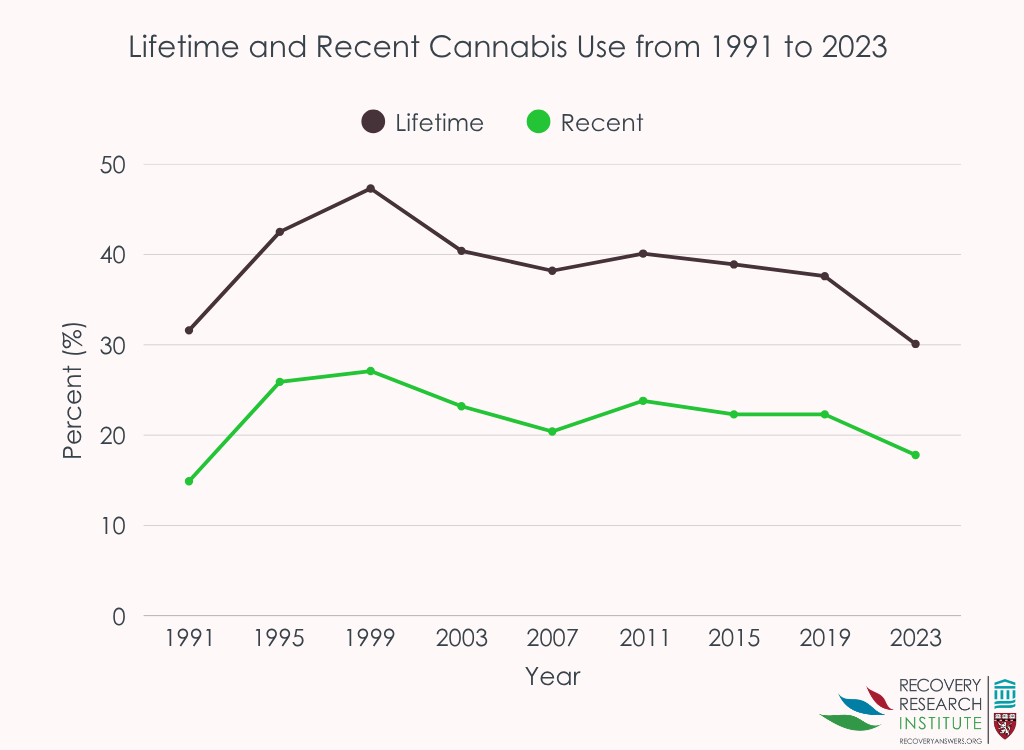
Among all adolescents regardless of sex and race/ethnicity, cannabis use rates rose from 1991 and peaked in 1999. Rates then subsequently declined through 2023, with lifetime use (i.e., through the time they took the survey as a high school student) decreasing from 47% in 1999 to 30% in 2023, recent use decreasing from 27% in 1999 to 18% in 2023, and early-age use decreasing from 12% in 1999 to 7% in 2023. This reflects an inverted U-shaped pattern (see graph below).
Trends by sex
While rates of any reported cannabis use were overall lower in 2023 than 1999, there was a shift between men and women. Men report higher levels of substance use on average than women, but for cannabis use, female adolescents reported higher rates of lifetime and recent use in 2023 than male adolescents. In 2023, these rates were 33% and 19% for female adolescents, respectively, vs. 27% and 16% of male adolescents. However, this reflects a decrease in the rates of men reporting cannabis use between 1999 and 2023, rather than an increase in the rates of women reporting cannabis use during that same time period, since these rates for women remained fairly consistent.
For early-age cannabis use, rates were similar for men and women in 2023 at 7%. Yet, rates similarly decreased for men, from 15% in 1999 to 7% in 2023, while rates for women remained fairly consistent, at 5% in 1999 and 7% in 2023.
Trends by race/ethnicity
For trends by race/ethnicity, male and female adolescents identifying as non-Hispanic Black, Hispanic, and another race/ethnicity apart from those asked about were more likely to have reported lifetime cannabis use than the national average. Adolescents identifying as non-Hispanic Black and another race/ethnicity also reported higher rates of recent cannabis use. Male and female adolescents identifying as Asian/Pacific Islander consistently reported lower rates of both lifetime and recent cannabis use. Male and female adolescents identifying as non-Hispanic Black, Hispanic, and another race/ethnicity were more likely to report early-age cannabis use than White adolescents.
WHAT ARE THE IMPLICATIONS OF THE STUDY FINDINGS?
This study demonstrated that cannabis use among youth peaked in 1999 and then decreased through 2023, a period of time that expands on prior research and provides a deeper understanding of how adolescent cannabis use has changed amidst changing policies and perceptions of harm. Results further showed that, while any use of cannabis overall was lower in 2023, use among women was stable between 1999 and 2023, while men’s use decreased. This reflects that cannabis use among male adolescents is converging with that of female adolescents. Although this is an encouraging trend for male adolescents, the finding that female adolescents now report higher rates of any cannabis use warrants further investigation and targeted prevention and intervention efforts.
Future research is also needed to investigate how trends may have differed for more specific populations. For example, one recent study found that legalization of cannabis use was associated with increases in use among people with psychiatric disorders or vulnerabilities. This suggests that cannabis may be decreasing for the general population of adolescents, but may be increasing among at-risk populations, underscoring the need for additional research and continued prevention efforts. Importantly, this study focused on adolescent youth. Other work shows that older youth – young/emerging adults – are using cannabis at historically high levels.
Finally, more work is needed on how use of higher potency THC products has changed over time. It is possible, for example, that fewer individuals are using any cannabis at all, but among those who are using, they are experiencing more consequences due to higher potency THC content. This may be especially concerning if individuals with other risk factors (e.g., family history of psychotic and other psychiatric disorders) are exposed to these higher potency forms of cannabis.
BOTTOM LINE
Reports of any cannabis use among adolescents peaked in 1999 and declined through 2023. However, decreases occurred primarily among male adolescents, while rates among female adolescents remained relatively stable, resulting in female adolescents reporting higher rates of any use of cannabis than male adolescents in 2023. These findings support continued prevention efforts. More work is needed to understand intensity of exposure to the potentially harmful THC levels.
- For individuals and families seeking recovery: Although cannabis use among adolescents decreased overall, changing patterns by sex suggest that female adolescents are not experiencing the same reductions over time as male adolescents. Families and young people may benefit from continued conversations about cannabis use, especially amidst changing policies and decreasing perceptions of harm. Potency and frequency of exposure was not assessed in this study.
- For treatment professionals and treatment systems: These findings support continued screening for cannabis use among adolescents and reinforce the importance of prevention and early intervention efforts that account for changing patterns of use across groups. Monitoring trends among populations that may remain at elevated risk may help tailor prevention and intervention efforts.
- For scientists: Because this study examined broad population trends, future research that investigates more specific populations, such as those at-risk, would help clarify whether declines in cannabis use are occurring similarly across groups. Additional research examining how changing cannabis policies, cannabis potency, perceptions of harm, and underlying vulnerabilities influence these patterns would deepen understanding of changing trends and shed light on which adolescent prevention efforts may be most helpful and for whom.
- For policy makers: These findings support continued investment in adolescent cannabis prevention efforts despite overall declines in use over time. Ongoing surveillance and policies that monitor changing patterns of use across populations may help identify groups who remain at elevated risk and inform more targeted prevention strategies.
CITATIONS
Amrock, S. M., & Sajkiewicz, A. J. (2026). Trends in US adolescent cannabis use, 1991–2023. Addictive Behaviors, 176. doi: 10.1016/j.addbeh.2026.108634.