When cannabis becomes legal for adults, what happens to cannabis use disorder among adolescents?

Cannabis legalization has markedly changed the cannabis use landscape in the U.S. Though adolescents can’t legally buy cannabis in any states with legalized recreational cannabis, these policy shifts still have the potential to influence adolescents’ behaviors and health. This study examined shifting trends in cannabis use disorder among California adolescents before and after recreational cannabis legalization.

Stay on the frontiers of
recovery science
with the free, monthly
Recovery Bulletin

l

WHAT PROBLEM DOES THIS STUDY ADDRESS?

The cannabis policy landscape in the U.S. has shifted considerably over the past decade, with recreational cannabis use legal for adults in 24 states and Washington, D.C., as of May 2026. Approximately 53% of the U.S. population lives in places where recreational cannabis use is legal, raising important questions about how these policy changes may also affect adolescents. The percentage of U.S. adolescents reporting any past-year cannabis use remained relatively stable for many years before declining substantially during the COVID-19 pandemic. Looking beyond whether adolescents use any amount of cannabis is also important because more frequent cannabis use is associated with a greater risk of developing cannabis use disorder. Additionally, a recent study found that adolescents who regularly use cannabis experienced more severe cannabis use disorder symptoms than adults who regularly use cannabis, even after accounting for the amount of THC consumed. Legalization for adults could encourage more frequent cannabis use among adolescents by making cannabis easier to obtain and making its use seem less harmful. However, relatively little research has examined whether legalization is associated with changes in adolescent cannabis use disorder, limiting our understanding of its potential consequences for adolescent health. To address this gap, the present study examined changes in rates of newly diagnosed cannabis use disorder among California adolescents over a 6-year period spanning the passage of recreational cannabis legalization and the subsequent start of legal retail sales.


HOW WAS THIS STUDY CONDUCTED?

The population-based time series study examined whether and how cannabis use disorder rates among adolescents changed following recreational cannabis legalization in California. Drawing on electronic health record data from Kaiser Permanente Northern California, the study included adolescents aged 13-17 years who were enrolled in the healthcare system for at least 1 month between January 2014 and February 2020. Less than 1% were excluded due to a prior cannabis use disorder diagnosis or missing sociodemographic data, yielding a final analytic sample of around 637,000 adolescents. Given the nature of the sample, findings may not be generalizable to uninsured adolescents or those outside Northern California.

The researchers compared monthly diagnosis trends before and after the policy changes. The study period included 2 important policy milestones in California: (1) the passage of recreational cannabis legalization in November 2016, which legalized cannabis possession and home cultivation for adults aged 21 years and older, and reduced penalties for underage possession; and (2) the start of legal recreational cannabis retail sales in January 2018. The researchers identified each adolescent’s first recorded cannabis use disorder diagnosis using diagnosis codes in electronic health records. Models accounted for age, sex, race/ethnicity, neighborhood socioeconomic conditions, and seasonal patterns.

WHAT DID THIS STUDY FIND?

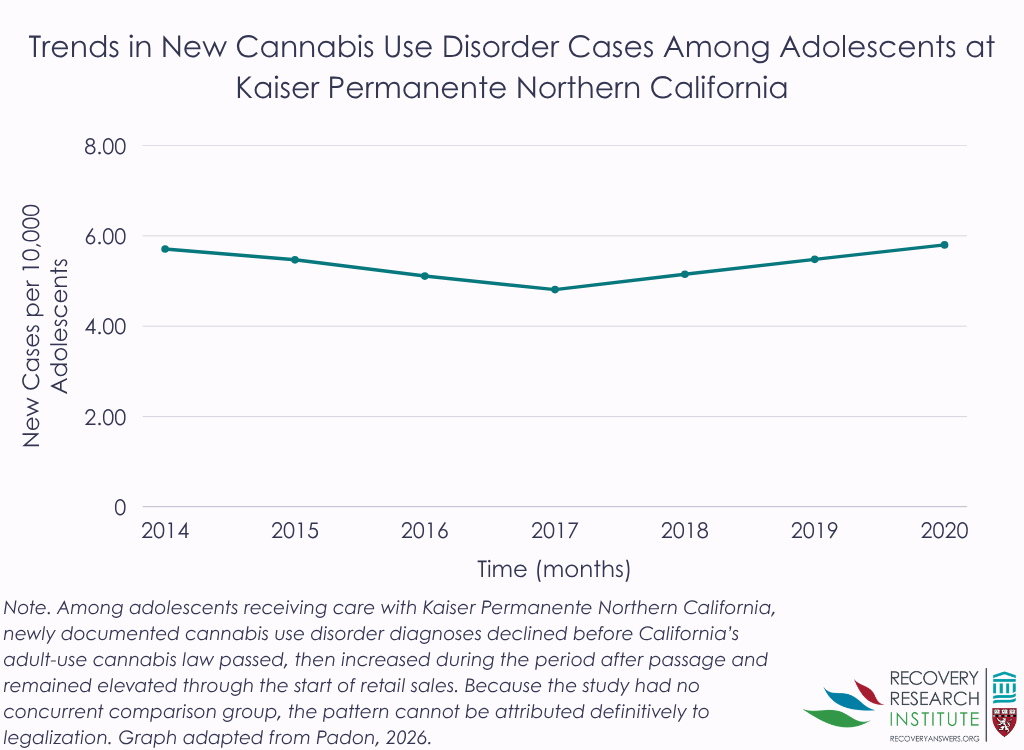
Before California’s law passed, newly recorded cannabis use disorder diagnoses among adolescents were becoming less common. As shown in the figure below, during the period after the law’s passage in November 2016, the direction of the trend changed, and diagnosis rates increased. The main analysis suggested that diagnosis rates continued to rise after legal recreational cannabis retail sales began in January 2018. However, the most pronounced increase in cannabis use disorder rates happened after the law passed, with a slowing trend after retail sales began. By February 2020, rates of newly diagnosed cannabis use disorder had returned to levels comparable to those observed at the beginning of the study period. Overall, these changes were small in absolute terms, with newly recorded diagnoses averaging about 5 per 10,000 adolescents each month across the study. Of note, this reflects diagnoses documented in health records, not all adolescents who may have had cannabis use disorder.


WHAT ARE THE IMPLICATIONS OF THE STUDY FINDINGS?

The results suggest that legalization may be associated with modest increases in newly recorded cannabis use disorder diagnoses among Northern California adolescents, consistent with previous reports documenting increases in past-year and frequent cannabis use for this age group in the state following legalization. These findings are also consistent with previous research among adolescents receiving psychiatric emergency services in Massachusetts, where increases in cannabis use and cannabis-related diagnoses were observed following the legalization of recreational cannabis retail sales. The findings were compatible with gradual changes in diagnosis rates but did not clearly establish sudden increases at either policy milestone. This pattern may reflect how cannabis use disorder develops over time, as some adolescents progress from occasional experimentation to more frequent and sustained use before developing the disorder, although the study did not track this progression in individual adolescents. Together, these findings highlight the importance of looking beyond cannabis use prevalence to better understand the potential consequences of legalization for adolescents. The findings indicate a change in the direction of diagnosis trends, but should not be interpreted as evidence of a large increase in the proportion of adolescents developing cannabis use disorder.

Notably, the increase in newly recorded cannabis use disorder rates emerged following the passage of recreational cannabis legalization, before legal retail sales began. This could suggest that broader legal and social changes surrounding cannabis may play a role beyond simply increasing access through retail markets. It is possible that legalization may have influenced how adolescents perceived the risks, consequences, and social acceptability of cannabis use. Indeed, a previous study found that perceived harmfulness fell more and past-month cannabis use rose more among eighth- and tenth-grade students in Washington than among students in states that had not legalized recreational cannabis. Other possible changes, such as greater willingness among adolescents to disclose cannabis use or differences in clinical screening and diagnostic practices, may also have contributed to the observed changes in recorded cannabis use disorder diagnoses.

Due to the observational nature of this study and the absence of a comparison group, it cannot be determined whether legalization itself contributed to the observed changes in cannabis use disorder or whether other factors were responsible. Additionally, although electronic health records allowed researchers to examine a large population of adolescents, those who did not receive healthcare services with Kaiser Permanente Northern California or a clinical diagnosis of cannabis use disorder would have been omitted from their data. A first recorded diagnosis may also occur well after symptoms emerged. Because the study ended in February 2020, it does not show whether the diagnosis trends persisted during or after the COVID-19 pandemic. Future research using more rigorous study designs and alternative methods of assessing cannabis use disorder could help clarify the relationship between legalization and adolescent cannabis-related harms.


BOTTOM LINE

Rates of newly recorded cannabis use disorder diagnoses among adolescents in Northern California were declining before recreational cannabis legalization, but this trend reversed slightly following the law’s passage. Given that the trend began after legalization but before retail sales were implemented it is likely that factors beyond availability, such as reduced perceptions of harm or greater willingness to report use and consequences, accounted for this trend reversal.


  • For individuals and families seeking recovery: Recreational cannabis use has been legalized for adults in 24 states and Washington, D.C. Changes in cannabis laws may have implications for adolescents. Families can help adolescents understand the potential risks of cannabis use by having open conversations about its consequences and signs of problematic use, which may also help them recognize when support is needed.
  • For treatment professionals and treatment systems: These findings highlight the importance of recognizing cannabis related problems among adolescents, particularly as recreational cannabis legalization continues to expand. Providers should consider not only whether adolescents use cannabis, but also the frequency of use and symptoms of cannabis use disorder. Early identification and appropriate intervention may help address cannabis-related problems before they become more severe.
  • For scientists: Future research should use more rigorous study designs, including comparisons across states with different cannabis legalization policies, to better understand whether legalization contributes to changes in adolescent cannabis use disorder. Studies should also examine whether similar trends occur among adolescents in other states and populations, particularly those without health insurance. Additional research is needed to understand the contextual factors that may explain these trends, such as shifting perceptions of cannabis-related risks and social norms.
  • For policy makers: These findings highlight the importance of monitoring cannabis-related harms among adolescents, alongside measures of cannabis use prevalence, to inform public health responses and cannabis policy decisions. Policymakers should also consider the adequacy and enforcement of safeguards intended to protect adolescents, including age-verification requirements, restrictions on cannabis advertising and retail locations, and regulations on cannabis products that may appeal to youth, though this study did not evaluate these safeguards or determine whether they reduce adolescent cannabis use disorder. Continued research is needed to determine which policies are most effective at reducing adolescent cannabis use and related harms.

CITATIONS

Padon, A. A., Cortez, C. A., Alexeeff, S. E., Slama, N. E., Liccardo Pacula, R., Silver, L. D., Sterling, S. A., Campbell, C. I., Satre, D. D., Does, M. B., & Young-Wolff, K. C. (2026). Adolescent cannabis use disorder following recreational cannabis legalization in California, USA: A population-based interrupted time series study. Addiction. Advance online publication. doi: 10.1111/add.70597.


Stay on the Frontiers of
recovery science
with the free, monthly
Recovery Bulletin

l

WHAT PROBLEM DOES THIS STUDY ADDRESS?

The cannabis policy landscape in the U.S. has shifted considerably over the past decade, with recreational cannabis use legal for adults in 24 states and Washington, D.C., as of May 2026. Approximately 53% of the U.S. population lives in places where recreational cannabis use is legal, raising important questions about how these policy changes may also affect adolescents. The percentage of U.S. adolescents reporting any past-year cannabis use remained relatively stable for many years before declining substantially during the COVID-19 pandemic. Looking beyond whether adolescents use any amount of cannabis is also important because more frequent cannabis use is associated with a greater risk of developing cannabis use disorder. Additionally, a recent study found that adolescents who regularly use cannabis experienced more severe cannabis use disorder symptoms than adults who regularly use cannabis, even after accounting for the amount of THC consumed. Legalization for adults could encourage more frequent cannabis use among adolescents by making cannabis easier to obtain and making its use seem less harmful. However, relatively little research has examined whether legalization is associated with changes in adolescent cannabis use disorder, limiting our understanding of its potential consequences for adolescent health. To address this gap, the present study examined changes in rates of newly diagnosed cannabis use disorder among California adolescents over a 6-year period spanning the passage of recreational cannabis legalization and the subsequent start of legal retail sales.


HOW WAS THIS STUDY CONDUCTED?

The population-based time series study examined whether and how cannabis use disorder rates among adolescents changed following recreational cannabis legalization in California. Drawing on electronic health record data from Kaiser Permanente Northern California, the study included adolescents aged 13-17 years who were enrolled in the healthcare system for at least 1 month between January 2014 and February 2020. Less than 1% were excluded due to a prior cannabis use disorder diagnosis or missing sociodemographic data, yielding a final analytic sample of around 637,000 adolescents. Given the nature of the sample, findings may not be generalizable to uninsured adolescents or those outside Northern California.

The researchers compared monthly diagnosis trends before and after the policy changes. The study period included 2 important policy milestones in California: (1) the passage of recreational cannabis legalization in November 2016, which legalized cannabis possession and home cultivation for adults aged 21 years and older, and reduced penalties for underage possession; and (2) the start of legal recreational cannabis retail sales in January 2018. The researchers identified each adolescent’s first recorded cannabis use disorder diagnosis using diagnosis codes in electronic health records. Models accounted for age, sex, race/ethnicity, neighborhood socioeconomic conditions, and seasonal patterns.


WHAT DID THIS STUDY FIND?

Before California’s law passed, newly recorded cannabis use disorder diagnoses among adolescents were becoming less common. As shown in the figure below, during the period after the law’s passage in November 2016, the direction of the trend changed, and diagnosis rates increased. The main analysis suggested that diagnosis rates continued to rise after legal recreational cannabis retail sales began in January 2018. However, the most pronounced increase in cannabis use disorder rates happened after the law passed, with a slowing trend after retail sales began. By February 2020, rates of newly diagnosed cannabis use disorder had returned to levels comparable to those observed at the beginning of the study period. Overall, these changes were small in absolute terms, with newly recorded diagnoses averaging about 5 per 10,000 adolescents each month across the study. Of note, this reflects diagnoses documented in health records, not all adolescents who may have had cannabis use disorder.


WHAT ARE THE IMPLICATIONS OF THE STUDY FINDINGS?

The results suggest that legalization may be associated with modest increases in newly recorded cannabis use disorder diagnoses among Northern California adolescents, consistent with previous reports documenting increases in past-year and frequent cannabis use for this age group in the state following legalization. These findings are also consistent with previous research among adolescents receiving psychiatric emergency services in Massachusetts, where increases in cannabis use and cannabis-related diagnoses were observed following the legalization of recreational cannabis retail sales. The findings were compatible with gradual changes in diagnosis rates but did not clearly establish sudden increases at either policy milestone. This pattern may reflect how cannabis use disorder develops over time, as some adolescents progress from occasional experimentation to more frequent and sustained use before developing the disorder, although the study did not track this progression in individual adolescents. Together, these findings highlight the importance of looking beyond cannabis use prevalence to better understand the potential consequences of legalization for adolescents. The findings indicate a change in the direction of diagnosis trends, but should not be interpreted as evidence of a large increase in the proportion of adolescents developing cannabis use disorder.

Notably, the increase in newly recorded cannabis use disorder rates emerged following the passage of recreational cannabis legalization, before legal retail sales began. This could suggest that broader legal and social changes surrounding cannabis may play a role beyond simply increasing access through retail markets. It is possible that legalization may have influenced how adolescents perceived the risks, consequences, and social acceptability of cannabis use. Indeed, a previous study found that perceived harmfulness fell more and past-month cannabis use rose more among eighth- and tenth-grade students in Washington than among students in states that had not legalized recreational cannabis. Other possible changes, such as greater willingness among adolescents to disclose cannabis use or differences in clinical screening and diagnostic practices, may also have contributed to the observed changes in recorded cannabis use disorder diagnoses.

Due to the observational nature of this study and the absence of a comparison group, it cannot be determined whether legalization itself contributed to the observed changes in cannabis use disorder or whether other factors were responsible. Additionally, although electronic health records allowed researchers to examine a large population of adolescents, those who did not receive healthcare services with Kaiser Permanente Northern California or a clinical diagnosis of cannabis use disorder would have been omitted from their data. A first recorded diagnosis may also occur well after symptoms emerged. Because the study ended in February 2020, it does not show whether the diagnosis trends persisted during or after the COVID-19 pandemic. Future research using more rigorous study designs and alternative methods of assessing cannabis use disorder could help clarify the relationship between legalization and adolescent cannabis-related harms.


BOTTOM LINE

Rates of newly recorded cannabis use disorder diagnoses among adolescents in Northern California were declining before recreational cannabis legalization, but this trend reversed slightly following the law’s passage. Given that the trend began after legalization but before retail sales were implemented it is likely that factors beyond availability, such as reduced perceptions of harm or greater willingness to report use and consequences, accounted for this trend reversal.


  • For individuals and families seeking recovery: Recreational cannabis use has been legalized for adults in 24 states and Washington, D.C. Changes in cannabis laws may have implications for adolescents. Families can help adolescents understand the potential risks of cannabis use by having open conversations about its consequences and signs of problematic use, which may also help them recognize when support is needed.
  • For treatment professionals and treatment systems: These findings highlight the importance of recognizing cannabis related problems among adolescents, particularly as recreational cannabis legalization continues to expand. Providers should consider not only whether adolescents use cannabis, but also the frequency of use and symptoms of cannabis use disorder. Early identification and appropriate intervention may help address cannabis-related problems before they become more severe.
  • For scientists: Future research should use more rigorous study designs, including comparisons across states with different cannabis legalization policies, to better understand whether legalization contributes to changes in adolescent cannabis use disorder. Studies should also examine whether similar trends occur among adolescents in other states and populations, particularly those without health insurance. Additional research is needed to understand the contextual factors that may explain these trends, such as shifting perceptions of cannabis-related risks and social norms.
  • For policy makers: These findings highlight the importance of monitoring cannabis-related harms among adolescents, alongside measures of cannabis use prevalence, to inform public health responses and cannabis policy decisions. Policymakers should also consider the adequacy and enforcement of safeguards intended to protect adolescents, including age-verification requirements, restrictions on cannabis advertising and retail locations, and regulations on cannabis products that may appeal to youth, though this study did not evaluate these safeguards or determine whether they reduce adolescent cannabis use disorder. Continued research is needed to determine which policies are most effective at reducing adolescent cannabis use and related harms.

CITATIONS

Padon, A. A., Cortez, C. A., Alexeeff, S. E., Slama, N. E., Liccardo Pacula, R., Silver, L. D., Sterling, S. A., Campbell, C. I., Satre, D. D., Does, M. B., & Young-Wolff, K. C. (2026). Adolescent cannabis use disorder following recreational cannabis legalization in California, USA: A population-based interrupted time series study. Addiction. Advance online publication. doi: 10.1111/add.70597.


Share this article

l

WHAT PROBLEM DOES THIS STUDY ADDRESS?

The cannabis policy landscape in the U.S. has shifted considerably over the past decade, with recreational cannabis use legal for adults in 24 states and Washington, D.C., as of May 2026. Approximately 53% of the U.S. population lives in places where recreational cannabis use is legal, raising important questions about how these policy changes may also affect adolescents. The percentage of U.S. adolescents reporting any past-year cannabis use remained relatively stable for many years before declining substantially during the COVID-19 pandemic. Looking beyond whether adolescents use any amount of cannabis is also important because more frequent cannabis use is associated with a greater risk of developing cannabis use disorder. Additionally, a recent study found that adolescents who regularly use cannabis experienced more severe cannabis use disorder symptoms than adults who regularly use cannabis, even after accounting for the amount of THC consumed. Legalization for adults could encourage more frequent cannabis use among adolescents by making cannabis easier to obtain and making its use seem less harmful. However, relatively little research has examined whether legalization is associated with changes in adolescent cannabis use disorder, limiting our understanding of its potential consequences for adolescent health. To address this gap, the present study examined changes in rates of newly diagnosed cannabis use disorder among California adolescents over a 6-year period spanning the passage of recreational cannabis legalization and the subsequent start of legal retail sales.


HOW WAS THIS STUDY CONDUCTED?

The population-based time series study examined whether and how cannabis use disorder rates among adolescents changed following recreational cannabis legalization in California. Drawing on electronic health record data from Kaiser Permanente Northern California, the study included adolescents aged 13-17 years who were enrolled in the healthcare system for at least 1 month between January 2014 and February 2020. Less than 1% were excluded due to a prior cannabis use disorder diagnosis or missing sociodemographic data, yielding a final analytic sample of around 637,000 adolescents. Given the nature of the sample, findings may not be generalizable to uninsured adolescents or those outside Northern California.

The researchers compared monthly diagnosis trends before and after the policy changes. The study period included 2 important policy milestones in California: (1) the passage of recreational cannabis legalization in November 2016, which legalized cannabis possession and home cultivation for adults aged 21 years and older, and reduced penalties for underage possession; and (2) the start of legal recreational cannabis retail sales in January 2018. The researchers identified each adolescent’s first recorded cannabis use disorder diagnosis using diagnosis codes in electronic health records. Models accounted for age, sex, race/ethnicity, neighborhood socioeconomic conditions, and seasonal patterns.


WHAT DID THIS STUDY FIND?

Before California’s law passed, newly recorded cannabis use disorder diagnoses among adolescents were becoming less common. As shown in the figure below, during the period after the law’s passage in November 2016, the direction of the trend changed, and diagnosis rates increased. The main analysis suggested that diagnosis rates continued to rise after legal recreational cannabis retail sales began in January 2018. However, the most pronounced increase in cannabis use disorder rates happened after the law passed, with a slowing trend after retail sales began. By February 2020, rates of newly diagnosed cannabis use disorder had returned to levels comparable to those observed at the beginning of the study period. Overall, these changes were small in absolute terms, with newly recorded diagnoses averaging about 5 per 10,000 adolescents each month across the study. Of note, this reflects diagnoses documented in health records, not all adolescents who may have had cannabis use disorder.


WHAT ARE THE IMPLICATIONS OF THE STUDY FINDINGS?

The results suggest that legalization may be associated with modest increases in newly recorded cannabis use disorder diagnoses among Northern California adolescents, consistent with previous reports documenting increases in past-year and frequent cannabis use for this age group in the state following legalization. These findings are also consistent with previous research among adolescents receiving psychiatric emergency services in Massachusetts, where increases in cannabis use and cannabis-related diagnoses were observed following the legalization of recreational cannabis retail sales. The findings were compatible with gradual changes in diagnosis rates but did not clearly establish sudden increases at either policy milestone. This pattern may reflect how cannabis use disorder develops over time, as some adolescents progress from occasional experimentation to more frequent and sustained use before developing the disorder, although the study did not track this progression in individual adolescents. Together, these findings highlight the importance of looking beyond cannabis use prevalence to better understand the potential consequences of legalization for adolescents. The findings indicate a change in the direction of diagnosis trends, but should not be interpreted as evidence of a large increase in the proportion of adolescents developing cannabis use disorder.

Notably, the increase in newly recorded cannabis use disorder rates emerged following the passage of recreational cannabis legalization, before legal retail sales began. This could suggest that broader legal and social changes surrounding cannabis may play a role beyond simply increasing access through retail markets. It is possible that legalization may have influenced how adolescents perceived the risks, consequences, and social acceptability of cannabis use. Indeed, a previous study found that perceived harmfulness fell more and past-month cannabis use rose more among eighth- and tenth-grade students in Washington than among students in states that had not legalized recreational cannabis. Other possible changes, such as greater willingness among adolescents to disclose cannabis use or differences in clinical screening and diagnostic practices, may also have contributed to the observed changes in recorded cannabis use disorder diagnoses.

Due to the observational nature of this study and the absence of a comparison group, it cannot be determined whether legalization itself contributed to the observed changes in cannabis use disorder or whether other factors were responsible. Additionally, although electronic health records allowed researchers to examine a large population of adolescents, those who did not receive healthcare services with Kaiser Permanente Northern California or a clinical diagnosis of cannabis use disorder would have been omitted from their data. A first recorded diagnosis may also occur well after symptoms emerged. Because the study ended in February 2020, it does not show whether the diagnosis trends persisted during or after the COVID-19 pandemic. Future research using more rigorous study designs and alternative methods of assessing cannabis use disorder could help clarify the relationship between legalization and adolescent cannabis-related harms.


BOTTOM LINE

Rates of newly recorded cannabis use disorder diagnoses among adolescents in Northern California were declining before recreational cannabis legalization, but this trend reversed slightly following the law’s passage. Given that the trend began after legalization but before retail sales were implemented it is likely that factors beyond availability, such as reduced perceptions of harm or greater willingness to report use and consequences, accounted for this trend reversal.


  • For individuals and families seeking recovery: Recreational cannabis use has been legalized for adults in 24 states and Washington, D.C. Changes in cannabis laws may have implications for adolescents. Families can help adolescents understand the potential risks of cannabis use by having open conversations about its consequences and signs of problematic use, which may also help them recognize when support is needed.
  • For treatment professionals and treatment systems: These findings highlight the importance of recognizing cannabis related problems among adolescents, particularly as recreational cannabis legalization continues to expand. Providers should consider not only whether adolescents use cannabis, but also the frequency of use and symptoms of cannabis use disorder. Early identification and appropriate intervention may help address cannabis-related problems before they become more severe.
  • For scientists: Future research should use more rigorous study designs, including comparisons across states with different cannabis legalization policies, to better understand whether legalization contributes to changes in adolescent cannabis use disorder. Studies should also examine whether similar trends occur among adolescents in other states and populations, particularly those without health insurance. Additional research is needed to understand the contextual factors that may explain these trends, such as shifting perceptions of cannabis-related risks and social norms.
  • For policy makers: These findings highlight the importance of monitoring cannabis-related harms among adolescents, alongside measures of cannabis use prevalence, to inform public health responses and cannabis policy decisions. Policymakers should also consider the adequacy and enforcement of safeguards intended to protect adolescents, including age-verification requirements, restrictions on cannabis advertising and retail locations, and regulations on cannabis products that may appeal to youth, though this study did not evaluate these safeguards or determine whether they reduce adolescent cannabis use disorder. Continued research is needed to determine which policies are most effective at reducing adolescent cannabis use and related harms.

CITATIONS

Padon, A. A., Cortez, C. A., Alexeeff, S. E., Slama, N. E., Liccardo Pacula, R., Silver, L. D., Sterling, S. A., Campbell, C. I., Satre, D. D., Does, M. B., & Young-Wolff, K. C. (2026). Adolescent cannabis use disorder following recreational cannabis legalization in California, USA: A population-based interrupted time series study. Addiction. Advance online publication. doi: 10.1111/add.70597.

Share this article