WHAT PROBLEM DOES THIS STUDY ADDRESS?
More than 48 million Americans met criteria for substance use disorder in 2024, and rates differ across demographic groups. Young adults ages 18-25 have the highest rates of substance use disorder of any age group, and men typically have higher rates than women, although this gap has narrowed in recent years. Some racial and ethnic groups – particularly Native American and multiracial individuals – and sexual minority populations also experience elevated risk for substance use disorder. Much less is known about how recovery is distributed across demographic groups. Young adults are especially important to understand because this age group has the highest rates of substance use disorder while engaging in treatment at lower rates than older adults, yet relatively little research has examined recovery patterns among this population. Understanding recovery across demographic groups can help improve engagement with treatment services, recovery supports, and public health messaging, as differences in recovery rates may reflect variation in access to care, social support, stigma, or other factors that influence recovery opportunities. This study examined whether substance use disorder and recovery rates differed across demographic groups in a nationally representative sample of US adults. The researchers tested whether age, gender, race and ethnicity, and sexual orientation were associated with substance use disorder and recovery rates and conducted separate analyses among young adults.
HOW WAS THIS STUDY CONDUCTED?
This study analyzed data from the 2021 National Survey on Drug Use and Health, a nationally representative survey of US adults (n = 44,728 adults). Participants completed structured clinical interviews to determine whether they met criteria for substance use disorder in the past year. Separately, they also reported, if they felt they ever had an alcohol or drug problem, whether they considered themselves to be in recovery or have recovered from this problem. The researchers then compared demographic groups on the likelihood separately of a) having a past-year substance use disorder and b) the likelihood of being in recovery. Notably, half of those in recovery also had a past-year substance use disorder; as such, many of these individuals who identified as being in recovery were either in recovery from a different substance (i.e., than the one for which they met criteria) or many were in early recovery.
Demographic characteristics included age (18-25, 26-34, 35-49, and 50 and older), race and ethnicity (Hispanic of any race, non-Hispanic White, Black, Native American/Alaskan Native, Native Hawaiian/Pacific Islander, Asian, and multiracial), gender (male and female), and sexual orientation (heterosexual, gay or lesbian, and bisexual). Analyses were conducted for all adults and separately for young adults.
Because the study used survey data collected at a single point in time, the findings show differences between groups but cannot explain why those differences exist or how recovery develops over time. Another caveat is that recovery status was based on individuals’ self-identification as being in recovery, the definition of which varies across individuals and cultures. Additionally, recovery was examined across the entire population rather than only among individuals who had previously experienced substance use problems. As a result, the findings describe who is in recovery in the population but do not directly estimate the likelihood of recovery among people who have experienced substance use problems or allow comparisons of recovery rates among individuals with substance use disorder across demographic groups.
WHAT DID THIS STUDY FIND?
About 17% of US adults reported a substance use disorder in the past year, and about 8% of all US adults reported being in recovery. Young adults had the highest rates of substance use disorder (22%) and the lowest rates of self-reported recovery (5%), while adults ages 26 and older were nearly twice as likely as young adults to identify as being in recovery (see graph below). Men were more likely than women to report both substance use disorder (20% vs. 14%) and recovery (10% vs. 7%). Substance use disorder and recovery also varied across racial and ethnic groups. Native American (28% substance use disorder, 11% recovery), multiracial (29%, 13%), and White (18%, 10%) participants had higher rates of both substance use disorder and recovery than other racial and ethnic groups, while Asian adults (9%, 3%) had the lowest rates of both substance use disorder and recovery. Sexual minority adults, particularly bisexual individuals, were more likely than heterosexual adults to report both substance use disorder (35% vs. 16%) and recovery (17% vs. 8%). Similar patterns for gender and race/ethnicity were observed among young adults specifically.
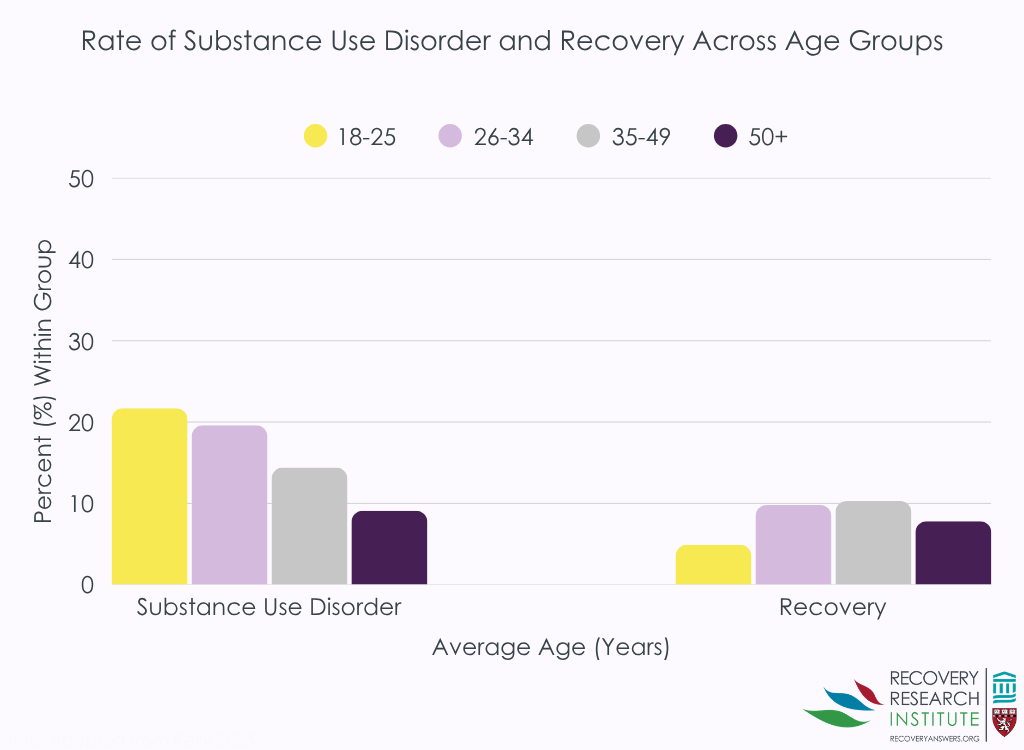
Many of the same groups with higher rates of substance use disorder also showed higher rates of recovery. Because recovery was measured across the full population rather than among people with substance use disorder, groups with higher rates of substance use disorder may also appear to have higher rates of recovery simply because more individuals in those groups have experienced substance use problems. Also, “recovery” is subjectively self-defined and may differ because different demographic groups think about recovery differently. For example, there are changing definitions of recovery in more recent years that may produce cohort effects whereby older adults with substance use disorder may have a different view on what constitutes “recovery” than young adults. Without an objective, standardized definition of “recovery”, it will remain difficult to estimate true “recovery” rates in population groups and subgroups.
WHAT ARE THE IMPLICATIONS OF THE STUDY FINDINGS?
This study provides a national snapshot of demographic differences in substance use disorder and recovery. Consistent with prior national studies of recovery, the findings suggest that self-reported recovery status is widespread but varies across demographic groups. Because “recovery” is subjectively defined, it could mean that personal interpretations of what “recovery” means may account for differences in recovery prevalence. That said, young adults showed the highest rates of substance use disorder but were least likely to self-identify as being in recovery, a pattern that is consistent with their relatively low levels of treatment engagement and prior research showing lower prevalence of recovery among young adults. This pattern suggests young adults may face unique barriers to recovery, may understand the diagnostic criteria questions differently (and thus are potentially over-diagnosed as having substance use disorder), or may still be early in the course of their substance use disorder. It is possible that longitudinal studies following emerging adults over time may reveal that many of these individuals eventually achieve recovery, though this was not examined in the current study.
Differences were also observed across gender, racial and ethnic groups, and sexual orientation. Men were more likely than women to report both substance use disorder and recovery. Native American, multiracial, and White adults showed elevated likelihood of both substance use disorder and recovery, while Asian adults had lower rates of both substance use disorder and recovery. Sexual minority adults, particularly bisexual individuals, showed higher rates of both substance use disorder and recovery than heterosexual adults. Collectively, these findings highlight the importance of culturally responsive prevention, treatment, and recovery support services that address the needs of diverse populations.
Strategies such as screening and brief intervention in settings where diverse young adults spend time (e.g., college campuses and primary care settings) may help identify substance use problems earlier. Digital tools such as chatbots and mobile interventions, as well as targeted messaging on social media, may help engage young adults and other populations who may be less likely to seek traditional services. These approaches, along with recovery support services tailored to diverse populations, may help reduce barriers to care and improve recovery outcomes.
However, because recovery was measured across the entire population rather than only among individuals with substance use disorder, the study cannot determine whether some groups are more or less likely to recover once substance use disorder develops. Future research examining recovery specifically among individuals with substance use disorder would help clarify whether recovery rates differ across demographic groups once substance use disorder develops.
BOTTOM LINE
Recovery from substance use disorder is common but varies across demographic groups. Young adults have the highest rates of substance use disorder and the lowest rates of recovery, with additional differences across gender, race and ethnicity, and sexual orientation. While there are many reasons potentially explaining young adults’ lower recovery rates, expanding early identification and engagement – including screening and brief intervention in settings such as colleges and primary care, targeted public health messaging and digital outreach (e.g., social media), and recovery supports tailored to diverse young adult populations – may help improve their recovery outcomes.
- For individuals and families seeking recovery: Recovery is common among people from all backgrounds, but individuals may face different challenges depending on their age, identity, and life circumstances. Young adults in particular may benefit from early intervention and recovery support. Resources designed for young people (e.g., collegiate recovery programs, young adult recovery meetings, or online recovery communities) may help make recovery feel more accessible and easier to maintain.
- For treatment professionals and treatment systems: Different demographic groups experience substance use disorder and recovery at different rates. Treatment providers and systems may benefit from developmentally appropriate services for young adults and culturally responsive approaches that address the needs of diverse populations. Expanding screening, outreach, and recovery support service offerings may help engage individuals earlier and improve long-term outcomes.
- For scientists: The findings point to the importance of distinguishing between individuals who do and do not recover after developing a substance use disorder. Future research should examine recovery rates specifically among individuals with a history of substance use disorder to clarify how recovery varies across demographic groups. Longitudinal studies are also needed to better understand recovery processes over time and to identify factors that may contribute to variation in recovery across populations.
- For policy makers: Policies that expand assertive outreach and access to treatment and recovery support services across diverse communities may help reduce disparities in substance use disorder and recovery. Investments in early intervention in primary care settings and services tailored to young adults and underserved populations may be particularly important for improving recovery outcomes.
CITATIONS
Kelly, L. M., Flori, J. N., Sabella, K. A., & Zajac, K. (2025). Demographic differences among adults and emerging adults with, without, and in recovery from alcohol and other drug use disorders. Substance Use & Misuse, 61(6), 818-828. doi: 10.1080/10826084.2025.2577281.