WHAT PROBLEM DOES THIS STUDY ADDRESS?
Recovery capital, or the available resources that can be used to support the initiation and maintenance of recovery from substance use disorder, is an important predictor of adult substance use disorder recovery outcomes. To date, however, little research has examined how recovery capital is associated with recovery outcomes among adolescents. A challenge of such work is that recovery capital is often measured by presence or absence of resources that are relevant to adults but not adolescents. For example, recovery capital includes elements like access to mutual-help groups, despite adolescents attending these services at lower rates than adults. As a result, existing measures may not adequately capture the types of recovery resources most relevant to adolescents. The lack of validated recovery capital measures specific to adolescents makes it difficult to determine whether recovery capital is related to substance use among this population and makes recovery care planning challenging. Another limitation is that recovery capital is typically assessed through self-report, which may not fully capture the broader community resources available to support recovery. This study examined how students self-reported recovery capital, and objective, county-level measure of the recovery environment called the Recovery Ecosystem Index, were associated with alcohol and cannabis use among students attending recovery high schools. The Recovery Ecosystem Index uses publicly available data on treatment services, recovery supports, and social and infrastructure conditions. Although the self-report measure was modified by the researchers for readability, neither measure was developed specifically for adolescents.
HOW WAS THIS STUDY CONDUCTED?
This cross-sectional study used data from the Systematic Evaluation of the Association of Recovery Schools project, which was designed to better understand the needs of students attending recovery high schools and to support recovery high school programming development. Recovery high schools are secondary schools that support students in recovery from substance use disorder while meeting state requirements for awarding a high school diploma. A total of 416 participants were recruited from 20 recovery high schools across the US between February 2022 and June 2023. All students enrolled at a recovery high school at the time the survey was conducted were eligible to participate. Surveys were administered to students on school grounds. Because participation was voluntary and only a subset of the nation’s recovery high schools took part, the findings may not generalize to all students in recovery or all recovery high schools.
Students self-reported the number of days they used alcohol or cannabis during the 90 days prior to the survey, and length of time enrolled in a recovery high school. Recovery capital was measured via the Assessment of Recovery Capital scale (adapted for readability among adolescents), a 50-item questionnaire which measures the internal and external resources available to those seeking to maintain recovery. In addition, students provided basic demographic information (e.g., race, age, and gender) and reported symptoms of possible mental health conditions (e.g., depression, anxiety, schizophrenia, etc.), and substance use problems.
The authors also assessed environmental recovery resources via the Recovery Ecosystem Index, an objective measure of county-level factors associated with substance use disorder recovery (including the number of substance use treatment facilities and average distance to medication assisted treatment providers) across all 50 states. Recovery Ecosystem Index scores were coded such that higher scores indicated more local recovery resources. Each school’s county was used as a proxy for students’ county of residence.
Data analysis included only students who provided complete alcohol/cannabis substance use data. The primary outcomes for this study were alcohol/cannabis abstinence (i.e., no reported use in the past 90 days) and number of days with alcohol/cannabis use during the prior 90 days.
WHAT DID THIS STUDY FIND?
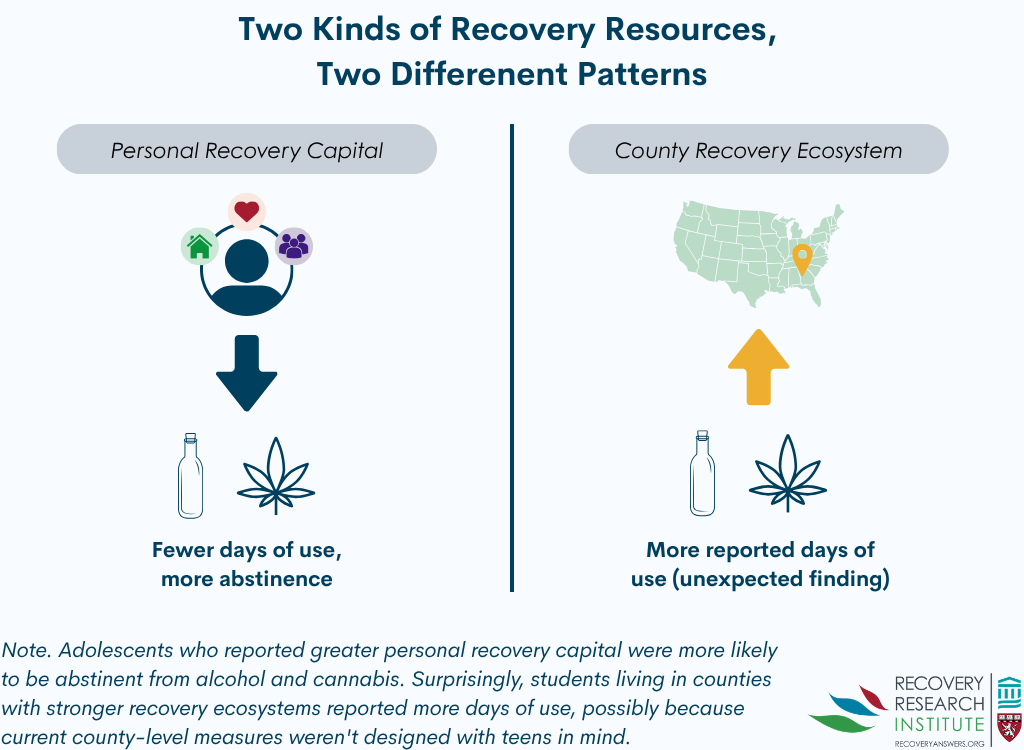
The first set of analyses examined the association between recovery capital and abstinence from alcohol and cannabis. Students with higher recovery capital scores were more likely to report abstinence from alcohol and cannabis. In addition, students enrolled in a recovery high school for at least 90 days were more likely to report being abstinent from alcohol/cannabis than those enrolled for less than 90 days. This link was stronger and more consistent for cannabis than for alcohol. Recovery ecosystem scores were not associated with either alcohol or cannabis abstinence.
The second set of analyses examined the number of days students reported using alcohol and the number of days they reported using cannabis during the past 90 days. Consistent with the abstinence findings, students with higher recovery capital scores reported fewer days of both alcohol use and cannabis use.
The analyses also showed, however, that as the recovery ecosystem scores increased, students reported more days of alcohol and cannabis use in the past 90 days. In addition, unlike the abstinence models, students who attended recovery high schools for at least 90 days reported more days of alcohol use than those who attended for less than 90 days. The reasons for these unexpected findings are unclear but may relate to limitations of the study methodology. For instance, the Recovery Ecosystem Index was not designed for adolescents and may not capture the youth-specific services and supports most relevant to their recovery. In addition, the researchers used each school’s county as a proxy for students’ county of residence, which may not accurately reflect the recovery resources available where the students live.
WHAT ARE THE IMPLICATIONS OF THE STUDY FINDINGS?
Among students attending recovery high schools, those with greater recovery capital reported less alcohol and cannabis use and were more likely to report abstinence from both substances. However, the findings for local recovery ecosystems and length of enrollment in recovery high school were mixed, underscoring the need for longitudinal research using youth-specific measures of recovery supports. These contradictory findings may have been the result of methodological issues. For example, students’ substance use data may have been inaccurate because they were uncomfortable self-reporting their behavior while at school. This may partially explain why longer enrollment in recovery high schools was associated with more days of substance use; perhaps students who had been enrolled for longer were more aware they would likely not be expelled for using substances. Alternatively, students who attend recovery high schools for longer may have more severe substance use disorders and remain enrolled in recovery high schools longer to receive continued support. Similarly, recovery ecosystem scores may not be a useful measure of environmental recovery support for adolescents. That is, the recovery ecosystem index measures numerous factors that, while important for adults (such as presence of adult drug courts in the county), are of less use to adolescents in recovery. It is also possible that students’ county of residence differed from their school’s county, which was used as a stand-in for where they actually lived. The exclusion of adolescent-specific treatment and recovery services in the metric may have impacted the results. Further work is needed to clarify how adolescent-appropriate environmental recovery resources and experiences at recovery high schools impact substance use among adolescents seeking recovery.
BOTTOM LINE
Among recovery high school students, greater individual recovery capital was associated with more abstinence and fewer days of alcohol and cannabis use. In contrast, students in counties with higher scores on the adult-oriented Recovery Ecosystem Index reported more days of alcohol and cannabis use, an unexpected finding that may indicate the measure does not adequately capture the youth-specific services and supports that matter for adolescent recovery. Because this was a cross-sectional study, these findings show associations and cannot establish whether recovery resources caused changes in substance use.
- For individuals and families seeking recovery: Recovery involves more than stopping substance use; it also involves building and maintaining resources that make recovery easier to sustain. In this study, recovery high school students with greater recovery capital reported more abstinence and fewer days of alcohol and cannabis use. The findings suggest the potential value of considering practical and social supports as part of recovery planning, including supportive relationships, reliable housing and transportation, meaningful school or community activities, and connections to recovery-supportive communities.
- For treatment professionals and treatment systems: Assessing an adolescent client’s recovery capital may give providers a practical way to identify strengths and gaps for individualized care planning. At the same time, this study is a reminder that adult-oriented measures of community recovery resources may not reflect what actually supports adolescent recovery, so treatment systems should be cautious about relying on these tools when evaluating a community’s fit for youth clients.
- For scientists: This study points to 2 concrete research priorities: developing recovery capital and community recovery resource measures tailored to adolescents’ developmental needs and using longitudinal designs to test whether recovery capital causally shapes, or is shaped by, adolescents’ service use and substance use over time.
- For policy makers: This study’s finding that county-level recovery resources were linked to more, not less, reported substance use should not be read as evidence that community recovery infrastructure is harmful; these measures were designed with adults in mind and likely don’t capture what actually supports teens. With only a small number of dedicated recovery high schools currently operating nationwide, policymakers may want to prioritize funding for youth-specific recovery supports reflecting adolescents’ actual needs.
CITATIONS
Jurinsky, J., George, S. S., Riccio, A. A., Finch, A. J., Kelly, J. F., & Hennessy, E. A. (2025). Recovery capital, the recovery ecosystem, and substance use among recovery high school students. Frontiers in Adolescent Medicine, 3, Article 1567567. doi: 10.3389/fradm.2025.1567567.