Mental health care settings remain good venues to engage people with substance use disorders
While substance use disorder and other mental illnesses frequently occur together, people living with both conditions are far more likely to seek help for their mental health than their substance use. This study analyzed national US data to examine the prevalence of mental health treatment seeking among people with substance use disorder.
Despite the availability of evidence-based treatments for substance use disorder, most individuals do not seek help. There are several potential barriers. The most common reason is that people do not yet recognize the extent of their substance use problem or perceive a need for treatment, while others can’t easily access specialized treatment, and for some, stigma remains a major barrier to getting help. Notably, people with substance use disorder appear more likely to seek treatment for mental health conditions than for their substance use issue. Understanding this disparity is important because it suggests a potential opportunity. If people with substance use disorder are already engaging with mental health providers, these clinicians might represent a strategic point of contact to identify individuals in need of substance use treatment and connect them to appropriate care, or even provide substance use related care themselves. This study examined the prevalence of mental health treatment seeking among people with substance use disorder to see if mental health care settings could potentially serve as a bridge to substance use disorder treatment.
HOW WAS THIS STUDY CONDUCTED?
This was a cross-sectional analysis of nationally representative data from over 92,000 US adults who participated in the National Survey on Drug Use and Health (NSDUH) in 2022 or 2023. Using this survey data, the study examined what percentage of people sought treatment for substance use, mental health, or both problems over the past year. The analysis considered how these rates varied based on whether individuals had only substance use disorder, only mental illness, or both conditions simultaneously. The researchers also looked at how treatment-seeking differed across different types of treatment (i.e., outpatient office visits, inpatient hospitalization, telehealth, and medications) and examined whether patterns varied by demographic characteristics including age, sex, race, and insurance type.
Treatment rates were assessed based on self-reported engagement with any past-year professional substance use or mental health services. Of note, for substance use, the study also examined whether including other services like mutual-help groups and peer recovery support services in their definition of substance use treatment made a difference to findings, but found the same results. The study sample was representative of the broader US population of adults 18 and older. Approximately 18% met criteria for substance use disorder in the past year, 23% met criteria for mental illness, and about 8% had both conditions.
WHAT DID THIS STUDY FIND?
There were low rates of substance use treatment despite significant need
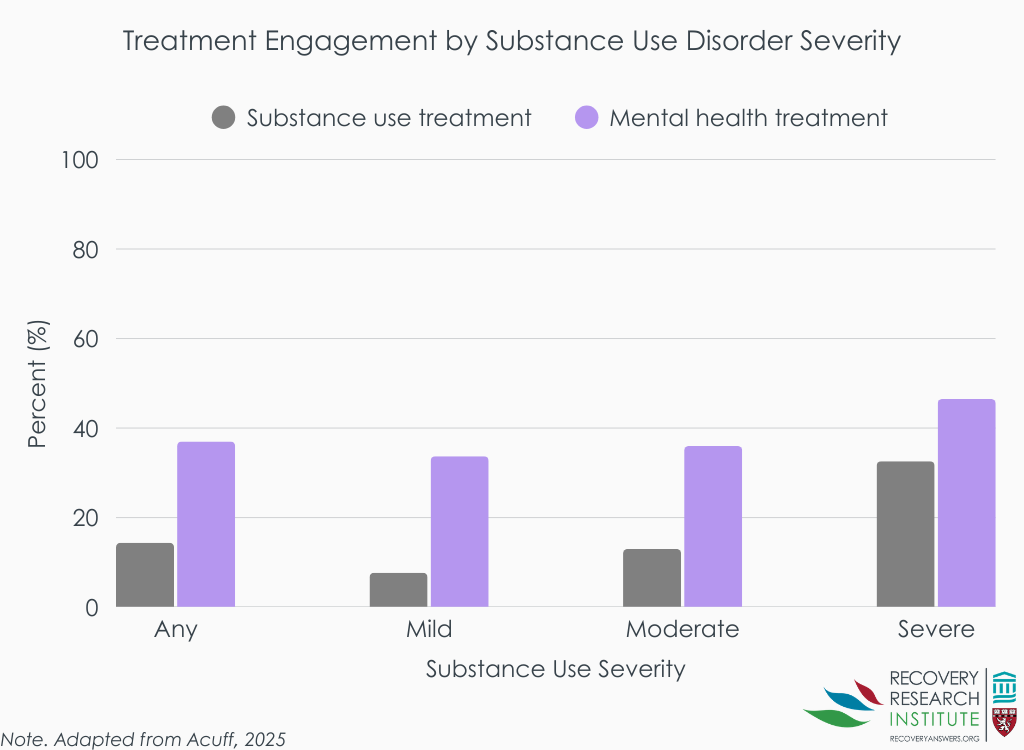
The researchers found the prevalence of past year substance use disorder in the US was 18%. However, only 5% of adults sought treatment for substance use in the past year, compared to 22% who sought treatment for mental illness. This disparity was even more striking among people with substance use disorder. Just 14% of individuals with substance use disorder received any substance use treatment, whereas 37% of people with substance use disorder received mental health treatment. This gap was seen across outpatient, telehealth, and medication modalities. Inpatient treatment was the main exception in that past yea as treatment rates were not markedly different between these groups. Indeed, as substance use severity increases (making inpatient treatment a better fit), this gap between substance use and mental health treatment decreases (see graph below), though it still persists.
Mental health treatment may be a gateway to substance use care
Notably, about 30% of people receiving mental health treatment had substance use disorder, suggesting these individuals were already in health care settings where substance use needs could potentially be identified and addressed. Among individuals with both substance use disorder and mental illness, nearly 57% sought treatment for mental illness, but only 21% sought treatment for substance use. This means that people with both conditions were 2.7 times more likely to access mental health care than substance use care.
Medication disparities are especially concerning
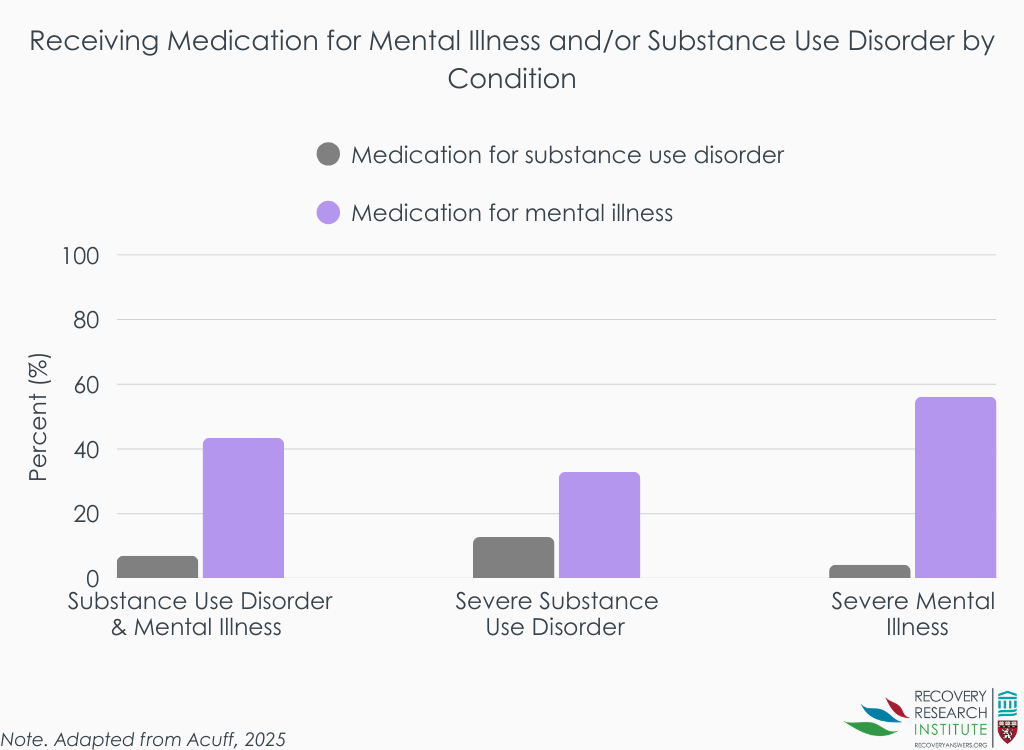
The difference between medication utilization for substance use disorder versus other mental illnesses was particularly pronounced (see graph below). Among people with both substance use disorder and a mental illness, 43% received medication for mental illness, but only 7% received medication for substance use. Even among individuals with severe substance use disorder, only 13% received medication-based treatment, compared to 56% of people with severe mental illness.
These patterns were fairly consistent across all demographic groups, but some important differences were observed
Among people with substance use disorder, the pattern of seeking mental health treatment more than substance use treatment held across all demographic groups. However, some important disparities emerged. Women with substance use disorder were 2.5 times more likely than men to seek mental health treatment, though both sexes sought substance use treatment at similar rates. Individuals from racial and ethnic minority groups showed lower rates of treatment-seeking for both problems compared to non-Hispanic White Americans, pointing to persistent health care access disparities. Perhaps not surprisingly, people without health insurance also had strikingly low treatment-seeking rates for both conditions, highlighting a significant care gap in the US.
WHAT ARE THE IMPLICATIONS OF THE STUDY FINDINGS?
This research reveals an important paradox. While people with substance use disorder clearly can and do engage with health care systems, they do so predominantly for mental health concerns rather than their substance use problem. This challenges the common assumption that barriers to substance use treatment are primarily about health care system avoidance. Rather, these findings suggest that the nature of substance use disorder may present a unique barrier within health care settings.
Among other reasons, stigma surrounding substance use and substance use treatment remains pervasive, even among health care providers, which may in part explain the treatment disparities observed by the researchers. Some providers working in mental health settings may feel unprepared or uncomfortable addressing substance use disorder, particularly when prescribing medications. This is notable given that effective medications exist for opioid and alcohol use disorders, yet their use remains far less common than psychiatric medications.
The medication disparity reported by these researchers is particularly concerning. The researchers note that while numerous medications have been approved for treating depression, only five medications have FDA approval for opioid use disorder treatment, three for alcohol use disorder, and none for stimulant or cannabis use disorders. This limited therapeutic arsenal, combined with lingering stigma, are likely contributing to lower medication utilization in substance use treatment.
This study also highlights a critical opportunity, which has been noted for many years. Since many people with substance use disorder are already accessing mental health care, these treatment settings represent an ideal location to integrate screening, brief intervention, and connection to substance use treatment. This type of study once again highlights this need to do screening in mental health settings for substance use disorder. Current treatment systems remain largely siloed, with many mental health and substance use services operating separately.
This was a cross-sectional study, meaning data were collected at a single point in time, so it can’t be determined if people seek mental health treatment first and then substance use treatment, or vice versa. It also precludes identifying causal relationships between variables.
The study relied on self-reported information about diagnosis and treatment-seeking rather than clinical interviews or medical records, which may result in underestimation or misreporting of substance use disorder and mental illness prevalence and treatment engagement.
The findings are based on individuals’ reported receipt of treatment services but do not capture important contextual information about treatment quality, outcomes, or why individuals did or did not seek treatment.
The researchers’ analysis did not examine patterns for specific substances separately or determine whether findings differed between individuals with alcohol use disorder versus those with other drug use disorders.
Although the sample is nationally representative, which is a major strength, persons experiencing homelessness and those incarcerated are underrepresented, which may skew estimates given the higher prevalence of substance use disorder in these populations.
BOTTOM LINE
The researchers’ findings reveal a substantial treatment engagement gap for substance use disorder relative to mental illness among people with substance use disorder. Individuals with substance use disorder appear more likely to seek treatment for mental health than for substance use, even if they have only a substance use disorder and no diagnosed mental illness. This highlights the opportunity to identify and connect individuals to substance use disorder treatment via existing mental health care settings. These findings underscore the need for integrated treatment approaches and suggest that, for those with substance use disorder, difficulties with mental health may be easier for them to recognize, acknowledge, and talk about, than associated or underlying substance use problems.
For individuals and families seeking recovery: The researchers’ findings highlight a substantial treatment engagement gap for individuals with substance use disorder and suggest that mental health treatment settings could be a place to engage individuals with substance use disorder in appropriate care. There will usually be benefits with appropriate referral to specialized substance use disorder treatment programs, but concurrent within-program treatment of both substance use disorder and mental illness can also be very effective.
For treatment professionals and treatment systems: The researchers’ findings highlight a substantial treatment engagement gap for individuals with substance use disorder and highlight the fact that mental health treatment settings are potentially good venues to identify and engage individuals with substance use disorder in appropriate care. Integrated care models, where substance use and mental health treatment are delivered in the same setting by coordinated teams, could help to engage more individuals in substance use disorder treatment. Additionally, system-level changes to reduce siloing between substance use and mental health services would likely increase identification and treatment engagement.
For scientists: The researchers’ cross-sectional findings highlight a substantial treatment engagement gap for individuals with substance use disorder. Prospective studies should examine whether early mental health engagement helps reduce substance use on its own or facilitates subsequent substance use treatment entry and whether integrated care improves outcomes versus fragmented approaches. The substantial medication disparities noted here also warrant further investigation into barriers to pharmacotherapy adoption. Future work should also continue to explore whether treatment-seeking patterns differ by specific substance (alcohol, opioid, stimulant) and examine mechanisms underlying disparities in minoritized populations.
For policy makers: The researchers’ findings highlight a substantial treatment engagement gap for individuals with substance use disorder. Reimbursement structures that support coordination between substance use and mental health providers could reduce care fragmentation. Expanded funding for medication treatment programs and efforts to normalize medications for substance use disorder through provider education and public awareness campaigns may help close this treatment gap. Additionally, policies addressing health insurance gaps are essential, given the extremely low treatment-seeking rates among uninsured individuals with substance use disorder.
Despite the availability of evidence-based treatments for substance use disorder, most individuals do not seek help. There are several potential barriers. The most common reason is that people do not yet recognize the extent of their substance use problem or perceive a need for treatment, while others can’t easily access specialized treatment, and for some, stigma remains a major barrier to getting help. Notably, people with substance use disorder appear more likely to seek treatment for mental health conditions than for their substance use issue. Understanding this disparity is important because it suggests a potential opportunity. If people with substance use disorder are already engaging with mental health providers, these clinicians might represent a strategic point of contact to identify individuals in need of substance use treatment and connect them to appropriate care, or even provide substance use related care themselves. This study examined the prevalence of mental health treatment seeking among people with substance use disorder to see if mental health care settings could potentially serve as a bridge to substance use disorder treatment.
HOW WAS THIS STUDY CONDUCTED?
This was a cross-sectional analysis of nationally representative data from over 92,000 US adults who participated in the National Survey on Drug Use and Health (NSDUH) in 2022 or 2023. Using this survey data, the study examined what percentage of people sought treatment for substance use, mental health, or both problems over the past year. The analysis considered how these rates varied based on whether individuals had only substance use disorder, only mental illness, or both conditions simultaneously. The researchers also looked at how treatment-seeking differed across different types of treatment (i.e., outpatient office visits, inpatient hospitalization, telehealth, and medications) and examined whether patterns varied by demographic characteristics including age, sex, race, and insurance type.
Treatment rates were assessed based on self-reported engagement with any past-year professional substance use or mental health services. Of note, for substance use, the study also examined whether including other services like mutual-help groups and peer recovery support services in their definition of substance use treatment made a difference to findings, but found the same results. The study sample was representative of the broader US population of adults 18 and older. Approximately 18% met criteria for substance use disorder in the past year, 23% met criteria for mental illness, and about 8% had both conditions.
WHAT DID THIS STUDY FIND?
There were low rates of substance use treatment despite significant need
The researchers found the prevalence of past year substance use disorder in the US was 18%. However, only 5% of adults sought treatment for substance use in the past year, compared to 22% who sought treatment for mental illness. This disparity was even more striking among people with substance use disorder. Just 14% of individuals with substance use disorder received any substance use treatment, whereas 37% of people with substance use disorder received mental health treatment. This gap was seen across outpatient, telehealth, and medication modalities. Inpatient treatment was the main exception in that past yea as treatment rates were not markedly different between these groups. Indeed, as substance use severity increases (making inpatient treatment a better fit), this gap between substance use and mental health treatment decreases (see graph below), though it still persists.
Mental health treatment may be a gateway to substance use care
Notably, about 30% of people receiving mental health treatment had substance use disorder, suggesting these individuals were already in health care settings where substance use needs could potentially be identified and addressed. Among individuals with both substance use disorder and mental illness, nearly 57% sought treatment for mental illness, but only 21% sought treatment for substance use. This means that people with both conditions were 2.7 times more likely to access mental health care than substance use care.
Medication disparities are especially concerning
The difference between medication utilization for substance use disorder versus other mental illnesses was particularly pronounced (see graph below). Among people with both substance use disorder and a mental illness, 43% received medication for mental illness, but only 7% received medication for substance use. Even among individuals with severe substance use disorder, only 13% received medication-based treatment, compared to 56% of people with severe mental illness.
These patterns were fairly consistent across all demographic groups, but some important differences were observed
Among people with substance use disorder, the pattern of seeking mental health treatment more than substance use treatment held across all demographic groups. However, some important disparities emerged. Women with substance use disorder were 2.5 times more likely than men to seek mental health treatment, though both sexes sought substance use treatment at similar rates. Individuals from racial and ethnic minority groups showed lower rates of treatment-seeking for both problems compared to non-Hispanic White Americans, pointing to persistent health care access disparities. Perhaps not surprisingly, people without health insurance also had strikingly low treatment-seeking rates for both conditions, highlighting a significant care gap in the US.
WHAT ARE THE IMPLICATIONS OF THE STUDY FINDINGS?
This research reveals an important paradox. While people with substance use disorder clearly can and do engage with health care systems, they do so predominantly for mental health concerns rather than their substance use problem. This challenges the common assumption that barriers to substance use treatment are primarily about health care system avoidance. Rather, these findings suggest that the nature of substance use disorder may present a unique barrier within health care settings.
Among other reasons, stigma surrounding substance use and substance use treatment remains pervasive, even among health care providers, which may in part explain the treatment disparities observed by the researchers. Some providers working in mental health settings may feel unprepared or uncomfortable addressing substance use disorder, particularly when prescribing medications. This is notable given that effective medications exist for opioid and alcohol use disorders, yet their use remains far less common than psychiatric medications.
The medication disparity reported by these researchers is particularly concerning. The researchers note that while numerous medications have been approved for treating depression, only five medications have FDA approval for opioid use disorder treatment, three for alcohol use disorder, and none for stimulant or cannabis use disorders. This limited therapeutic arsenal, combined with lingering stigma, are likely contributing to lower medication utilization in substance use treatment.
This study also highlights a critical opportunity, which has been noted for many years. Since many people with substance use disorder are already accessing mental health care, these treatment settings represent an ideal location to integrate screening, brief intervention, and connection to substance use treatment. This type of study once again highlights this need to do screening in mental health settings for substance use disorder. Current treatment systems remain largely siloed, with many mental health and substance use services operating separately.
This was a cross-sectional study, meaning data were collected at a single point in time, so it can’t be determined if people seek mental health treatment first and then substance use treatment, or vice versa. It also precludes identifying causal relationships between variables.
The study relied on self-reported information about diagnosis and treatment-seeking rather than clinical interviews or medical records, which may result in underestimation or misreporting of substance use disorder and mental illness prevalence and treatment engagement.
The findings are based on individuals’ reported receipt of treatment services but do not capture important contextual information about treatment quality, outcomes, or why individuals did or did not seek treatment.
The researchers’ analysis did not examine patterns for specific substances separately or determine whether findings differed between individuals with alcohol use disorder versus those with other drug use disorders.
Although the sample is nationally representative, which is a major strength, persons experiencing homelessness and those incarcerated are underrepresented, which may skew estimates given the higher prevalence of substance use disorder in these populations.
BOTTOM LINE
The researchers’ findings reveal a substantial treatment engagement gap for substance use disorder relative to mental illness among people with substance use disorder. Individuals with substance use disorder appear more likely to seek treatment for mental health than for substance use, even if they have only a substance use disorder and no diagnosed mental illness. This highlights the opportunity to identify and connect individuals to substance use disorder treatment via existing mental health care settings. These findings underscore the need for integrated treatment approaches and suggest that, for those with substance use disorder, difficulties with mental health may be easier for them to recognize, acknowledge, and talk about, than associated or underlying substance use problems.
For individuals and families seeking recovery: The researchers’ findings highlight a substantial treatment engagement gap for individuals with substance use disorder and suggest that mental health treatment settings could be a place to engage individuals with substance use disorder in appropriate care. There will usually be benefits with appropriate referral to specialized substance use disorder treatment programs, but concurrent within-program treatment of both substance use disorder and mental illness can also be very effective.
For treatment professionals and treatment systems: The researchers’ findings highlight a substantial treatment engagement gap for individuals with substance use disorder and highlight the fact that mental health treatment settings are potentially good venues to identify and engage individuals with substance use disorder in appropriate care. Integrated care models, where substance use and mental health treatment are delivered in the same setting by coordinated teams, could help to engage more individuals in substance use disorder treatment. Additionally, system-level changes to reduce siloing between substance use and mental health services would likely increase identification and treatment engagement.
For scientists: The researchers’ cross-sectional findings highlight a substantial treatment engagement gap for individuals with substance use disorder. Prospective studies should examine whether early mental health engagement helps reduce substance use on its own or facilitates subsequent substance use treatment entry and whether integrated care improves outcomes versus fragmented approaches. The substantial medication disparities noted here also warrant further investigation into barriers to pharmacotherapy adoption. Future work should also continue to explore whether treatment-seeking patterns differ by specific substance (alcohol, opioid, stimulant) and examine mechanisms underlying disparities in minoritized populations.
For policy makers: The researchers’ findings highlight a substantial treatment engagement gap for individuals with substance use disorder. Reimbursement structures that support coordination between substance use and mental health providers could reduce care fragmentation. Expanded funding for medication treatment programs and efforts to normalize medications for substance use disorder through provider education and public awareness campaigns may help close this treatment gap. Additionally, policies addressing health insurance gaps are essential, given the extremely low treatment-seeking rates among uninsured individuals with substance use disorder.
Despite the availability of evidence-based treatments for substance use disorder, most individuals do not seek help. There are several potential barriers. The most common reason is that people do not yet recognize the extent of their substance use problem or perceive a need for treatment, while others can’t easily access specialized treatment, and for some, stigma remains a major barrier to getting help. Notably, people with substance use disorder appear more likely to seek treatment for mental health conditions than for their substance use issue. Understanding this disparity is important because it suggests a potential opportunity. If people with substance use disorder are already engaging with mental health providers, these clinicians might represent a strategic point of contact to identify individuals in need of substance use treatment and connect them to appropriate care, or even provide substance use related care themselves. This study examined the prevalence of mental health treatment seeking among people with substance use disorder to see if mental health care settings could potentially serve as a bridge to substance use disorder treatment.
HOW WAS THIS STUDY CONDUCTED?
This was a cross-sectional analysis of nationally representative data from over 92,000 US adults who participated in the National Survey on Drug Use and Health (NSDUH) in 2022 or 2023. Using this survey data, the study examined what percentage of people sought treatment for substance use, mental health, or both problems over the past year. The analysis considered how these rates varied based on whether individuals had only substance use disorder, only mental illness, or both conditions simultaneously. The researchers also looked at how treatment-seeking differed across different types of treatment (i.e., outpatient office visits, inpatient hospitalization, telehealth, and medications) and examined whether patterns varied by demographic characteristics including age, sex, race, and insurance type.
Treatment rates were assessed based on self-reported engagement with any past-year professional substance use or mental health services. Of note, for substance use, the study also examined whether including other services like mutual-help groups and peer recovery support services in their definition of substance use treatment made a difference to findings, but found the same results. The study sample was representative of the broader US population of adults 18 and older. Approximately 18% met criteria for substance use disorder in the past year, 23% met criteria for mental illness, and about 8% had both conditions.
WHAT DID THIS STUDY FIND?
There were low rates of substance use treatment despite significant need
The researchers found the prevalence of past year substance use disorder in the US was 18%. However, only 5% of adults sought treatment for substance use in the past year, compared to 22% who sought treatment for mental illness. This disparity was even more striking among people with substance use disorder. Just 14% of individuals with substance use disorder received any substance use treatment, whereas 37% of people with substance use disorder received mental health treatment. This gap was seen across outpatient, telehealth, and medication modalities. Inpatient treatment was the main exception in that past yea as treatment rates were not markedly different between these groups. Indeed, as substance use severity increases (making inpatient treatment a better fit), this gap between substance use and mental health treatment decreases (see graph below), though it still persists.
Mental health treatment may be a gateway to substance use care
Notably, about 30% of people receiving mental health treatment had substance use disorder, suggesting these individuals were already in health care settings where substance use needs could potentially be identified and addressed. Among individuals with both substance use disorder and mental illness, nearly 57% sought treatment for mental illness, but only 21% sought treatment for substance use. This means that people with both conditions were 2.7 times more likely to access mental health care than substance use care.
Medication disparities are especially concerning
The difference between medication utilization for substance use disorder versus other mental illnesses was particularly pronounced (see graph below). Among people with both substance use disorder and a mental illness, 43% received medication for mental illness, but only 7% received medication for substance use. Even among individuals with severe substance use disorder, only 13% received medication-based treatment, compared to 56% of people with severe mental illness.
These patterns were fairly consistent across all demographic groups, but some important differences were observed
Among people with substance use disorder, the pattern of seeking mental health treatment more than substance use treatment held across all demographic groups. However, some important disparities emerged. Women with substance use disorder were 2.5 times more likely than men to seek mental health treatment, though both sexes sought substance use treatment at similar rates. Individuals from racial and ethnic minority groups showed lower rates of treatment-seeking for both problems compared to non-Hispanic White Americans, pointing to persistent health care access disparities. Perhaps not surprisingly, people without health insurance also had strikingly low treatment-seeking rates for both conditions, highlighting a significant care gap in the US.
WHAT ARE THE IMPLICATIONS OF THE STUDY FINDINGS?
This research reveals an important paradox. While people with substance use disorder clearly can and do engage with health care systems, they do so predominantly for mental health concerns rather than their substance use problem. This challenges the common assumption that barriers to substance use treatment are primarily about health care system avoidance. Rather, these findings suggest that the nature of substance use disorder may present a unique barrier within health care settings.
Among other reasons, stigma surrounding substance use and substance use treatment remains pervasive, even among health care providers, which may in part explain the treatment disparities observed by the researchers. Some providers working in mental health settings may feel unprepared or uncomfortable addressing substance use disorder, particularly when prescribing medications. This is notable given that effective medications exist for opioid and alcohol use disorders, yet their use remains far less common than psychiatric medications.
The medication disparity reported by these researchers is particularly concerning. The researchers note that while numerous medications have been approved for treating depression, only five medications have FDA approval for opioid use disorder treatment, three for alcohol use disorder, and none for stimulant or cannabis use disorders. This limited therapeutic arsenal, combined with lingering stigma, are likely contributing to lower medication utilization in substance use treatment.
This study also highlights a critical opportunity, which has been noted for many years. Since many people with substance use disorder are already accessing mental health care, these treatment settings represent an ideal location to integrate screening, brief intervention, and connection to substance use treatment. This type of study once again highlights this need to do screening in mental health settings for substance use disorder. Current treatment systems remain largely siloed, with many mental health and substance use services operating separately.
This was a cross-sectional study, meaning data were collected at a single point in time, so it can’t be determined if people seek mental health treatment first and then substance use treatment, or vice versa. It also precludes identifying causal relationships between variables.
The study relied on self-reported information about diagnosis and treatment-seeking rather than clinical interviews or medical records, which may result in underestimation or misreporting of substance use disorder and mental illness prevalence and treatment engagement.
The findings are based on individuals’ reported receipt of treatment services but do not capture important contextual information about treatment quality, outcomes, or why individuals did or did not seek treatment.
The researchers’ analysis did not examine patterns for specific substances separately or determine whether findings differed between individuals with alcohol use disorder versus those with other drug use disorders.
Although the sample is nationally representative, which is a major strength, persons experiencing homelessness and those incarcerated are underrepresented, which may skew estimates given the higher prevalence of substance use disorder in these populations.
BOTTOM LINE
The researchers’ findings reveal a substantial treatment engagement gap for substance use disorder relative to mental illness among people with substance use disorder. Individuals with substance use disorder appear more likely to seek treatment for mental health than for substance use, even if they have only a substance use disorder and no diagnosed mental illness. This highlights the opportunity to identify and connect individuals to substance use disorder treatment via existing mental health care settings. These findings underscore the need for integrated treatment approaches and suggest that, for those with substance use disorder, difficulties with mental health may be easier for them to recognize, acknowledge, and talk about, than associated or underlying substance use problems.
For individuals and families seeking recovery: The researchers’ findings highlight a substantial treatment engagement gap for individuals with substance use disorder and suggest that mental health treatment settings could be a place to engage individuals with substance use disorder in appropriate care. There will usually be benefits with appropriate referral to specialized substance use disorder treatment programs, but concurrent within-program treatment of both substance use disorder and mental illness can also be very effective.
For treatment professionals and treatment systems: The researchers’ findings highlight a substantial treatment engagement gap for individuals with substance use disorder and highlight the fact that mental health treatment settings are potentially good venues to identify and engage individuals with substance use disorder in appropriate care. Integrated care models, where substance use and mental health treatment are delivered in the same setting by coordinated teams, could help to engage more individuals in substance use disorder treatment. Additionally, system-level changes to reduce siloing between substance use and mental health services would likely increase identification and treatment engagement.
For scientists: The researchers’ cross-sectional findings highlight a substantial treatment engagement gap for individuals with substance use disorder. Prospective studies should examine whether early mental health engagement helps reduce substance use on its own or facilitates subsequent substance use treatment entry and whether integrated care improves outcomes versus fragmented approaches. The substantial medication disparities noted here also warrant further investigation into barriers to pharmacotherapy adoption. Future work should also continue to explore whether treatment-seeking patterns differ by specific substance (alcohol, opioid, stimulant) and examine mechanisms underlying disparities in minoritized populations.
For policy makers: The researchers’ findings highlight a substantial treatment engagement gap for individuals with substance use disorder. Reimbursement structures that support coordination between substance use and mental health providers could reduce care fragmentation. Expanded funding for medication treatment programs and efforts to normalize medications for substance use disorder through provider education and public awareness campaigns may help close this treatment gap. Additionally, policies addressing health insurance gaps are essential, given the extremely low treatment-seeking rates among uninsured individuals with substance use disorder.