“It works if you work it”: Different mutual-help groups may offer similar benefit for those who get involved

12-step groups like Alcoholics Anonymous (AA) have long been the go-to support option for people seeking recovery from alcohol problems, but attendance at newer options like SMART, LifeRing, and Women for Sobriety are on the rise. Their growth has further accelerated since the COVID-19 pandemic expanded access to online meetings. This study examined whether participation in these newer options helps improve alcohol abstinence as much as 12-step groups.

Stay on the frontiers of
recovery science
with the free, monthly
Recovery Bulletin

l

WHAT PROBLEM DOES THIS STUDY ADDRESS?

Alcoholics Anonymous (AA) has several million members in 180 countries, has continuously operated for 91 years, and is the world’s most widely available and widely used mutual-help organization. As the first 12-step program, it has given rise to numerous other 12-step programs like Narcotics Anonymous. Participation in AA, and clinical interventions that facilitate AA participation, have been shown to increase alcohol use disorder remission rates and increase continuous alcohol abstinence more than first-line clinical interventions like cognitive behavioral therapy (CBT). While other types of mutual-help groups have emerged, these have received far less research attention. Investigation into the effects of participation in second-wave (i.e., newer, non-12-step) mutual-help groups such as SMART Recovery, LifeRing Secular Recovery, and Women for Sobriety, is important because some adults prefer approaches that emphasize secular support, self-directed change, or women-specific approaches. SMART Recovery offers practical tools grounded in cognitive-behavioral principles to help people manage urges and change addictive behaviors. LifeRing emphasizes abstinence, secular peer support, and developing a personal recovery plan. Women for Sobriety’s philosophy is based on 13 acceptance statements to support abstinence, emotional growth, and self-esteem among women. The present study examined how participation in these second-wave mutual-help groups compare to 12-step participation on likelihood of alcohol abstinence and reductions in alcohol problems.


HOW WAS THIS STUDY CONDUCTED?

This observational study followed 1,152 US adults with a self-reported lifetime alcohol use disorder who had attended at least 1 meeting of AA or other 12-step group, SMART Recovery, LifeRing, and/or Women for Sobriety in the past 30 days. Of the 1,152 participants who completed the baseline survey, about 82% (943 people) had enough follow-up data to be included in the main analyses. Follow-up response rates were otherwise high, ranging from 81–88% at 6 and 12 months. At the time of data collection, each of these mutual-help groups were abstinence focused, though SMART subsequently shifted to a broader range of recovery goals, including reduced use, so the study findings may not fully reflect how SMART operates today.

Data from two national cohorts (2015 and 2021) were combined, and participants completed surveys at baseline, 6 months, and 12 months. Participants attending only SMART Recovery, LifeRing, or Women for Sobriety tended to have higher education and incomes and were less likely to report multiple lifetime drug problems than those attending only 12-step groups, which is consistent with previous research. Differences in age, gender, race/ethnicity, marital status, and recovery goals varied by group. When examining differences between mutual-help groups, analyses statistically controlled for these demographic and clinical characteristics, along with prior specialty treatment, lifetime alcohol use disorder severity, baseline alcohol outcomes, study cohort, and follow-up survey wave. Because the study was conducted online, researchers used a careful screening process to remove likely fraudulent or low-quality survey responses before analysis.

The researchers examined whether the type of mutual-help group attended (12-step only, SMART only, LifeRing only, Women for Sobriety only, or multiple groups) and the level of active involvement predicted alcohol outcomes at both 6- and 12-month follow-ups.

Active involvement included not only meeting attendance, but also having a regular (e.g., “home”) group, having someone to call for support (e.g., “sponsor” or other mentor), leading meetings (e.g., “chairing”), and volunteering or performing service activities within the group. The analyses examined whether group attendance and involvement at baseline predicted alcohol outcomes reported at 6 months, and whether attendance and involvement at 6 months predicted outcomes reported at 12 months. At each follow-up, abstinence and alcohol-related problems covered the preceding 6 months, while heavy-drinking days covered the preceding 30 days. At each follow-up, outcomes included alcohol abstinence and any alcohol related problems during the preceding 6 months, and the number of heavy drinking days during the preceding 30 days. Heavy drinking was defined as consuming 5 or more drinks for men or 4 or more drinks for women in a single day.


WHAT DID THIS STUDY FIND?

Alcohol use variables at the start of the study were generally similar across groups, although participants in some second-wave groups reported more alcohol-related problems at baseline. These comparisons describe existing attendees, not outcomes measured after an equal period of group participation. Older participants and those with a lifetime goal of abstinence tended to be more actively involved in their mutual-help groups. More active participation was also observed among individuals with a history of specialty addiction treatment, multiple lifetime drug problems, and those who were unemployed.

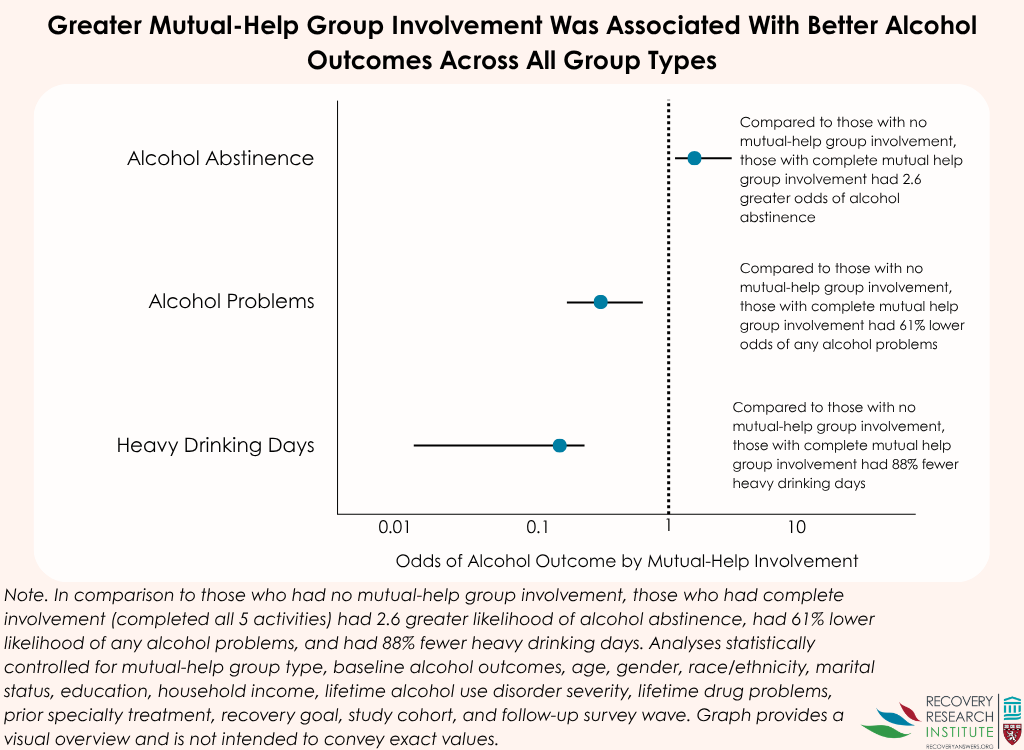
Overall, higher involvement in any mutual-help group was related to higher odds of alcohol abstinence, lower odds of any alcohol problem, and fewer heavy drinking days at follow-up surveys. This was true no matter which mutual-help group participants attended. Individuals that actively participated by attending 4+ meetings per month, having a regular (“home”) group, having someone to call for support (“sponsor”), leading meetings (“chairing”), or volunteering within the group were nearly 3 times as likely to report alcohol abstinence at follow-up compared to those who did none of these things. Similarly, participants who were more actively involved in any group were less than half as likely to report any alcohol problems compared to those who weren’t. Regarding heavy drinking days, those that actively participated reported 88% fewer heavy drinking days. Alcohol outcomes among adults across second-wave groups were similar to those attending a 12-step group.

WHAT ARE THE IMPLICATIONS OF THE STUDY FINDINGS?

The most important finding from this study was that active involvement – attendance and other program activities – in a mutual-help group mattered more than which mutual-help group participants attended. Greater active involvement consistently predicted higher odds of alcohol abstinence, lower odds of any alcohol-related problem, and fewer heavy drinking days. As a 12-step group, AA participation produces similar outcomes to first-line clinical interventions for supporting alcohol abstinence; this study suggests that similar benefits are associated with active involvement in second-wave mutual-help groups, including SMART Recovery, LifeRing, and Women for Sobriety for those that choose them. These findings support offering adults with alcohol use disorder a choice among mutual-help groups and encouraging active participation in groups that best aligns with their preferences, values, and recovery goals.

This may be particularly important for treatment providers, families, courts, and others referring individuals to community-based recovery supports. However, participants chose which groups to attend, and those attending only second-wave groups tended to have higher education and incomes and fewer lifetime drug problems than those attending only 12-step groups. Although the analyses statistically accounted for these differences, the study cannot establish whether the groups offer comparable benefits specifically for people with lower incomes or education, or more treatment and co-occurring drug problem histories. It’s unclear for example whether randomizing individuals to these differing mutual-help offerings would result in the same outcomes, or whether people with the more severe histories and less recovery capital might do better with the high-density social support offered in 12-step groups like AA, which appears to naturally engage more of these types of individuals. Additionally, at baseline, participants in the 12-step-only group had higher levels of active involvement. Thus, while mutual-help involvement is associated with improved alcohol outcomes for all of the mutual-help group types investigated here, 12-step groups may either offer more opportunities, or otherwise provide more encouragement for this higher level of participation. The study also found that younger adults overall had the lowest levels of active participation, suggesting engagement challenges for this age group. That said, young people have been shown to benefit well from participation in mutual-help resources.

An important study element should be considered when interpreting these findings. As is true for most research on mutual-help groups, assessments were conducted several months apart. Analyses with these longer time lags could miss more immediate or short-lived associations between group participation and drinking (e.g., the effect of reaching out to a sponsor when experiencing a craving). They also could not separate the contribution of earlier involvement from continued participation during the intervening months. Future research should continue identifying strategies to increase active participation and better understand what features of mutual-help groups promote sustained engagement and recovery and the timeline over which any such benefits occur.


BOTTOM LINE

For adults with alcohol use disorder, active involvement, attendance and other program activities, was associated with benefits in alcohol abstinence, problems, and heavy drinking across all mutual-help group types examined in this study, including 12-step, SMART, Women for Sobriety, and LifeRing. Adults attending only second-wave groups tended to have higher education and incomes and fewer lifetime drug problems than those attending only 12-step groups; future research should examine whether groups offer comparable benefits for people across all backgrounds.


  • For individuals and families seeking recovery: If you or a loved one is considering attending a mutual-help group to support alcohol use disorder recovery, the findings from this study suggest that finding a group that’s a good fit for your background and personal preferences along with active involvement (e.g., attending regularly, working with a sponsor or mentor, building supportive friendships, or volunteering within the group) could be helpful.
  • For treatment professionals and treatment systems: The findings from this study suggest that increased active involvement in a variety of mutual-help groups is helpful. Because a good fit between a person and their group may encourage deeper involvement, offering adults a choice among several mutual-help groups could help more people engage actively.
  • For scientists: This longitudinal, observational study among adults with lifetime alcohol use disorder found in time-lagged analyses that level of involvement in mutual-help groups was associated with benefits in terms of alcohol abstinence, reduced problems, and fewer heavy drinking days irrespective of which group individuals attended including both 12-step and second-wave groups. Future studies might examine whether there are differences in mechanisms of behavior change explaining benefits for each type of group, to inform clinical referral strategies.
  • For policy makers: Expanding access and referrals to all mutual-help groups, including both 12-step group and newer second-wave groups like SMARAT, may reduce the disease burden of alcohol use disorder by helping engage more people with these community-based options. Findings also suggest that policies should support active involvement in mutual-help groups, including attendance and other program activities like working with a sponsor or mentor, rather than prioritize one group type over another.

CITATIONS

Zemore, S. E., Lui, C. K., Mericle, A. A., Li, L., Martinez, P., & Timko, C. (2026). Second-wave mutual-help groups: Examining effectiveness for individuals with alcohol use disorders in the longitudinal, US national PAL Study cohorts. International Journal of Drug Policy, 147. doi: 10.1016/j.drugpo.2025.104921.



Stay on the Frontiers of
recovery science
with the free, monthly
Recovery Bulletin

l

WHAT PROBLEM DOES THIS STUDY ADDRESS?

Alcoholics Anonymous (AA) has several million members in 180 countries, has continuously operated for 91 years, and is the world’s most widely available and widely used mutual-help organization. As the first 12-step program, it has given rise to numerous other 12-step programs like Narcotics Anonymous. Participation in AA, and clinical interventions that facilitate AA participation, have been shown to increase alcohol use disorder remission rates and increase continuous alcohol abstinence more than first-line clinical interventions like cognitive behavioral therapy (CBT). While other types of mutual-help groups have emerged, these have received far less research attention. Investigation into the effects of participation in second-wave (i.e., newer, non-12-step) mutual-help groups such as SMART Recovery, LifeRing Secular Recovery, and Women for Sobriety, is important because some adults prefer approaches that emphasize secular support, self-directed change, or women-specific approaches. SMART Recovery offers practical tools grounded in cognitive-behavioral principles to help people manage urges and change addictive behaviors. LifeRing emphasizes abstinence, secular peer support, and developing a personal recovery plan. Women for Sobriety’s philosophy is based on 13 acceptance statements to support abstinence, emotional growth, and self-esteem among women. The present study examined how participation in these second-wave mutual-help groups compare to 12-step participation on likelihood of alcohol abstinence and reductions in alcohol problems.


HOW WAS THIS STUDY CONDUCTED?

This observational study followed 1,152 US adults with a self-reported lifetime alcohol use disorder who had attended at least 1 meeting of AA or other 12-step group, SMART Recovery, LifeRing, and/or Women for Sobriety in the past 30 days. Of the 1,152 participants who completed the baseline survey, about 82% (943 people) had enough follow-up data to be included in the main analyses. Follow-up response rates were otherwise high, ranging from 81–88% at 6 and 12 months. At the time of data collection, each of these mutual-help groups were abstinence focused, though SMART subsequently shifted to a broader range of recovery goals, including reduced use, so the study findings may not fully reflect how SMART operates today.

Data from two national cohorts (2015 and 2021) were combined, and participants completed surveys at baseline, 6 months, and 12 months. Participants attending only SMART Recovery, LifeRing, or Women for Sobriety tended to have higher education and incomes and were less likely to report multiple lifetime drug problems than those attending only 12-step groups, which is consistent with previous research. Differences in age, gender, race/ethnicity, marital status, and recovery goals varied by group. When examining differences between mutual-help groups, analyses statistically controlled for these demographic and clinical characteristics, along with prior specialty treatment, lifetime alcohol use disorder severity, baseline alcohol outcomes, study cohort, and follow-up survey wave. Because the study was conducted online, researchers used a careful screening process to remove likely fraudulent or low-quality survey responses before analysis.

The researchers examined whether the type of mutual-help group attended (12-step only, SMART only, LifeRing only, Women for Sobriety only, or multiple groups) and the level of active involvement predicted alcohol outcomes at both 6- and 12-month follow-ups.

Active involvement included not only meeting attendance, but also having a regular (e.g., “home”) group, having someone to call for support (e.g., “sponsor” or other mentor), leading meetings (e.g., “chairing”), and volunteering or performing service activities within the group. The analyses examined whether group attendance and involvement at baseline predicted alcohol outcomes reported at 6 months, and whether attendance and involvement at 6 months predicted outcomes reported at 12 months. At each follow-up, abstinence and alcohol-related problems covered the preceding 6 months, while heavy-drinking days covered the preceding 30 days. At each follow-up, outcomes included alcohol abstinence and any alcohol related problems during the preceding 6 months, and the number of heavy drinking days during the preceding 30 days. Heavy drinking was defined as consuming 5 or more drinks for men or 4 or more drinks for women in a single day.


WHAT DID THIS STUDY FIND?

Alcohol use variables at the start of the study were generally similar across groups, although participants in some second-wave groups reported more alcohol-related problems at baseline. These comparisons describe existing attendees, not outcomes measured after an equal period of group participation. Older participants and those with a lifetime goal of abstinence tended to be more actively involved in their mutual-help groups. More active participation was also observed among individuals with a history of specialty addiction treatment, multiple lifetime drug problems, and those who were unemployed.

Overall, higher involvement in any mutual-help group was related to higher odds of alcohol abstinence, lower odds of any alcohol problem, and fewer heavy drinking days at follow-up surveys. This was true no matter which mutual-help group participants attended. Individuals that actively participated by attending 4+ meetings per month, having a regular (“home”) group, having someone to call for support (“sponsor”), leading meetings (“chairing”), or volunteering within the group were nearly 3 times as likely to report alcohol abstinence at follow-up compared to those who did none of these things. Similarly, participants who were more actively involved in any group were less than half as likely to report any alcohol problems compared to those who weren’t. Regarding heavy drinking days, those that actively participated reported 88% fewer heavy drinking days. Alcohol outcomes among adults across second-wave groups were similar to those attending a 12-step group.


WHAT ARE THE IMPLICATIONS OF THE STUDY FINDINGS?

The most important finding from this study was that active involvement – attendance and other program activities – in a mutual-help group mattered more than which mutual-help group participants attended. Greater active involvement consistently predicted higher odds of alcohol abstinence, lower odds of any alcohol-related problem, and fewer heavy drinking days. As a 12-step group, AA participation produces similar outcomes to first-line clinical interventions for supporting alcohol abstinence; this study suggests that similar benefits are associated with active involvement in second-wave mutual-help groups, including SMART Recovery, LifeRing, and Women for Sobriety for those that choose them. These findings support offering adults with alcohol use disorder a choice among mutual-help groups and encouraging active participation in groups that best aligns with their preferences, values, and recovery goals.

This may be particularly important for treatment providers, families, courts, and others referring individuals to community-based recovery supports. However, participants chose which groups to attend, and those attending only second-wave groups tended to have higher education and incomes and fewer lifetime drug problems than those attending only 12-step groups. Although the analyses statistically accounted for these differences, the study cannot establish whether the groups offer comparable benefits specifically for people with lower incomes or education, or more treatment and co-occurring drug problem histories. It’s unclear for example whether randomizing individuals to these differing mutual-help offerings would result in the same outcomes, or whether people with the more severe histories and less recovery capital might do better with the high-density social support offered in 12-step groups like AA, which appears to naturally engage more of these types of individuals. Additionally, at baseline, participants in the 12-step-only group had higher levels of active involvement. Thus, while mutual-help involvement is associated with improved alcohol outcomes for all of the mutual-help group types investigated here, 12-step groups may either offer more opportunities, or otherwise provide more encouragement for this higher level of participation. The study also found that younger adults overall had the lowest levels of active participation, suggesting engagement challenges for this age group. That said, young people have been shown to benefit well from participation in mutual-help resources.

An important study element should be considered when interpreting these findings. As is true for most research on mutual-help groups, assessments were conducted several months apart. Analyses with these longer time lags could miss more immediate or short-lived associations between group participation and drinking (e.g., the effect of reaching out to a sponsor when experiencing a craving). They also could not separate the contribution of earlier involvement from continued participation during the intervening months. Future research should continue identifying strategies to increase active participation and better understand what features of mutual-help groups promote sustained engagement and recovery and the timeline over which any such benefits occur.


BOTTOM LINE

For adults with alcohol use disorder, active involvement, attendance and other program activities, was associated with benefits in alcohol abstinence, problems, and heavy drinking across all mutual-help group types examined in this study, including 12-step, SMART, Women for Sobriety, and LifeRing. Adults attending only second-wave groups tended to have higher education and incomes and fewer lifetime drug problems than those attending only 12-step groups; future research should examine whether groups offer comparable benefits for people across all backgrounds.


  • For individuals and families seeking recovery: If you or a loved one is considering attending a mutual-help group to support alcohol use disorder recovery, the findings from this study suggest that finding a group that’s a good fit for your background and personal preferences along with active involvement (e.g., attending regularly, working with a sponsor or mentor, building supportive friendships, or volunteering within the group) could be helpful.
  • For treatment professionals and treatment systems: The findings from this study suggest that increased active involvement in a variety of mutual-help groups is helpful. Because a good fit between a person and their group may encourage deeper involvement, offering adults a choice among several mutual-help groups could help more people engage actively.
  • For scientists: This longitudinal, observational study among adults with lifetime alcohol use disorder found in time-lagged analyses that level of involvement in mutual-help groups was associated with benefits in terms of alcohol abstinence, reduced problems, and fewer heavy drinking days irrespective of which group individuals attended including both 12-step and second-wave groups. Future studies might examine whether there are differences in mechanisms of behavior change explaining benefits for each type of group, to inform clinical referral strategies.
  • For policy makers: Expanding access and referrals to all mutual-help groups, including both 12-step group and newer second-wave groups like SMARAT, may reduce the disease burden of alcohol use disorder by helping engage more people with these community-based options. Findings also suggest that policies should support active involvement in mutual-help groups, including attendance and other program activities like working with a sponsor or mentor, rather than prioritize one group type over another.

CITATIONS

Zemore, S. E., Lui, C. K., Mericle, A. A., Li, L., Martinez, P., & Timko, C. (2026). Second-wave mutual-help groups: Examining effectiveness for individuals with alcohol use disorders in the longitudinal, US national PAL Study cohorts. International Journal of Drug Policy, 147. doi: 10.1016/j.drugpo.2025.104921.


Share this article

l

WHAT PROBLEM DOES THIS STUDY ADDRESS?

Alcoholics Anonymous (AA) has several million members in 180 countries, has continuously operated for 91 years, and is the world’s most widely available and widely used mutual-help organization. As the first 12-step program, it has given rise to numerous other 12-step programs like Narcotics Anonymous. Participation in AA, and clinical interventions that facilitate AA participation, have been shown to increase alcohol use disorder remission rates and increase continuous alcohol abstinence more than first-line clinical interventions like cognitive behavioral therapy (CBT). While other types of mutual-help groups have emerged, these have received far less research attention. Investigation into the effects of participation in second-wave (i.e., newer, non-12-step) mutual-help groups such as SMART Recovery, LifeRing Secular Recovery, and Women for Sobriety, is important because some adults prefer approaches that emphasize secular support, self-directed change, or women-specific approaches. SMART Recovery offers practical tools grounded in cognitive-behavioral principles to help people manage urges and change addictive behaviors. LifeRing emphasizes abstinence, secular peer support, and developing a personal recovery plan. Women for Sobriety’s philosophy is based on 13 acceptance statements to support abstinence, emotional growth, and self-esteem among women. The present study examined how participation in these second-wave mutual-help groups compare to 12-step participation on likelihood of alcohol abstinence and reductions in alcohol problems.


HOW WAS THIS STUDY CONDUCTED?

This observational study followed 1,152 US adults with a self-reported lifetime alcohol use disorder who had attended at least 1 meeting of AA or other 12-step group, SMART Recovery, LifeRing, and/or Women for Sobriety in the past 30 days. Of the 1,152 participants who completed the baseline survey, about 82% (943 people) had enough follow-up data to be included in the main analyses. Follow-up response rates were otherwise high, ranging from 81–88% at 6 and 12 months. At the time of data collection, each of these mutual-help groups were abstinence focused, though SMART subsequently shifted to a broader range of recovery goals, including reduced use, so the study findings may not fully reflect how SMART operates today.

Data from two national cohorts (2015 and 2021) were combined, and participants completed surveys at baseline, 6 months, and 12 months. Participants attending only SMART Recovery, LifeRing, or Women for Sobriety tended to have higher education and incomes and were less likely to report multiple lifetime drug problems than those attending only 12-step groups, which is consistent with previous research. Differences in age, gender, race/ethnicity, marital status, and recovery goals varied by group. When examining differences between mutual-help groups, analyses statistically controlled for these demographic and clinical characteristics, along with prior specialty treatment, lifetime alcohol use disorder severity, baseline alcohol outcomes, study cohort, and follow-up survey wave. Because the study was conducted online, researchers used a careful screening process to remove likely fraudulent or low-quality survey responses before analysis.

The researchers examined whether the type of mutual-help group attended (12-step only, SMART only, LifeRing only, Women for Sobriety only, or multiple groups) and the level of active involvement predicted alcohol outcomes at both 6- and 12-month follow-ups.

Active involvement included not only meeting attendance, but also having a regular (e.g., “home”) group, having someone to call for support (e.g., “sponsor” or other mentor), leading meetings (e.g., “chairing”), and volunteering or performing service activities within the group. The analyses examined whether group attendance and involvement at baseline predicted alcohol outcomes reported at 6 months, and whether attendance and involvement at 6 months predicted outcomes reported at 12 months. At each follow-up, abstinence and alcohol-related problems covered the preceding 6 months, while heavy-drinking days covered the preceding 30 days. At each follow-up, outcomes included alcohol abstinence and any alcohol related problems during the preceding 6 months, and the number of heavy drinking days during the preceding 30 days. Heavy drinking was defined as consuming 5 or more drinks for men or 4 or more drinks for women in a single day.


WHAT DID THIS STUDY FIND?

Alcohol use variables at the start of the study were generally similar across groups, although participants in some second-wave groups reported more alcohol-related problems at baseline. These comparisons describe existing attendees, not outcomes measured after an equal period of group participation. Older participants and those with a lifetime goal of abstinence tended to be more actively involved in their mutual-help groups. More active participation was also observed among individuals with a history of specialty addiction treatment, multiple lifetime drug problems, and those who were unemployed.

Overall, higher involvement in any mutual-help group was related to higher odds of alcohol abstinence, lower odds of any alcohol problem, and fewer heavy drinking days at follow-up surveys. This was true no matter which mutual-help group participants attended. Individuals that actively participated by attending 4+ meetings per month, having a regular (“home”) group, having someone to call for support (“sponsor”), leading meetings (“chairing”), or volunteering within the group were nearly 3 times as likely to report alcohol abstinence at follow-up compared to those who did none of these things. Similarly, participants who were more actively involved in any group were less than half as likely to report any alcohol problems compared to those who weren’t. Regarding heavy drinking days, those that actively participated reported 88% fewer heavy drinking days. Alcohol outcomes among adults across second-wave groups were similar to those attending a 12-step group.


WHAT ARE THE IMPLICATIONS OF THE STUDY FINDINGS?

The most important finding from this study was that active involvement – attendance and other program activities – in a mutual-help group mattered more than which mutual-help group participants attended. Greater active involvement consistently predicted higher odds of alcohol abstinence, lower odds of any alcohol-related problem, and fewer heavy drinking days. As a 12-step group, AA participation produces similar outcomes to first-line clinical interventions for supporting alcohol abstinence; this study suggests that similar benefits are associated with active involvement in second-wave mutual-help groups, including SMART Recovery, LifeRing, and Women for Sobriety for those that choose them. These findings support offering adults with alcohol use disorder a choice among mutual-help groups and encouraging active participation in groups that best aligns with their preferences, values, and recovery goals.

This may be particularly important for treatment providers, families, courts, and others referring individuals to community-based recovery supports. However, participants chose which groups to attend, and those attending only second-wave groups tended to have higher education and incomes and fewer lifetime drug problems than those attending only 12-step groups. Although the analyses statistically accounted for these differences, the study cannot establish whether the groups offer comparable benefits specifically for people with lower incomes or education, or more treatment and co-occurring drug problem histories. It’s unclear for example whether randomizing individuals to these differing mutual-help offerings would result in the same outcomes, or whether people with the more severe histories and less recovery capital might do better with the high-density social support offered in 12-step groups like AA, which appears to naturally engage more of these types of individuals. Additionally, at baseline, participants in the 12-step-only group had higher levels of active involvement. Thus, while mutual-help involvement is associated with improved alcohol outcomes for all of the mutual-help group types investigated here, 12-step groups may either offer more opportunities, or otherwise provide more encouragement for this higher level of participation. The study also found that younger adults overall had the lowest levels of active participation, suggesting engagement challenges for this age group. That said, young people have been shown to benefit well from participation in mutual-help resources.

An important study element should be considered when interpreting these findings. As is true for most research on mutual-help groups, assessments were conducted several months apart. Analyses with these longer time lags could miss more immediate or short-lived associations between group participation and drinking (e.g., the effect of reaching out to a sponsor when experiencing a craving). They also could not separate the contribution of earlier involvement from continued participation during the intervening months. Future research should continue identifying strategies to increase active participation and better understand what features of mutual-help groups promote sustained engagement and recovery and the timeline over which any such benefits occur.


BOTTOM LINE

For adults with alcohol use disorder, active involvement, attendance and other program activities, was associated with benefits in alcohol abstinence, problems, and heavy drinking across all mutual-help group types examined in this study, including 12-step, SMART, Women for Sobriety, and LifeRing. Adults attending only second-wave groups tended to have higher education and incomes and fewer lifetime drug problems than those attending only 12-step groups; future research should examine whether groups offer comparable benefits for people across all backgrounds.


  • For individuals and families seeking recovery: If you or a loved one is considering attending a mutual-help group to support alcohol use disorder recovery, the findings from this study suggest that finding a group that’s a good fit for your background and personal preferences along with active involvement (e.g., attending regularly, working with a sponsor or mentor, building supportive friendships, or volunteering within the group) could be helpful.
  • For treatment professionals and treatment systems: The findings from this study suggest that increased active involvement in a variety of mutual-help groups is helpful. Because a good fit between a person and their group may encourage deeper involvement, offering adults a choice among several mutual-help groups could help more people engage actively.
  • For scientists: This longitudinal, observational study among adults with lifetime alcohol use disorder found in time-lagged analyses that level of involvement in mutual-help groups was associated with benefits in terms of alcohol abstinence, reduced problems, and fewer heavy drinking days irrespective of which group individuals attended including both 12-step and second-wave groups. Future studies might examine whether there are differences in mechanisms of behavior change explaining benefits for each type of group, to inform clinical referral strategies.
  • For policy makers: Expanding access and referrals to all mutual-help groups, including both 12-step group and newer second-wave groups like SMARAT, may reduce the disease burden of alcohol use disorder by helping engage more people with these community-based options. Findings also suggest that policies should support active involvement in mutual-help groups, including attendance and other program activities like working with a sponsor or mentor, rather than prioritize one group type over another.

CITATIONS

Zemore, S. E., Lui, C. K., Mericle, A. A., Li, L., Martinez, P., & Timko, C. (2026). Second-wave mutual-help groups: Examining effectiveness for individuals with alcohol use disorders in the longitudinal, US national PAL Study cohorts. International Journal of Drug Policy, 147. doi: 10.1016/j.drugpo.2025.104921.


Share this article