How is vaping different cannabis compounds associated with depression and anxiety among adolescents?

  • Home
  • Research
  • How is vaping different cannabis compounds associated with depression and anxiety among adolescents?

Cannabis vaping has become increasingly common among adolescents and is linked to poorer mental health outcomes. This study examined the associations between different patterns of cannabis vaping – involving THC, CBD, or both – and symptoms of depression and anxiety among US adolescents.

Stay on the frontiers of
recovery science
with the free, monthly
Recovery Bulletin

l

WHAT PROBLEM DOES THIS STUDY ADDRESS?

Cannabis use has been linked to increased risk for anxiety and depression, and cannabis use disorder commonly co-occurs with mental health conditions. At the same time, cannabis products have become increasingly potent and are now available in a variety of forms, including vaping products containing varying amounts of tetrahydrocannabinol (THC) and cannabidiol (CBD), raising further concerns about their potential impact on adolescent mental health.

THC is the primary psychoactive component of cannabis that produces intoxicating effects and has been associated with cognitive impairment, poorer mental health outcomes, and increased risk of cannabis use disorder. In contrast, CBD is non-intoxicating and is sometimes promoted for therapeutic effects related to anxiety relief, though research findings have been mixed. Despite increasing use of these products, relatively little research has examined whether there are different associations between patterns of cannabis vaping and symptoms of anxiety and depression among adolescents. This study examined whether adolescents who reported THC-only vaping, CBD-only vaping, or dual THC/CBD vaping differed in their likelihood of reporting clinically significant depressive or anxiety symptoms compared to adolescents who did not report cannabis vaping.


HOW WAS THIS STUDY CONDUCTED?

This study was a secondary analysis of cross-sectional survey data from US adolescents between the ages of 11 and 18 (N = 69,899) collected across 3 years (2021-2023) of the National Youth Tobacco Survey, a nationally representative survey. Participants reported whether they had vaped THC and/or CBD products in the past 30 days and were grouped into 4 categories: 1) THC-only vaping, 2) CBD-only vaping, 3) dual THC/CBD vaping, and 4) no cannabis vaping. Participants also completed brief validated screening questionnaires assessing whether participants were experiencing clinically significant levels of depression and anxiety symptoms (i.e., presence of the clinical disorder is “likely”). The study then examined associations between cannabis vaping patterns and mental health symptoms while accounting for factors that could also influence mental health or substance use, including age, sex, race/ethnicity, sexual orientation, nicotine vaping, cigarette smoking, and vaping-related social media exposure. This type of statistical adjustment is done to try and isolate the effect of vaping patterns on mental health outcomes.

Although this study included a large nationally representative sample across multiple years, the data were cross-sectional, meaning participants were not followed over time and each survey year included different adolescents. As a result, the researchers could not determine whether cannabis vaping contributed to elevated mental health symptoms, whether adolescents already experiencing elevated mental health symptoms were more likely to vape cannabis products, or whether other unmeasured factors influenced both. In addition, all measures relied on adolescent self-report, and the study could not verify whether participants accurately knew the contents of the products they vaped or whether their responses were fully accurate.


WHAT DID THIS STUDY FIND?

Most adolescents (92%) did not report cannabis vaping in the past 30 days, though about 5.1% reported THC-only vaping, 2.5% reported dual THC/CBD vaping, and 0.4% reported CBD-only vaping. Slightly more than 1 in 4 adolescents (26.4%) reported clinically significant depressive symptoms and almost 1 in 3 (30.8%) reported clinically significant anxiety symptoms.

As shown in the graph below, adolescents reporting any type of cannabis vaping had higher rates of clinically significant depressive and anxiety symptoms than adolescents who did not report cannabis vaping.

More specifically, nearly half (49.4%) of adolescents reporting dual THC/CBD vaping and more than 43% of those reporting THC-only or CBD-only vaping reported clinically significant depressive symptoms, compared to about 1/4 (24.8%) of adolescents who did not report cannabis vaping. More than half of adolescents reporting CBD-only vaping (54.5%), about half of those reporting dual THC/CBD vaping (50.4%), and nearly half of those reporting THC-only vaping (45.5%) reported clinically significant anxiety symptoms, compared to less than 1/3 (29.4%) of adolescents who did not report cannabis vaping.
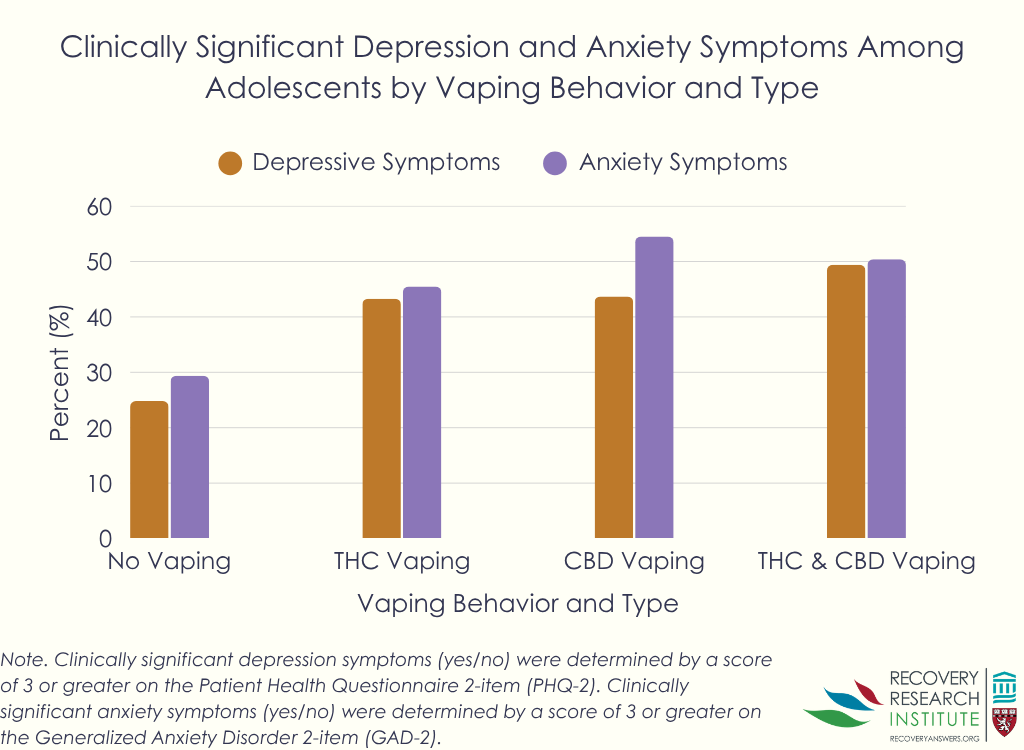
Accounting for demographic characteristics and other factors that could influence mental health or substance use, adolescents reporting dual THC/CBD vaping were about 1.5 times more likely to report clinically significant depressive symptoms than adolescents who did not report cannabis vaping. Adolescents reporting THC-only vaping were 1.4 times more likely to report clinically significant depressive symptoms and 1.2 times more likely to report clinically significant anxiety symptoms. Adolescents reporting CBD-only vaping were 1.7 times more likely to report clinically significant anxiety symptoms than adolescents who did not report cannabis vaping. When analyses were limited to adolescents who reported cannabis vaping, those reporting CBD-only vaping were 1.5 times more likely to report clinically significant anxiety symptoms than those reporting THC-only vaping, although there were no differences in clinically significant depressive symptoms between groups.


WHAT ARE THE IMPLICATIONS OF THE STUDY FINDINGS?

Findings from this study add to a growing body of evidence linking adolescent cannabis use with poorer mental health outcomes. Adolescents who reported cannabis vaping generally reported higher rates of clinically significant anxiety and/or depressive symptoms than adolescents who did not report cannabis vaping. All forms of cannabis vaping examined (THC-only vaping, CBD-only vaping, and dual THC/CBD vaping) were associated with elevated mental health symptoms relative to adolescents who did not report cannabis vaping, although patterns of association differed somewhat across cannabis vaping groups. These findings are consistent with broader evidence showing that cannabis use and mental health symptoms commonly co-occur among adolescents, and that cannabis legalization may, in part, be exacerbating this relationship.

At the same time, because the study was cross-sectional, it cannot be determined whether cannabis vaping contributed to elevated anxiety or depression symptoms, whether adolescents already experiencing elevated mental health symptoms were more likely to vape cannabis products, or whether the relationship may be bidirectional. That said, prior longitudinal research among youth and young adults has found that increases in cannabis use worsens depressive symptoms over time. Theoretically, this can occur because cannabis use interferes with the development of brain structures implicated in emotion regulation and processing. Taken together, the findings contribute to a growing body of evidence suggesting adolescent cannabis use may worsen mental health outcomes while highlighting the need for longitudinal research to better understand how cannabis vaping, product type, frequency of use, potency, and mental health symptoms are related over time.


BOTTOM LINE

Adolescents who reported cannabis vaping generally reported higher rates of clinically significant anxiety and/or depressive symptoms than adolescents who did not report cannabis vaping. The cross-sectional study design used here cannot help determine how cannabis use and mental health symptoms are causally related, but other longitudinal studies indeed suggest youth cannabis use increases the risk for later mental health symptoms and disorders. Although patterns of association differed somewhat across cannabis vaping groups, all forms of cannabis vaping examined (THC-only vaping, CBD-only vaping, and dual THC/CBD vaping) were associated with elevated mental health symptoms. Future longitudinal studies are needed to better understand how cannabis vaping and mental health symptoms are related over time in adolescents and to clarify the mechanisms by which it may produce poorer mental health if that is more firmly established to be causally true.


  • For individuals and families seeking recovery: Adolescents who reported cannabis vaping generally reported higher rates of clinically significant anxiety and/or depressive symptoms than youth who did not report cannabis vaping. Families may benefit from discussing cannabis vaping with adolescents, including the potential mental health concerns associated with vaping cannabis products of any kind.
  • For treatment professionals and treatment systems: Adolescents reporting cannabis vaping of any kind may experience elevated rates of anxiety and depressive symptoms. Clinicians may benefit from assessing cannabis vaping and proactively addressing both cannabis use and co-occurring mental health symptoms.
  • For scientists: Findings suggest that different cannabis vaping behaviors may have somewhat different associations with adolescent mental health, though all forms of cannabis vaping examined were associated with elevated mental health symptoms. Future longitudinal research is needed to better understand how cannabis vaping and mental health symptoms are related over time among adolescents, including the potential roles of product type, potency, and frequency of use.
  • For policy makers: Findings from this study add to growing evidence linking adolescent cannabis vaping with elevated mental health symptoms. As cannabis products become increasingly accessible to adolescents, policies aimed at restricting youth access and strengthening prevention efforts may help reduce potential harms, particularly given that no form of cannabis use is considered safe for youth.

CITATIONS

Chung, J., Stjepanović, D., Cheng, B., Lim, C. C., Hall, W., Connor, J. P., & Chan, G. C. (2026). Cannabis vaping and mental health: The association of Δ‐9‐tetrahydrocannabinol and cannabidiol with anxiety and depressive symptoms—Findings from the United States National Youth Tobacco Survey (2021–2023). Addiction, 121(3), 617-628. doi: 10.1111/add.70218.



Stay on the Frontiers of
recovery science
with the free, monthly
Recovery Bulletin

l

WHAT PROBLEM DOES THIS STUDY ADDRESS?

Cannabis use has been linked to increased risk for anxiety and depression, and cannabis use disorder commonly co-occurs with mental health conditions. At the same time, cannabis products have become increasingly potent and are now available in a variety of forms, including vaping products containing varying amounts of tetrahydrocannabinol (THC) and cannabidiol (CBD), raising further concerns about their potential impact on adolescent mental health.

THC is the primary psychoactive component of cannabis that produces intoxicating effects and has been associated with cognitive impairment, poorer mental health outcomes, and increased risk of cannabis use disorder. In contrast, CBD is non-intoxicating and is sometimes promoted for therapeutic effects related to anxiety relief, though research findings have been mixed. Despite increasing use of these products, relatively little research has examined whether there are different associations between patterns of cannabis vaping and symptoms of anxiety and depression among adolescents. This study examined whether adolescents who reported THC-only vaping, CBD-only vaping, or dual THC/CBD vaping differed in their likelihood of reporting clinically significant depressive or anxiety symptoms compared to adolescents who did not report cannabis vaping.


HOW WAS THIS STUDY CONDUCTED?

This study was a secondary analysis of cross-sectional survey data from US adolescents between the ages of 11 and 18 (N = 69,899) collected across 3 years (2021-2023) of the National Youth Tobacco Survey, a nationally representative survey. Participants reported whether they had vaped THC and/or CBD products in the past 30 days and were grouped into 4 categories: 1) THC-only vaping, 2) CBD-only vaping, 3) dual THC/CBD vaping, and 4) no cannabis vaping. Participants also completed brief validated screening questionnaires assessing whether participants were experiencing clinically significant levels of depression and anxiety symptoms (i.e., presence of the clinical disorder is “likely”). The study then examined associations between cannabis vaping patterns and mental health symptoms while accounting for factors that could also influence mental health or substance use, including age, sex, race/ethnicity, sexual orientation, nicotine vaping, cigarette smoking, and vaping-related social media exposure. This type of statistical adjustment is done to try and isolate the effect of vaping patterns on mental health outcomes.

Although this study included a large nationally representative sample across multiple years, the data were cross-sectional, meaning participants were not followed over time and each survey year included different adolescents. As a result, the researchers could not determine whether cannabis vaping contributed to elevated mental health symptoms, whether adolescents already experiencing elevated mental health symptoms were more likely to vape cannabis products, or whether other unmeasured factors influenced both. In addition, all measures relied on adolescent self-report, and the study could not verify whether participants accurately knew the contents of the products they vaped or whether their responses were fully accurate.


WHAT DID THIS STUDY FIND?

Most adolescents (92%) did not report cannabis vaping in the past 30 days, though about 5.1% reported THC-only vaping, 2.5% reported dual THC/CBD vaping, and 0.4% reported CBD-only vaping. Slightly more than 1 in 4 adolescents (26.4%) reported clinically significant depressive symptoms and almost 1 in 3 (30.8%) reported clinically significant anxiety symptoms.

As shown in the graph below, adolescents reporting any type of cannabis vaping had higher rates of clinically significant depressive and anxiety symptoms than adolescents who did not report cannabis vaping.

More specifically, nearly half (49.4%) of adolescents reporting dual THC/CBD vaping and more than 43% of those reporting THC-only or CBD-only vaping reported clinically significant depressive symptoms, compared to about 1/4 (24.8%) of adolescents who did not report cannabis vaping. More than half of adolescents reporting CBD-only vaping (54.5%), about half of those reporting dual THC/CBD vaping (50.4%), and nearly half of those reporting THC-only vaping (45.5%) reported clinically significant anxiety symptoms, compared to less than 1/3 (29.4%) of adolescents who did not report cannabis vaping.

Accounting for demographic characteristics and other factors that could influence mental health or substance use, adolescents reporting dual THC/CBD vaping were about 1.5 times more likely to report clinically significant depressive symptoms than adolescents who did not report cannabis vaping. Adolescents reporting THC-only vaping were 1.4 times more likely to report clinically significant depressive symptoms and 1.2 times more likely to report clinically significant anxiety symptoms. Adolescents reporting CBD-only vaping were 1.7 times more likely to report clinically significant anxiety symptoms than adolescents who did not report cannabis vaping. When analyses were limited to adolescents who reported cannabis vaping, those reporting CBD-only vaping were 1.5 times more likely to report clinically significant anxiety symptoms than those reporting THC-only vaping, although there were no differences in clinically significant depressive symptoms between groups.


WHAT ARE THE IMPLICATIONS OF THE STUDY FINDINGS?

Findings from this study add to a growing body of evidence linking adolescent cannabis use with poorer mental health outcomes. Adolescents who reported cannabis vaping generally reported higher rates of clinically significant anxiety and/or depressive symptoms than adolescents who did not report cannabis vaping. All forms of cannabis vaping examined (THC-only vaping, CBD-only vaping, and dual THC/CBD vaping) were associated with elevated mental health symptoms relative to adolescents who did not report cannabis vaping, although patterns of association differed somewhat across cannabis vaping groups. These findings are consistent with broader evidence showing that cannabis use and mental health symptoms commonly co-occur among adolescents, and that cannabis legalization may, in part, be exacerbating this relationship.

At the same time, because the study was cross-sectional, it cannot be determined whether cannabis vaping contributed to elevated anxiety or depression symptoms, whether adolescents already experiencing elevated mental health symptoms were more likely to vape cannabis products, or whether the relationship may be bidirectional. That said, prior longitudinal research among youth and young adults has found that increases in cannabis use worsens depressive symptoms over time. Theoretically, this can occur because cannabis use interferes with the development of brain structures implicated in emotion regulation and processing. Taken together, the findings contribute to a growing body of evidence suggesting adolescent cannabis use may worsen mental health outcomes while highlighting the need for longitudinal research to better understand how cannabis vaping, product type, frequency of use, potency, and mental health symptoms are related over time.


BOTTOM LINE

Adolescents who reported cannabis vaping generally reported higher rates of clinically significant anxiety and/or depressive symptoms than adolescents who did not report cannabis vaping. The cross-sectional study design used here cannot help determine how cannabis use and mental health symptoms are causally related, but other longitudinal studies indeed suggest youth cannabis use increases the risk for later mental health symptoms and disorders. Although patterns of association differed somewhat across cannabis vaping groups, all forms of cannabis vaping examined (THC-only vaping, CBD-only vaping, and dual THC/CBD vaping) were associated with elevated mental health symptoms. Future longitudinal studies are needed to better understand how cannabis vaping and mental health symptoms are related over time in adolescents and to clarify the mechanisms by which it may produce poorer mental health if that is more firmly established to be causally true.


  • For individuals and families seeking recovery: Adolescents who reported cannabis vaping generally reported higher rates of clinically significant anxiety and/or depressive symptoms than youth who did not report cannabis vaping. Families may benefit from discussing cannabis vaping with adolescents, including the potential mental health concerns associated with vaping cannabis products of any kind.
  • For treatment professionals and treatment systems: Adolescents reporting cannabis vaping of any kind may experience elevated rates of anxiety and depressive symptoms. Clinicians may benefit from assessing cannabis vaping and proactively addressing both cannabis use and co-occurring mental health symptoms.
  • For scientists: Findings suggest that different cannabis vaping behaviors may have somewhat different associations with adolescent mental health, though all forms of cannabis vaping examined were associated with elevated mental health symptoms. Future longitudinal research is needed to better understand how cannabis vaping and mental health symptoms are related over time among adolescents, including the potential roles of product type, potency, and frequency of use.
  • For policy makers: Findings from this study add to growing evidence linking adolescent cannabis vaping with elevated mental health symptoms. As cannabis products become increasingly accessible to adolescents, policies aimed at restricting youth access and strengthening prevention efforts may help reduce potential harms, particularly given that no form of cannabis use is considered safe for youth.

CITATIONS

Chung, J., Stjepanović, D., Cheng, B., Lim, C. C., Hall, W., Connor, J. P., & Chan, G. C. (2026). Cannabis vaping and mental health: The association of Δ‐9‐tetrahydrocannabinol and cannabidiol with anxiety and depressive symptoms—Findings from the United States National Youth Tobacco Survey (2021–2023). Addiction, 121(3), 617-628. doi: 10.1111/add.70218.


Share this article

l

WHAT PROBLEM DOES THIS STUDY ADDRESS?

Cannabis use has been linked to increased risk for anxiety and depression, and cannabis use disorder commonly co-occurs with mental health conditions. At the same time, cannabis products have become increasingly potent and are now available in a variety of forms, including vaping products containing varying amounts of tetrahydrocannabinol (THC) and cannabidiol (CBD), raising further concerns about their potential impact on adolescent mental health.

THC is the primary psychoactive component of cannabis that produces intoxicating effects and has been associated with cognitive impairment, poorer mental health outcomes, and increased risk of cannabis use disorder. In contrast, CBD is non-intoxicating and is sometimes promoted for therapeutic effects related to anxiety relief, though research findings have been mixed. Despite increasing use of these products, relatively little research has examined whether there are different associations between patterns of cannabis vaping and symptoms of anxiety and depression among adolescents. This study examined whether adolescents who reported THC-only vaping, CBD-only vaping, or dual THC/CBD vaping differed in their likelihood of reporting clinically significant depressive or anxiety symptoms compared to adolescents who did not report cannabis vaping.


HOW WAS THIS STUDY CONDUCTED?

This study was a secondary analysis of cross-sectional survey data from US adolescents between the ages of 11 and 18 (N = 69,899) collected across 3 years (2021-2023) of the National Youth Tobacco Survey, a nationally representative survey. Participants reported whether they had vaped THC and/or CBD products in the past 30 days and were grouped into 4 categories: 1) THC-only vaping, 2) CBD-only vaping, 3) dual THC/CBD vaping, and 4) no cannabis vaping. Participants also completed brief validated screening questionnaires assessing whether participants were experiencing clinically significant levels of depression and anxiety symptoms (i.e., presence of the clinical disorder is “likely”). The study then examined associations between cannabis vaping patterns and mental health symptoms while accounting for factors that could also influence mental health or substance use, including age, sex, race/ethnicity, sexual orientation, nicotine vaping, cigarette smoking, and vaping-related social media exposure. This type of statistical adjustment is done to try and isolate the effect of vaping patterns on mental health outcomes.

Although this study included a large nationally representative sample across multiple years, the data were cross-sectional, meaning participants were not followed over time and each survey year included different adolescents. As a result, the researchers could not determine whether cannabis vaping contributed to elevated mental health symptoms, whether adolescents already experiencing elevated mental health symptoms were more likely to vape cannabis products, or whether other unmeasured factors influenced both. In addition, all measures relied on adolescent self-report, and the study could not verify whether participants accurately knew the contents of the products they vaped or whether their responses were fully accurate.


WHAT DID THIS STUDY FIND?

Most adolescents (92%) did not report cannabis vaping in the past 30 days, though about 5.1% reported THC-only vaping, 2.5% reported dual THC/CBD vaping, and 0.4% reported CBD-only vaping. Slightly more than 1 in 4 adolescents (26.4%) reported clinically significant depressive symptoms and almost 1 in 3 (30.8%) reported clinically significant anxiety symptoms.

As shown in the graph below, adolescents reporting any type of cannabis vaping had higher rates of clinically significant depressive and anxiety symptoms than adolescents who did not report cannabis vaping.

More specifically, nearly half (49.4%) of adolescents reporting dual THC/CBD vaping and more than 43% of those reporting THC-only or CBD-only vaping reported clinically significant depressive symptoms, compared to about 1/4 (24.8%) of adolescents who did not report cannabis vaping. More than half of adolescents reporting CBD-only vaping (54.5%), about half of those reporting dual THC/CBD vaping (50.4%), and nearly half of those reporting THC-only vaping (45.5%) reported clinically significant anxiety symptoms, compared to less than 1/3 (29.4%) of adolescents who did not report cannabis vaping.

Accounting for demographic characteristics and other factors that could influence mental health or substance use, adolescents reporting dual THC/CBD vaping were about 1.5 times more likely to report clinically significant depressive symptoms than adolescents who did not report cannabis vaping. Adolescents reporting THC-only vaping were 1.4 times more likely to report clinically significant depressive symptoms and 1.2 times more likely to report clinically significant anxiety symptoms. Adolescents reporting CBD-only vaping were 1.7 times more likely to report clinically significant anxiety symptoms than adolescents who did not report cannabis vaping. When analyses were limited to adolescents who reported cannabis vaping, those reporting CBD-only vaping were 1.5 times more likely to report clinically significant anxiety symptoms than those reporting THC-only vaping, although there were no differences in clinically significant depressive symptoms between groups.


WHAT ARE THE IMPLICATIONS OF THE STUDY FINDINGS?

Findings from this study add to a growing body of evidence linking adolescent cannabis use with poorer mental health outcomes. Adolescents who reported cannabis vaping generally reported higher rates of clinically significant anxiety and/or depressive symptoms than adolescents who did not report cannabis vaping. All forms of cannabis vaping examined (THC-only vaping, CBD-only vaping, and dual THC/CBD vaping) were associated with elevated mental health symptoms relative to adolescents who did not report cannabis vaping, although patterns of association differed somewhat across cannabis vaping groups. These findings are consistent with broader evidence showing that cannabis use and mental health symptoms commonly co-occur among adolescents, and that cannabis legalization may, in part, be exacerbating this relationship.

At the same time, because the study was cross-sectional, it cannot be determined whether cannabis vaping contributed to elevated anxiety or depression symptoms, whether adolescents already experiencing elevated mental health symptoms were more likely to vape cannabis products, or whether the relationship may be bidirectional. That said, prior longitudinal research among youth and young adults has found that increases in cannabis use worsens depressive symptoms over time. Theoretically, this can occur because cannabis use interferes with the development of brain structures implicated in emotion regulation and processing. Taken together, the findings contribute to a growing body of evidence suggesting adolescent cannabis use may worsen mental health outcomes while highlighting the need for longitudinal research to better understand how cannabis vaping, product type, frequency of use, potency, and mental health symptoms are related over time.


BOTTOM LINE

Adolescents who reported cannabis vaping generally reported higher rates of clinically significant anxiety and/or depressive symptoms than adolescents who did not report cannabis vaping. The cross-sectional study design used here cannot help determine how cannabis use and mental health symptoms are causally related, but other longitudinal studies indeed suggest youth cannabis use increases the risk for later mental health symptoms and disorders. Although patterns of association differed somewhat across cannabis vaping groups, all forms of cannabis vaping examined (THC-only vaping, CBD-only vaping, and dual THC/CBD vaping) were associated with elevated mental health symptoms. Future longitudinal studies are needed to better understand how cannabis vaping and mental health symptoms are related over time in adolescents and to clarify the mechanisms by which it may produce poorer mental health if that is more firmly established to be causally true.


  • For individuals and families seeking recovery: Adolescents who reported cannabis vaping generally reported higher rates of clinically significant anxiety and/or depressive symptoms than youth who did not report cannabis vaping. Families may benefit from discussing cannabis vaping with adolescents, including the potential mental health concerns associated with vaping cannabis products of any kind.
  • For treatment professionals and treatment systems: Adolescents reporting cannabis vaping of any kind may experience elevated rates of anxiety and depressive symptoms. Clinicians may benefit from assessing cannabis vaping and proactively addressing both cannabis use and co-occurring mental health symptoms.
  • For scientists: Findings suggest that different cannabis vaping behaviors may have somewhat different associations with adolescent mental health, though all forms of cannabis vaping examined were associated with elevated mental health symptoms. Future longitudinal research is needed to better understand how cannabis vaping and mental health symptoms are related over time among adolescents, including the potential roles of product type, potency, and frequency of use.
  • For policy makers: Findings from this study add to growing evidence linking adolescent cannabis vaping with elevated mental health symptoms. As cannabis products become increasingly accessible to adolescents, policies aimed at restricting youth access and strengthening prevention efforts may help reduce potential harms, particularly given that no form of cannabis use is considered safe for youth.

CITATIONS

Chung, J., Stjepanović, D., Cheng, B., Lim, C. C., Hall, W., Connor, J. P., & Chan, G. C. (2026). Cannabis vaping and mental health: The association of Δ‐9‐tetrahydrocannabinol and cannabidiol with anxiety and depressive symptoms—Findings from the United States National Youth Tobacco Survey (2021–2023). Addiction, 121(3), 617-628. doi: 10.1111/add.70218.

Share this article