A different kind of networking: How AA may support recovery

Alcoholics Anonymous (AA) is a widely available, empirically-supported resource for people with alcohol use disorder. Understanding how it works can inform clinical recommendations and help improve other types of services. This study used a novel approach to examine if it works by helping reduce the number of drinkers in someone’s social network.

Stay on the frontiers of
recovery science
with the free, monthly
Recovery Bulletin

l

WHAT PROBLEM DOES THIS STUDY ADDRESS?

Alcoholics Anonymous (AA) is a community-based mutual-help organization for people seeking recovery from alcohol and other substance use disorders. AA has approximately 2 million members across 180 countries, with 73% located in the United States and Canada. Research shows that AA, and treatments that systematically encourage AA involvement, increase alcohol abstinence and reduce heavy drinking episodes. One way AA supports recovery is by facilitating adaptive social network changes (e.g., increasing affiliations with pro-recovery peers). However, most earlier studies of these social changes used brief questions that cannot show how a person’s relationships fit together. Because brief questions often do not capture how network members are connected or how often they drink, a detailed approach may help researchers and clinicians identify which relationships to strengthen and which to change during recovery. This study used a detailed social network assessment to test whether AA works by helping reduce the number of people in somebody’s network that drink alcohol.


HOW WAS THIS STUDY CONDUCTED?

This longitudinal cohort study drew upon data from a larger observational study of US and Canadian adults with alcohol use disorder who were beginning a new recovery attempt. Individuals aged 21-65 years were recruited through treatment programs and online advertising in Boston, MA, and Hamilton, ON. Because participants came from only two cities, the findings may not apply to other regions. Eligible participants met diagnostic criteria for alcohol use disorder, reported at least high-risk drinking (i.e., more than 14 drinks per week for men or 7 for women), and identified alcohol as their primary drug. Participants who increased their AA attendance by at least 1 meeting per week between the start of the study and the 6-week follow-up (the AA group) were compared with participants who did not. At follow-up, the AA group averaged about 5 meetings per week. Because people who chose to attend more meetings may differ from those who did not, researchers used a statistical matching method to pair each person in the AA group with a similar person who did not increase attendance, based on age, sex, education, income, and baseline drinking. This technique yielded 71 participants in the AA group and 71 participants in the matched comparison group for a total analytic sample of 142 participants. Although matching improved group comparability, unmeasured factors, such as abstinence motivation and recovery goals, could still have influenced both AA attendance and drinking outcomes. Also, changes in drinking during the 6 weeks could themselves have affected how often people attended meetings, and the matching could not account for this. Drinking outcomes included the percentage of drinking and heavy drinking days, reported in an interview covering the previous 45 days at the 6-week follow-up. Participants identified up to 20 important people in their social networks and reported each person’s drinking frequency, heavy drinking frequency, and social connections with other network members. Researchers used these responses to examine network drinking behavior and structural characteristics. Mediation models accounting for baseline measures of the outcome were run to test whether social network drinking frequency helped explain the association between AA attendance and drinking outcomes at the 6-week follow-up. Because AA attendance, network drinking, and participants’ own drinking were all measured at the same 6-week visit, the study cannot show which came first or whether one caused the other. The sample also was primarily white and had little racial diversity, which reduces generalizability to racial/ethnic minority groups.


WHAT DID THIS STUDY FIND?

People who increased AA attendance reported much less drinking at 6 weeks than similar people who did not

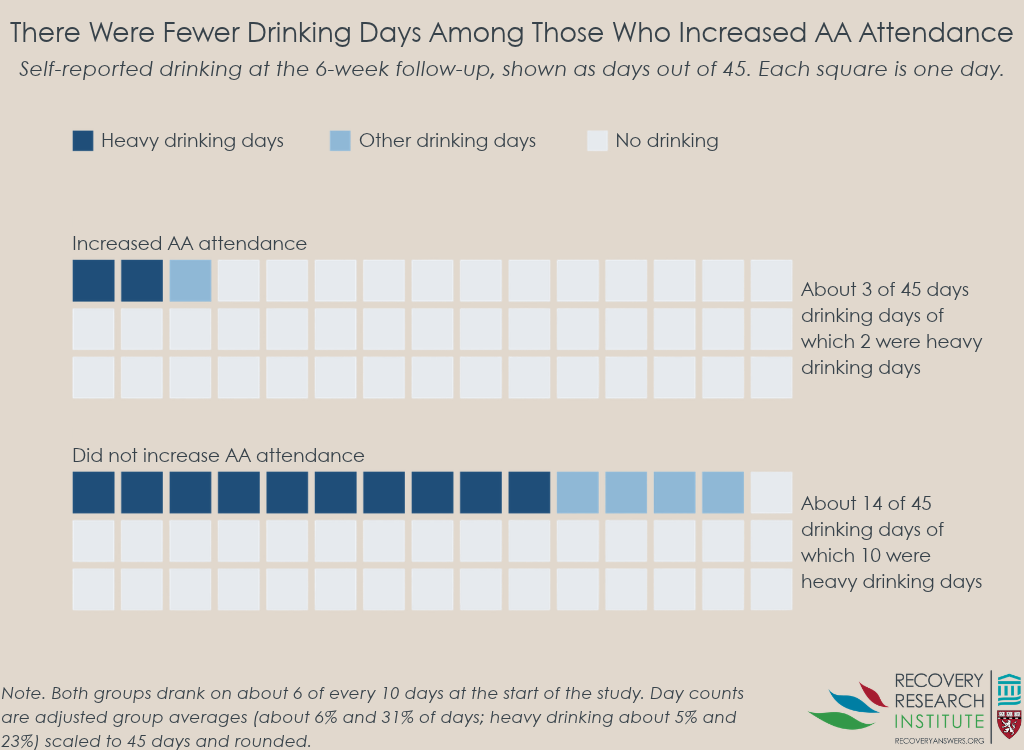
Both groups drank on about 6 of every 10 days at the start of the study. At 6 weeks, the AA group reported drinking on about 6% of days (roughly 3 of the past 45 days), compared with about 31% of days (roughly 14 days) in the comparison group. Heavy drinking occurred on about 5% of days (roughly 2 days) in the AA group and about 23% of days (roughly 10 days) in the comparison group. Because people were not randomized to attend AA, these differences cannot be attributed to AA alone.
People who increased AA attendance described fewer drinkers in their social networks

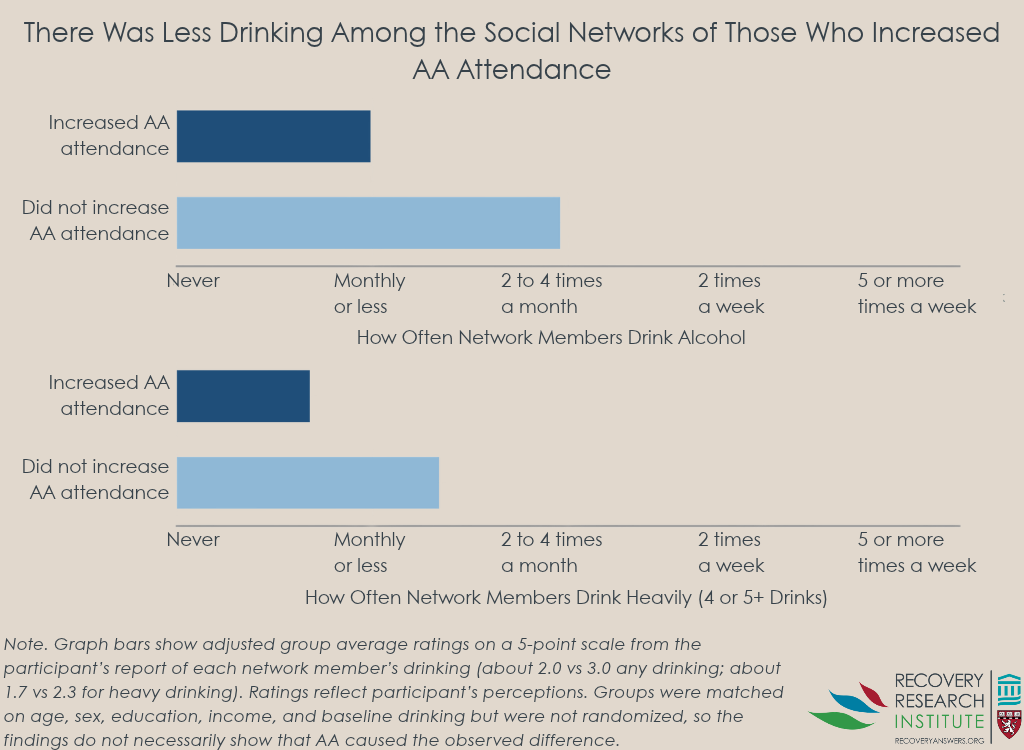
On average, the AA group described the people in their networks as drinking about once a month or less, compared with 2 to 4 times a month in the comparison group. They also reported less heavy drinking among network members. Their networks had slightly more connections among members and were less centered on a few people, but these differences were small and preliminary. Whether network members who drank were more likely to be connected to each other did not clearly differ between groups.
Fewer drinkers in people’s networks explained a small part of the link

Participants who attended more AA meetings also reported fewer drinkers in their networks, and fewer drinkers in their networks was associated with less drinking and less heavy drinking by participants themselves. Network drinking accounted for roughly 15% of the link between AA attendance and someone’s own drinking. AA attendance remained strongly linked to less drinking even after accounting for network drinking, suggesting other factors, such as support, coping skills, or motivation, may also matter. This analysis was exploratory and, because everything was measured at the same time, cannot show that network changes led to less drinking.


WHAT ARE THE IMPLICATIONS OF THE STUDY FINDINGS?

These findings suggest that reducing drinkers in a person’s social network may be one pathway through which AA attendance is linked to less drinking, although it explained only a small share of that link. By providing opportunities to connect with others who share similar experiences and recovery goals, AA may help individuals develop recovery-supportive relationships, reduce exposure to social environments where heavy drinking is common (by increasing time spent in spaces and events that do not involve alcohol), or both, although this study could not test these possibilities directly. More broadly, these findings are consistent with the value of attending to individuals’ social environments as part of recovery efforts. In practice, this may involve helping individuals assess how their existing relationships influence their recovery efforts and identify opportunities to strengthen or expand recovery-supportive connections. AA and other community-based recovery supports may help facilitate these changes, particularly during the early stages of recovery when individuals may be navigating substantial changes in their social relationships and routines. These findings should be interpreted cautiously. The study was observational and exploratory, followed people for only 6 weeks, and relied on self-reports, including reports of others’ drinking. Because AA attendance, network drinking, and participants’ own drinking were measured at the same visit, it cannot show that network changes led to less drinking. However, an earlier study that followed people over time found that more AA attendance was followed by fewer drinking-supportive and more abstinence-supportive people in participants’ networks, and that these network changes explained a modest share of AA’s link to later drinking.

A strength of this study is its use of a formal social network assessment that captures not only the drinking behaviors of each important member of a person’s social network, but also how those members are connected to one another. This approach allowed researchers to examine the structure of participants’ social networks and whether these characteristics differed by AA attendance. Results indicated that individuals who increased their AA attendance had slightly more interconnected and less centralized networks, meaning their relationships were less concentrated around a few people. One possible explanation is that AA may give people a wider pool of contacts to draw on, thereby reducing reliance on a smaller number of relationships for social support. Although the observed differences were small, they raise important questions about whether the organization of social relationships, in addition to the drinking behaviors of network members, may influence drinking outcomes.

It is not yet known whether the social mechanisms through which AA is linked to less drinking differ across individuals, for example by age or recovery goals. Further research examining whether the mechanisms underlying AA’s benefits differ across subgroups is needed to help clarify not only how AA helps, but also for whom specific mechanisms are most influential. Moreover, although AA is among the most widely available mutual-help organizations, other options exist, such as SMART Recovery, and future studies could test whether these also facilitate similar social network changes.


BOTTOM LINE

Building on earlier research that used brief measures of social networks, social network drinking frequency explained a small part of the association between AA attendance and individual drinking outcomes, suggesting that having fewer drinkers in one’s network may be one of several ways AA attendance is linked to less drinking, although this observational, exploratory study cannot show cause and effect.


  • For individuals and families seeking recovery: The findings of this study are consistent with the idea that supportive social networks can be an important part of recovery. For individuals seeking recovery, building relationships with others whose own drinking behaviors align with this goal may help create a social environment conducive to recovery. Participating in AA may help facilitate these positive social network changes.
  • For treatment professionals and treatment systems: These findings suggest it may be worthwhile to ask about patients’ social environments during treatment and recovery planning. Clinicians can help patients identify relationships that support their recovery goals and explore opportunities for building new social connections. Linkages to AA and other mutual-help groups may be one strategy for facilitating these connections, particularly during the early stages of recovery when individuals may be navigating substantial changes in their lives.
  • For scientists: Future research should test whether this social mechanism supports longer-term outcomes. Studies with larger, more generalizable samples and time-lagged analyses, ideally including designs that encourage AA involvement (for example, 12-step facilitation trials), are needed to strengthen understanding of these relationships and establish their temporal sequence. Researchers should also investigate other potential mechanisms of AA’s benefits, since network drinking explained only a small part of the link.
  • For policy makers: AA is a widely available, low-cost recovery support that may confer benefits partly by facilitating positive social network changes. Investing in interventions that increase access to and engagement with AA and other approaches that can help enhance social networks may be a cost-effective strategy for reducing the public health burden associated with alcohol use disorder.

CITATIONS

Levitt, E. E., Rahman, L., Singh, D., Belisario, K., Doggett, A., Clifton, A., Stout, R., Kelly, J. F., & MacKillop, J. (2026). Changes in alcohol‐related social network composition mediate the effects of AA meeting attendance on drinking following a recovery attempt in adults with alcohol use disorder. Addiction, 121(1), 72-81. doi: 10.1111/add.70172.



Stay on the Frontiers of
recovery science
with the free, monthly
Recovery Bulletin

l

WHAT PROBLEM DOES THIS STUDY ADDRESS?

Alcoholics Anonymous (AA) is a community-based mutual-help organization for people seeking recovery from alcohol and other substance use disorders. AA has approximately 2 million members across 180 countries, with 73% located in the United States and Canada. Research shows that AA, and treatments that systematically encourage AA involvement, increase alcohol abstinence and reduce heavy drinking episodes. One way AA supports recovery is by facilitating adaptive social network changes (e.g., increasing affiliations with pro-recovery peers). However, most earlier studies of these social changes used brief questions that cannot show how a person’s relationships fit together. Because brief questions often do not capture how network members are connected or how often they drink, a detailed approach may help researchers and clinicians identify which relationships to strengthen and which to change during recovery. This study used a detailed social network assessment to test whether AA works by helping reduce the number of people in somebody’s network that drink alcohol.


HOW WAS THIS STUDY CONDUCTED?

This longitudinal cohort study drew upon data from a larger observational study of US and Canadian adults with alcohol use disorder who were beginning a new recovery attempt. Individuals aged 21-65 years were recruited through treatment programs and online advertising in Boston, MA, and Hamilton, ON. Because participants came from only two cities, the findings may not apply to other regions. Eligible participants met diagnostic criteria for alcohol use disorder, reported at least high-risk drinking (i.e., more than 14 drinks per week for men or 7 for women), and identified alcohol as their primary drug. Participants who increased their AA attendance by at least 1 meeting per week between the start of the study and the 6-week follow-up (the AA group) were compared with participants who did not. At follow-up, the AA group averaged about 5 meetings per week. Because people who chose to attend more meetings may differ from those who did not, researchers used a statistical matching method to pair each person in the AA group with a similar person who did not increase attendance, based on age, sex, education, income, and baseline drinking. This technique yielded 71 participants in the AA group and 71 participants in the matched comparison group for a total analytic sample of 142 participants. Although matching improved group comparability, unmeasured factors, such as abstinence motivation and recovery goals, could still have influenced both AA attendance and drinking outcomes. Also, changes in drinking during the 6 weeks could themselves have affected how often people attended meetings, and the matching could not account for this. Drinking outcomes included the percentage of drinking and heavy drinking days, reported in an interview covering the previous 45 days at the 6-week follow-up. Participants identified up to 20 important people in their social networks and reported each person’s drinking frequency, heavy drinking frequency, and social connections with other network members. Researchers used these responses to examine network drinking behavior and structural characteristics. Mediation models accounting for baseline measures of the outcome were run to test whether social network drinking frequency helped explain the association between AA attendance and drinking outcomes at the 6-week follow-up. Because AA attendance, network drinking, and participants’ own drinking were all measured at the same 6-week visit, the study cannot show which came first or whether one caused the other. The sample also was primarily white and had little racial diversity, which reduces generalizability to racial/ethnic minority groups.


WHAT DID THIS STUDY FIND?

People who increased AA attendance reported much less drinking at 6 weeks than similar people who did not

Both groups drank on about 6 of every 10 days at the start of the study. At 6 weeks, the AA group reported drinking on about 6% of days (roughly 3 of the past 45 days), compared with about 31% of days (roughly 14 days) in the comparison group. Heavy drinking occurred on about 5% of days (roughly 2 days) in the AA group and about 23% of days (roughly 10 days) in the comparison group. Because people were not randomized to attend AA, these differences cannot be attributed to AA alone.

People who increased AA attendance described fewer drinkers in their social networks

On average, the AA group described the people in their networks as drinking about once a month or less, compared with 2 to 4 times a month in the comparison group. They also reported less heavy drinking among network members. Their networks had slightly more connections among members and were less centered on a few people, but these differences were small and preliminary. Whether network members who drank were more likely to be connected to each other did not clearly differ between groups.

Fewer drinkers in people’s networks explained a small part of the link

Participants who attended more AA meetings also reported fewer drinkers in their networks, and fewer drinkers in their networks was associated with less drinking and less heavy drinking by participants themselves. Network drinking accounted for roughly 15% of the link between AA attendance and someone’s own drinking. AA attendance remained strongly linked to less drinking even after accounting for network drinking, suggesting other factors, such as support, coping skills, or motivation, may also matter. This analysis was exploratory and, because everything was measured at the same time, cannot show that network changes led to less drinking.


WHAT ARE THE IMPLICATIONS OF THE STUDY FINDINGS?

These findings suggest that reducing drinkers in a person’s social network may be one pathway through which AA attendance is linked to less drinking, although it explained only a small share of that link. By providing opportunities to connect with others who share similar experiences and recovery goals, AA may help individuals develop recovery-supportive relationships, reduce exposure to social environments where heavy drinking is common (by increasing time spent in spaces and events that do not involve alcohol), or both, although this study could not test these possibilities directly. More broadly, these findings are consistent with the value of attending to individuals’ social environments as part of recovery efforts. In practice, this may involve helping individuals assess how their existing relationships influence their recovery efforts and identify opportunities to strengthen or expand recovery-supportive connections. AA and other community-based recovery supports may help facilitate these changes, particularly during the early stages of recovery when individuals may be navigating substantial changes in their social relationships and routines. These findings should be interpreted cautiously. The study was observational and exploratory, followed people for only 6 weeks, and relied on self-reports, including reports of others’ drinking. Because AA attendance, network drinking, and participants’ own drinking were measured at the same visit, it cannot show that network changes led to less drinking. However, an earlier study that followed people over time found that more AA attendance was followed by fewer drinking-supportive and more abstinence-supportive people in participants’ networks, and that these network changes explained a modest share of AA’s link to later drinking.

A strength of this study is its use of a formal social network assessment that captures not only the drinking behaviors of each important member of a person’s social network, but also how those members are connected to one another. This approach allowed researchers to examine the structure of participants’ social networks and whether these characteristics differed by AA attendance. Results indicated that individuals who increased their AA attendance had slightly more interconnected and less centralized networks, meaning their relationships were less concentrated around a few people. One possible explanation is that AA may give people a wider pool of contacts to draw on, thereby reducing reliance on a smaller number of relationships for social support. Although the observed differences were small, they raise important questions about whether the organization of social relationships, in addition to the drinking behaviors of network members, may influence drinking outcomes.

It is not yet known whether the social mechanisms through which AA is linked to less drinking differ across individuals, for example by age or recovery goals. Further research examining whether the mechanisms underlying AA’s benefits differ across subgroups is needed to help clarify not only how AA helps, but also for whom specific mechanisms are most influential. Moreover, although AA is among the most widely available mutual-help organizations, other options exist, such as SMART Recovery, and future studies could test whether these also facilitate similar social network changes.


BOTTOM LINE

Building on earlier research that used brief measures of social networks, social network drinking frequency explained a small part of the association between AA attendance and individual drinking outcomes, suggesting that having fewer drinkers in one’s network may be one of several ways AA attendance is linked to less drinking, although this observational, exploratory study cannot show cause and effect.


  • For individuals and families seeking recovery: The findings of this study are consistent with the idea that supportive social networks can be an important part of recovery. For individuals seeking recovery, building relationships with others whose own drinking behaviors align with this goal may help create a social environment conducive to recovery. Participating in AA may help facilitate these positive social network changes.
  • For treatment professionals and treatment systems: These findings suggest it may be worthwhile to ask about patients’ social environments during treatment and recovery planning. Clinicians can help patients identify relationships that support their recovery goals and explore opportunities for building new social connections. Linkages to AA and other mutual-help groups may be one strategy for facilitating these connections, particularly during the early stages of recovery when individuals may be navigating substantial changes in their lives.
  • For scientists: Future research should test whether this social mechanism supports longer-term outcomes. Studies with larger, more generalizable samples and time-lagged analyses, ideally including designs that encourage AA involvement (for example, 12-step facilitation trials), are needed to strengthen understanding of these relationships and establish their temporal sequence. Researchers should also investigate other potential mechanisms of AA’s benefits, since network drinking explained only a small part of the link.
  • For policy makers: AA is a widely available, low-cost recovery support that may confer benefits partly by facilitating positive social network changes. Investing in interventions that increase access to and engagement with AA and other approaches that can help enhance social networks may be a cost-effective strategy for reducing the public health burden associated with alcohol use disorder.

CITATIONS

Levitt, E. E., Rahman, L., Singh, D., Belisario, K., Doggett, A., Clifton, A., Stout, R., Kelly, J. F., & MacKillop, J. (2026). Changes in alcohol‐related social network composition mediate the effects of AA meeting attendance on drinking following a recovery attempt in adults with alcohol use disorder. Addiction, 121(1), 72-81. doi: 10.1111/add.70172.


Share this article

l

WHAT PROBLEM DOES THIS STUDY ADDRESS?

Alcoholics Anonymous (AA) is a community-based mutual-help organization for people seeking recovery from alcohol and other substance use disorders. AA has approximately 2 million members across 180 countries, with 73% located in the United States and Canada. Research shows that AA, and treatments that systematically encourage AA involvement, increase alcohol abstinence and reduce heavy drinking episodes. One way AA supports recovery is by facilitating adaptive social network changes (e.g., increasing affiliations with pro-recovery peers). However, most earlier studies of these social changes used brief questions that cannot show how a person’s relationships fit together. Because brief questions often do not capture how network members are connected or how often they drink, a detailed approach may help researchers and clinicians identify which relationships to strengthen and which to change during recovery. This study used a detailed social network assessment to test whether AA works by helping reduce the number of people in somebody’s network that drink alcohol.


HOW WAS THIS STUDY CONDUCTED?

This longitudinal cohort study drew upon data from a larger observational study of US and Canadian adults with alcohol use disorder who were beginning a new recovery attempt. Individuals aged 21-65 years were recruited through treatment programs and online advertising in Boston, MA, and Hamilton, ON. Because participants came from only two cities, the findings may not apply to other regions. Eligible participants met diagnostic criteria for alcohol use disorder, reported at least high-risk drinking (i.e., more than 14 drinks per week for men or 7 for women), and identified alcohol as their primary drug. Participants who increased their AA attendance by at least 1 meeting per week between the start of the study and the 6-week follow-up (the AA group) were compared with participants who did not. At follow-up, the AA group averaged about 5 meetings per week. Because people who chose to attend more meetings may differ from those who did not, researchers used a statistical matching method to pair each person in the AA group with a similar person who did not increase attendance, based on age, sex, education, income, and baseline drinking. This technique yielded 71 participants in the AA group and 71 participants in the matched comparison group for a total analytic sample of 142 participants. Although matching improved group comparability, unmeasured factors, such as abstinence motivation and recovery goals, could still have influenced both AA attendance and drinking outcomes. Also, changes in drinking during the 6 weeks could themselves have affected how often people attended meetings, and the matching could not account for this. Drinking outcomes included the percentage of drinking and heavy drinking days, reported in an interview covering the previous 45 days at the 6-week follow-up. Participants identified up to 20 important people in their social networks and reported each person’s drinking frequency, heavy drinking frequency, and social connections with other network members. Researchers used these responses to examine network drinking behavior and structural characteristics. Mediation models accounting for baseline measures of the outcome were run to test whether social network drinking frequency helped explain the association between AA attendance and drinking outcomes at the 6-week follow-up. Because AA attendance, network drinking, and participants’ own drinking were all measured at the same 6-week visit, the study cannot show which came first or whether one caused the other. The sample also was primarily white and had little racial diversity, which reduces generalizability to racial/ethnic minority groups.


WHAT DID THIS STUDY FIND?

People who increased AA attendance reported much less drinking at 6 weeks than similar people who did not

Both groups drank on about 6 of every 10 days at the start of the study. At 6 weeks, the AA group reported drinking on about 6% of days (roughly 3 of the past 45 days), compared with about 31% of days (roughly 14 days) in the comparison group. Heavy drinking occurred on about 5% of days (roughly 2 days) in the AA group and about 23% of days (roughly 10 days) in the comparison group. Because people were not randomized to attend AA, these differences cannot be attributed to AA alone.

People who increased AA attendance described fewer drinkers in their social networks

On average, the AA group described the people in their networks as drinking about once a month or less, compared with 2 to 4 times a month in the comparison group. They also reported less heavy drinking among network members. Their networks had slightly more connections among members and were less centered on a few people, but these differences were small and preliminary. Whether network members who drank were more likely to be connected to each other did not clearly differ between groups.

Fewer drinkers in people’s networks explained a small part of the link

Participants who attended more AA meetings also reported fewer drinkers in their networks, and fewer drinkers in their networks was associated with less drinking and less heavy drinking by participants themselves. Network drinking accounted for roughly 15% of the link between AA attendance and someone’s own drinking. AA attendance remained strongly linked to less drinking even after accounting for network drinking, suggesting other factors, such as support, coping skills, or motivation, may also matter. This analysis was exploratory and, because everything was measured at the same time, cannot show that network changes led to less drinking.


WHAT ARE THE IMPLICATIONS OF THE STUDY FINDINGS?

These findings suggest that reducing drinkers in a person’s social network may be one pathway through which AA attendance is linked to less drinking, although it explained only a small share of that link. By providing opportunities to connect with others who share similar experiences and recovery goals, AA may help individuals develop recovery-supportive relationships, reduce exposure to social environments where heavy drinking is common (by increasing time spent in spaces and events that do not involve alcohol), or both, although this study could not test these possibilities directly. More broadly, these findings are consistent with the value of attending to individuals’ social environments as part of recovery efforts. In practice, this may involve helping individuals assess how their existing relationships influence their recovery efforts and identify opportunities to strengthen or expand recovery-supportive connections. AA and other community-based recovery supports may help facilitate these changes, particularly during the early stages of recovery when individuals may be navigating substantial changes in their social relationships and routines. These findings should be interpreted cautiously. The study was observational and exploratory, followed people for only 6 weeks, and relied on self-reports, including reports of others’ drinking. Because AA attendance, network drinking, and participants’ own drinking were measured at the same visit, it cannot show that network changes led to less drinking. However, an earlier study that followed people over time found that more AA attendance was followed by fewer drinking-supportive and more abstinence-supportive people in participants’ networks, and that these network changes explained a modest share of AA’s link to later drinking.

A strength of this study is its use of a formal social network assessment that captures not only the drinking behaviors of each important member of a person’s social network, but also how those members are connected to one another. This approach allowed researchers to examine the structure of participants’ social networks and whether these characteristics differed by AA attendance. Results indicated that individuals who increased their AA attendance had slightly more interconnected and less centralized networks, meaning their relationships were less concentrated around a few people. One possible explanation is that AA may give people a wider pool of contacts to draw on, thereby reducing reliance on a smaller number of relationships for social support. Although the observed differences were small, they raise important questions about whether the organization of social relationships, in addition to the drinking behaviors of network members, may influence drinking outcomes.

It is not yet known whether the social mechanisms through which AA is linked to less drinking differ across individuals, for example by age or recovery goals. Further research examining whether the mechanisms underlying AA’s benefits differ across subgroups is needed to help clarify not only how AA helps, but also for whom specific mechanisms are most influential. Moreover, although AA is among the most widely available mutual-help organizations, other options exist, such as SMART Recovery, and future studies could test whether these also facilitate similar social network changes.


BOTTOM LINE

Building on earlier research that used brief measures of social networks, social network drinking frequency explained a small part of the association between AA attendance and individual drinking outcomes, suggesting that having fewer drinkers in one’s network may be one of several ways AA attendance is linked to less drinking, although this observational, exploratory study cannot show cause and effect.


  • For individuals and families seeking recovery: The findings of this study are consistent with the idea that supportive social networks can be an important part of recovery. For individuals seeking recovery, building relationships with others whose own drinking behaviors align with this goal may help create a social environment conducive to recovery. Participating in AA may help facilitate these positive social network changes.
  • For treatment professionals and treatment systems: These findings suggest it may be worthwhile to ask about patients’ social environments during treatment and recovery planning. Clinicians can help patients identify relationships that support their recovery goals and explore opportunities for building new social connections. Linkages to AA and other mutual-help groups may be one strategy for facilitating these connections, particularly during the early stages of recovery when individuals may be navigating substantial changes in their lives.
  • For scientists: Future research should test whether this social mechanism supports longer-term outcomes. Studies with larger, more generalizable samples and time-lagged analyses, ideally including designs that encourage AA involvement (for example, 12-step facilitation trials), are needed to strengthen understanding of these relationships and establish their temporal sequence. Researchers should also investigate other potential mechanisms of AA’s benefits, since network drinking explained only a small part of the link.
  • For policy makers: AA is a widely available, low-cost recovery support that may confer benefits partly by facilitating positive social network changes. Investing in interventions that increase access to and engagement with AA and other approaches that can help enhance social networks may be a cost-effective strategy for reducing the public health burden associated with alcohol use disorder.

CITATIONS

Levitt, E. E., Rahman, L., Singh, D., Belisario, K., Doggett, A., Clifton, A., Stout, R., Kelly, J. F., & MacKillop, J. (2026). Changes in alcohol‐related social network composition mediate the effects of AA meeting attendance on drinking following a recovery attempt in adults with alcohol use disorder. Addiction, 121(1), 72-81. doi: 10.1111/add.70172.


Share this article