Receiving peer support is thought to explain, in part, why recovery residences offer benefit. But what about giving support? This study examined whether helping others predicted better recovery outcomes among residents of sober living houses.

Receiving peer support is thought to explain, in part, why recovery residences offer benefit. But what about giving support? This study examined whether helping others predicted better recovery outcomes among residents of sober living houses.
Recovery residences are among the most widely available recovery support services, offering housing and supportive environments for individuals in or seeking substance use disorder recovery. Indeed, a national study estimated that more than 10,000 recovery residences operate in the United States. Evidence suggests recovery residences have larger benefits on abstinence, employment, personal earnings, and some criminal justice outcomes, as well as cost benefits, relative to continuing care as usual. Sober living houses are a type of recovery residence that utilizes a social model approach, which includes abstinence-focused goals, peer support/helping, shared responsibility and decision-making, and (typically) encouragement to attend mutual-help groups (e.g., 12-step meetings). Regarding peer support, one study described the strong reciprocal nature of giving and receiving help across three different contexts (other sober living house residents, 12-step attendees, and family and friends), though the potential benefits of helping others on sober living house residents’ recovery are less well known. This study sought to help fill that gap by examining whether giving help, as well as receiving it, in those three contexts predicted improvements in residents’ alcohol use and alcohol-related problems.
This longitudinal study examined whether giving and receiving help were associated with better alcohol outcomes. The sample was comprised of 205 new adult residents of sober living houses in Los Angeles County, California who met criteria for alcohol use disorder within the past year, which may limit generalizability to other geographic regions, recovery residence models/systems, and substance use disorders. Baseline data were collected within 30 days of entering a sober living house, and follow-up interviews were conducted at 1, 2, 3, and 6 months post-baseline. At each interview wave, participants reported how frequently they gave and received help over the past 30 days in the context of sober living house residents, 12-step attendees, and family and friends. The primary outcome was past 30-day alcohol use, which was assessed as any alcohol use (yes vs. no) and the number of drinking days among those with alcohol use. The secondary outcome was past 30-day alcohol-related problems, which was analyzed dichotomously (any problems vs. none). This was done presumably because for individuals in sober living, rates of alcohol use and alcohol-related problems are generally low (i.e., many individuals will have no alcohol use or problems). Models examined whether giving and receiving help in each context predicted better subsequent outcomes at the following time point. All models controlled for age, employment status, income, psychiatric problem severity, and baseline measures of the outcomes; time-varying covariates included interview wave, sober living house length of stay, and 12-step meeting attendance. Models tested separately for each helping type (giving and receiving) and context, for a total of 6 models per outcome. In addition, the study descriptively examined how giving and receiving help changed over time.
Giving and receiving help did not increase over time
The frequency of giving and receiving help across all three contexts generally remained stable or declined though the 6-month follow-up. The only notable exception was giving help to other sober living house residents, which increased at the 1-month follow-up but declined in subsequent interview waves, which may have been related to completed stays in the recovery residence.
Giving help predicted lower alcohol use but not alcohol-related problems
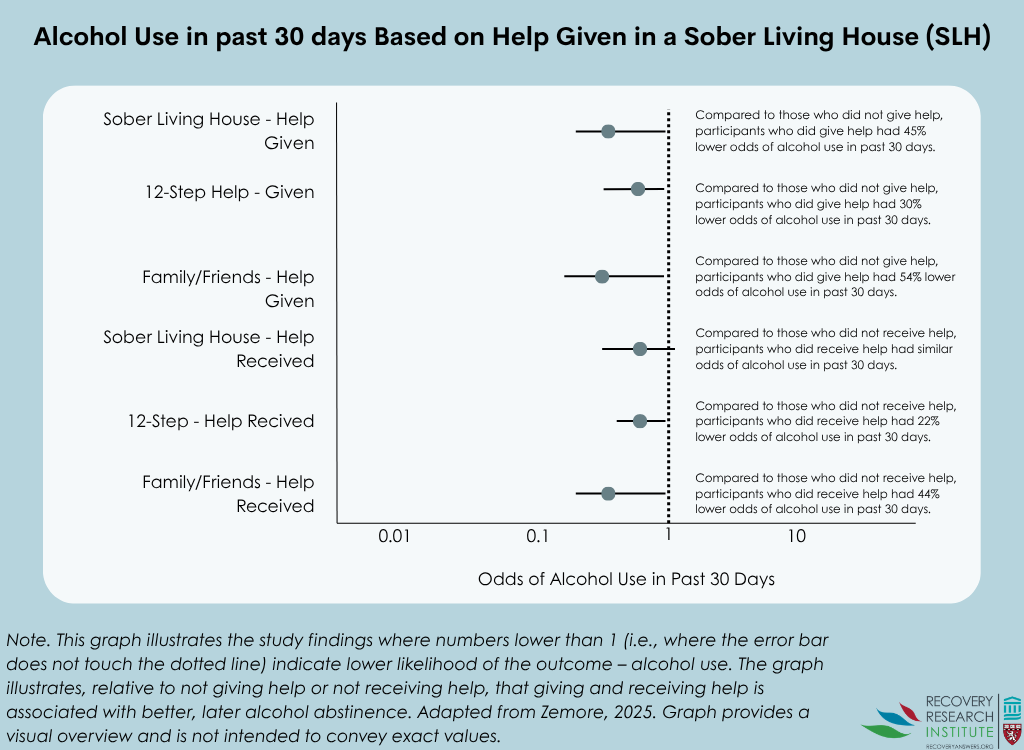
Giving help in all three contexts was associated with lower odds of using alcohol (see graph below). Giving help to family and friends, but not other sober living house residents or 12-step attendees, was also associated with fewer drinking days among participants who reported using alcohol. Giving help was not associated with alcohol-related problems, though receiving help from sober living house residents and 12-step attendees was associated with lower odds of one or more alcohol problems.
Receiving help predicted lower alcohol use and alcohol-related problems
Receiving help from 12-step attendees and family and friends was associated with lower odds of using alcohol, whereas receiving help from other sober living house residents and 12-step attendees was associated with lower odds of alcohol-related problems. Receiving help was not associated with drinking frequency among those with alcohol use.
Giving and receiving help in the contexts of sober living house residents, 12-step attendees, and family and friends was prospectively associated with better alcohol outcomes. Notably, however, the study did not examine whether giving help predicts better alcohol use outcomes independent of receiving help; that is, whether both giving and receiving confer independent benefit. Future work may help tease apart if giving help, independent of receiving it, offers benefit.
Giving help predicted lower odds of alcohol use and fewer drinking days among those with alcohol use, whereas receiving help predicted lower odds of alcohol use and alcohol-related problems. Taken together, these findings suggest that helping in all three contexts could be beneficial in alcohol use disorder recovery, particularly among sober living house residents. Though more work should be done on what types of helping and to what degree they are needed to produce these benefits. Also, in light of the decreases in helping frequency in sober living homes and 12-step groups over time, it is possible that the need for more intensive helping relationships may diminish as recovery becomes more stable. Future studies might assess how the impacts of helping change over time (i.e., in different recovery stages), as well as whether specific types and degrees of helping are more or less beneficial.
In addition, researchers should examine the mechanisms underlying giving and receiving help as well as whether certain subgroups may benefit more from helping. It could also be simply that as some individuals complete their stays in the sober living home, help given and received decreases both in this context and in 12-step groups (which may be facilitated by sober living homes). Although causality cannot be inferred given the study’s observational design, its findings provide preliminary support for the value of helping – which is the cornerstone of many mutual-help models like AA (“give it away to keep it”) – particularly when first entering a sober living house.
Giving and receiving help predicted better alcohol outcomes in sober living house residents, suggesting that helping in all three contexts – sober living homes, 12-step groups, and friends/family – may be associated with alcohol use disorder recovery. However, it cannot be determined from the study whether giving help provides benefit independent of receiving help. Further research is needed to determine whether both giving and receiving help offer independent benefits.
Zemore, S. E., Mahoney, E., Subbaraman, M. S., Mericle, A. A., & Polcin, D. L. (2025). Giving and receiving help in three contexts as predictors of alcohol outcomes in a longitudinal study of sober living house residents. American Journal of Community Psychology, 1-3. doi: 10.1002/ajcp.70029.
Recovery residences are among the most widely available recovery support services, offering housing and supportive environments for individuals in or seeking substance use disorder recovery. Indeed, a national study estimated that more than 10,000 recovery residences operate in the United States. Evidence suggests recovery residences have larger benefits on abstinence, employment, personal earnings, and some criminal justice outcomes, as well as cost benefits, relative to continuing care as usual. Sober living houses are a type of recovery residence that utilizes a social model approach, which includes abstinence-focused goals, peer support/helping, shared responsibility and decision-making, and (typically) encouragement to attend mutual-help groups (e.g., 12-step meetings). Regarding peer support, one study described the strong reciprocal nature of giving and receiving help across three different contexts (other sober living house residents, 12-step attendees, and family and friends), though the potential benefits of helping others on sober living house residents’ recovery are less well known. This study sought to help fill that gap by examining whether giving help, as well as receiving it, in those three contexts predicted improvements in residents’ alcohol use and alcohol-related problems.
This longitudinal study examined whether giving and receiving help were associated with better alcohol outcomes. The sample was comprised of 205 new adult residents of sober living houses in Los Angeles County, California who met criteria for alcohol use disorder within the past year, which may limit generalizability to other geographic regions, recovery residence models/systems, and substance use disorders. Baseline data were collected within 30 days of entering a sober living house, and follow-up interviews were conducted at 1, 2, 3, and 6 months post-baseline. At each interview wave, participants reported how frequently they gave and received help over the past 30 days in the context of sober living house residents, 12-step attendees, and family and friends. The primary outcome was past 30-day alcohol use, which was assessed as any alcohol use (yes vs. no) and the number of drinking days among those with alcohol use. The secondary outcome was past 30-day alcohol-related problems, which was analyzed dichotomously (any problems vs. none). This was done presumably because for individuals in sober living, rates of alcohol use and alcohol-related problems are generally low (i.e., many individuals will have no alcohol use or problems). Models examined whether giving and receiving help in each context predicted better subsequent outcomes at the following time point. All models controlled for age, employment status, income, psychiatric problem severity, and baseline measures of the outcomes; time-varying covariates included interview wave, sober living house length of stay, and 12-step meeting attendance. Models tested separately for each helping type (giving and receiving) and context, for a total of 6 models per outcome. In addition, the study descriptively examined how giving and receiving help changed over time.
Giving and receiving help did not increase over time
The frequency of giving and receiving help across all three contexts generally remained stable or declined though the 6-month follow-up. The only notable exception was giving help to other sober living house residents, which increased at the 1-month follow-up but declined in subsequent interview waves, which may have been related to completed stays in the recovery residence.
Giving help predicted lower alcohol use but not alcohol-related problems
Giving help in all three contexts was associated with lower odds of using alcohol (see graph below). Giving help to family and friends, but not other sober living house residents or 12-step attendees, was also associated with fewer drinking days among participants who reported using alcohol. Giving help was not associated with alcohol-related problems, though receiving help from sober living house residents and 12-step attendees was associated with lower odds of one or more alcohol problems.
Receiving help predicted lower alcohol use and alcohol-related problems
Receiving help from 12-step attendees and family and friends was associated with lower odds of using alcohol, whereas receiving help from other sober living house residents and 12-step attendees was associated with lower odds of alcohol-related problems. Receiving help was not associated with drinking frequency among those with alcohol use.
Giving and receiving help in the contexts of sober living house residents, 12-step attendees, and family and friends was prospectively associated with better alcohol outcomes. Notably, however, the study did not examine whether giving help predicts better alcohol use outcomes independent of receiving help; that is, whether both giving and receiving confer independent benefit. Future work may help tease apart if giving help, independent of receiving it, offers benefit.
Giving help predicted lower odds of alcohol use and fewer drinking days among those with alcohol use, whereas receiving help predicted lower odds of alcohol use and alcohol-related problems. Taken together, these findings suggest that helping in all three contexts could be beneficial in alcohol use disorder recovery, particularly among sober living house residents. Though more work should be done on what types of helping and to what degree they are needed to produce these benefits. Also, in light of the decreases in helping frequency in sober living homes and 12-step groups over time, it is possible that the need for more intensive helping relationships may diminish as recovery becomes more stable. Future studies might assess how the impacts of helping change over time (i.e., in different recovery stages), as well as whether specific types and degrees of helping are more or less beneficial.
In addition, researchers should examine the mechanisms underlying giving and receiving help as well as whether certain subgroups may benefit more from helping. It could also be simply that as some individuals complete their stays in the sober living home, help given and received decreases both in this context and in 12-step groups (which may be facilitated by sober living homes). Although causality cannot be inferred given the study’s observational design, its findings provide preliminary support for the value of helping – which is the cornerstone of many mutual-help models like AA (“give it away to keep it”) – particularly when first entering a sober living house.
Giving and receiving help predicted better alcohol outcomes in sober living house residents, suggesting that helping in all three contexts – sober living homes, 12-step groups, and friends/family – may be associated with alcohol use disorder recovery. However, it cannot be determined from the study whether giving help provides benefit independent of receiving help. Further research is needed to determine whether both giving and receiving help offer independent benefits.
Zemore, S. E., Mahoney, E., Subbaraman, M. S., Mericle, A. A., & Polcin, D. L. (2025). Giving and receiving help in three contexts as predictors of alcohol outcomes in a longitudinal study of sober living house residents. American Journal of Community Psychology, 1-3. doi: 10.1002/ajcp.70029.







Recovery residences are among the most widely available recovery support services, offering housing and supportive environments for individuals in or seeking substance use disorder recovery. Indeed, a national study estimated that more than 10,000 recovery residences operate in the United States. Evidence suggests recovery residences have larger benefits on abstinence, employment, personal earnings, and some criminal justice outcomes, as well as cost benefits, relative to continuing care as usual. Sober living houses are a type of recovery residence that utilizes a social model approach, which includes abstinence-focused goals, peer support/helping, shared responsibility and decision-making, and (typically) encouragement to attend mutual-help groups (e.g., 12-step meetings). Regarding peer support, one study described the strong reciprocal nature of giving and receiving help across three different contexts (other sober living house residents, 12-step attendees, and family and friends), though the potential benefits of helping others on sober living house residents’ recovery are less well known. This study sought to help fill that gap by examining whether giving help, as well as receiving it, in those three contexts predicted improvements in residents’ alcohol use and alcohol-related problems.
This longitudinal study examined whether giving and receiving help were associated with better alcohol outcomes. The sample was comprised of 205 new adult residents of sober living houses in Los Angeles County, California who met criteria for alcohol use disorder within the past year, which may limit generalizability to other geographic regions, recovery residence models/systems, and substance use disorders. Baseline data were collected within 30 days of entering a sober living house, and follow-up interviews were conducted at 1, 2, 3, and 6 months post-baseline. At each interview wave, participants reported how frequently they gave and received help over the past 30 days in the context of sober living house residents, 12-step attendees, and family and friends. The primary outcome was past 30-day alcohol use, which was assessed as any alcohol use (yes vs. no) and the number of drinking days among those with alcohol use. The secondary outcome was past 30-day alcohol-related problems, which was analyzed dichotomously (any problems vs. none). This was done presumably because for individuals in sober living, rates of alcohol use and alcohol-related problems are generally low (i.e., many individuals will have no alcohol use or problems). Models examined whether giving and receiving help in each context predicted better subsequent outcomes at the following time point. All models controlled for age, employment status, income, psychiatric problem severity, and baseline measures of the outcomes; time-varying covariates included interview wave, sober living house length of stay, and 12-step meeting attendance. Models tested separately for each helping type (giving and receiving) and context, for a total of 6 models per outcome. In addition, the study descriptively examined how giving and receiving help changed over time.
Giving and receiving help did not increase over time
The frequency of giving and receiving help across all three contexts generally remained stable or declined though the 6-month follow-up. The only notable exception was giving help to other sober living house residents, which increased at the 1-month follow-up but declined in subsequent interview waves, which may have been related to completed stays in the recovery residence.
Giving help predicted lower alcohol use but not alcohol-related problems
Giving help in all three contexts was associated with lower odds of using alcohol (see graph below). Giving help to family and friends, but not other sober living house residents or 12-step attendees, was also associated with fewer drinking days among participants who reported using alcohol. Giving help was not associated with alcohol-related problems, though receiving help from sober living house residents and 12-step attendees was associated with lower odds of one or more alcohol problems.
Receiving help predicted lower alcohol use and alcohol-related problems
Receiving help from 12-step attendees and family and friends was associated with lower odds of using alcohol, whereas receiving help from other sober living house residents and 12-step attendees was associated with lower odds of alcohol-related problems. Receiving help was not associated with drinking frequency among those with alcohol use.
Giving and receiving help in the contexts of sober living house residents, 12-step attendees, and family and friends was prospectively associated with better alcohol outcomes. Notably, however, the study did not examine whether giving help predicts better alcohol use outcomes independent of receiving help; that is, whether both giving and receiving confer independent benefit. Future work may help tease apart if giving help, independent of receiving it, offers benefit.
Giving help predicted lower odds of alcohol use and fewer drinking days among those with alcohol use, whereas receiving help predicted lower odds of alcohol use and alcohol-related problems. Taken together, these findings suggest that helping in all three contexts could be beneficial in alcohol use disorder recovery, particularly among sober living house residents. Though more work should be done on what types of helping and to what degree they are needed to produce these benefits. Also, in light of the decreases in helping frequency in sober living homes and 12-step groups over time, it is possible that the need for more intensive helping relationships may diminish as recovery becomes more stable. Future studies might assess how the impacts of helping change over time (i.e., in different recovery stages), as well as whether specific types and degrees of helping are more or less beneficial.
In addition, researchers should examine the mechanisms underlying giving and receiving help as well as whether certain subgroups may benefit more from helping. It could also be simply that as some individuals complete their stays in the sober living home, help given and received decreases both in this context and in 12-step groups (which may be facilitated by sober living homes). Although causality cannot be inferred given the study’s observational design, its findings provide preliminary support for the value of helping – which is the cornerstone of many mutual-help models like AA (“give it away to keep it”) – particularly when first entering a sober living house.
Giving and receiving help predicted better alcohol outcomes in sober living house residents, suggesting that helping in all three contexts – sober living homes, 12-step groups, and friends/family – may be associated with alcohol use disorder recovery. However, it cannot be determined from the study whether giving help provides benefit independent of receiving help. Further research is needed to determine whether both giving and receiving help offer independent benefits.
Zemore, S. E., Mahoney, E., Subbaraman, M. S., Mericle, A. A., & Polcin, D. L. (2025). Giving and receiving help in three contexts as predictors of alcohol outcomes in a longitudinal study of sober living house residents. American Journal of Community Psychology, 1-3. doi: 10.1002/ajcp.70029.