WHAT PROBLEM DOES THIS STUDY ADDRESS?
People with opioid use disorder are often hospitalized for urgent medical problems (e.g., opioid poisoning, infections), which gives hospitals a chance to start medication treatment for opioid use disorder and link patients to follow-up care. However, few patients receive medication treatment during a hospital stay, and death rates after discharge are high. To address this, many hospitals have created addiction consultation services, which help connect people to treatment. In a randomized trial, patients offered such in-hospital consultation were more likely than patients receiving usual care to start medication in the hospital and to connect with follow-up care after leaving. Despite promising results, the cost of implementing addiction consultation services in hospitals is a potential barrier to its adoption. Assessing the costs involved in implementing consultation services in hospitals and comparing it with costs incurred by providing usual care can help shed light on the cost-effectiveness of hospital-based consultation services, thereby informing decision-making among hospital administrators. This study compared the cost-effectiveness of the Substance Use Treatment and Recovery Team service to usual care among hospitalized patients with a suspected opioid use disorder.
HOW WAS THIS STUDY CONDUCTED?
This study was an economic evaluation of the Substance Use Treatment and Recovery Team addiction consultation service—which pairs an addiction medicine specialist with a care manager who helps patients overcome obstacles to starting medication and attending follow-ups—was implemented in 3 U.S. medical centers with 325 patients. Cost-effectiveness of the consultation service was compared to usual care. Participants included adult inpatients who were hospitalized between November 2021 to September 2023 and were diagnosed with a probable opioid use disorder.
These participants were randomized to either receive the consultation service (i.e., the intervention group) or to receive care as usual. Participants in the intervention group received a tailored intervention with motivational interviewing and discharge planning, which included diagnostic assessments, clinical recommendations, a treatment plan, a discharge plan with linkage to treatment, and follow-up phone calls for 1 month. Participants in the usual care group received care that was standard practice at each medical center, which could include assessment, education, treatment initiation, and/or referral to care following discharge. Usual care services were much less structured and at the discretion of the provider.
The main outcomes were costs and health benefits over 12 months. Health benefit was measured in quality-adjusted life years, an index that combines length and quality of life (1 equals a year in perfect health). The researchers estimated the extra cost and the extra health benefit per patient, then divided one by the other to find how much the Substance Use Treatment and Recovery Team service cost for each quality-adjusted life year gained. They compared that with $150,000, a commonly used U.S. benchmark for good value. Because the trial followed patients only briefly, a computer model projected the full year using published estimates for quality of life and health care spending. Costs were examined from 2 viewpoints. The health sector viewpoint counted the cost of delivering the service (mostly staff time) plus health care spending. The limited societal viewpoint added patient travel and time, lost work time, and lost earnings from early death, but left out some costs, such as those related to crime. Usual care was assumed to cost nothing extra to deliver. Health care spending depended on whether a patient was untreated, had started medication, or stayed on medication, using published figures applied equally to both groups, so differences between groups came only from how many patients started and stayed on medication.
From the perspective of society, these same costs were included in addition to informal health care costs (i.e., transportation and patient time), productivity losses from missed time at work and reduced productivity at work in a month (e.g., due to illness from the opioid use disorder), and premature mortality.
The researchers calculated a single value-for-money figure by dividing the average extra cost of the service by the average extra health benefit, compared with usual care. This shows how much it cost to gain one quality-adjusted life year. They then tested how much this figure changed when the model’s assumptions were varied, to see which assumptions mattered most.
Of note, because this study was conducted in 3 large academic medical centers, results may not generalize to smaller medical centers with fewer resources. In particular, what may be cost-effective for centers with plentiful resources may be cost-prohibitive in those with fewer resources. Further, because Substance Use Treatment and Recovery Team and usual care patients were treated in the same hospitals, the usual care group may have been influenced by the service. For example, staff who saw the Substance Use Treatment and Recovery Team at work may have improved care for other patients with opioid use disorder. This could make the two groups look more alike and may have led the study to underestimate the service’s benefit.
WHAT DID THIS STUDY FIND?
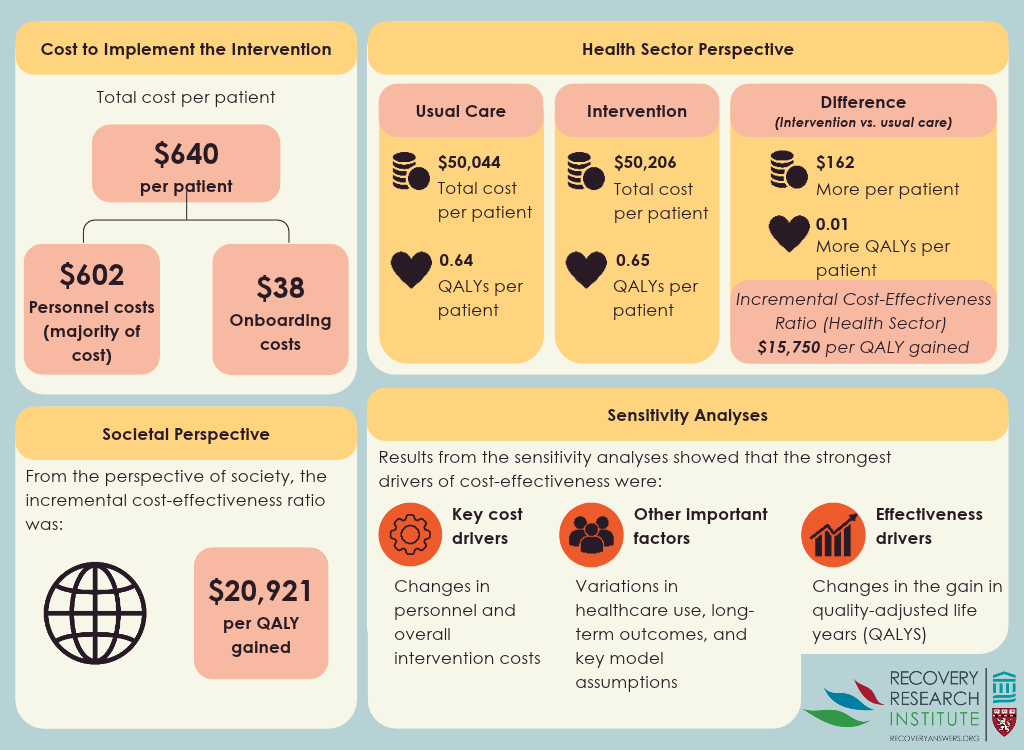
Overall, the cost to implement the intervention was $640 per patient, with the majority from personnel costs ($602) and the remaining from onboarding costs ($38). From the perspective of the health sector, the net cost for the intervention group was $50,206 with 0.65 quality-adjusted life years per patient, compared to $50,044 with 0.64 quality-adjusted life years per patient for the usual care group. This reflects a difference of $162 more for the intervention group, with a gain of 0.01 quality-adjusted life years per patient, which results in an incremental cost-effectiveness ratio of $15,750 per quality-adjusted life year gained. From the perspective of society, this ratio was $20,921 per quality-adjusted life year. Results from the sensitivity analyses showed that the strongest drivers of cost-effectiveness were health care expenditures and intervention effectiveness.
WHAT ARE THE IMPLICATIONS OF THE STUDY FINDINGS?
This study suggests that the Substance Use Treatment and Recovery Team addiction consultation service may be good value for starting medication treatment for opioid use disorder in the hospital and linking patients to follow-up care, from both health sector and limited societal viewpoints. The gain per patient was small (about 4 days of full health in 1 year), but so was the added cost (about $160 per patient over 1 year), and the ratio fell well below a commonly used U.S. benchmark for good value. Because the health gains were estimated with computer modeling based on prior research rather than measured in patients, this should be seen as a promising signal rather than firm proof. The result depended largely on published estimates that people who stay on medication have lower health care costs than people who are untreated, which offset much of the service’s cost. While future research is needed with smaller medical centers, these findings may help leaders of large academic hospitals weigh the cost of such services. Other research suggests that addiction services and peer support offered through hospitals and emergency departments may help engage people in care, although those studies were observational and cannot show that the services caused the benefits. The study authors suggest that payers could consider payment models that encourage hospitals to offer these services. Payers may have a reason to do so, because the service added only a small amount to total health care costs and appeared to be good value, and because people who stay on medication are estimated to have lower health care costs than people who remain untreated. For example, a payer could give hospitals a bonus when more of their patients with opioid use disorder start medication during a hospital stay and connect with follow-up care after discharge. Such a payment could help cover the cost of staff like an addiction medicine specialist and a care manager.
BOTTOM LINE
A hospital-based addiction consultation service that helps start and link patients to medication for opioid use disorder appears to be good value for large academic hospitals over 1 year. Because results rely on a model rather than long-term patient outcomes, they are promising but not definitive.
- For individuals and families seeking recovery: This study examined costs to hospitals rather than patient experiences, so its direct implications for individuals are limited. Hospital visits for overdoses or other health problems may provide an opportunity to link people with opioid use disorder to treatment and recovery support. Asking about medication treatment and available follow-up services during a hospital visit may help individuals access care and support beyond their immediate medical needs.
- For treatment professionals and treatment systems: Hospitals considering an addiction consultation service can plan for it as a modest staffing cost rather than a major investment. In this study, each patient required about 2 hours of an addiction medicine specialist’s time and about 3.5 hours of a care manager’s time, including follow-up calls. About half of the delivery cost was billable specialist time, so the net cost to a hospital may be lower than it appears, although billing was not analyzed.
- For scientists: Because this study was conducted in 3 large academic medical centers, future research in smaller hospitals with fewer resources would help clarify whether addiction consultation services are similarly cost-effective across different hospital settings. Additionally, future trials conducted in separate hospitals for the intervention and usual-care groups could minimize spillover effects and help clarify the service’s impact on costs and patient outcomes. Studies that measure costs, quality of life, overdoses, and treatment retention directly in patients over longer periods, and that include other substances, would reduce reliance on modeled assumptions.
- For policy makers: These findings suggest that funding or payment models that help hospitals offer addiction consultation services may be worth considering, as the authors propose. Evidence for smaller hospitals is lacking, and the results rely on a 1-year model.
CITATIONS
Okunogbe, A., Peltz, A., Danovitch, I., Ober, A. J., & Nuckols, T. K. (2026). Cost-effectiveness of the START hospital addiction consultation service for opioid use disorder treatment. JAMA Network Open, 9(5). doi: 10.1001/jamanetworkopen.2026.11324.