WHAT PROBLEM DOES THIS STUDY ADDRESS?
Although medications for opioid use disorder reduce overdose risk and improve recovery outcomes, most people with opioid use disorder do not receive them. Barriers such as stigma, limited treatment availability, transportation challenges, and misconceptions about medication can delay or prevent treatment initiation, with 20-40% of people endorsing not wanting to take these medications. Recovery coaches—peer workers with lived experience of substance use disorder and recovery—are increasingly being used to help individuals navigate such barriers, connect with treatment services, and build recovery support. However, research on peer-based interventions has produced mixed findings, suggesting that their success may differ based on how and where they are implemented. Implementation setting may be particularly important because organizations differ in their resources, culture, and goals. Community organizations (e.g., behavioral health organizations, medical clinics) may be well positioned to support linkage to treatment, whereas criminal-legal settings (e.g., detention centers, specialty courts, probation and parole offices) often face challenges related to stigma and barriers to implementing evidence-based practices. In addition, individuals living in rural communities may have fewer treatment options and face greater transportation barriers than those living in urban areas. This study implemented a large recovery coach-based medication for opioid use disorder linkage program and examined whether medication for opioid use disorder initiation differed across implementation settings, including community organizations or criminal-legal settings located in either rural or urban areas.
HOW WAS THIS STUDY CONDUCTED?
This observational study analyzed data from 754 individuals with opioid use disorder or current non-prescribed opioid use who enrolled in a recovery coach-based medication for opioid use disorder linkage program across 29 organizations in Kentucky between December 2020 and December 2022. The program covered all FDA-approved medications for opioid use disorder (i.e., methadone, buprenorphine, and naltrexone), and coaches did not track which specific medication participants started. Participants enrolled through 1 of 4 implementation settings: urban community organizations, urban criminal-legal organizations, rural community organizations, or rural criminal-legal organizations. Recovery coaches provided weekly coaching sessions together with telephone support, education about medication for opioid use disorder, assistance identifying and addressing barriers to treatment, support in setting recovery goals, and ongoing recovery support. Recovery coaches were peer workers with lived experience of substance use disorder, but having lived experience specifically with medications for opioids use disorder was not a program requirement, and coaches’ own medication history was not systematically tracked. For participants interested in initiating medication for opioid use disorder, recovery coaches also helped identify providers, schedule intake appointments, and support appointment attendance through daily reminders leading up to the appointment and weekly follow-ups for the first month after initiating treatment.
The primary outcome was based on a yes/no question that coaches asked participants at every coaching visit; whether they were currently receiving medication for opioid use disorder. Participants were counted as having initiated medication for opioid use disorder if they answered ‘yes’ at any visit. This was based on participants’ self-report, not on prescription or medical records. The researchers examined whether medication for opioid use disorder initiation differed across the four types of implementation settings, while accounting for participant characteristics such as age, sex, race and ethnicity, and initial interest in medication for opioid use disorder. The analysis did not account for other factors that could affect treatment motivation or need, such as opioid use disorder severity and prior medication utilization, or local treatment availability.
Because this was not a randomized study, participants were not assigned to different implementation settings. As a result, differences in medication for opioid use disorder initiation across settings may partly reflect differences in the individuals served, organizations involved, or other local factors that were not measured. For example, the number of opioid use disorder medication providers available and accepting new patients in a given community was not measured or accounted for in this study, even though the availability of nearby treatment options likely affects whether someone can successfully start a medication for opioid use disorder, independent of the recovery coaching program itself. In addition, all implementation settings were located within a single US state (Kentucky), which may limit the extent to which these findings generalize to other states, regions, or countries with different treatment systems, policies, and population characteristics. The study also relied on self-reported treatment initiation, and some participant information was missing or incompletely recorded, which may have influenced outcomes in unknown ways.
WHAT DID THIS STUDY FIND?
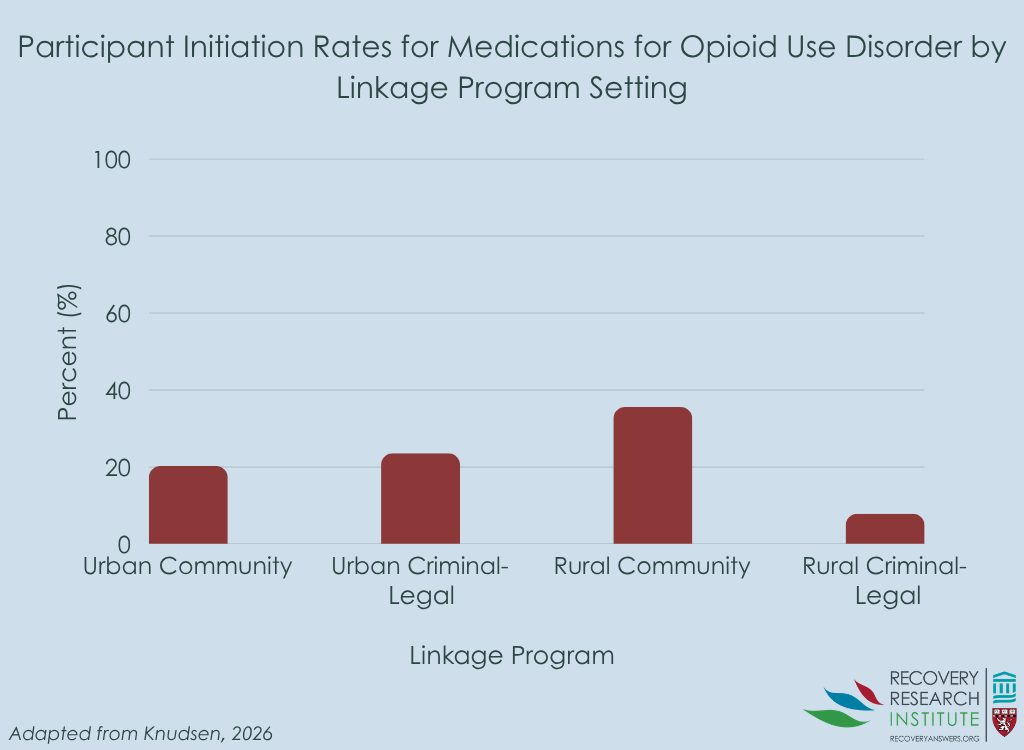
Overall, almost 1 in 4 participants (23%) reported initiating medication for opioid use disorder after enrolling in the recovery coaching program. However, as shown in the graph below, medication for opioid use disorder initiation differed significantly across implementation settings. Participants enrolled through rural community organizations were the most likely to initiate medication for opioid use disorder, while those enrolled through rural criminal-legal organizations were the least likely. Participants from rural criminal-legal organizations were also less likely to express interest in medication for opioid use disorder at their first recovery coaching session than those enrolled through rural community organizations. After accounting for demographic characteristics and participants’ initial interest in medications, individuals enrolled through rural community organizations were 85% more likely to initiate medication for opioid use disorder than those enrolled through urban community organizations. In contrast, participants enrolled through rural criminal-legal organizations were 66% less likely to initiate medication for opioid use disorder than those enrolled through urban community organizations. Participants who expressed interest in opioid use disorder medication during their first recovery coaching session were also 3.5 times more likely to start treatment than those who were not initially interested. Demographic characteristics such as age, sex, race, and ethnicity were not associated with whether someone initiated medication, suggesting that medication for opioid use disorder initiation did not significantly differ according to participants’ demographic characteristics.
WHAT ARE THE IMPLICATIONS OF THE STUDY FINDINGS?
Findings suggest that recovery coach-based linkage programs may help some people with opioid use disorder connect with opioid use disorder medication treatment, though this study’s design cannot establish whether coaching increased initiation compared with no coaching or another approach. The 23% initiation rate observed here is comparable to rates reported for other peer-based linkage programs, which have ranged from about 9% to 60%, and is similar to or slightly below national estimates suggesting roughly 25% of people with past-year opioid use disorder receive medications for opioid use disorder. As such, this rate does not indicate the program outperformed what might have happened otherwise. Differences across implementation settings suggest that factors such as organizational resources, stigma surrounding medication treatment, or barriers within criminal-legal systems may be associated with whether people successfully initiate medication for opioid use disorder. Participants enrolled through rural community organizations were the most likely to initiate medication, suggesting that recovery coaching may represent one promising approach for addressing treatment access barriers in rural areas where services are often limited. This finding is consistent with prior work showing that rural recovery community organizations can serve as valuable sources of recovery support despite operating in resource-constrained environments. At the same time, the lower rates of medication for opioid use disorder initiation observed in rural criminal-legal settings suggest that additional barriers may exist within these environments that limit successful linkage to care. It’s also possible that participants who enrolled through rural community organizations were, on average, more ready or motivated to pursue treatment than those enrolled through criminal-legal settings, for reasons the study could not fully capture. The analysis did adjust for participants’ stated interest in medication for opioid use disorder at their first visit, but a range of other factors related to treatment motivation and readiness, such as prior treatment experience, perceived need, or coercion into program enrollment, were not measured. It is plausible that participants referred through criminal-legal settings, who may be required or pressured to enroll rather than seeking help voluntarily, could differ systematically in their motivation from those who sought out a community organization on their own, which would make it difficult to fully separate the effect of the setting from differences in who was enrolled there. Previous research has highlighted challenges to implementing evidence-based practices and medication for opioid use disorder within criminal-legal settings, including stigma toward medication treatment and competing organizational priorities (i.e., criminal justice vs. public health). Future research should identify the specific factors that help or hinder medication for opioid use disorder initiation across implementation settings and determine how recovery coaching programs can be adapted to improve outcomes in settings where linkage to care is more challenging. Randomized controlled trials are also needed to determine the effectiveness of recovery coach-based medication for opioid use disorder linkage programs and whether their impact differs across implementation settings.
BOTTOM LINE
Recovery coaches may help connect people with opioid use disorder to medication for opioid use disorder treatment, but the setting in which those services are delivered appears to matter. Some of this variation may reflect differences in who enrolled at each site rather than the setting itself. Participants enrolled through rural community organizations (e.g., behavioral health organizations, medical clinics) were more likely to initiate medication for opioid use disorder than those enrolled through urban community organizations, whereas participants enrolled through rural criminal-legal settings (e.g., detention centers, pretrial services, specialty courts, probation and parole offices) were less likely to do so. Future research, including randomized trials, is needed to better understand the setting-specific barriers and facilitators associated with medication for opioid use disorder initiation, particularly within rural and criminal justice settings.
- For individuals and families seeking recovery: Recovery coaches provide practical support, such as help identifying medication for opioid use disorder providers, scheduling appointments, and addressing barriers to treatment, though this study cannot determine how much this support might increase medication for opioid use disorder initiation compared with not having a coach. Individuals interested in medication for opioid use disorder may still find it worthwhile to connect with peer recovery support services, since these programs are designed to help identify treatment options and support entry into care, even though their added benefit hasn’t yet been directly tested.
- For treatment professionals and treatment systems: Treatment systems may benefit from examining how organizational and community factors influence medication for opioid use disorder linkage outcomes and identifying strategies to strengthen referral pathways and reduce barriers to treatment initiation in settings where linkage to care may be more challenging (e.g., rural criminal-legal settings).
- For scientists: Implementation setting appears to be an important contextual factor associated with the success of recovery coach-based medication for opioid use disorder linkage programs. Future research should examine the mechanisms underlying these differences and identify implementation strategies that improve outcomes in rural criminal-legal settings. Randomized controlled trials are also needed to evaluate the effectiveness of recovery coach-based medication for opioid use disorder linkage programs and their impact on substance use and recovery outcomes over time.
- For policy makers: Expanding access to recovery coaching services may help increase medication for opioid use disorder initiation among individuals with opioid use disorder. Findings suggest that policies aimed at reducing barriers to medication for opioid use disorder and strengthening linkage-to-care services within criminal-legal systems, particularly in rural communities, may improve treatment access and potentially reduce overdose risk.
CITATIONS
Knudsen, H. K., Fallin-Bennett, A., Fanucchi, L., Lofwall, M. R., McGladrey, M., Oser, C. B., Biggers, G., Ross, A., Chadwell, J., & Walsh, S. L. (2026). Increasing initiation of medications for opioid use disorder through recovery coaches: The role of implementation setting. Journal of Addiction Medicine, 20(1), 15-21. doi: 10.1097/ADM.0000000000001482.