l
Financing strategies, meaning where funds are directed to support implementation of a program, can affect how successful implementation is (e.g., how many providers or clients a program reaches). The Adolescent Community Reinforcement Approach is one evidence-based treatment for youth substance use disorder that combines cognitive-behavioral therapy and parent/caregiver interventions to help youth replace substance use behaviors with healthier alternatives. However, even though it is evidence-based, a lack of stable funding has been a major barrier to deploying it consistently.
The US Substance Abuse and Mental Health Services Administration (best known by its acronym SAMHSA) first awarded organization-focused grants directly to treatment organizations from 2006 to 2010, then awarded state-focused grants to state substance use agencies (which in turn funded treatment organizations) starting in 2012. Because SAMHSA used these two different funding approaches to support many of the same treatment programs at different times, this offered a natural, real-world way to compare them. SAMHSA had designed the state-focused grants expecting them to achieve even greater reach than the earlier organization-focused grants. The researchers’ study tested that expectation by comparing implementation reach between the 2 grant types, as well as the specific factors that helped or hindered that reach.
This mixed-methods study used both quantitative and qualitative methods to compare 2 federal grant mechanisms that directed funds towards organizations or states, with the goal of determining how these financing strategies affected the implementation of adolescent community reinforcement approach treatment program. The researchers were interested in: (1) whether grant type influenced implementation reach; (2) whether any effects from the grant type on implementation reach were moderated, or changed by, funding stability and organizational capacity; and (3) the barriers and facilitators to program implementation. Implementation of the program took place from 2006 through 2021. A natural experimental design was used, leveraging naturally occurring variation in the type of grant funding each project received.
Reach was defined as the proportion of individuals who were trained in delivery of the program and received certification in program delivery or supervision by the end of the funding period. There are different levels of certification that reflect the number and type of procedures in which the provider is proficient. The primary outcome of interest in this study was the proportion of participants who achieved any certification. Additional outcomes included the different certification levels and types: first-level, full-level, and supervisor. First-level certification requires demonstrated proficiency in 9 core treatment techniques and qualifies clinicians to deliver the program independently. Full-level certification requires proficiency in 10 additional techniques, for a total of 19. Supervisor certification assesses the ability to supervise clinicians and evaluate their delivery of the program.
Quantitative data on certification rates were obtained through administrative training records, while quantitative data on the moderator variables (i.e., funding stability and organizational capacity) were obtained from a 25-minute web-based survey. Qualitative data on barriers and facilitators were obtained through 45-60-minute semi-structured interviews with clinicians and supervisors under both grant types that asked participants about implementation approaches and support, sustainability planning, and infrastructure.
For the quantitative statistical analyses, the researchers tested differences in the rates of program certification between organization-focused grants and state-focused grants, while controlling for the covariates of turnover rates, number of providers trained, number of supervisors who sought certification, grant end date, and quarters of grant funding. Such statistical controlling helps to isolate the effect of interest; i.e., whether the type of grant is independently associated with implementation reach. Moderator variables and their interaction with grant type were then tested. Qualitative analyses included coding of transcripts using a qualitative software program and a codebook that was added to and refined throughout the coding process. Summaries of the coded content were developed and categorized into the domains of innovation, inner context, outer context, and bridging factors.
For the interviews and surveys, clinicians and clinical supervisors who were responsible for treating youth substance use disorders were eligible to participate, with preference given to those knowledgeable about implementation of the adolescent community reinforcement approach treatment program. State agency administrators also participated in the interviews. Certification records were available for all 164 organizations across 35 states (82 organizations per grant type). A subset of these organizations also took part in interviews (154 organizations, 249 providers) and surveys (138 organizations, 202 providers); 32 additional state agency administrators from 18 states were interviewed about the state-focused grants.
Importantly, because this study used an observational experimental design, the researchers could not fully attribute the outcomes to the effects of grant type. In other words, there may have been other variables that influenced the type of grant that the organization received that may have also influenced outcomes. However, the researchers did attempt to test the extent this occurred with sensitivity analyses and found no differences. This study also only compared 2 grant types. Other grant types may differentially impact implementation reach. Finally, this study cannot shed light on the feasibility of the certification process and how grant type may affect clinical outcomes or program reach among clients.
Certification rates were higher with organization-focused grants
Overall, the average rate for any certification from treatment programs who received organization-focused grants was 72%, while the rate from programs who received state-focused grants was 36% (see figure below). Similarly, the average rate for first-level certification from treatment programs who received organization-focused grants was 62%, while the rate from programs who received state-focused grants was 36%.
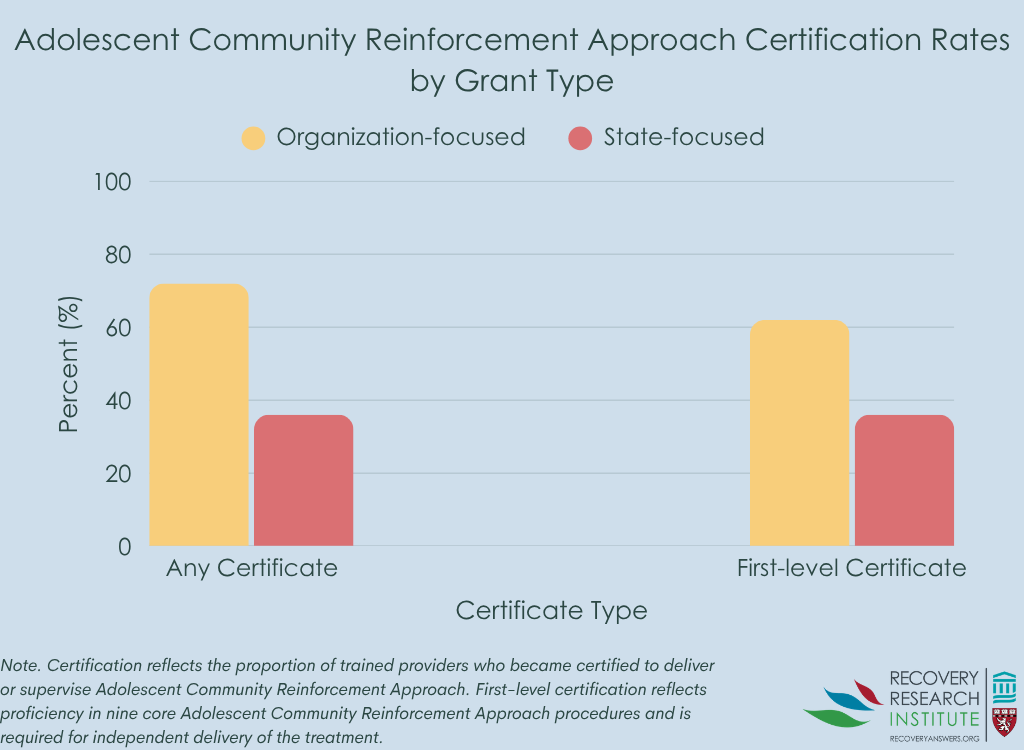
Results from the quantitative analyses showed that rates for any and first-level certification were 27 and 23 percentage points lower, respectively, for state-focused grants than organization-focused grants, while controlling for covariates. However, the study did not find clear differences between grant types in full-level or supervisor certification rates. It also found no clear evidence that funding stability or organizational capacity changed the relationship between grant type and certification rates.
Providers who achieved certification, under either grant type, consistently met the field’s standard for skillful delivery of the program, so the certification-rate gap between organization-focused and state-focused grants reflects how many providers got certified rather than how well those who did certify delivered the program.
Implementation experiences differed by grant type
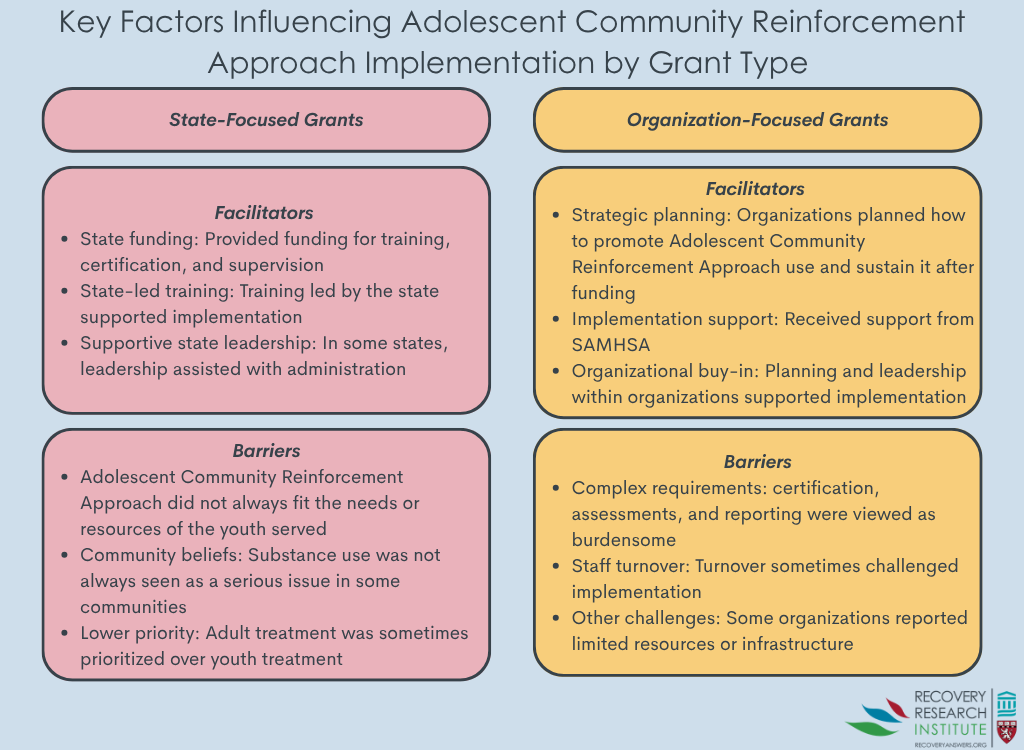
Results from the qualitative interviews identified barriers and facilitators to implementation. Organization-focused grantees described strategic planning and direct SAMHSA support as helpful, but also reported burdensome assessment and reporting requirements. State-focused grantees valued state funding, training, and supportive leadership, while describing challenges with the program’s fit for the youth served and limited community priority for youth substance use treatment.
Key barriers to implementation included the fit of the program with the target population (e.g., lack of resources that prevents participation in extracurricular activities; different needs for youth in residential care); the belief that substance use is not a serious issue in some communities; and prioritizing adult treatment instead of youth treatment. Respondents from programs receiving state-focused grants more frequently reported barriers regarding program fit, community beliefs, and lack of priority than respondents from programs receiving organization-focused grants. Organization-focused grantees, in turn, more often described complex and burdensome assessment and reporting requirements tied to their federal grants.
Key facilitators to implementation included strategic planning to promote use of the treatment program, including plans for sustainment when funding ended; training activities led by the state; and support provided by SAMHSA for organization-focused grants.
Respondents from programs receiving organization-focused grants more frequently reported facilitators regarding strategic planning, while respondents from programs receiving state-focused grants described little such planning. State leadership support, which was relevant only to state-focused grants, was described as both a barrier and facilitator, depending on the state. Respondents from some states described the support they received from state agency administrators as helpful in assisting project administration, moving providers through the certification process, and encouraging buy-in. However, respondents from other states discussed how their state agencies did not encourage use of the treatment program, and that they experienced challenges in fulfilling their role, such as limited decision-making authority when local authorities controlled decisions, and turnover among state agency staff.
This study demonstrated that certification rates for a youth substance use treatment program were lower when funds were issued to the state rather than the organization. The qualitative interviews showed that participants from state-focused grants were less likely to report engaging in strategic planning than those from organization-focused grants and experienced greater challenges implementing program activities. These results help explain why certification rates may have been lower in state-focused grants. The observational study design prevents the researchers from being able to fully attribute the outcomes to the effects of grant type and more research is needed—such as in-depth case studies comparing states’ policy contexts and additional quasi-experimental analyses—to better understand how other factors may have influenced which grant type an organization received and how that, in turn, affected outcomes. However, taken together, the findings of this study suggest that investing in organizations directly can help increase certification rates and improve implementation processes. It is worth noting that this study measured reach within individual treatment organizations. Because state-focused grants supported many more organizations overall, the total number of certified providers statewide may still have been larger under state-focused grants, even though the certification rate within each organization was lower. While future research is needed to compare other funding strategies and evaluate how grant type may affect clinical outcomes and program reach among clients, this work helps guide investments for implementation of youth substance use programs.
Certification rates for a youth substance use treatment program were lower when funds were issued to the state rather than the organization, which may be related to greater strategic planning and fewer challenges in implementing program activities among organization-focused grantees. These results suggest that investing directly in organizations may help increase certification rates and the reach of treatment program implementation.
Dopp, A. R., Hunter, S. B., Godley, M. D., González, I., Bongard, M., Han, B., Cantor, J., Hindmarch, G., Lindquist, K., Wright, B., Schlang, D., Passetti, L. L., Wright, K. L., Kilmer, B., Aarons, G., A., & Purtle, J. (2023). Comparing organization-focused and state-focused financing strategies on provider-level reach of a youth substance use treatment model: a mixed-method study. Implementation Science, 18(1), Article 50. doi: 10.1186/s13012-023-01305-z.
l
Financing strategies, meaning where funds are directed to support implementation of a program, can affect how successful implementation is (e.g., how many providers or clients a program reaches). The Adolescent Community Reinforcement Approach is one evidence-based treatment for youth substance use disorder that combines cognitive-behavioral therapy and parent/caregiver interventions to help youth replace substance use behaviors with healthier alternatives. However, even though it is evidence-based, a lack of stable funding has been a major barrier to deploying it consistently.
The US Substance Abuse and Mental Health Services Administration (best known by its acronym SAMHSA) first awarded organization-focused grants directly to treatment organizations from 2006 to 2010, then awarded state-focused grants to state substance use agencies (which in turn funded treatment organizations) starting in 2012. Because SAMHSA used these two different funding approaches to support many of the same treatment programs at different times, this offered a natural, real-world way to compare them. SAMHSA had designed the state-focused grants expecting them to achieve even greater reach than the earlier organization-focused grants. The researchers’ study tested that expectation by comparing implementation reach between the 2 grant types, as well as the specific factors that helped or hindered that reach.
This mixed-methods study used both quantitative and qualitative methods to compare 2 federal grant mechanisms that directed funds towards organizations or states, with the goal of determining how these financing strategies affected the implementation of adolescent community reinforcement approach treatment program. The researchers were interested in: (1) whether grant type influenced implementation reach; (2) whether any effects from the grant type on implementation reach were moderated, or changed by, funding stability and organizational capacity; and (3) the barriers and facilitators to program implementation. Implementation of the program took place from 2006 through 2021. A natural experimental design was used, leveraging naturally occurring variation in the type of grant funding each project received.
Reach was defined as the proportion of individuals who were trained in delivery of the program and received certification in program delivery or supervision by the end of the funding period. There are different levels of certification that reflect the number and type of procedures in which the provider is proficient. The primary outcome of interest in this study was the proportion of participants who achieved any certification. Additional outcomes included the different certification levels and types: first-level, full-level, and supervisor. First-level certification requires demonstrated proficiency in 9 core treatment techniques and qualifies clinicians to deliver the program independently. Full-level certification requires proficiency in 10 additional techniques, for a total of 19. Supervisor certification assesses the ability to supervise clinicians and evaluate their delivery of the program.
Quantitative data on certification rates were obtained through administrative training records, while quantitative data on the moderator variables (i.e., funding stability and organizational capacity) were obtained from a 25-minute web-based survey. Qualitative data on barriers and facilitators were obtained through 45-60-minute semi-structured interviews with clinicians and supervisors under both grant types that asked participants about implementation approaches and support, sustainability planning, and infrastructure.
For the quantitative statistical analyses, the researchers tested differences in the rates of program certification between organization-focused grants and state-focused grants, while controlling for the covariates of turnover rates, number of providers trained, number of supervisors who sought certification, grant end date, and quarters of grant funding. Such statistical controlling helps to isolate the effect of interest; i.e., whether the type of grant is independently associated with implementation reach. Moderator variables and their interaction with grant type were then tested. Qualitative analyses included coding of transcripts using a qualitative software program and a codebook that was added to and refined throughout the coding process. Summaries of the coded content were developed and categorized into the domains of innovation, inner context, outer context, and bridging factors.
For the interviews and surveys, clinicians and clinical supervisors who were responsible for treating youth substance use disorders were eligible to participate, with preference given to those knowledgeable about implementation of the adolescent community reinforcement approach treatment program. State agency administrators also participated in the interviews. Certification records were available for all 164 organizations across 35 states (82 organizations per grant type). A subset of these organizations also took part in interviews (154 organizations, 249 providers) and surveys (138 organizations, 202 providers); 32 additional state agency administrators from 18 states were interviewed about the state-focused grants.
Importantly, because this study used an observational experimental design, the researchers could not fully attribute the outcomes to the effects of grant type. In other words, there may have been other variables that influenced the type of grant that the organization received that may have also influenced outcomes. However, the researchers did attempt to test the extent this occurred with sensitivity analyses and found no differences. This study also only compared 2 grant types. Other grant types may differentially impact implementation reach. Finally, this study cannot shed light on the feasibility of the certification process and how grant type may affect clinical outcomes or program reach among clients.
Certification rates were higher with organization-focused grants
Overall, the average rate for any certification from treatment programs who received organization-focused grants was 72%, while the rate from programs who received state-focused grants was 36% (see figure below). Similarly, the average rate for first-level certification from treatment programs who received organization-focused grants was 62%, while the rate from programs who received state-focused grants was 36%.

Results from the quantitative analyses showed that rates for any and first-level certification were 27 and 23 percentage points lower, respectively, for state-focused grants than organization-focused grants, while controlling for covariates. However, the study did not find clear differences between grant types in full-level or supervisor certification rates. It also found no clear evidence that funding stability or organizational capacity changed the relationship between grant type and certification rates.
Providers who achieved certification, under either grant type, consistently met the field’s standard for skillful delivery of the program, so the certification-rate gap between organization-focused and state-focused grants reflects how many providers got certified rather than how well those who did certify delivered the program.
Implementation experiences differed by grant type
Results from the qualitative interviews identified barriers and facilitators to implementation. Organization-focused grantees described strategic planning and direct SAMHSA support as helpful, but also reported burdensome assessment and reporting requirements. State-focused grantees valued state funding, training, and supportive leadership, while describing challenges with the program’s fit for the youth served and limited community priority for youth substance use treatment.
Key barriers to implementation included the fit of the program with the target population (e.g., lack of resources that prevents participation in extracurricular activities; different needs for youth in residential care); the belief that substance use is not a serious issue in some communities; and prioritizing adult treatment instead of youth treatment. Respondents from programs receiving state-focused grants more frequently reported barriers regarding program fit, community beliefs, and lack of priority than respondents from programs receiving organization-focused grants. Organization-focused grantees, in turn, more often described complex and burdensome assessment and reporting requirements tied to their federal grants.
Key facilitators to implementation included strategic planning to promote use of the treatment program, including plans for sustainment when funding ended; training activities led by the state; and support provided by SAMHSA for organization-focused grants.
Respondents from programs receiving organization-focused grants more frequently reported facilitators regarding strategic planning, while respondents from programs receiving state-focused grants described little such planning. State leadership support, which was relevant only to state-focused grants, was described as both a barrier and facilitator, depending on the state. Respondents from some states described the support they received from state agency administrators as helpful in assisting project administration, moving providers through the certification process, and encouraging buy-in. However, respondents from other states discussed how their state agencies did not encourage use of the treatment program, and that they experienced challenges in fulfilling their role, such as limited decision-making authority when local authorities controlled decisions, and turnover among state agency staff.

This study demonstrated that certification rates for a youth substance use treatment program were lower when funds were issued to the state rather than the organization. The qualitative interviews showed that participants from state-focused grants were less likely to report engaging in strategic planning than those from organization-focused grants and experienced greater challenges implementing program activities. These results help explain why certification rates may have been lower in state-focused grants. The observational study design prevents the researchers from being able to fully attribute the outcomes to the effects of grant type and more research is needed—such as in-depth case studies comparing states’ policy contexts and additional quasi-experimental analyses—to better understand how other factors may have influenced which grant type an organization received and how that, in turn, affected outcomes. However, taken together, the findings of this study suggest that investing in organizations directly can help increase certification rates and improve implementation processes. It is worth noting that this study measured reach within individual treatment organizations. Because state-focused grants supported many more organizations overall, the total number of certified providers statewide may still have been larger under state-focused grants, even though the certification rate within each organization was lower. While future research is needed to compare other funding strategies and evaluate how grant type may affect clinical outcomes and program reach among clients, this work helps guide investments for implementation of youth substance use programs.
Certification rates for a youth substance use treatment program were lower when funds were issued to the state rather than the organization, which may be related to greater strategic planning and fewer challenges in implementing program activities among organization-focused grantees. These results suggest that investing directly in organizations may help increase certification rates and the reach of treatment program implementation.
Dopp, A. R., Hunter, S. B., Godley, M. D., González, I., Bongard, M., Han, B., Cantor, J., Hindmarch, G., Lindquist, K., Wright, B., Schlang, D., Passetti, L. L., Wright, K. L., Kilmer, B., Aarons, G., A., & Purtle, J. (2023). Comparing organization-focused and state-focused financing strategies on provider-level reach of a youth substance use treatment model: a mixed-method study. Implementation Science, 18(1), Article 50. doi: 10.1186/s13012-023-01305-z.

l
Financing strategies, meaning where funds are directed to support implementation of a program, can affect how successful implementation is (e.g., how many providers or clients a program reaches). The Adolescent Community Reinforcement Approach is one evidence-based treatment for youth substance use disorder that combines cognitive-behavioral therapy and parent/caregiver interventions to help youth replace substance use behaviors with healthier alternatives. However, even though it is evidence-based, a lack of stable funding has been a major barrier to deploying it consistently.
The US Substance Abuse and Mental Health Services Administration (best known by its acronym SAMHSA) first awarded organization-focused grants directly to treatment organizations from 2006 to 2010, then awarded state-focused grants to state substance use agencies (which in turn funded treatment organizations) starting in 2012. Because SAMHSA used these two different funding approaches to support many of the same treatment programs at different times, this offered a natural, real-world way to compare them. SAMHSA had designed the state-focused grants expecting them to achieve even greater reach than the earlier organization-focused grants. The researchers’ study tested that expectation by comparing implementation reach between the 2 grant types, as well as the specific factors that helped or hindered that reach.
This mixed-methods study used both quantitative and qualitative methods to compare 2 federal grant mechanisms that directed funds towards organizations or states, with the goal of determining how these financing strategies affected the implementation of adolescent community reinforcement approach treatment program. The researchers were interested in: (1) whether grant type influenced implementation reach; (2) whether any effects from the grant type on implementation reach were moderated, or changed by, funding stability and organizational capacity; and (3) the barriers and facilitators to program implementation. Implementation of the program took place from 2006 through 2021. A natural experimental design was used, leveraging naturally occurring variation in the type of grant funding each project received.
Reach was defined as the proportion of individuals who were trained in delivery of the program and received certification in program delivery or supervision by the end of the funding period. There are different levels of certification that reflect the number and type of procedures in which the provider is proficient. The primary outcome of interest in this study was the proportion of participants who achieved any certification. Additional outcomes included the different certification levels and types: first-level, full-level, and supervisor. First-level certification requires demonstrated proficiency in 9 core treatment techniques and qualifies clinicians to deliver the program independently. Full-level certification requires proficiency in 10 additional techniques, for a total of 19. Supervisor certification assesses the ability to supervise clinicians and evaluate their delivery of the program.
Quantitative data on certification rates were obtained through administrative training records, while quantitative data on the moderator variables (i.e., funding stability and organizational capacity) were obtained from a 25-minute web-based survey. Qualitative data on barriers and facilitators were obtained through 45-60-minute semi-structured interviews with clinicians and supervisors under both grant types that asked participants about implementation approaches and support, sustainability planning, and infrastructure.
For the quantitative statistical analyses, the researchers tested differences in the rates of program certification between organization-focused grants and state-focused grants, while controlling for the covariates of turnover rates, number of providers trained, number of supervisors who sought certification, grant end date, and quarters of grant funding. Such statistical controlling helps to isolate the effect of interest; i.e., whether the type of grant is independently associated with implementation reach. Moderator variables and their interaction with grant type were then tested. Qualitative analyses included coding of transcripts using a qualitative software program and a codebook that was added to and refined throughout the coding process. Summaries of the coded content were developed and categorized into the domains of innovation, inner context, outer context, and bridging factors.
For the interviews and surveys, clinicians and clinical supervisors who were responsible for treating youth substance use disorders were eligible to participate, with preference given to those knowledgeable about implementation of the adolescent community reinforcement approach treatment program. State agency administrators also participated in the interviews. Certification records were available for all 164 organizations across 35 states (82 organizations per grant type). A subset of these organizations also took part in interviews (154 organizations, 249 providers) and surveys (138 organizations, 202 providers); 32 additional state agency administrators from 18 states were interviewed about the state-focused grants.
Importantly, because this study used an observational experimental design, the researchers could not fully attribute the outcomes to the effects of grant type. In other words, there may have been other variables that influenced the type of grant that the organization received that may have also influenced outcomes. However, the researchers did attempt to test the extent this occurred with sensitivity analyses and found no differences. This study also only compared 2 grant types. Other grant types may differentially impact implementation reach. Finally, this study cannot shed light on the feasibility of the certification process and how grant type may affect clinical outcomes or program reach among clients.
Certification rates were higher with organization-focused grants
Overall, the average rate for any certification from treatment programs who received organization-focused grants was 72%, while the rate from programs who received state-focused grants was 36% (see figure below). Similarly, the average rate for first-level certification from treatment programs who received organization-focused grants was 62%, while the rate from programs who received state-focused grants was 36%.

Results from the quantitative analyses showed that rates for any and first-level certification were 27 and 23 percentage points lower, respectively, for state-focused grants than organization-focused grants, while controlling for covariates. However, the study did not find clear differences between grant types in full-level or supervisor certification rates. It also found no clear evidence that funding stability or organizational capacity changed the relationship between grant type and certification rates.
Providers who achieved certification, under either grant type, consistently met the field’s standard for skillful delivery of the program, so the certification-rate gap between organization-focused and state-focused grants reflects how many providers got certified rather than how well those who did certify delivered the program.
Implementation experiences differed by grant type
Results from the qualitative interviews identified barriers and facilitators to implementation. Organization-focused grantees described strategic planning and direct SAMHSA support as helpful, but also reported burdensome assessment and reporting requirements. State-focused grantees valued state funding, training, and supportive leadership, while describing challenges with the program’s fit for the youth served and limited community priority for youth substance use treatment.
Key barriers to implementation included the fit of the program with the target population (e.g., lack of resources that prevents participation in extracurricular activities; different needs for youth in residential care); the belief that substance use is not a serious issue in some communities; and prioritizing adult treatment instead of youth treatment. Respondents from programs receiving state-focused grants more frequently reported barriers regarding program fit, community beliefs, and lack of priority than respondents from programs receiving organization-focused grants. Organization-focused grantees, in turn, more often described complex and burdensome assessment and reporting requirements tied to their federal grants.
Key facilitators to implementation included strategic planning to promote use of the treatment program, including plans for sustainment when funding ended; training activities led by the state; and support provided by SAMHSA for organization-focused grants.
Respondents from programs receiving organization-focused grants more frequently reported facilitators regarding strategic planning, while respondents from programs receiving state-focused grants described little such planning. State leadership support, which was relevant only to state-focused grants, was described as both a barrier and facilitator, depending on the state. Respondents from some states described the support they received from state agency administrators as helpful in assisting project administration, moving providers through the certification process, and encouraging buy-in. However, respondents from other states discussed how their state agencies did not encourage use of the treatment program, and that they experienced challenges in fulfilling their role, such as limited decision-making authority when local authorities controlled decisions, and turnover among state agency staff.

This study demonstrated that certification rates for a youth substance use treatment program were lower when funds were issued to the state rather than the organization. The qualitative interviews showed that participants from state-focused grants were less likely to report engaging in strategic planning than those from organization-focused grants and experienced greater challenges implementing program activities. These results help explain why certification rates may have been lower in state-focused grants. The observational study design prevents the researchers from being able to fully attribute the outcomes to the effects of grant type and more research is needed—such as in-depth case studies comparing states’ policy contexts and additional quasi-experimental analyses—to better understand how other factors may have influenced which grant type an organization received and how that, in turn, affected outcomes. However, taken together, the findings of this study suggest that investing in organizations directly can help increase certification rates and improve implementation processes. It is worth noting that this study measured reach within individual treatment organizations. Because state-focused grants supported many more organizations overall, the total number of certified providers statewide may still have been larger under state-focused grants, even though the certification rate within each organization was lower. While future research is needed to compare other funding strategies and evaluate how grant type may affect clinical outcomes and program reach among clients, this work helps guide investments for implementation of youth substance use programs.
Certification rates for a youth substance use treatment program were lower when funds were issued to the state rather than the organization, which may be related to greater strategic planning and fewer challenges in implementing program activities among organization-focused grantees. These results suggest that investing directly in organizations may help increase certification rates and the reach of treatment program implementation.
Dopp, A. R., Hunter, S. B., Godley, M. D., González, I., Bongard, M., Han, B., Cantor, J., Hindmarch, G., Lindquist, K., Wright, B., Schlang, D., Passetti, L. L., Wright, K. L., Kilmer, B., Aarons, G., A., & Purtle, J. (2023). Comparing organization-focused and state-focused financing strategies on provider-level reach of a youth substance use treatment model: a mixed-method study. Implementation Science, 18(1), Article 50. doi: 10.1186/s13012-023-01305-z.