Delivering peer recovery support services in community settings does cost money, but is a good value proposition
Peer recovery support services like recovery coaching have become an increasingly common component of substance use disorder clinical and community care. However, little is known about how much these services actually cost to provide or what the key drivers of expenses are. This study explored the cost of delivering peer recovery support services in recovery community centers.
Peer recovery support services, like recovery coaching, are increasingly being utilized across a wide range of clinical and community settings. One setting in which peer recovery support services are integral is recovery community centers, recovery “hubs” which provide a range of recovery-oriented, professional- and peer-delivered services. Although evidence demonstrates that peer recovery support services improve retention in treatment, reduce utilization of emergency services, improve linkage to medications for opioid use disorder, and have been shown to be cost effective to health systems and society, the actual costs of providing these services in community settings remains largely unknown. This knowledge gap presents a challenge for recovery community centers seeking to sustain operations, secure funding, and advocate for adequate resources. Additionally, policymakers and funders lack concrete data on the economic requirements for implementing peer recovery programs at scale.
HOW WAS THIS STUDY CONDUCTED?
This was a retrospective, cost-analysis of 2 recovery community center delivery models provided by Voices of Hope in Kentucky, USA in 2022. The researchers collected financial data from the agency’s accounting software and conducted key informant surveys with staff to determine how employees spent their time. The study evaluated 2 distinct programs: 1) the Voices of Hope recovery community center standard services model including recovery coaching, telephone recovery support, hosting mutual-help meetings, overdose education and naloxone distribution, social events, and community events designed to reduce stigma, funded through a mix of Kentucky Opioid Response Effort funds, foundation grants, and philanthropy, and 2) an expanded peer recovery support services program designed to promote medication for opioid use disorder linkage and retention, funded through National Institutes of Health (NIH) HEAL Initiative grants as part of the HEALing Communities Study and Justice Community Opioid Innovation Network. The researchers used a modified Substance Abuse Services Cost Analysis Program to calculate program costs, allocate labor expenses, and estimate per-participant annual costs.
WHAT DID THIS STUDY FIND?
The recovery community center cost approximately $2,824/person to deliver
Throughout 2022, the Voices of Hope recovery community center standard program regularly staffed over 50 full-time positions and used over 1,800 hours of volunteer time through a range of programmatic and administrative roles.
Their standard recovery community center program enrolled 721 individuals and incurred total operating costs of $876,831. About 23% of these costs ($201,671) were dedicated to non-participant-driven community support services such as hosting mutual-help meetings, laundry facilities, computer access, and community meals available to daily walk-in visitors. The annual per-participant cost was $2,824, with administrative labor accounting for 46% of total service-level expenses.
The more resource-intensive expanded peer recovery support program cost approximately $5,286/person to deliver
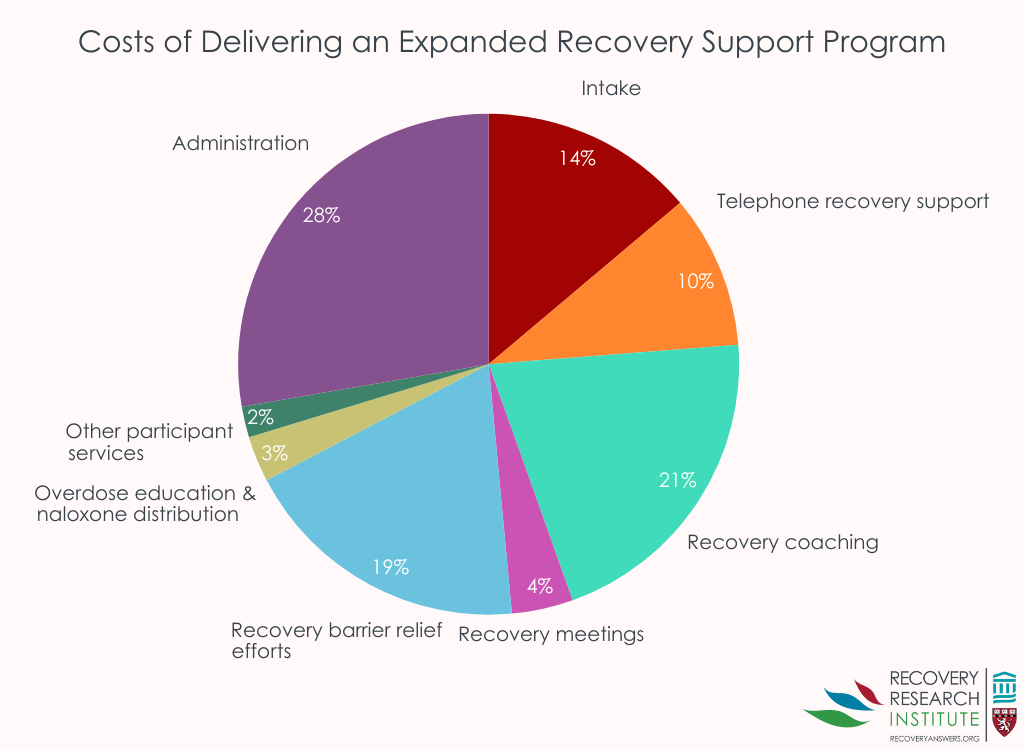
In 2022, Voices of Hope’s expanded peer recovery support program served 1,411 individuals with $2,500,613 in annual operating costs, with per-participant expenses of $5,286 annually (see figure below). Labor expenses accounted for more than two-thirds of all costs, with administrative tasks comprising 28% of expenses in this program.
Labor was the primary cost driver for both models
In both programs, personnel expenses represented the largest cost category. In the standard recovery community center program almost half of the costs were for labor. Labor costs were also high for the expanded peer recovery support services program, however, this program also invested heavily in barrier relief services (e.g., 2 weeks of emergency housing), which constituted the second-largest category of participant-facing expenses and included transportation support and emergency housing assistance to help individuals access and remain in medication for opioid use disorder treatment.
WHAT ARE THE IMPLICATIONS OF THE STUDY FINDINGS?
This study highlights the substantial financial investment needed to provide intensive peer recovery support services in community settings much of which is driven by staffing needs. The higher per-participant costs in the expanded program reflect investments in evidence-based practices, including intensive recovery coaching, barrier relief services, and wraparound supports specifically designed to improve medication for opioid use disorder linkage and retention.
Though these costs are significant, they may still reflect a value proposition, with other research comparing the costs of peer recovery support services to specialty addiction treatment finding that peer support services deliver good value for the money from both healthcare system and societal perspectives. While providing peer recovery support requires a meaningful upfront investment ($2,800–$5,300 per person annually for Voices of Hope), these services may deliver significant return by effectively extending the benefits of specialty treatment and supporting sustained recovery. Though programs like Voices of Hope may not be the beneficiaries of these cost savings, their funders (state and federal governments etc.) are likely to directly benefit via improved public health and healthcare cost savings.
The distinction between standard recovery community center services and specialized opioid use disorder-focused programs in the researchers’ study, highlight the need for organizations to tailor their financial planning to the intensity and scope of services offered. Additionally, the significant role of federal grant funding in enabling this expanded peer recovery support services model highlights that sustainable funding mechanisms are critical for programs addressing the opioid crisis.
The researchers’ findings also suggest that policy and funding decisions must account for the true costs of effective peer recovery support. For example, it is possible that services aimed at promoting treatment access and retention, and medication for opioid use disorder may carry higher per-participant costs, but may generate substantial savings by preventing injury and deaths, emergency department utilization and overnight stays in the hospital, and other costly consequences of untreated opioid use disorder.
This cost analysis focused on a single recovery community center in Kentucky, USA. Results may not generalize to other recovery community centers in different geographic locations, funding environments, or organizational contexts.
The analyses focus on one year (2022) and do not examine how costs may fluctuate based on economic factors, staffing changes, or variations in participant enrollment and needs.
The expanded peer recovery support services program costs reported in this study include research-related expenses (e.g., data collection, human subjects protection, staff meetings with study personnel) that would not necessarily be incurred in non-research peer recovery support service delivery. While self-studies such as this represent legitimate training and oversight expenses, here they inflated the reported costs relative to routine program delivery.
Detailed cost breakdowns for specific service components (e.g., individual recovery coaching sessions versus group mutual aid meetings) were not provided, limiting understanding of which specific services drive costs.
The study does not include outcome or cost-effectiveness data, so the relationship between costs incurred and outcomes achieved cannot be determined from this study alone.
BOTTOM LINE
Providing peer recovery support services within recovery community centers requires some financial investment, with labor comprising the majority of expenses. At the same time, peer recovery support services may generate substantial savings by improving treatment retention and outcomes, and averting high and unnecessary medical costs. For every dollar spent on peer support, communities may gain meaningful returns through improved health outcomes and sustained recovery.
For individuals and families seeking recovery: Peer recovery support services can provide valuable support to people seeking recovery from substance use disorder and can be an important complement to formal treatment. It may be helpful to know that while many services are free to the end-user, significant resources are needed to provide these services, especially in terms of labor, much of which comes from state and federal health agencies.
For treatment professionals and treatment systems: Peer recovery support services can strengthen existing treatment programs. Though the researchers’ findings indicate it takes significant investment to provide these services, they may pay for themselves in terms of better treatment retention and outcomes. Partnering with recovery community centers or embedding trained peer specialists in clinics, hospitals, and justice settings may help patients stay engaged, navigate real-world barriers (like transportation and housing), and help translate acute treatment gains into sustained recovery.
For scientists: Additional research is needed to examine cost structures across multiple recovery community centers, in different geographic and funding contexts, and to link costs to specific outcomes (e.g., medication for opioid use disorder, treatment initiation rates and retention, overdose prevention). Future economic evaluations should include cost-effectiveness and cost-benefit analyses comparing peer recovery support services to standard care or other interventions. Longitudinal cost tracking would reveal how program costs change over time as organizations mature or face funding fluctuations.
For policy makers: Peer recovery support services may lead to better public health while using resources more efficiently. Economic analyses also indicate that long-term peer recovery support is a good investment of resources, with program costs offset by savings related to reduced healthcare utilization. Together, these findings speak to the value of stable, dedicated funding streams for recovery community centers and peer recovery services.
Peer recovery support services, like recovery coaching, are increasingly being utilized across a wide range of clinical and community settings. One setting in which peer recovery support services are integral is recovery community centers, recovery “hubs” which provide a range of recovery-oriented, professional- and peer-delivered services. Although evidence demonstrates that peer recovery support services improve retention in treatment, reduce utilization of emergency services, improve linkage to medications for opioid use disorder, and have been shown to be cost effective to health systems and society, the actual costs of providing these services in community settings remains largely unknown. This knowledge gap presents a challenge for recovery community centers seeking to sustain operations, secure funding, and advocate for adequate resources. Additionally, policymakers and funders lack concrete data on the economic requirements for implementing peer recovery programs at scale.
HOW WAS THIS STUDY CONDUCTED?
This was a retrospective, cost-analysis of 2 recovery community center delivery models provided by Voices of Hope in Kentucky, USA in 2022. The researchers collected financial data from the agency’s accounting software and conducted key informant surveys with staff to determine how employees spent their time. The study evaluated 2 distinct programs: 1) the Voices of Hope recovery community center standard services model including recovery coaching, telephone recovery support, hosting mutual-help meetings, overdose education and naloxone distribution, social events, and community events designed to reduce stigma, funded through a mix of Kentucky Opioid Response Effort funds, foundation grants, and philanthropy, and 2) an expanded peer recovery support services program designed to promote medication for opioid use disorder linkage and retention, funded through National Institutes of Health (NIH) HEAL Initiative grants as part of the HEALing Communities Study and Justice Community Opioid Innovation Network. The researchers used a modified Substance Abuse Services Cost Analysis Program to calculate program costs, allocate labor expenses, and estimate per-participant annual costs.
WHAT DID THIS STUDY FIND?
The recovery community center cost approximately $2,824/person to deliver
Throughout 2022, the Voices of Hope recovery community center standard program regularly staffed over 50 full-time positions and used over 1,800 hours of volunteer time through a range of programmatic and administrative roles.
Their standard recovery community center program enrolled 721 individuals and incurred total operating costs of $876,831. About 23% of these costs ($201,671) were dedicated to non-participant-driven community support services such as hosting mutual-help meetings, laundry facilities, computer access, and community meals available to daily walk-in visitors. The annual per-participant cost was $2,824, with administrative labor accounting for 46% of total service-level expenses.
The more resource-intensive expanded peer recovery support program cost approximately $5,286/person to deliver
In 2022, Voices of Hope’s expanded peer recovery support program served 1,411 individuals with $2,500,613 in annual operating costs, with per-participant expenses of $5,286 annually (see figure below). Labor expenses accounted for more than two-thirds of all costs, with administrative tasks comprising 28% of expenses in this program.
Labor was the primary cost driver for both models
In both programs, personnel expenses represented the largest cost category. In the standard recovery community center program almost half of the costs were for labor. Labor costs were also high for the expanded peer recovery support services program, however, this program also invested heavily in barrier relief services (e.g., 2 weeks of emergency housing), which constituted the second-largest category of participant-facing expenses and included transportation support and emergency housing assistance to help individuals access and remain in medication for opioid use disorder treatment.
WHAT ARE THE IMPLICATIONS OF THE STUDY FINDINGS?
This study highlights the substantial financial investment needed to provide intensive peer recovery support services in community settings much of which is driven by staffing needs. The higher per-participant costs in the expanded program reflect investments in evidence-based practices, including intensive recovery coaching, barrier relief services, and wraparound supports specifically designed to improve medication for opioid use disorder linkage and retention.
Though these costs are significant, they may still reflect a value proposition, with other research comparing the costs of peer recovery support services to specialty addiction treatment finding that peer support services deliver good value for the money from both healthcare system and societal perspectives. While providing peer recovery support requires a meaningful upfront investment ($2,800–$5,300 per person annually for Voices of Hope), these services may deliver significant return by effectively extending the benefits of specialty treatment and supporting sustained recovery. Though programs like Voices of Hope may not be the beneficiaries of these cost savings, their funders (state and federal governments etc.) are likely to directly benefit via improved public health and healthcare cost savings.
The distinction between standard recovery community center services and specialized opioid use disorder-focused programs in the researchers’ study, highlight the need for organizations to tailor their financial planning to the intensity and scope of services offered. Additionally, the significant role of federal grant funding in enabling this expanded peer recovery support services model highlights that sustainable funding mechanisms are critical for programs addressing the opioid crisis.
The researchers’ findings also suggest that policy and funding decisions must account for the true costs of effective peer recovery support. For example, it is possible that services aimed at promoting treatment access and retention, and medication for opioid use disorder may carry higher per-participant costs, but may generate substantial savings by preventing injury and deaths, emergency department utilization and overnight stays in the hospital, and other costly consequences of untreated opioid use disorder.
This cost analysis focused on a single recovery community center in Kentucky, USA. Results may not generalize to other recovery community centers in different geographic locations, funding environments, or organizational contexts.
The analyses focus on one year (2022) and do not examine how costs may fluctuate based on economic factors, staffing changes, or variations in participant enrollment and needs.
The expanded peer recovery support services program costs reported in this study include research-related expenses (e.g., data collection, human subjects protection, staff meetings with study personnel) that would not necessarily be incurred in non-research peer recovery support service delivery. While self-studies such as this represent legitimate training and oversight expenses, here they inflated the reported costs relative to routine program delivery.
Detailed cost breakdowns for specific service components (e.g., individual recovery coaching sessions versus group mutual aid meetings) were not provided, limiting understanding of which specific services drive costs.
The study does not include outcome or cost-effectiveness data, so the relationship between costs incurred and outcomes achieved cannot be determined from this study alone.
BOTTOM LINE
Providing peer recovery support services within recovery community centers requires some financial investment, with labor comprising the majority of expenses. At the same time, peer recovery support services may generate substantial savings by improving treatment retention and outcomes, and averting high and unnecessary medical costs. For every dollar spent on peer support, communities may gain meaningful returns through improved health outcomes and sustained recovery.
For individuals and families seeking recovery: Peer recovery support services can provide valuable support to people seeking recovery from substance use disorder and can be an important complement to formal treatment. It may be helpful to know that while many services are free to the end-user, significant resources are needed to provide these services, especially in terms of labor, much of which comes from state and federal health agencies.
For treatment professionals and treatment systems: Peer recovery support services can strengthen existing treatment programs. Though the researchers’ findings indicate it takes significant investment to provide these services, they may pay for themselves in terms of better treatment retention and outcomes. Partnering with recovery community centers or embedding trained peer specialists in clinics, hospitals, and justice settings may help patients stay engaged, navigate real-world barriers (like transportation and housing), and help translate acute treatment gains into sustained recovery.
For scientists: Additional research is needed to examine cost structures across multiple recovery community centers, in different geographic and funding contexts, and to link costs to specific outcomes (e.g., medication for opioid use disorder, treatment initiation rates and retention, overdose prevention). Future economic evaluations should include cost-effectiveness and cost-benefit analyses comparing peer recovery support services to standard care or other interventions. Longitudinal cost tracking would reveal how program costs change over time as organizations mature or face funding fluctuations.
For policy makers: Peer recovery support services may lead to better public health while using resources more efficiently. Economic analyses also indicate that long-term peer recovery support is a good investment of resources, with program costs offset by savings related to reduced healthcare utilization. Together, these findings speak to the value of stable, dedicated funding streams for recovery community centers and peer recovery services.
Peer recovery support services, like recovery coaching, are increasingly being utilized across a wide range of clinical and community settings. One setting in which peer recovery support services are integral is recovery community centers, recovery “hubs” which provide a range of recovery-oriented, professional- and peer-delivered services. Although evidence demonstrates that peer recovery support services improve retention in treatment, reduce utilization of emergency services, improve linkage to medications for opioid use disorder, and have been shown to be cost effective to health systems and society, the actual costs of providing these services in community settings remains largely unknown. This knowledge gap presents a challenge for recovery community centers seeking to sustain operations, secure funding, and advocate for adequate resources. Additionally, policymakers and funders lack concrete data on the economic requirements for implementing peer recovery programs at scale.
HOW WAS THIS STUDY CONDUCTED?
This was a retrospective, cost-analysis of 2 recovery community center delivery models provided by Voices of Hope in Kentucky, USA in 2022. The researchers collected financial data from the agency’s accounting software and conducted key informant surveys with staff to determine how employees spent their time. The study evaluated 2 distinct programs: 1) the Voices of Hope recovery community center standard services model including recovery coaching, telephone recovery support, hosting mutual-help meetings, overdose education and naloxone distribution, social events, and community events designed to reduce stigma, funded through a mix of Kentucky Opioid Response Effort funds, foundation grants, and philanthropy, and 2) an expanded peer recovery support services program designed to promote medication for opioid use disorder linkage and retention, funded through National Institutes of Health (NIH) HEAL Initiative grants as part of the HEALing Communities Study and Justice Community Opioid Innovation Network. The researchers used a modified Substance Abuse Services Cost Analysis Program to calculate program costs, allocate labor expenses, and estimate per-participant annual costs.
WHAT DID THIS STUDY FIND?
The recovery community center cost approximately $2,824/person to deliver
Throughout 2022, the Voices of Hope recovery community center standard program regularly staffed over 50 full-time positions and used over 1,800 hours of volunteer time through a range of programmatic and administrative roles.
Their standard recovery community center program enrolled 721 individuals and incurred total operating costs of $876,831. About 23% of these costs ($201,671) were dedicated to non-participant-driven community support services such as hosting mutual-help meetings, laundry facilities, computer access, and community meals available to daily walk-in visitors. The annual per-participant cost was $2,824, with administrative labor accounting for 46% of total service-level expenses.
The more resource-intensive expanded peer recovery support program cost approximately $5,286/person to deliver
In 2022, Voices of Hope’s expanded peer recovery support program served 1,411 individuals with $2,500,613 in annual operating costs, with per-participant expenses of $5,286 annually (see figure below). Labor expenses accounted for more than two-thirds of all costs, with administrative tasks comprising 28% of expenses in this program.
Labor was the primary cost driver for both models
In both programs, personnel expenses represented the largest cost category. In the standard recovery community center program almost half of the costs were for labor. Labor costs were also high for the expanded peer recovery support services program, however, this program also invested heavily in barrier relief services (e.g., 2 weeks of emergency housing), which constituted the second-largest category of participant-facing expenses and included transportation support and emergency housing assistance to help individuals access and remain in medication for opioid use disorder treatment.
WHAT ARE THE IMPLICATIONS OF THE STUDY FINDINGS?
This study highlights the substantial financial investment needed to provide intensive peer recovery support services in community settings much of which is driven by staffing needs. The higher per-participant costs in the expanded program reflect investments in evidence-based practices, including intensive recovery coaching, barrier relief services, and wraparound supports specifically designed to improve medication for opioid use disorder linkage and retention.
Though these costs are significant, they may still reflect a value proposition, with other research comparing the costs of peer recovery support services to specialty addiction treatment finding that peer support services deliver good value for the money from both healthcare system and societal perspectives. While providing peer recovery support requires a meaningful upfront investment ($2,800–$5,300 per person annually for Voices of Hope), these services may deliver significant return by effectively extending the benefits of specialty treatment and supporting sustained recovery. Though programs like Voices of Hope may not be the beneficiaries of these cost savings, their funders (state and federal governments etc.) are likely to directly benefit via improved public health and healthcare cost savings.
The distinction between standard recovery community center services and specialized opioid use disorder-focused programs in the researchers’ study, highlight the need for organizations to tailor their financial planning to the intensity and scope of services offered. Additionally, the significant role of federal grant funding in enabling this expanded peer recovery support services model highlights that sustainable funding mechanisms are critical for programs addressing the opioid crisis.
The researchers’ findings also suggest that policy and funding decisions must account for the true costs of effective peer recovery support. For example, it is possible that services aimed at promoting treatment access and retention, and medication for opioid use disorder may carry higher per-participant costs, but may generate substantial savings by preventing injury and deaths, emergency department utilization and overnight stays in the hospital, and other costly consequences of untreated opioid use disorder.
This cost analysis focused on a single recovery community center in Kentucky, USA. Results may not generalize to other recovery community centers in different geographic locations, funding environments, or organizational contexts.
The analyses focus on one year (2022) and do not examine how costs may fluctuate based on economic factors, staffing changes, or variations in participant enrollment and needs.
The expanded peer recovery support services program costs reported in this study include research-related expenses (e.g., data collection, human subjects protection, staff meetings with study personnel) that would not necessarily be incurred in non-research peer recovery support service delivery. While self-studies such as this represent legitimate training and oversight expenses, here they inflated the reported costs relative to routine program delivery.
Detailed cost breakdowns for specific service components (e.g., individual recovery coaching sessions versus group mutual aid meetings) were not provided, limiting understanding of which specific services drive costs.
The study does not include outcome or cost-effectiveness data, so the relationship between costs incurred and outcomes achieved cannot be determined from this study alone.
BOTTOM LINE
Providing peer recovery support services within recovery community centers requires some financial investment, with labor comprising the majority of expenses. At the same time, peer recovery support services may generate substantial savings by improving treatment retention and outcomes, and averting high and unnecessary medical costs. For every dollar spent on peer support, communities may gain meaningful returns through improved health outcomes and sustained recovery.
For individuals and families seeking recovery: Peer recovery support services can provide valuable support to people seeking recovery from substance use disorder and can be an important complement to formal treatment. It may be helpful to know that while many services are free to the end-user, significant resources are needed to provide these services, especially in terms of labor, much of which comes from state and federal health agencies.
For treatment professionals and treatment systems: Peer recovery support services can strengthen existing treatment programs. Though the researchers’ findings indicate it takes significant investment to provide these services, they may pay for themselves in terms of better treatment retention and outcomes. Partnering with recovery community centers or embedding trained peer specialists in clinics, hospitals, and justice settings may help patients stay engaged, navigate real-world barriers (like transportation and housing), and help translate acute treatment gains into sustained recovery.
For scientists: Additional research is needed to examine cost structures across multiple recovery community centers, in different geographic and funding contexts, and to link costs to specific outcomes (e.g., medication for opioid use disorder, treatment initiation rates and retention, overdose prevention). Future economic evaluations should include cost-effectiveness and cost-benefit analyses comparing peer recovery support services to standard care or other interventions. Longitudinal cost tracking would reveal how program costs change over time as organizations mature or face funding fluctuations.
For policy makers: Peer recovery support services may lead to better public health while using resources more efficiently. Economic analyses also indicate that long-term peer recovery support is a good investment of resources, with program costs offset by savings related to reduced healthcare utilization. Together, these findings speak to the value of stable, dedicated funding streams for recovery community centers and peer recovery services.