Can AI “talk the talk”? Examining how an AI chatbot communicates about substance use change

Artificial intelligence (AI) chatbots may offer a scalable way to expand access to behavioral counseling for substance use disorder. This study examined conversations between emergency department patients and an AI chatbot testing whether the chatbot used communication strategies consistent with motivational interviewing and whether certain strategies were linked to more patient language in favor of change.

Stay on the frontiers of
recovery science
with the free, monthly
Recovery Bulletin

l

WHAT PROBLEM DOES THIS STUDY ADDRESS?

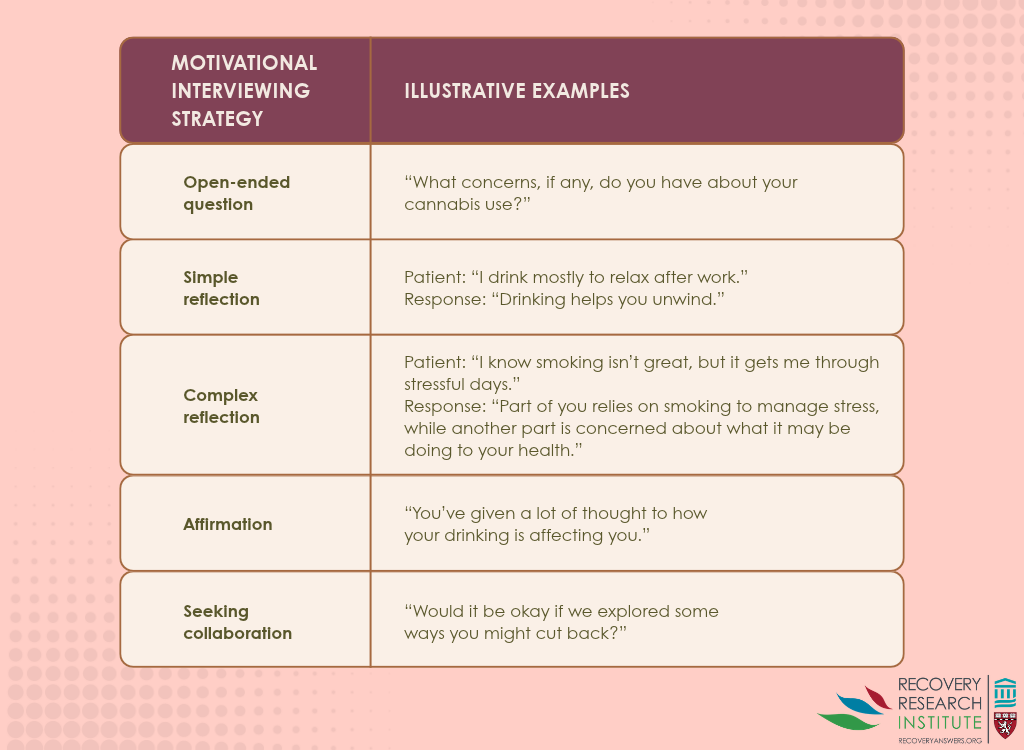
Many people with substance use disorder never receive treatment. This is sometimes referred to as a treatment gap. Screening and brief interventions in healthcare settings have been proposed as one way to help narrow it, often using approaches such as motivational interviewing (commonly referred to by its acronym MI) to increase a person’s motivation to change their substance use behaviors. MI seeks, in part, to elicit change talk (i.e., statements expressing reasons, desire, ability, or commitment to change substance use) relative to sustain talk (i.e., statements that reflect maintaining substance use). Counselor strategies such as reflective listening, open-ended questions, affirmations, and collaboration (see table below for examples) are known to promote change talk, whereas MI-inconsistent strategies such as confrontation and unsolicited persuasion may reinforce resistance. Yet MI takes considerable provider training and skill, which makes it hard to offer in busy settings such as emergency departments. Large language model-based AI chatbots could potentially provide a scalable way to deliver motivational interventions in these settings. Prior research conducted by the researchers in this study suggested that AI chatbots can feasibly deliver motivational interventions for substance use that are acceptable to patients, including in emergency department settings, but less is known about whether they reproduce the specific conversational processes thought to promote motivation for change. This study tested whether an AI chatbot’s conversations with emergency department patients who frequently used alcohol, cannabis, or nicotine looked like MI, and which chatbot strategies were linked to more change talk. The researchers expected that open-ended questions and deeper reflections would be associated with more change talk. They also explored whether change talk was linked to higher readiness to change right after the chat.

HOW WAS THIS STUDY CONDUCTED?

This study was a secondary analysis of a pilot study conducted in a single academic emergency department in Northern California from April to July 2025. Ninety-eight adults ages 18-70 (mean age = 40 years) who reported heavy drinking (4 or more drinks in a day), frequent nicotine use, or weekly cannabis use in the prior month completed a text-based interaction with an MI counseling AI chatbot, which the research team built for this study by giving a large language model (GPT-4) a structured motivational interviewing script. Before the interaction, participants reported their substance use and readiness to change; readiness was reassessed immediately afterward for most participants (this question was added after the first 14 people). The researchers examined 109 session transcripts, with the main substance-specific analyses focusing on 105 sessions addressing alcohol (38), nicotine (37), or cannabis (30).

Participants knew they were talking to an AI chatbot. Most were highly educated and reported trust in AI. The researchers coded each chatbot statement for MI strategies such as open questions, simple and complex reflections, affirmations, collaboration, and advice. Patient statements were coded as change talk, sustain talk, neutral, or other language. The primary outcome was change talk balance, or the proportion of motivational statements favoring change relative to all statements favoring either change or continued substance use. The researchers examined whether participants’ baseline readiness to change and substance use severity, as well as conversational strategies used in the chatbot’s responses, were associated with greater change talk balance and explored whether greater change talk balance was associated with increased readiness to change immediately after the session. Coding agreement was generally strong for simpler chatbot responses but lower for more nuanced strategies, including complex reflections and collaboration, and was lowest for patient change talk. Because the analysis compared sessions with one another, sessions from the same person were not fully independent. In addition, this was a relatively small, single-site study without a human counselor or other comparison group, so it cannot show that any chatbot strategy caused change talk or determine how the chatbot compares with human-delivered MI.


WHAT DID THIS STUDY FIND?

The chatbot generally communicated in a manner consistent with MI. Across sessions, about 31% of the chatbot’s responses were open questions, 29% were reflections of participants’ statements, and 17% were affirmations. The chatbot did not use confrontation or persuasion, which are at odds with MI. The relative frequency of these different types of responses was also similar across alcohol-, cannabis-, and nicotine-focused sessions. About 42% of patient statements across sessions were change talk, compared with 22% sustain talk. Certain types of chatbot responses were associated with a greater balance of change talk relative to sustain talk. Specifically, sessions with a higher percentage of complex reflections and open questions, as well as sessions in which the chatbot used language seeking collaboration with the patient, contained a greater balance of change to sustain talk. Longer sessions also had a greater change to sustain talk balance.

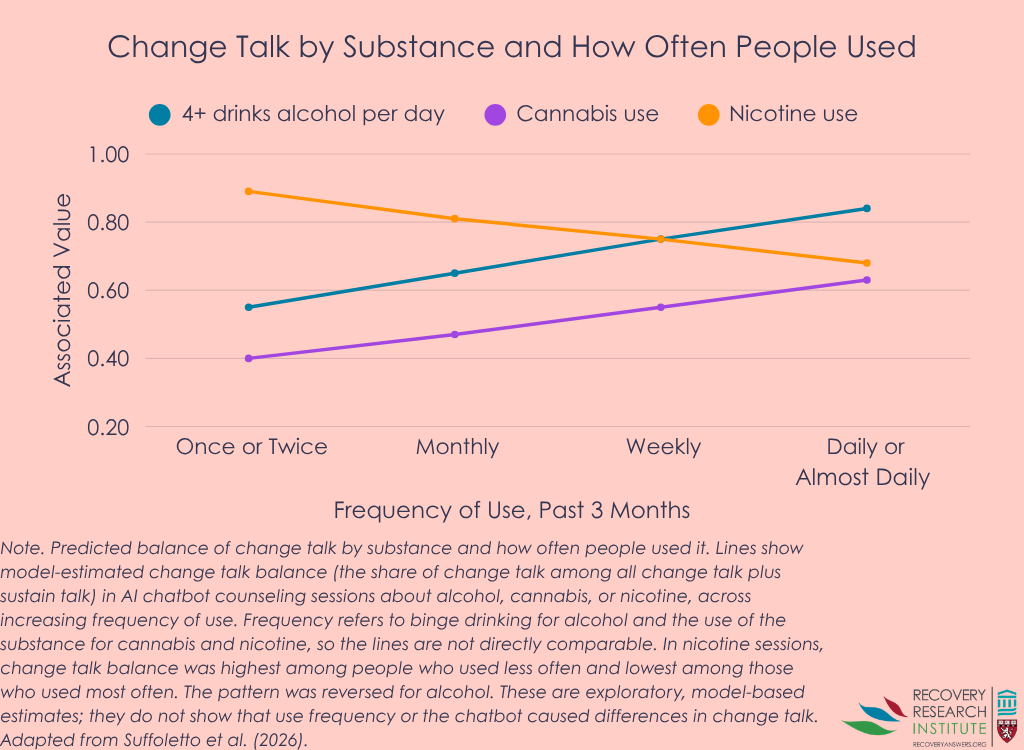
These links are not proof of cause. The chatbot may also have reflected more when patients were already expressing change talk (rather than the reverse), and seeking collaboration was rare. Patients who entered the session with greater readiness to change also expressed a greater balance of change talk relative to sustain talk. As shown in the figure below, patient responses also differed according to the substance being discussed. About 50% of patient statements in nicotine-focused sessions were change talk, compared with 33% in cannabis-focused sessions. Alcohol-focused sessions fell in between (43%). Cannabis-focused sessions also contained more sustain talk than nicotine-focused sessions.

The relationship between substance use severity and change talk balance also differed by substance. In exploratory analyses, people who used nicotine more often had a lower balance of change to sustain talk, whereas for alcohol the pattern ran the other way; i.e., those with more severe alcohol problems expressed more change talk and less sustain talk. Finally, among people who rated their readiness to change before and after the chat, readiness rose in about 1/3 (31%). Readiness did not rise for the rest, and many started with high readiness and had little room to increase. Those who expressed a greater balance of change talk relative to sustain talk during the session tended to show larger immediate increases in readiness to change, although this was an exploratory finding and the relationship was modest. The study did not assess subsequent substance use.

WHAT ARE THE IMPLICATIONS OF THE STUDY FINDINGS?

Findings from this study provide early evidence that an AI chatbot-delivered brief substance use intervention can produce several of the conversation patterns that MI theory emphasizes. The association of complex reflections, open questions, and collaborative language with more patient language favoring change is notable because these are among the conversational processes through which MI is theorized to promote motivation for behavior change. This extends prior research from the same group showing that a large language model-based chatbot designed to deliver MI-based counseling to young adults with risky alcohol use was feasible, acceptable, and demonstrated high adherence to MI principles. The present study moves this research forward by examining the actual conversational processes occurring between patients and the chatbot and linking those processes with patient motivational language and immediate changes in readiness to change. The differences in change talk across substances and severities of use also raise the possibility, which needs replication, that AI-delivered conversations could be adjusted to the substance and how heavily it is used. Although the study cannot explain these differences, future research could test whether adapting the intervention to the substance being discussed, severity of use, and an individual’s responses during the conversation better promotes motivation for change.

Although the AI chatbot intervention generated conversations with several features consistent with MI, questions remain about whether AI-delivered substance use conversations help people change and how safe they are. Staff reviewed every transcript in this study and found no harmful or inaccurate content, but the sample was small. Prior research shows that generative AI chatbots generally provide high-quality responses to substance use questions but can occasionally provide inaccurate or potentially harmful information. Whether a conversational AI intervention such as the chatbot used in this study can produce reductions in alcohol, cannabis, or nicotine use remains unknown. Participants were mostly well educated, trusted AI, were not seeking treatment, and came from one academic emergency department, so results may not apply to other groups. The study’s small, single-site sample, absence of a comparison condition, lower reliability of some conversational coding, and measurement of readiness but not substance use after the intervention limit the conclusions that can be drawn. Future experimental studies are needed to determine whether specific AI conversational strategies cause greater change talk, whether greater change talk translates into meaningful short- and long-term changes in substance use, and how AI-delivered interventions compare with (or may complement) human-delivered approaches.


BOTTOM LINE

An AI chatbot produced conversations that matched several MI techniques, and sessions with more change talk also tended to show larger short-term gains in readiness to change. Without a comparison group or any measure of later substance use, the study cannot show that the chatbot helps people change or works as well as a human counselor.


  • For individuals and families seeking recovery: For people interested in rethinking their alcohol, nicotine, or cannabis use, AI chatbots designed to use MI may eventually offer an accessible way to explore motivation for change. However, this study does not show that interacting with an AI chatbot produces changes in substance use or provides the same benefits as working with a trained professional, and these tools should not yet be viewed as substitutes for established treatment and recovery supports.
  • For treatment professionals and treatment systems: AI chatbots could eventually provide a scalable way to offer brief motivational support in healthcare settings where provider time and resources are limited. More evidence is needed, however, to establish AI chatbot counseling interventions’ safety and impact on substance use outcomes and to determine how AI-based interventions might best complement clinician-delivered care.
  • For scientists: Findings from this study suggest value in evaluating AI chatbot interventions using established psychotherapy process frameworks. Experimental studies are needed to determine whether specific AI chatbot conversational strategies cause increases in change talk and whether greater change talk translates into short- and long-term changes in substance use. Analyses should also test whether chatbot reflections follow patients’ change talk rather than evoke it. Comparisons of AI-delivered, other digital, human-delivered, and hybrid approaches could also help identify how AI-delivered interventions compare with and might complement existing approaches across different populations and settings.
  • For policy makers: Generative AI chatbots may eventually provide a scalable way to expand access to brief substance use support, particularly in settings with limited behavioral health resources. Current evidence suggests these systems can feasibly produce conversations consistent with established MI frameworks, but evidence that they safely improve substance use outcomes is needed before they are to be widely implemented.

CITATIONS

Suffoletto, B., Preiksaitis, C., Kim, D., Rose, C., Pitre, V., Pillai, N., & Mandal, M. (2026). AI counseling agent for motivational interviewing: Conversational processes associated with change talk in emergency department patients. Journal of Substance Use and Addiction Treatment, 190. doi: 10.1016/j.josat.2026.210053.



Stay on the Frontiers of
recovery science
with the free, monthly
Recovery Bulletin

l

WHAT PROBLEM DOES THIS STUDY ADDRESS?

Many people with substance use disorder never receive treatment. This is sometimes referred to as a treatment gap. Screening and brief interventions in healthcare settings have been proposed as one way to help narrow it, often using approaches such as motivational interviewing (commonly referred to by its acronym MI) to increase a person’s motivation to change their substance use behaviors. MI seeks, in part, to elicit change talk (i.e., statements expressing reasons, desire, ability, or commitment to change substance use) relative to sustain talk (i.e., statements that reflect maintaining substance use). Counselor strategies such as reflective listening, open-ended questions, affirmations, and collaboration (see table below for examples) are known to promote change talk, whereas MI-inconsistent strategies such as confrontation and unsolicited persuasion may reinforce resistance. Yet MI takes considerable provider training and skill, which makes it hard to offer in busy settings such as emergency departments. Large language model-based AI chatbots could potentially provide a scalable way to deliver motivational interventions in these settings. Prior research conducted by the researchers in this study suggested that AI chatbots can feasibly deliver motivational interventions for substance use that are acceptable to patients, including in emergency department settings, but less is known about whether they reproduce the specific conversational processes thought to promote motivation for change. This study tested whether an AI chatbot’s conversations with emergency department patients who frequently used alcohol, cannabis, or nicotine looked like MI, and which chatbot strategies were linked to more change talk. The researchers expected that open-ended questions and deeper reflections would be associated with more change talk. They also explored whether change talk was linked to higher readiness to change right after the chat.


HOW WAS THIS STUDY CONDUCTED?

This study was a secondary analysis of a pilot study conducted in a single academic emergency department in Northern California from April to July 2025. Ninety-eight adults ages 18-70 (mean age = 40 years) who reported heavy drinking (4 or more drinks in a day), frequent nicotine use, or weekly cannabis use in the prior month completed a text-based interaction with an MI counseling AI chatbot, which the research team built for this study by giving a large language model (GPT-4) a structured motivational interviewing script. Before the interaction, participants reported their substance use and readiness to change; readiness was reassessed immediately afterward for most participants (this question was added after the first 14 people). The researchers examined 109 session transcripts, with the main substance-specific analyses focusing on 105 sessions addressing alcohol (38), nicotine (37), or cannabis (30).

Participants knew they were talking to an AI chatbot. Most were highly educated and reported trust in AI. The researchers coded each chatbot statement for MI strategies such as open questions, simple and complex reflections, affirmations, collaboration, and advice. Patient statements were coded as change talk, sustain talk, neutral, or other language. The primary outcome was change talk balance, or the proportion of motivational statements favoring change relative to all statements favoring either change or continued substance use. The researchers examined whether participants’ baseline readiness to change and substance use severity, as well as conversational strategies used in the chatbot’s responses, were associated with greater change talk balance and explored whether greater change talk balance was associated with increased readiness to change immediately after the session. Coding agreement was generally strong for simpler chatbot responses but lower for more nuanced strategies, including complex reflections and collaboration, and was lowest for patient change talk. Because the analysis compared sessions with one another, sessions from the same person were not fully independent. In addition, this was a relatively small, single-site study without a human counselor or other comparison group, so it cannot show that any chatbot strategy caused change talk or determine how the chatbot compares with human-delivered MI.


WHAT DID THIS STUDY FIND?

The chatbot generally communicated in a manner consistent with MI. Across sessions, about 31% of the chatbot’s responses were open questions, 29% were reflections of participants’ statements, and 17% were affirmations. The chatbot did not use confrontation or persuasion, which are at odds with MI. The relative frequency of these different types of responses was also similar across alcohol-, cannabis-, and nicotine-focused sessions. About 42% of patient statements across sessions were change talk, compared with 22% sustain talk. Certain types of chatbot responses were associated with a greater balance of change talk relative to sustain talk. Specifically, sessions with a higher percentage of complex reflections and open questions, as well as sessions in which the chatbot used language seeking collaboration with the patient, contained a greater balance of change to sustain talk. Longer sessions also had a greater change to sustain talk balance.

These links are not proof of cause. The chatbot may also have reflected more when patients were already expressing change talk (rather than the reverse), and seeking collaboration was rare. Patients who entered the session with greater readiness to change also expressed a greater balance of change talk relative to sustain talk. As shown in the figure below, patient responses also differed according to the substance being discussed. About 50% of patient statements in nicotine-focused sessions were change talk, compared with 33% in cannabis-focused sessions. Alcohol-focused sessions fell in between (43%). Cannabis-focused sessions also contained more sustain talk than nicotine-focused sessions.

The relationship between substance use severity and change talk balance also differed by substance. In exploratory analyses, people who used nicotine more often had a lower balance of change to sustain talk, whereas for alcohol the pattern ran the other way; i.e., those with more severe alcohol problems expressed more change talk and less sustain talk. Finally, among people who rated their readiness to change before and after the chat, readiness rose in about 1/3 (31%). Readiness did not rise for the rest, and many started with high readiness and had little room to increase. Those who expressed a greater balance of change talk relative to sustain talk during the session tended to show larger immediate increases in readiness to change, although this was an exploratory finding and the relationship was modest. The study did not assess subsequent substance use.


WHAT ARE THE IMPLICATIONS OF THE STUDY FINDINGS?

Findings from this study provide early evidence that an AI chatbot-delivered brief substance use intervention can produce several of the conversation patterns that MI theory emphasizes. The association of complex reflections, open questions, and collaborative language with more patient language favoring change is notable because these are among the conversational processes through which MI is theorized to promote motivation for behavior change. This extends prior research from the same group showing that a large language model-based chatbot designed to deliver MI-based counseling to young adults with risky alcohol use was feasible, acceptable, and demonstrated high adherence to MI principles. The present study moves this research forward by examining the actual conversational processes occurring between patients and the chatbot and linking those processes with patient motivational language and immediate changes in readiness to change. The differences in change talk across substances and severities of use also raise the possibility, which needs replication, that AI-delivered conversations could be adjusted to the substance and how heavily it is used. Although the study cannot explain these differences, future research could test whether adapting the intervention to the substance being discussed, severity of use, and an individual’s responses during the conversation better promotes motivation for change.

Although the AI chatbot intervention generated conversations with several features consistent with MI, questions remain about whether AI-delivered substance use conversations help people change and how safe they are. Staff reviewed every transcript in this study and found no harmful or inaccurate content, but the sample was small. Prior research shows that generative AI chatbots generally provide high-quality responses to substance use questions but can occasionally provide inaccurate or potentially harmful information. Whether a conversational AI intervention such as the chatbot used in this study can produce reductions in alcohol, cannabis, or nicotine use remains unknown. Participants were mostly well educated, trusted AI, were not seeking treatment, and came from one academic emergency department, so results may not apply to other groups. The study’s small, single-site sample, absence of a comparison condition, lower reliability of some conversational coding, and measurement of readiness but not substance use after the intervention limit the conclusions that can be drawn. Future experimental studies are needed to determine whether specific AI conversational strategies cause greater change talk, whether greater change talk translates into meaningful short- and long-term changes in substance use, and how AI-delivered interventions compare with (or may complement) human-delivered approaches.


BOTTOM LINE

An AI chatbot produced conversations that matched several MI techniques, and sessions with more change talk also tended to show larger short-term gains in readiness to change. Without a comparison group or any measure of later substance use, the study cannot show that the chatbot helps people change or works as well as a human counselor.


  • For individuals and families seeking recovery: For people interested in rethinking their alcohol, nicotine, or cannabis use, AI chatbots designed to use MI may eventually offer an accessible way to explore motivation for change. However, this study does not show that interacting with an AI chatbot produces changes in substance use or provides the same benefits as working with a trained professional, and these tools should not yet be viewed as substitutes for established treatment and recovery supports.
  • For treatment professionals and treatment systems: AI chatbots could eventually provide a scalable way to offer brief motivational support in healthcare settings where provider time and resources are limited. More evidence is needed, however, to establish AI chatbot counseling interventions’ safety and impact on substance use outcomes and to determine how AI-based interventions might best complement clinician-delivered care.
  • For scientists: Findings from this study suggest value in evaluating AI chatbot interventions using established psychotherapy process frameworks. Experimental studies are needed to determine whether specific AI chatbot conversational strategies cause increases in change talk and whether greater change talk translates into short- and long-term changes in substance use. Analyses should also test whether chatbot reflections follow patients’ change talk rather than evoke it. Comparisons of AI-delivered, other digital, human-delivered, and hybrid approaches could also help identify how AI-delivered interventions compare with and might complement existing approaches across different populations and settings.
  • For policy makers: Generative AI chatbots may eventually provide a scalable way to expand access to brief substance use support, particularly in settings with limited behavioral health resources. Current evidence suggests these systems can feasibly produce conversations consistent with established MI frameworks, but evidence that they safely improve substance use outcomes is needed before they are to be widely implemented.

CITATIONS

Suffoletto, B., Preiksaitis, C., Kim, D., Rose, C., Pitre, V., Pillai, N., & Mandal, M. (2026). AI counseling agent for motivational interviewing: Conversational processes associated with change talk in emergency department patients. Journal of Substance Use and Addiction Treatment, 190. doi: 10.1016/j.josat.2026.210053.


Share this article

l

WHAT PROBLEM DOES THIS STUDY ADDRESS?

Many people with substance use disorder never receive treatment. This is sometimes referred to as a treatment gap. Screening and brief interventions in healthcare settings have been proposed as one way to help narrow it, often using approaches such as motivational interviewing (commonly referred to by its acronym MI) to increase a person’s motivation to change their substance use behaviors. MI seeks, in part, to elicit change talk (i.e., statements expressing reasons, desire, ability, or commitment to change substance use) relative to sustain talk (i.e., statements that reflect maintaining substance use). Counselor strategies such as reflective listening, open-ended questions, affirmations, and collaboration (see table below for examples) are known to promote change talk, whereas MI-inconsistent strategies such as confrontation and unsolicited persuasion may reinforce resistance. Yet MI takes considerable provider training and skill, which makes it hard to offer in busy settings such as emergency departments. Large language model-based AI chatbots could potentially provide a scalable way to deliver motivational interventions in these settings. Prior research conducted by the researchers in this study suggested that AI chatbots can feasibly deliver motivational interventions for substance use that are acceptable to patients, including in emergency department settings, but less is known about whether they reproduce the specific conversational processes thought to promote motivation for change. This study tested whether an AI chatbot’s conversations with emergency department patients who frequently used alcohol, cannabis, or nicotine looked like MI, and which chatbot strategies were linked to more change talk. The researchers expected that open-ended questions and deeper reflections would be associated with more change talk. They also explored whether change talk was linked to higher readiness to change right after the chat.


HOW WAS THIS STUDY CONDUCTED?

This study was a secondary analysis of a pilot study conducted in a single academic emergency department in Northern California from April to July 2025. Ninety-eight adults ages 18-70 (mean age = 40 years) who reported heavy drinking (4 or more drinks in a day), frequent nicotine use, or weekly cannabis use in the prior month completed a text-based interaction with an MI counseling AI chatbot, which the research team built for this study by giving a large language model (GPT-4) a structured motivational interviewing script. Before the interaction, participants reported their substance use and readiness to change; readiness was reassessed immediately afterward for most participants (this question was added after the first 14 people). The researchers examined 109 session transcripts, with the main substance-specific analyses focusing on 105 sessions addressing alcohol (38), nicotine (37), or cannabis (30).

Participants knew they were talking to an AI chatbot. Most were highly educated and reported trust in AI. The researchers coded each chatbot statement for MI strategies such as open questions, simple and complex reflections, affirmations, collaboration, and advice. Patient statements were coded as change talk, sustain talk, neutral, or other language. The primary outcome was change talk balance, or the proportion of motivational statements favoring change relative to all statements favoring either change or continued substance use. The researchers examined whether participants’ baseline readiness to change and substance use severity, as well as conversational strategies used in the chatbot’s responses, were associated with greater change talk balance and explored whether greater change talk balance was associated with increased readiness to change immediately after the session. Coding agreement was generally strong for simpler chatbot responses but lower for more nuanced strategies, including complex reflections and collaboration, and was lowest for patient change talk. Because the analysis compared sessions with one another, sessions from the same person were not fully independent. In addition, this was a relatively small, single-site study without a human counselor or other comparison group, so it cannot show that any chatbot strategy caused change talk or determine how the chatbot compares with human-delivered MI.


WHAT DID THIS STUDY FIND?

The chatbot generally communicated in a manner consistent with MI. Across sessions, about 31% of the chatbot’s responses were open questions, 29% were reflections of participants’ statements, and 17% were affirmations. The chatbot did not use confrontation or persuasion, which are at odds with MI. The relative frequency of these different types of responses was also similar across alcohol-, cannabis-, and nicotine-focused sessions. About 42% of patient statements across sessions were change talk, compared with 22% sustain talk. Certain types of chatbot responses were associated with a greater balance of change talk relative to sustain talk. Specifically, sessions with a higher percentage of complex reflections and open questions, as well as sessions in which the chatbot used language seeking collaboration with the patient, contained a greater balance of change to sustain talk. Longer sessions also had a greater change to sustain talk balance.

These links are not proof of cause. The chatbot may also have reflected more when patients were already expressing change talk (rather than the reverse), and seeking collaboration was rare. Patients who entered the session with greater readiness to change also expressed a greater balance of change talk relative to sustain talk. As shown in the figure below, patient responses also differed according to the substance being discussed. About 50% of patient statements in nicotine-focused sessions were change talk, compared with 33% in cannabis-focused sessions. Alcohol-focused sessions fell in between (43%). Cannabis-focused sessions also contained more sustain talk than nicotine-focused sessions.

The relationship between substance use severity and change talk balance also differed by substance. In exploratory analyses, people who used nicotine more often had a lower balance of change to sustain talk, whereas for alcohol the pattern ran the other way; i.e., those with more severe alcohol problems expressed more change talk and less sustain talk. Finally, among people who rated their readiness to change before and after the chat, readiness rose in about 1/3 (31%). Readiness did not rise for the rest, and many started with high readiness and had little room to increase. Those who expressed a greater balance of change talk relative to sustain talk during the session tended to show larger immediate increases in readiness to change, although this was an exploratory finding and the relationship was modest. The study did not assess subsequent substance use.


WHAT ARE THE IMPLICATIONS OF THE STUDY FINDINGS?

Findings from this study provide early evidence that an AI chatbot-delivered brief substance use intervention can produce several of the conversation patterns that MI theory emphasizes. The association of complex reflections, open questions, and collaborative language with more patient language favoring change is notable because these are among the conversational processes through which MI is theorized to promote motivation for behavior change. This extends prior research from the same group showing that a large language model-based chatbot designed to deliver MI-based counseling to young adults with risky alcohol use was feasible, acceptable, and demonstrated high adherence to MI principles. The present study moves this research forward by examining the actual conversational processes occurring between patients and the chatbot and linking those processes with patient motivational language and immediate changes in readiness to change. The differences in change talk across substances and severities of use also raise the possibility, which needs replication, that AI-delivered conversations could be adjusted to the substance and how heavily it is used. Although the study cannot explain these differences, future research could test whether adapting the intervention to the substance being discussed, severity of use, and an individual’s responses during the conversation better promotes motivation for change.

Although the AI chatbot intervention generated conversations with several features consistent with MI, questions remain about whether AI-delivered substance use conversations help people change and how safe they are. Staff reviewed every transcript in this study and found no harmful or inaccurate content, but the sample was small. Prior research shows that generative AI chatbots generally provide high-quality responses to substance use questions but can occasionally provide inaccurate or potentially harmful information. Whether a conversational AI intervention such as the chatbot used in this study can produce reductions in alcohol, cannabis, or nicotine use remains unknown. Participants were mostly well educated, trusted AI, were not seeking treatment, and came from one academic emergency department, so results may not apply to other groups. The study’s small, single-site sample, absence of a comparison condition, lower reliability of some conversational coding, and measurement of readiness but not substance use after the intervention limit the conclusions that can be drawn. Future experimental studies are needed to determine whether specific AI conversational strategies cause greater change talk, whether greater change talk translates into meaningful short- and long-term changes in substance use, and how AI-delivered interventions compare with (or may complement) human-delivered approaches.


BOTTOM LINE

An AI chatbot produced conversations that matched several MI techniques, and sessions with more change talk also tended to show larger short-term gains in readiness to change. Without a comparison group or any measure of later substance use, the study cannot show that the chatbot helps people change or works as well as a human counselor.


  • For individuals and families seeking recovery: For people interested in rethinking their alcohol, nicotine, or cannabis use, AI chatbots designed to use MI may eventually offer an accessible way to explore motivation for change. However, this study does not show that interacting with an AI chatbot produces changes in substance use or provides the same benefits as working with a trained professional, and these tools should not yet be viewed as substitutes for established treatment and recovery supports.
  • For treatment professionals and treatment systems: AI chatbots could eventually provide a scalable way to offer brief motivational support in healthcare settings where provider time and resources are limited. More evidence is needed, however, to establish AI chatbot counseling interventions’ safety and impact on substance use outcomes and to determine how AI-based interventions might best complement clinician-delivered care.
  • For scientists: Findings from this study suggest value in evaluating AI chatbot interventions using established psychotherapy process frameworks. Experimental studies are needed to determine whether specific AI chatbot conversational strategies cause increases in change talk and whether greater change talk translates into short- and long-term changes in substance use. Analyses should also test whether chatbot reflections follow patients’ change talk rather than evoke it. Comparisons of AI-delivered, other digital, human-delivered, and hybrid approaches could also help identify how AI-delivered interventions compare with and might complement existing approaches across different populations and settings.
  • For policy makers: Generative AI chatbots may eventually provide a scalable way to expand access to brief substance use support, particularly in settings with limited behavioral health resources. Current evidence suggests these systems can feasibly produce conversations consistent with established MI frameworks, but evidence that they safely improve substance use outcomes is needed before they are to be widely implemented.

CITATIONS

Suffoletto, B., Preiksaitis, C., Kim, D., Rose, C., Pitre, V., Pillai, N., & Mandal, M. (2026). AI counseling agent for motivational interviewing: Conversational processes associated with change talk in emergency department patients. Journal of Substance Use and Addiction Treatment, 190. doi: 10.1016/j.josat.2026.210053.


Share this article