
Behavioral Addictions: Are They More or Less Stigmatized than Alcohol & Drug Addictions?
Series: Breaking the Stigma
Substance use disorders (SUD) are among the most highly stigmatized conditions in the world. Individuals’ perceptions of those with SUD affects not only how they are treated day-to-day, but also local and national policies impacting ability to access treatment and other resources such as employment and housing.
“Behavioral addictions” are also important to understand in this context as their coverage in the popular press and in scientific studies has increased dramatically during the past 15 years. These are behaviors (e.g,. gambling, sexual activity, eating) with potentially pleasant short-term effects in which people might continue to engage despite negative consequences.
Thege and colleagues surveyed individuals from Alberta, Canada to extend current research on SUD perceptions and stigma, and to elucidate similarities and differences between public perception of substance-related and behavioral addictions.
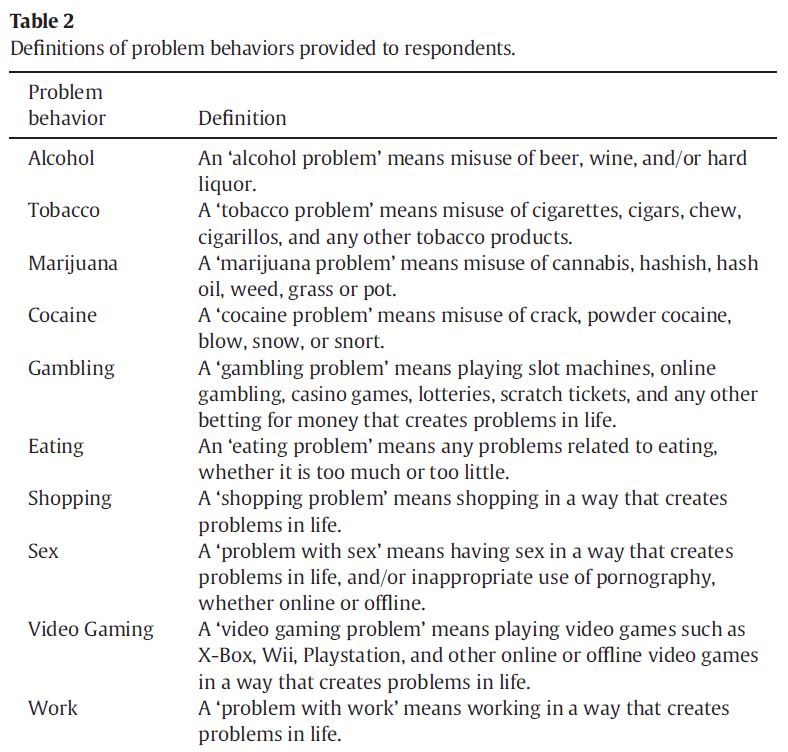
Respondents were randomly assigned to report on their perceptions of a single problem such that only 400 individuals reported on their perceptions for each problem. Respondents rated perceived addiction liability and several etiological factors using a scale from 1 (very unlikely) to 5 (very likely) to answer whether the problem behavior might be caused by one of the following: “character problem or flaw”, “chemical imbalance in the brain”, “genetic or inherited problem”, “the way a person was raised”, “exposure to traumatic events in early childhood”, and “stressful circumstances in a person’s life”. Sample demographics were: 64% female; 24% under 34, 47% between 35 and 54; and 30% over 55; 17% had a high school diploma, 23% some college, and 26% with a college or post-secondary diploma; 68% were married, 17% single, 13% separated divorced, and 3% widowed; 90% employed or retired, 7% unemployed, and 3% were students; 28% had an annual household income of $100,000+ while between 5 and 11% of respondents had household incomes in one of several $10,000 income ranges (e.g., $50,000-59,999).
Survey results showed that respondents rated substances as having greater addiction liability than behaviors – driven by perceived addictiveness of tobacco and cocaine relative to alcohol and marijuana.
Character problem, chemical imbalance, childhood upbringing, and stressful circumstances were each rated as having greater relevance to substance-related versus behavioral addictions.
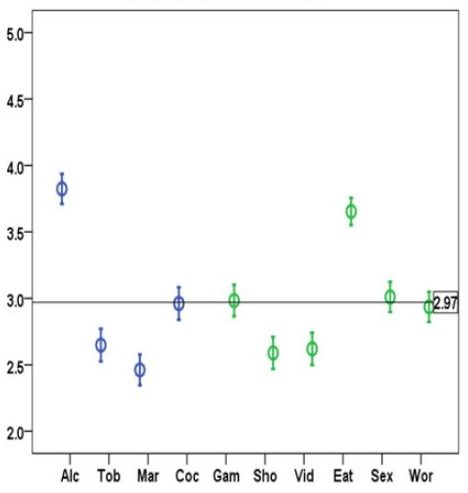
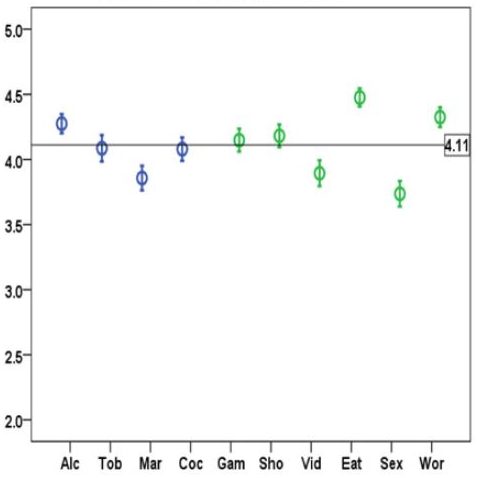
Notably, authors did not compare the various etiologies, but based on graphical depictions, respondents perceived “current stressful circumstances” as having the greatest causal impact on having a substance or behavior-related problem (mean of 4.11 out of 5), while genetic factors had the smallest causal impact (mean of 2.97 out of 5). Regarding genetics in particular, alcohol was rated highest (mean of approximately 4 out of 5) and marijuana rated lowest (mean of approximately 2.5 out of 5).
Genetic or Inherited Factors
Current Stressful Circumstances
IN CONTEXT
Overall, this Canadian sample of lay individuals perceived substances as having a greater propensity to become a problem than behaviors such as playing video games, sex, gambling, and shopping.
In parallel, they endorsed having a moral or character problem as a cause of the problem to a greater degree for behavioral addictions.
If such perceptions are also present among those suffering from these problems, it could increase shame and decrease the likelihood of seeking help.
This study was unique in its focus on behavioral addictions. As the field learns more about the nature of behavioral addictions, understanding perceptions and stigma of such problems will also be important. The study also extends other research on perceptions of substance use disorders to a Canadian sample.
- LIMITATIONS
-
- It is unclear how representative the sample is to the population from which it was drawn, making it difficult to determine the generalizability of these results.
BOTTOM LINE
- For individuals & families seeking recovery: Seek information from formal organizations (e.g., the National Institute on Drug Abuse) on the nature of the substance related and/or behavioral addiction – when attempting to understand the cause. Substance use disorders (SUDs) remain highly stigmatized conditions of which the public holds several misperceptions. If struggling with a behavioral addiction as well, you may be even more likely to encounter ideas that perpetuate stigma (e.g., that a character flaw is responsible for the problem behavior).For scientists: Our understanding of the similarities and differences between SUD and behavioral addictions is in its infancy. In addition to elucidating stigmas, it will be critical to develop evidence-based approaches to modify misinformed perceptions. Evidence exists which suggests that a substantial minority of individuals in recovery from substance addictions may continue to struggle with behavioral addictions (see previous recoveryanswers.org summary here). More research is needed to estimate prevalence and impact on relapse to substances as well as other outcomes.For policy makers: More research needs to be supported to investigate the prevalence, nature, and societal impact of behavioral addictions.For treatment professionals and treatment systems: Family and friends’ perceptions of SUD and behavioral addictions are likely to affect their loved one’s treatment engagement. If one does not yet exist, consider developing a group to provide education on the nature of these disorders and skills to best support their loved one’s behavior change efforts and recovery.
CITATIONS
Thege, B. K., Colman, I., el-Guebaly, N., Hodgins, D. C., Patten, S. B., Schopflocher, D., … & Wild, T. C. (2015). Social judgments of behavioral versus substance-related addictions: A population-based study. Addictive behaviors, 42, 24-31.