WHAT PROBLEM DOES THIS STUDY ADDRESS?
Stigmatizing terms like ‘addict’ or ‘substance abuse’ still often show up in healthcare settings when describing people who use substances and their behaviors. For patients, hearing or reading this language can trigger shame and isolation that keeps them from seeking care, while for providers, repeated exposure can quietly shape more judgmental, lower-quality treatment decisions. In contrast, the use of non-stigmatizing, person-first language (e.g., “person with a substance use disorder” instead of “substance abuser”), is associated with improved outcomes, such as increased referrals to substance use disorder treatment. While evidence clearly highlights the importance of using non-stigmatizing language, there is a need for strategies to increase its use in healthcare settings. This includes clinical notes maintained in electronic health records, which are shared across healthcare providers and are now directly accessible to patients in the US. This study evaluated whether a system-wide “Words Matter” campaign could reduce stigmatizing substance use language in clinical notes and increase knowledge of person-first language among healthcare staff.
HOW WAS THIS STUDY CONDUCTED?
This was an observational study assessing the outcomes of the Words Matter campaign, designed to decrease stigmatizing substance use language in electronic health records within a large, urban healthcare system in Denver, Colorado. The Words Matter campaign, which reached over 1,500 healthcare employees across 26 different departments, consisted of multiple components, including a 20-minute educational presentation about the consequences of using stigmatizing language and the evidence-based rationale for using person-first language. Employees were provided with a language guide and invited to sign a voluntary pledge to use person-first language. Researchers also flagged stigmatizing substance use terms embedded in preexisting clinical note templates within the electronic health record system and facilitated outreach efforts to replace them. To make sure the analysis was accurate, researchers also checked that their computer program did not mistakenly flag non-stigmatizing terms that share similar wording (e.g., ‘elder abuse’).
Researchers used natural language processing, a computerized method for analyzing large amounts of text, to identify stigmatizing substance use language like ‘addict,’ ‘alcoholic,’ and ‘substance abuse’ in approximately 15 million clinical notes. They then used statistical models to establish trends in stigmatizing language use before the campaign and to predict how those trends would be expected to continue had the campaign not taken place. This allowed the researchers to test whether stigmatizing language decreased more after the campaign than would have been expected based on existing trends. The primary outcome measure was weekly change in the proportion of clinical notes containing stigmatizing substance use language during a pre-campaign period lasting from January 2022 to September 2023, versus a post-campaign period lasting from March 2024 to March 2025. Analyses included all clinical notes regardless of patient substance use disorder status, as well as a separate analysis of patients identified as having a substance use disorder based on their diagnosis codes, screening results, or use of medications to treat alcohol or opioid use disorder. Researchers also examined the Words Matter pledge, indicating intention to use person-first, non-judgmental language as well as changes in staff members’ self-reported knowledge of person-first/non-stigmatizing language following the educational presentation using a single-group, pre-post assessment design.
WHAT DID THIS STUDY FIND?
Stigmatizing language was reduced 12 months after the Words Matter campaign
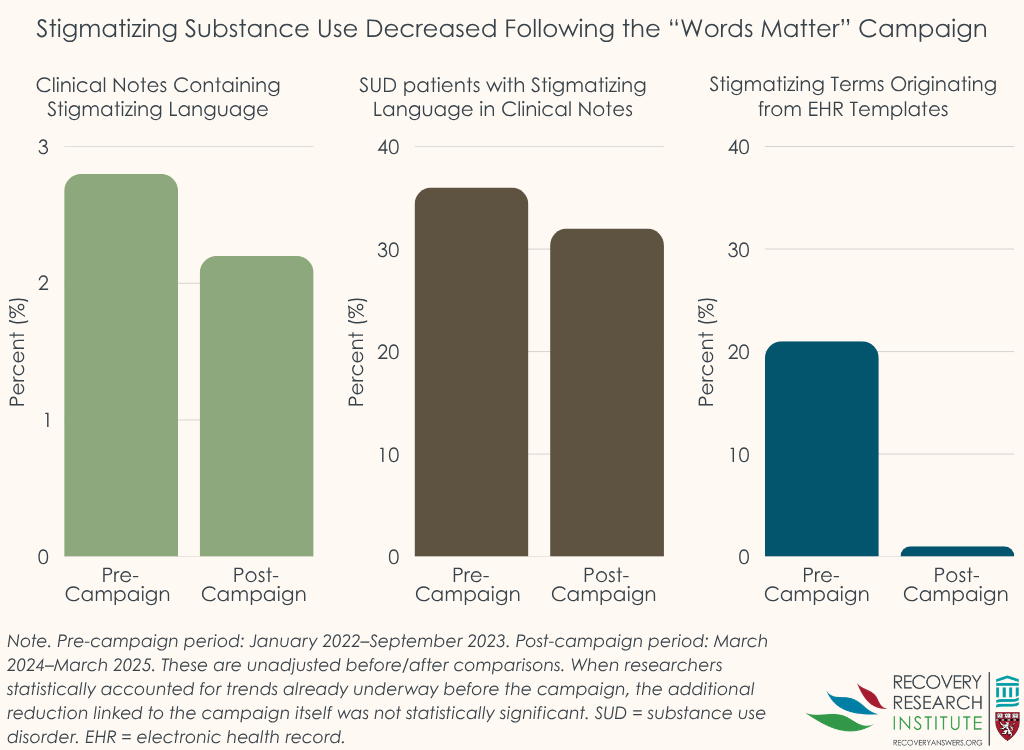
As shown in the figure below, the prevalence of stigmatizing language in clinical notes declined from 2.8% to 2.0% post-campaign. Overall, researchers estimated a 34.6% cumulative reduction in stigmatizing language 12 months after campaign launch, equivalent to approximately 1,381 fewer clinical notes. The proportion of patients with substance use disorder with stigmatizing language in their clinical notes decreased from 36.4% to 32.4%. Looking at all patients regardless of substance use disorder status, the proportion with at least 1 note containing stigmatizing language fell from 15.9% to 10.9%. During both the pre- and post-campaign period, most stigmatizing language involved the word ‘abuse’.
It’s important to note, however, that stigmatizing language was declining before the campaign, and these ongoing decreases may have contributed to some of the observed reduction. After accounting for this existing trend and other patterns in the data over time, researchers observed a 0.34% greater-than-expected weekly reduction in stigmatizing language with the Words Matter campaign across all electronic health record sources. However, this campaign-associated reduction was not statistically significant. A separate statistical check found that the timing of the slowdown in stigmatizing language did line up with the campaign’s launch, suggesting the true picture may lie somewhere between no effect and clear effect. Because stigmatizing language appeared in fewer than 3% of clinical notes at baseline, even meaningful reductions represented relatively small changes in the overall number of clinical notes, making it more difficult to detect a statistically significant campaign effect. Although the findings cannot establish that the campaign itself caused the reduction, the magnitude and direction of the observed changes suggest potentially meaningful improvements in clinical documentation.
Revising stigmatizing terms in electronic health record templates was associated with particularly large reductions
Importantly, 21% of stigmatizing substance use terms originated from preexisting clinical note templates within the electronic health record system rather than from clinician word choice. Approximately 10 electronic health record templates were flagged as containing stigmatizing substance use language and were subsequently revised by leaders of the Words Matter campaign team. Following template updates, just over 1% of stigmatizing terms originated from this source.
Brief education increased knowledge of person-first language among healthcare staff
Healthcare staff who attended a 20-minute educational presentation self-reported their knowledge of person-first language on a scale ranging from 1 (no knowledge) to 5 (extensive knowledge) both before and after the presentation. Among the approximately 1 in 4 presentation attendees who completed the pre- and post-presentation surveys, self-reported knowledge scores increased by an average of 1 point following the brief, evidence-based education. Across the broader campaign, 763 staff members signed the Words Matter pledge, indicating their intention to use person-first, non-judgmental language.
WHAT ARE THE IMPLICATIONS OF THE STUDY FINDINGS?
Stigmatizing language describing people who use substances and substance use behaviors is common in clinical notes, may harm patients, and could negatively influence clinical judgements and quality of care. This study found that the data-informed, multi-pronged Words Matter campaign was associated with measurable reductions in stigmatizing substance use language in clinical notes within a large healthcare system. Although the observed reduction cannot be conclusively attributed to the Words Matter campaign, the magnitude and direction of the changes suggest potentially meaningful shifts in clinical documentation and institutional culture. As expected, once flagged wording was removed from clinical note templates within the electronic health record system, pronounced reductions in stigmatizing terms were observed, suggesting that modifying templates may be an efficient, high-impact strategy for decreasing stigmatizing language in clinical notes. Moreover, a concise educational presentation modestly enhanced self-reported knowledge of person-first language among healthcare staff from various departments.
Some limitations should be considered. The study examined written documentation only and therefore did not capture verbal communication. Researchers also could not determine whether individual staff members who received the educational presentation subsequently changed their documentation practices. Further, because staff knowledge was only measured before and after the presentation without a comparison group of staff who did not attend, we can’t be fully certain that the presentation itself, rather than some other factor, caused the improvement. In addition, since the campaign took place in one healthcare system within a single city, the generalizability of the findings may be limited. Also, the study did not evaluate whether changes in stigmatizing language translated into improved patient experiences, treatment engagement, or other clinical outcomes. Finally, computerized searches may count language that is not stigmatizing in context. For example, a similar previous study counted references to Alcoholics Anonymous as stigmatizing despite using rules to account for context. Although the current study excluded some context-specific uses, such as “elder abuse” and “alcoholic liver disease,” it is unclear whether non-stigmatizing references like Alcoholics Anonymous were accounted for.
BOTTOM LINE
Healthcare systems may be able to reduce stigmatizing substance use language in clinical notes through targeted changes to clinical documentation templates and brief provider education. However, the current study provides promising preliminary findings rather than conclusive evidence of the effectiveness of these approaches.
- For individuals and families seeking recovery: The way we talk about individuals with substance use disorder matters. Exposure to stigmatizing language, which can occur in part through patient access to clinical notes, may contribute to feelings of shame and negatively affect trust in healthcare institutions. While non-stigmatizing, person-first language is often preferred by people with substance use disorder, there may be individual differences in language preferences.
- For treatment professionals and treatment systems: Treatment professionals should consider using person-first, non-stigmatizing language in clinical notes and reviewing preexisting electronic health record templates for stigmatizing terminology. Various resources, including the National Institute of Drug Abuse’s (NIDA) Words Matter list, provide non-stigmatizing language recommendations for providers.
- For scientists: More comprehensive evaluations of stigma-reduction campaigns are needed. Future research should investigate whether clinical documentation differs based on the sociodemographic characteristics of the patient or provider, and whether changes in documentation practices are sustained over time. There is also a need for research examining whether changes in substance use disorder language translates into meaningful clinical outcomes, such as improved patient experience, treatment engagement and retention, and quality of care.
- For policy makers: The findings of this study highlight multiple opportunities for scalable intervention. Revising electronic health record templates was associated with meaningful reductions in stigmatizing substance use language originating from those templates, suggesting that system-level changes to clinical documentation may offer a relatively low-effort, high-impact strategy for stigma reduction.
CITATIONS
Braun, H. M., Still, L., Elrick, E., Tillman, A. R., Bacon, E., Loh, R., Bender, B., Mills, J., & Shlay, J. C. (2026). Words matter: A campaign to reduce stigmatizing substance use language at an urban health system. Journal of Substance Use and Addiction Treatment, 188, Article 210000. doi: 10.1016/j.josat.2026.210000.