WHAT PROBLEM DOES THIS STUDY ADDRESS?
Mutual-help groups and other community-based services provide beneficial recovery support, but practical obstacles and personal factors like stigma may also prevent some individuals from using them. Digital recovery support services provide online, 24/7 access to recovery resources, potentially overcoming barriers to in-person services, such as scheduling constraints, geographic distance, and stigma. Digital recovery support services are increasingly being utilized, with 45% of adults in a recent outpatient treatment sample reporting that they used these services at some point in their lives.
In The Rooms is a popular digital recovery support service with an estimated 1.2 million members that combines live online recovery meetings with discussion boards, social networking features, and recovery resources. Like mutual-help groups, In The Rooms is primarily peer-led, and its content is generated by its members. A prior study conducted with a sample of In The Rooms members found that approximately 80% reported that the service increased their recovery motivation and self-efficacy, and a qualitative study found that members particularly valued its anonymity, convenience, and exposure to more diverse recovery perspectives. While a longitudinal evaluation of an Australian digital recovery support service found that greater use of the website was associated with more favorable alcohol use outcomes. However, no prior research has prospectively examined recovery outcomes in relation to In The Rooms participation. This study examined whether In The Rooms participation was associated with substance use and quality of life over a period of 6 months.
HOW WAS THIS STUDY CONDUCTED?
This observational study examined In The Rooms participation and recovery outcomes among 250 US adults recruited directly from the service. Members were eligible to participate if they had used In The Rooms during the previous 90 days for their own alcohol or other drug recovery and identified as being in recovery, seeking recovery, or interested in recovery. Because existing In The Rooms members self-selected to participate, the findings may not generalize to users of other digital recovery support services or to individuals in recovery more broadly. Women, sexual minorities, individuals who were taking medications for opioid use disorder, and those with anxiety were more common in this sample than in a nationally representative recovery sample, which may limit how well the findings generalize to other groups in recovery. On average, participants were already abstinent on about 7 in 10 days when the study began, so these findings may not generalize as well to people who are using substances more heavily.
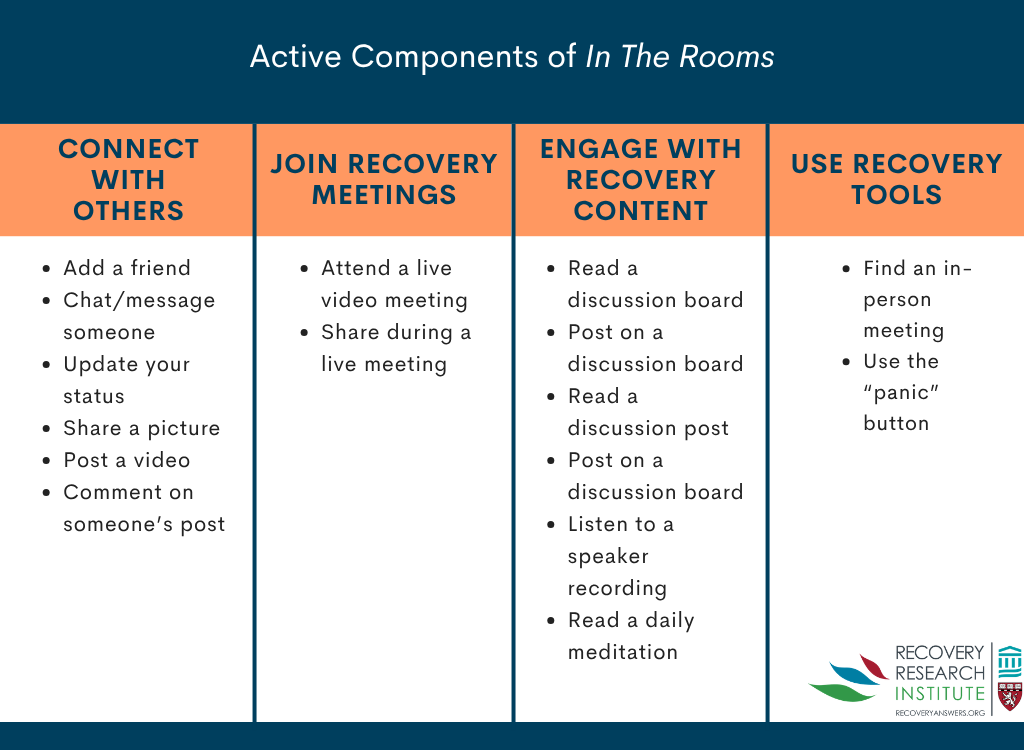
Participants completed surveys at baseline and again at 3 and 6 months post-baseline. The outcomes of interest were the number of days participants abstained from alcohol and other drugs during the past 90 days, and their quality of life. The primary predictor was In The Rooms participation, which was measured in two ways: time and activity. Participants reported how often they used In The Rooms and how much time they typically spent on the service over the past 90 days, which were multiplied together to create a composite measure of time. Participants also reported whether they engaged in 16 different activities over the past 90 days that fell under 4 different categories: connecting with others, joining recovery meetings, engaging with recovery content, and using recovery tools, which were summed to create an activity composite score. Because participants were asked to recall their In The Rooms use over the previous three months, they may have forgotten activities or overestimated or underestimated their participation. These inaccuracies could affect the estimated relationship between participation and recovery outcomes.
The researchers first examined whether In The Rooms participation differed across 3 groups: participants with less than 1 year in recovery or who did not identify as being in recovery, those with 1 to less than 5 years in recovery, and those with 5 or more years in recovery. The researchers examined whether time spent on In The Rooms and the number of different activities used were related to abstinence and quality of life measured at the same assessment. These analyses accounted for other factors that could influence the outcomes, including substance use disorder identified through a self-reported symptom checklist, and mental health conditions, such as anxiety or depression that participants reported had been diagnosed and had caused problems in the previous 3 months. The abstinence analyses also accounted for attendance at in-person recovery support meetings. The researchers also examined whether the associations between In The Rooms participation and recovery outcomes differed by recovery duration. Time-lagged models were estimated to examine whether In The Rooms participation at one assessment predicted outcomes at the subsequent assessment, providing a more robust test of the temporal relationship between participation and recovery outcomes.
WHAT DID THIS STUDY FIND?
Participants earlier in recovery initially spent more time on In The Rooms
Participants with less than 1 year of recovery or who did not identify as being in recovery spent more time on In The Rooms at baseline than participants with 5 or more years in recovery, but these differences were not observed at the follow-ups. The number of activities participants engaged in did not differ by recovery duration.
In The Rooms participation was associated with abstinence but not quality of life
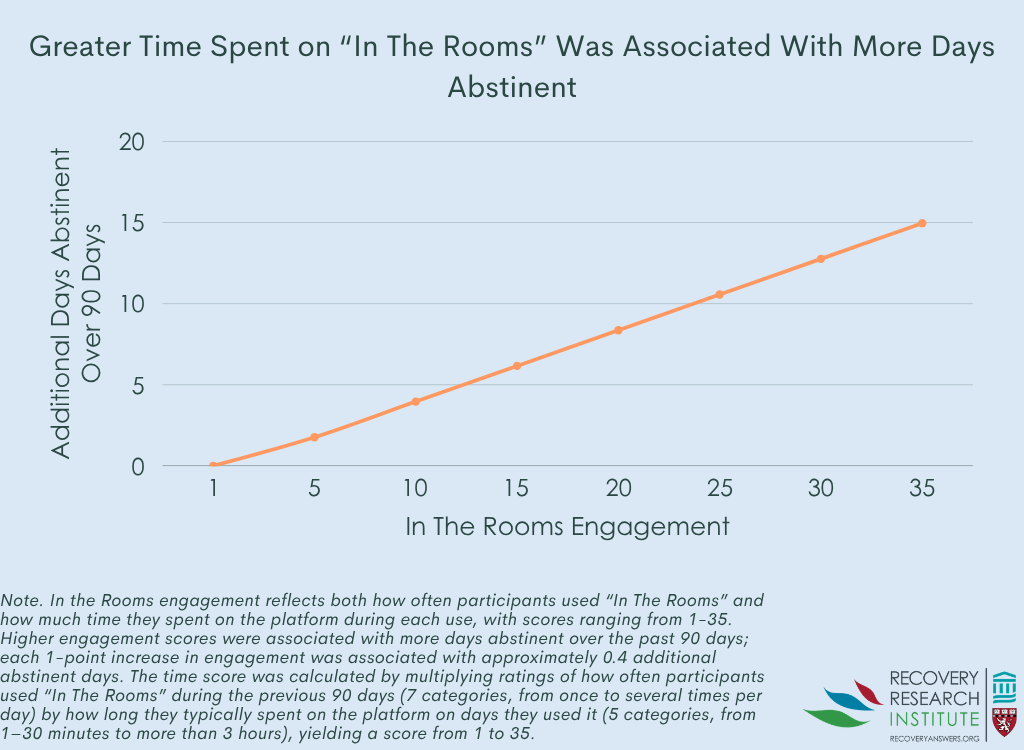
When participation and abstinence were measured during the same 90-day period, greater time spent on In The Rooms was associated with more days abstinent (see figure below). The observed effect size suggests that someone who participated weekly for 1 hour would report approximately 3 more days of abstinence over a 90-day period than someone who participated only once for 30 minutes or less. However, there wasn’t an association between time and days abstinent in the time-lagged models, nor was time significantly associated with quality of life.
When participation and abstinence were measured during the same 90-day period, the number of activities participants engaged in was not associated with days abstinent. However, a different pattern emerged in the time-lagged models, where the association between activity and days abstinent differed by recovery duration. Among participants with less than one year in recovery or who did not yet identify as being in recovery, each additional In The Rooms activity was associated with approximately 2 additional days of abstinence at the subsequent assessment. This benefit was clearly greater for people with 1 to 5 years in recovery; the comparison with people in recovery for 5 years or more was less certain and should be interpreted cautiously. Number of activities was not associated with quality of life in the contemporaneous or time-lagged models.
WHAT ARE THE IMPLICATIONS OF THE STUDY FINDINGS?
These findings suggest that In The Rooms has promise as a recovery support tool, and it may offer the biggest benefit to people who are new to recovery. Greater time spent on In The Rooms was associated with more days abstinent in the contemporaneous statistical models, although this association was not observed in the time-lagged models. In contrast, engaging in a greater number of activities predicted more abstinent days among individuals in their first year of recovery or who did not yet identify as being in recovery. Together with greater initial use of the service among those earlier in recovery, these findings suggest that digital recovery communities may be particularly beneficial during this sensitive time when individuals are building recovery-supportive routines, relationships, and resources.
The findings also suggest that the potential value of In The Rooms may extend beyond attending live online recovery meetings. The association between time spent on the service and abstinence remained even after accounting for online meeting attendance. Also, engaging in a greater variety of In The Rooms activities predicted subsequent abstinence among individuals earlier in recovery. Together, these findings suggest that other features of the service, such as connecting with other members and accessing recovery-related content, may also contribute to its potential benefits. Offering multiple ways to engage with recovery support may therefore be an important feature of digital recovery services, allowing individuals to participate in ways that align with their needs and preferences.
In contrast, neither time spent on In The Rooms nor the number of activities used was associated with quality of life. Quality of life is influenced by many aspects of an individual’s circumstances beyond substance use and recovery support, and improvements in these broader areas may take longer to emerge. Future research with longer follow-up periods could help determine whether sustained participation in digital recovery support services is eventually associated with improvements in quality of life.
Due to the observational nature of this study, it is unclear whether In The Rooms participation itself improves abstinence. Rigorous comparative studies are needed to determine whether In The Rooms offers benefits beyond other forms of recovery support, and to identify the types of engagement and populations for which it may be most useful. Nonetheless, these findings highlight the potential of digital recovery services like In The Rooms as accessible, beneficial sources of recovery support.
BOTTOM LINE
Greater participation in In The Rooms was associated with more days abstinent, with some evidence that engaging in a wider variety of activities may be particularly relevant for people in early recovery. However, participation was not associated with quality of life, and the mixed findings across analyses, combined with the observational study design, mean we can’t yet conclude that In The Rooms participation itself causes better recovery outcomes.
- For individuals and families seeking recovery: Digital recovery support services are a convenient way to access recovery support, particularly for individuals who face barriers to attending in-person services or prefer the flexibility or relative anonymity of online spaces. These communities can also provide multiple ways to engage, including meetings, peer interaction, discussion forums, and recovery-related resources. Although the findings are promising, online recovery communities should be viewed as one potential source of support rather than a proven replacement for evidence-based treatment and recovery services.
- For treatment professionals and treatment systems: Digital recovery support services may complement existing recovery supports by providing an additional, accessible option, particularly for individuals early in recovery or those who have difficulty accessing in-person resources. Providers could consider discussing online recovery communities alongside other community-based recovery supports when helping patients identify resources that match their needs and preferences.
- For scientists: Future studies should employ experimental or rigorous quasi-experimental designs to establish whether participation in digital recovery support services leads to improvements in recovery outcomes. Research should also incorporate objective measures of platform engagement, collected from the platform with participant permission, where possible (rather than retrospective self-reports) and investigate which specific activities or features are responsible for potential benefits. Given preliminary evidence of greater benefit among those earlier in recovery, future studies should examine how the effects and functions of digital recovery supports may vary across recovery stages and between abstinent and non-abstinent recovery pathways.
- For policy makers: Digital recovery support services may help expand the reach of recovery resources by providing flexible and geographically unrestricted access to support. Policies and funding initiatives that support rigorous evaluation of these services could help determine whether they can complement existing treatment and community-based recovery infrastructure.
CITATIONS
Bergman, B. G., Boorman, E. P., Russell, A. M., Colditz, J. B., & Kelly, J. F. (2026). Effects of participation in a large, online community for substance use disorder recovery: A naturalistic, longitudinal study. Psychology of Addictive Behaviors, 40(2), 189-198. doi: 10.1037/adb0001123.