WHAT PROBLEM DOES THIS STUDY ADDRESS?
Social relationships are strongly linked to alcohol use and alcohol use disorder recovery outcomes. Recovery can involve shifts away from pro-substance-using social connections and toward pro-abstinence or recovery-supportive connections. Much of this work focuses on the characteristics of a person’s social network rather than the quality of their relationships, which is also likely to change given the substantial transitions experienced during early recovery.
In active alcohol use disorder, relationships can be strained by conflict and pressure to address alcohol-related problems. Initiating recovery may alleviate some of these issues, but this period may also mark the loss of relationships before recovery-supportive relationships develop. Identifying when relationship conflict eases and when supportive friendships take root and the characteristics that predict this is crucial because the findings could guide the nature and timing of recovery supports. Accordingly, this study examined changes in positive and negative interpersonal dynamics during the first year of alcohol use disorder recovery and whether those trajectories varied by remission status.
HOW WAS THIS STUDY CONDUCTED?
This observational study examined interpersonal relationship quality over a 1-year period in a sample of 501 adults recruited from outpatient treatment settings and the community in the USA and Canada. Participants were adults with current alcohol use disorder and recent high-risk drinking (defined as more than 14 standard drinks per week for men or more than 7 standard drinks per week for women, per NIAAA criteria, in the 30 days before starting their recovery attempt) who were beginning a serious attempt either to abstain from alcohol or to drink without problems. Data were collected upon study enrollment, with follow-ups at 1.5, 3, 6, 9, and 12 months post-baseline. The outcomes of interest were negative interpersonal dynamics, characterized by hostility and rejection, and positive interpersonal dynamics, characterized by friendship and emotional support. Predictors of interest included alcohol use disorder symptoms, recovery capital (the full range of personal, social, and community resources that support recovery), commitment to sobriety, abstinence self-efficacy, income, and social network recovery engagement. The researchers used statistical modeling to track how negative and positive relationship dynamics changed over the 12-month period, and to identify which baseline characteristics were linked to how people started out and how much they changed over time. These patterns were then compared across three groups based on participants’ alcohol use disorder status at 12 months: abstinent remission, non-abstinent remission, or no remission. Although remission status was based on 12-month follow-up data and treated as fixed, it should be noted that remission status can fluctuate over time, particularly in the early stages of recovery.
WHAT DID THIS STUDY FIND?
Negative dynamics declined, but no significant changes in positive dynamics were observed
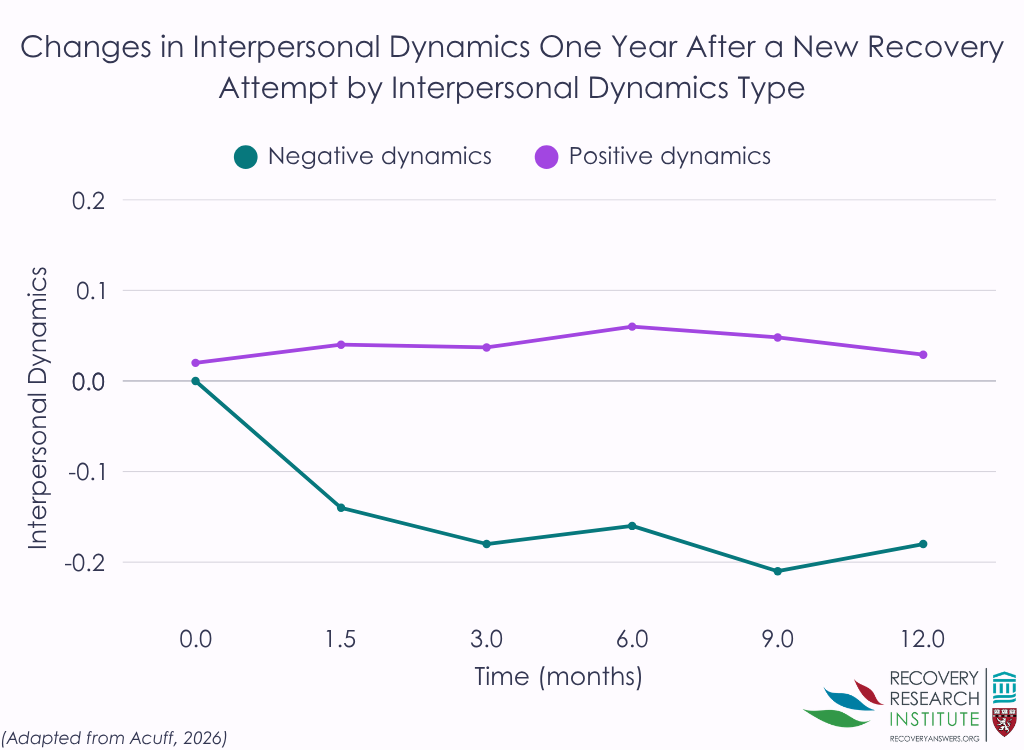
A significant reduction in negative dynamics was observed over the follow-up period. The steepest decline occurred at the 1.5-month follow-up, suggesting that, on average, the largest changes were experienced earlier in recovery. Participants in abstinent and non-abstinent 12-month remission showed larger, though still modest, reductions in negative interpersonal dynamics than participants who were not in remission. Whether changes of this size translated into noticeable improvements in everyday relationship functioning is not known. No significant changes in positive dynamics were observed in the full sample or the three remission groups during the follow-up period.
Recovery capital was associated with initial relationship quality
Across the full sample and within each remission group, participants with higher baseline recovery capital reported significantly lower negative dynamics as well as more positive dynamics at the start of the study. However, the relationship between recovery capital and change over the following year ran in the opposite direction from what the researchers expected. Participants who started with lower recovery capital showed steeper subsequent declines in negative dynamics and larger increases in positive dynamics, while those who started with higher recovery capital showed comparatively flatter trajectories.
WHAT ARE THE IMPLICATIONS OF THE STUDY FINDINGS?
In this sample, perceived hostility and rejection declined during the first year of a recovery attempt, whereas perceived friendship and emotional support did not change significantly on average. Because interpersonal conflict is a commonly cited reason for wanting to reduce alcohol use, reductions in negative dynamics could theoretically support recovery. The reverse may also be true. Drinking less, or not drinking at all, could itself lead people to get along better with family and friends, independent of any effect on motivation to stay in recovery. This study’s design cannot distinguish between these possibilities. Reduced conflict may reinforce recovery, reduced drinking may ease conflict, or both may occur together.
The lack of change in positive dynamics is notable given the transitions and challenges experienced in early recovery. This finding raises the possibility that rebuilding positive relationships may take longer than reducing hostility and rejection and may sometimes require targeted support, though this study did not test that explanation. This finding is supported by previous studies that have shown that reductions in negative consequences occur earlier, while improvements in well-being and other positive experiences typically take longer. To offset this, interventions that provide rewarding substance-free activities may be particularly beneficial for individuals in recovery working to improve their relationships. Mutual-help groups such as Alcoholics Anonymous and The Phoenix may be one avenue for this kind of support, as they can provide opportunities to build new friendships and engage in enjoyable, substance-free activities alongside others in recovery.
Recovery capital was linked to better relationship quality at the very start of a recovery attempt, which is encouraging given that it is a modifiable, buildable resource. However, its relationship to the pace of improvement over time was less straightforward. In this sample, people with lower recovery capital tended to show more relationship improvement over the following year, not less. This pattern is consistent with regression to the mean, a common statistical phenomenon in naturalistic, single-group studies in which people who start with unusually low or high scores tend to drift toward the average over repeated measurements, independent of any real underlying change. It may also reflect a ceiling or floor effect. People who start with higher recovery capital may already have more supportive and less harmful relationships, leaving less room for further improvement, whereas those who start with lower recovery capital have more room to grow.
Notably, the magnitude of change in both negative and positive interpersonal dynamics was similar for participants in abstinent remission and non-abstinent remission, suggesting that reduced interpersonal conflict was not unique to complete abstinence. However, this similarity may partly reflect how remission itself is defined, because continued alcohol use despite social or interpersonal problems is one of the diagnostic criteria for alcohol use disorder. Someone classified as being in remission has, by definition, likely stopped experiencing significant interpersonal problems related to their drinking. This overlap between the outcome measured (interpersonal dynamics) and part of the remission definition itself should be kept in mind when interpreting these findings. Helping individuals build personal, social, and community resources early in recovery may still support relationship quality overall, but this study does not show that higher recovery capital accelerates improvement over time.
Key limitations include the study’s observational design, which prevents conclusions about whether remission caused the reductions in negative interpersonal interactions or vice versa, and the use of 12-month remission status to define groups retrospectively. The smaller remission subgroups, numerous predictor tests, and differential attrition increase uncertainty and the possibility of chance findings.
BOTTOM LINE
During the first year of a new alcohol use disorder recovery attempt, perceived hostility and rejection declined, particularly among participants classified as being in remission at 12 months, while perceived friendship and emotional support did not change significantly on average. Higher recovery capital was associated with better relationship quality at enrollment, but its associations with change over time were complex and require more research.
- For individuals and families seeking recovery: Quitting or reducing drinking may provide respite from conflict, criticism, and rejection, which can also yield positive feelings. However, building new sources of friendship and support may take longer. To help facilitate these changes, individuals may benefit from seeking out recovery-supportive relationships and rewarding substance-free activities, such as those offered by The Phoenix.
- For treatment professionals and treatment systems: Treatment professionals should encourage activities and practices that help patients find meaningful, recovery-supportive relationships. Family- and couple-based approaches, such as Behavioral Couples Therapy, may be valuable to incorporate when feasible. Treatment systems should also connect patients to community-based recovery supports and other resources to help bolster recovery capital.
- For scientists: Future studies should investigate changes in relationship quality over a longer period with more granular follow-up assessments to better understand the dynamic interplay of interpersonal relationships and recovery outcomes. Notably, this study found that lower baseline recovery capital predicted steeper subsequent improvement in interpersonal dynamics, a pattern that may reflect regression to the mean, a ceiling/floor effect for those starting with higher recovery capital, or a genuine but unexpected relationship. This warrants replication and further investigation to distinguish among these explanations. This study should also be replicated with other types of substance use recovery and populations, particularly adolescents, given the salience of peer relationships during that developmental stage.
- For policy makers: Policies that expand access to treatment and support new recovery attempts may have benefits that extend beyond substance use itself, including improved relationship quality and well-being. At the same time, policies aimed specifically at rebuilding social connection and support networks may need to operate on a longer timeline than policies focused on reducing conflict and should not assume that reduced substance use alone is sufficient to restore positive relationships or help build new ones.
CITATIONS
Acuff, S. F., Meisel, S. N., Hennessy, E. A., Belisario, K. L., Garber, M. L., MacKillop, J., & Kelly, J. F. (2026). Predictors and trajectories of negative and positive interpersonal dynamics in remission from alcohol use disorder. Alcohol: Clinical and Experimental Research, 50(5). doi: 10.1111/acer.70284.