WHAT PROBLEM DOES THIS STUDY ADDRESS?
Social connections are vital to recovery, and different types of relationships may contribute in unique ways. Prior research has contrasted support from friends and peers, who may provide more emotional support, from that provided by family members, who may provide more instrumental support (e.g., financial assistance, help with transportation, etc.).
Although both can influence substance use and recovery outcomes, less is known about how these sources of support interact within recovery-oriented settings. Oxford House recovery homes are among the most common recovery housing models in the United States and require residents to maintain abstinence, contribute to household expenses, and follow house rules.
Research has shown that these are helpful and cost-effective recovery residence models. These homes operate without professional staff and are governed by residents themselves, making peer relationships a central component of the environment. The current study examined how supportive family relationships and social networks within Oxford Houses jointly influence recovery over time.
HOW WAS THIS STUDY CONDUCTED?
The researchers recruited 602 residents from 42 Oxford House recovery homes across North Carolina, Texas, and Oregon to examine how supportive family relationships and social networks within recovery homes influence recovery over time. Data were collected every 4 months for 2 years, resulting in 6 waves of data collection used in the analyses.
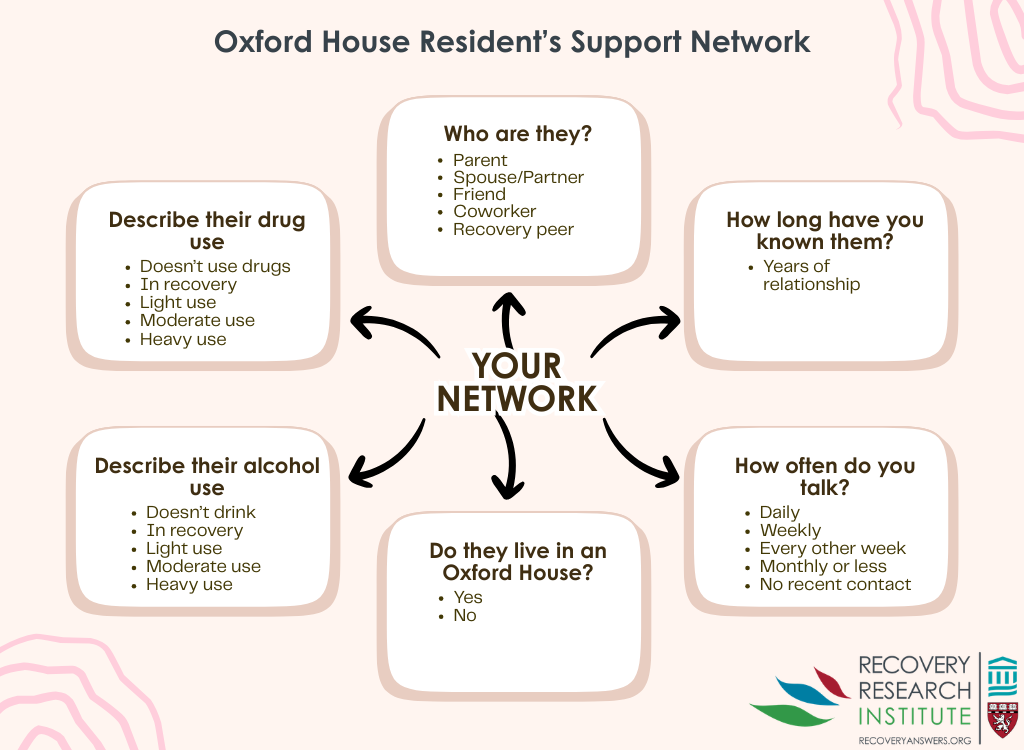
At each wave, residents rated the strength of their relationships with every other resident in the house, allowing the researchers to map social networks and track how they changed over time. Participants also identified important people in their broader social networks, including those in Oxford House residences, and provided information about those individuals, including their relationship to the participant, frequency of contact, and substance use status (see graphic below). Residents were classified as having a recovery-supportive family relationship if they listed a family member first when asked about their most important people, had regular contact with that person (at least weekly), and reported that the family member did not use alcohol or other substances. Thus, these family members were individuals close to the participant who were abstinent and may even have been in recovery themselves, though this was not clear from the study. Recovery was measured using a composite Recovery Factor score that incorporated indicators such as wages, quality of life, self-esteem, self-efficacy, stress, social support, sense of community, and hope. Using longitudinal social network analysis, the researchers examined both how strong relationships among residents formed and changed over time and how supportive family relationships and strong ties to other residents contributed to residents’ recovery trajectories.
WHAT DID THIS STUDY FIND?
Oxford House residents had stronger recovery factor scores the longer they lived in the house, although these gains eventually leveled off over time. Recovery also improved more quickly among residents who had strong ties to peers with higher recovery scores and among those who reported a supportive family relationship (i.e., listed a family member first, had weekly contact with that person, and the family member was abstinent). Interestingly, residents with supportive family relationships were less likely to be identified by other residents as strong relationship partners. The study also found that supportive family relationships appeared to reduce the importance of peer support within the house to the recovery outcome. Specifically, strong ties to higher-recovery scoring peers predicted better recovery outcomes only for residents who did not have a close, abstinent family member.
WHAT ARE THE IMPLICATIONS OF THE STUDY FINDINGS?
Social support has long been recognized as a key component of recovery, yet less is known about how different sources of support interact within recovery-supportive environments such as recovery residences. This study extends the literature on recovery housing and social networks by demonstrating that supportive family relationships and recovery-oriented peer relationships may serve compensatory or substitute functions in supporting recovery. Residents with a close, abstinent family member appeared to benefit directly from those relationships, whereas residents without such support benefited most from strong connections to peers with higher levels of recovery. While this study did not examine whether family support would have been just as helpful if the family member was not abstinent themselves, we can presume this would not have been the case from other work. Specifically, support for cutting down or quitting alcohol from individuals in recovery themselves improves alcohol outcomes to a greater degree than support from people not in recovery, especially for abstinence. Another study showed that an intervention linking individuals with alcohol use disorder to 12-step groups (i.e., a 12-step facilitation), was more helpful than other psychosocial interventions for participants whose closest network ties helped reinforce their drinking. Taken together, if someone’s family or close friends either do not help, or possibly hinder, their recovery, supportive peers – especially those with strong recoveries themselves – are even more important to their well-being.
One caveat is that the recovery outcome used in this study was an original composite measure of employment wages, quality of life, self-efficacy, self-esteem, stress, social support, sense of community, and hope. That said, the measure had been validated empirically by the research team, increasing confidence in its utility as a novel measure of recovery outcome.
Overall, these findings suggest that recovery services should consider the broader social context of individuals in recovery, including both family and peer support systems. More broadly, the study reinforces a growing body of research highlighting the importance of engaging and strengthening supportive family relationships while also fostering opportunities for meaningful recovery-oriented peer connections when family support is limited.
BOTTOM LINE
Among adults living in Oxford House residences, supportive family relationships and recovery-oriented peer relationships appear to serve compensatory or substitute functions. Residents with supportive family members showed stronger recovery over time, and didn’t show additional benefits from supportive peer relations, whereas residents without family support benefited most from strong ties to peers who had higher levels of recovery.
- For individuals and families seeking recovery: Supportive relationships matter. Individuals in recovery may benefit from staying connected to supportive, non-using family members and from developing relationships with peers who are further along in their recovery journey. Recovery homes may provide an environment where these recovery-supportive relationships can develop and grow.
- For treatment professionals and treatment systems: Family and peer relationships both play important roles in recovery initiation, maintenance and growth. Although some recovery services, such as Oxford Houses, rely heavily on peer support and resident governance, treatment and recovery systems may benefit from assessing the availability of supportive family relationships and helping individuals strengthen recovery-supportive connections. When family support specifically provided by close, abstinent family members is limited or unavailable, fostering opportunities to build relationships with peers in recovery may provide an important alternative source of support.
- For scientists: The current study identified potentially compensatory or substitution roles for supportive family relationships and recovery-oriented peer relationships in promoting recovery. Future research should examine how changes in the strength, quality, and availability of family and peer relationships influence recovery outcomes over time, as well as how broader recovery ecosystem factors may shape the relative importance of these different sources of support.
- For policy makers: This study highlights the importance of social support in recovery, including both support from close, abstinent family members and recovery-oriented peer connections. Investments in recovery housing and other recovery support services may help individuals access and sustain these important sources of recovery capital, potentially improving long-term recovery outcomes and reducing the broader societal costs associated with substance use disorders.
CITATIONS
Jason, L. A., Light, J. M., Krause, R., & Sikora, A. (2026). The effect of supportive familial relationships on social networks and recovery. Journal of Substance Use and Addiction Treatment, 183. doi: 10.1016/j.josat.2026.209897.