WHAT PROBLEM DOES THIS STUDY ADDRESS?
Substance-related consequences are commonly experienced by family and friends of people with substance use disorders, who often do not have support systems in place to help them.
Services have been developed within the broader context of mutual-help organizations that can provide support to these family members and friends – sometimes referred to as “concerned significant others”. Self Management and Recovery Training (SMART) Family and Friends, for example, is a mutual-help group specifically focused on the wellbeing of loved ones of people with substance use disorders.
The 8-module program is delivered by a facilitator flexibly in full day workshops or multiple 1–2 hour sessions. The program is grounded in strengths-based principles and elements that reduce the harmful consequences of substance use to promote positive lifestyle changes, self-care, assertive communication, and problem solving for the concerned significant other. Although initial studies suggest these groups may be helpful, there are many potential barriers to implementation, particularly the need to recruit and train facilitators.
This study used mixed methods (both qualitative and quantitative) to evaluate the perceived effectiveness of SMART Family and Friends training among facilitators, and to examine program implementation in Australia.
HOW WAS THIS STUDY CONDUCTED?
This study used an exploratory cross-sectional design. After completing the SMART Family and Friends facilitator training program, trained facilitators completed quantitative measures on the perceived effectiveness of the SMART Family and Friend training program. It is worth noting that these questionnaires were only completed after the training, not before so that change in knowledge and attitudes could be measured.
In this survey, participants answered questions about their own demographics and completed the Work Practice Questionnaire which assessed participants perception of role adequacy, perceived training outcomes, and perceived relevance of the training. Approximately 2 months later, after facilitators presumably had an opportunity to facilitate a SMART Family and Friends group, facilitators participated in qualitative semi-structured interviews. The researchers wanted to better understand participants’ motives for attending the training, training experiences, barriers and facilitators to intervention delivery, helpfulness of the intervention, and suggestions for improving dissemination of the program. The researchers then conducted thematic analysis to extract common themes across participants pertaining to areas of interest. The trainings were provided via Zoom in single day workshops lasting approximately 8 hours. Facilitators had either direct lived experience with substance use, experience as the family member/friend of someone with substance use, or experience providing services to family members/friends. Many had professional training, including as social worker or counselor, case manager, or peer worker.
WHAT DID THIS STUDY FIND?
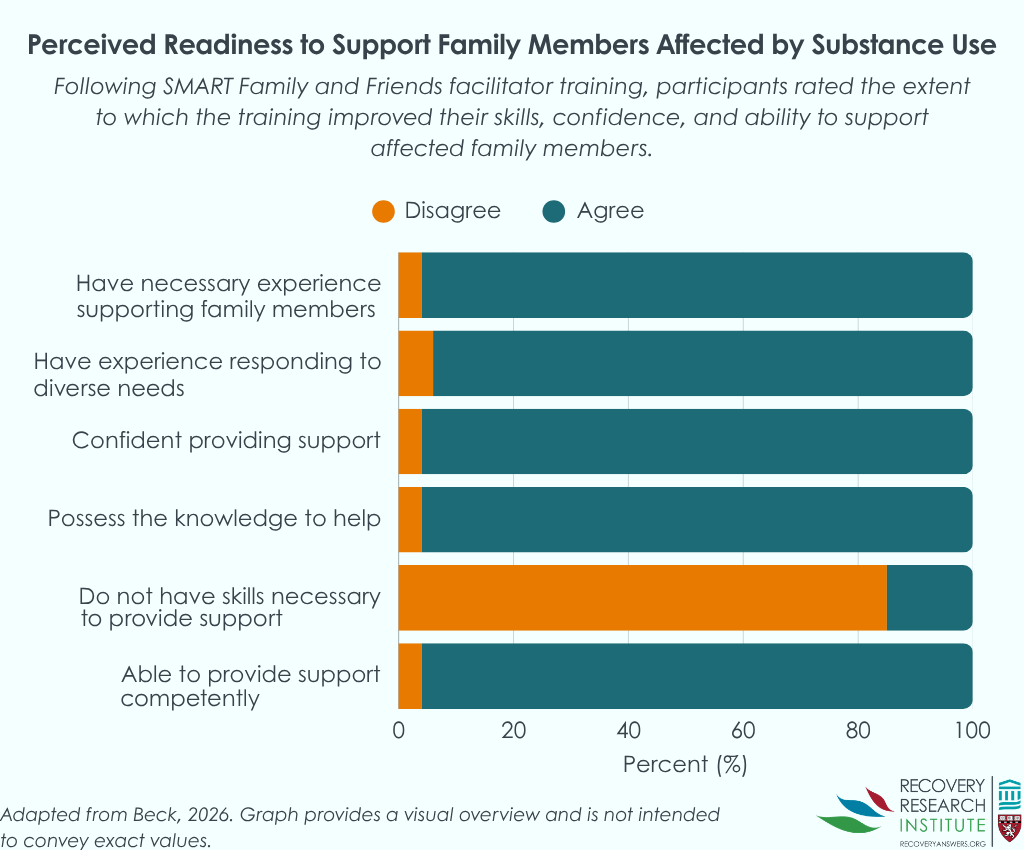
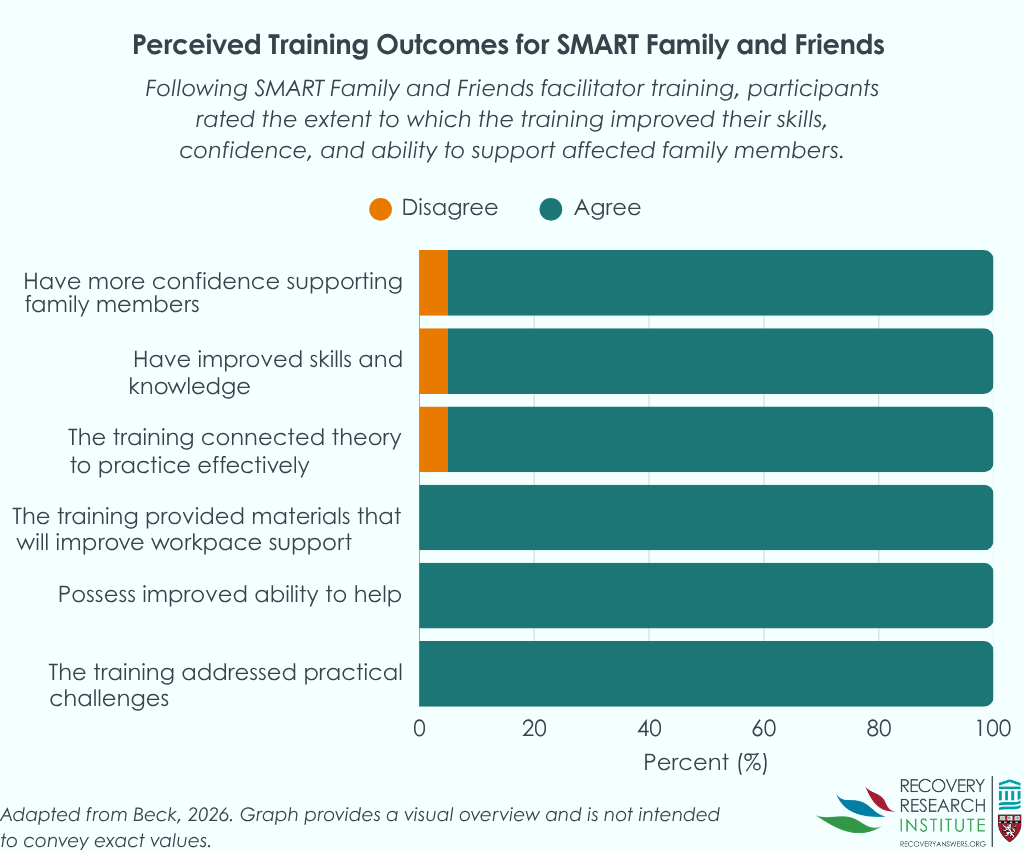
Out of 24 participants who completed the training and participated in the research study, 16 delivered the SMART Family and Friends program, either on a volunteer basis (n = 6) or through an organization (n = 10). Participants generally felt they were adequately prepared for the role, answering positively between 91.6% and 95.9% of the time to items such as “I have the necessary knowledge to help affected family members”. Participants also generally felt positively about training outcomes responding positively to 83.3% to 100% on items such as “all in all, this training program will improve my response to issues experienced by affected family members” (see graphic below).
Finally, participants felt that the training was relevant to their needs and to the needs of those they serve, with positive ratings between 95.8% to 100% on items such as “I will use some of the things I learnt at this training program in my work.”
Qualitative Findings
As expected, participants perceived SMART as helpful
Most participants were familiar with the SMART ethos and wanted to participate in the training due to positive perceptions SMART tenets, perception of broad applicability across people and substances, the perceived therapeutic benefits and the structure of this approach. Many also enjoyed the structured approach of the program and felt that the material taught was relevant to their work more broadly and would apply some of what they learned within other work contexts. Participants who had an opportunity to facilitate groups also reported positive experiences with attendees of the group, with facilitators observing change in family members and friends in the way they respond and talk about their loved one.
Participants noted several barriers to carrying out groups and engaging family members/friends
Participants described the “logistical nightmare” of trying to respond to needs and availability of different clients, which was impacted by lack of paid time and resources. Participants expressed difficulty in coordinating room space within their organization, with many mentioning that their organization’s building was already at capacity. High staff turnover was an additional barrier, as participants reported that this can lead to increased caseloads and limited time to offer supplementary services, like the SMART Family and Friends group. Further, management and executive levels of organizations sometimes did not readily endorse program implementation, particularly when interfering with the day-to-day bread and butter services offered. Online services were suggested by the researchers as potential alternative delivery systems to lessen some of these concerns, though this suggestion was met with varied motivation, capacity, and interest in online video conference meetings (e.g., via Zoom). Participants noted additional barriers to group engagement and implementation, including the need for childcare and a lack in professional confidence to handle high risk content, such as domestic violence.
Facilitators reported being aware of the vast need that was currently unmet and presumably filled by the provision of the SMART Family and Friends program. Facilitators observed high levels of loneliness, stress, and burden from care of loved ones with addiction. Yet, they also reported having trouble recruiting and filling groups. Facilitators felt this was due to the stigma of addiction. They also reported that, in some cases, people may already have support or may not be aware that they could use additional support, or be unwilling to open up about private familial experiences. In many cases, socioeconomic barriers may prevent engagement in such groups, as family and friends of loved ones with addiction may need to address more pressing needs, such as housing instability.
Participants also noted individual characteristics that may impact implementation. For example, some facilitators noted that they had their own struggles with family members in addiction and wondered about their own ability to remain objective. On the other hand, facilitators also noted that lessons learned from SMART Family and Friends could be applied to other areas in their professional lives and helped themselves to better understand their own personal needs, which the researchers interpreted as potentially mediating the risks of burnout.
WHAT ARE THE IMPLICATIONS OF THE STUDY FINDINGS?
Broadly, participants in the SMART Family and Friends facilitator training felt that the content of the training was useful, and that the program prepared them for the role. After the training, approximately 2 of every 3 participants actually led a SMART Family and Friend program, suggesting that these types of training programs may be useful for disseminating the program. Further, participants noted appreciation for certain elements of the training program, including the general ethos and the structure. However, participants also noted important barriers, such as facilitator experiences or difficulties attending groups, to consider when implementing such groups for family and friends of loved ones.
Such barriers may be critical to address in order to maximize the benefit from such facilitator trainings. Organizational barriers such as a lack of support from executive and managerial levels, in addition to lack of resources and general provider burnout, appeared to be particularly important to address, in addition to group participant socioeconomic factors that may hinder engagement.
BOTTOM LINE
SMART Family and Friends facilitator trainings have the potential to increase access to resources for family and friends of people experiencing addiction. Yet, key barriers exist, including facilitator burden and trouble for family/friends accessing groups, that should be addressed to maximize the impact of these interventions in the community.
- For individuals and families seeking recovery: If you have a loved one experiencing addiction, it is important to know that you are not alone. There are resources, such as SMART Family and Friends, Al-Anon, or Community Reinforcement Approach and Family Training (i.e., CRAFT) that are designed to provide support to you as a family member or friend. These groups may provide additional support for your well-being, skills to manage stress and interpersonal conflict, and, in some cases, may help to facilitate discussions with loved ones about seeking help with their addiction.
- For treatment professionals and treatment systems: Family and friends of people with addiction may experience their own harms related to their loved one’s substance use, warranting focused support. Programs like SMART Family and Friends have a relatively low barrier to entry, yet may provide attendees with the support needed to manage the stress related to their loved one’s substance use. However, it is important to note that barriers do exist like insufficient time and space, which may need to be addressed prior to implementation.
- For scientists: Despite development of potentially helpful interventions such as SMART Family and Friends, little is known about how to effectively use these within community settings. This study provides important qualitative details about such implementation, yet more research exploring different pathways to dissemination may improve uptake of important programs such as these.
- For policy makers: The researchers noted substantive barriers to engaging with the SMART Family and Friends program, including a lack of funding and resources through their own organization, and a lack of childcare and transportation for potential attendees. Subsidies for facilitating such groups may improve dissemination while reducing provider burnout, which may lead to greater improvements in family and friend well-being.
CITATIONS
Beck, A. K., Gray, R. M., Wells, M., Deane, F. P., Larance, B., Hides, L., Manning, V., Baker, A. L., Shakeshaft, A., Dal, E., Argent, A., & Kelly, P. J. (2026). SMART Family and Friends mutual‐help groups: Findings from a mixed‐methods formative implementation evaluation. Drug and Alcohol Review, 45(3). doi: 10.1111/dar.70137.