WHAT PROBLEM DOES THIS STUDY ADDRESS?
In university settings, alcohol use is often embedded into social events and widely perceived as a typical part of the university experience. This normalization of drinking contributes to higher rates of hazardous alcohol use in university students. Heavy drinking is particularly common in Spain, with approximately 40% of university students in a recent study reporting high-risk drinking behaviors. Given the potential health and psychosocial consequences of heavy drinking, many brief alcohol interventions have been designed for university students. Because university students are less likely to seek formal treatment, brief interventions provide an accessible opportunity to promote changes in alcohol use. Brief Alcohol Screening and Intervention for College Students (BASICS) is one such intervention that aims to reduce alcohol use through motivational interviewing and personalized normative feedback (i.e., comparing one’s alcohol use to that of their peers). BASICS has a robust evidence base, with a meta-analysis of randomized controlled trials showing that BASICS produces modest but meaningful reductions on alcohol consumption at 0-3 months and 3-6 months post-intervention. Although most evaluations of BASICS are limited to short-term outcomes, there is some evidence that BASICS reduces alcohol use up to 12 months post-intervention. BASICS has been adapted across a variety of formats and modalities, including different types of facilitators.
Peer-led interventions are thought to be particularly well-suited for university settings because a shared sense of identity with the facilitator may enhance credibility and receptiveness, both of which can promote intervention uptake. An evaluation of BASICS facilitated entirely by peers showed beneficial short-term effects, but further research is needed to assess long-term benefits, particularly in the context of Spanish universities. Therefore, this randomized controlled trial evaluated the effectiveness of a peer-led, single-session BASICS intervention on long-term alcohol consumption in a sample of Spanish university students.
HOW WAS THIS STUDY CONDUCTED?
This randomized controlled trial evaluated the long-term effects of BASICS on alcohol consumption in students who had at least 1 past-month episode of heavy drinking. Notably, the study did not report how heavy drinking was defined, though usually it means 4+ drinks in 1 day for women and 5+ for men. Students – average age 19 years old – at a private university in Spain were recruited for the study though campus announcements and social media.
From a pool of 2,780 students who were invited to participate in the study, 384 (13.8%) volunteered to participate. Differences between invited students and participants were not reported. Upon applying the exclusion criteria, the final sample consisted of 308 first and second-year students who reported one or more heavy drinking episodes within the past month. They reported about 12 drinks per week, on average, based on the Spanish benchmark of 10g of ethanol per standard drink (the US standard drink is higher at 14g). Because the number of participants who volunteered for the study represents a small subset of the students who were invited to participate, generalizability to the broader student body is limited.
Participants were randomly assigned to an intervention or control group at a 1:1 ratio (i.e., each group had 154 participants). While statistical comparisons of the groups were not reported, inspection of the table of participant characteristics suggests groups were largely similar at baseline.
The intervention group received a 50-minute, in-person BASICS session delivered in a private setting by a trained peer facilitator, and the control group did not receive any services or materials.
The primary outcome was the number of drinks consumed during a typical week; secondary outcomes included additional alcohol use measures, alcohol-related consequences, and motivation and self-efficacy to reduce drinking. Data were collected at baseline as well as 1-month and 12-month follow-ups to measure short-term and long-term outcomes, respectively. Differences between the intervention and control groups were compared at each follow-up to evaluate the effectiveness of the intervention.
WHAT DID THIS STUDY FIND?
BASICS had long-term reductions in alcohol consumption and alcohol-related consequences
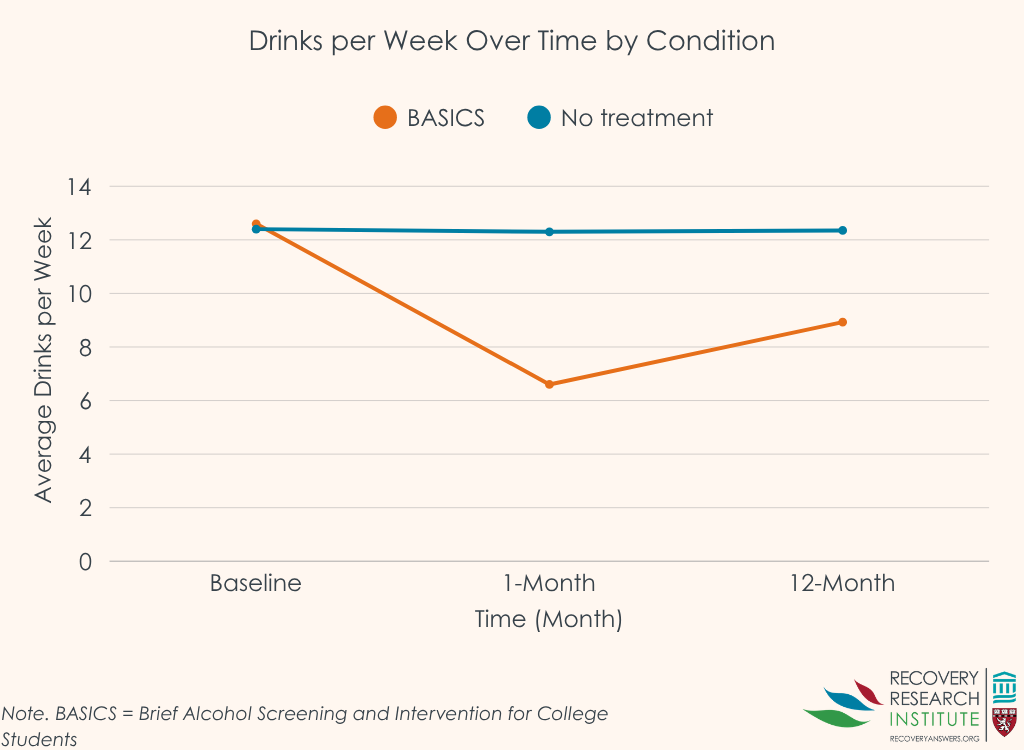
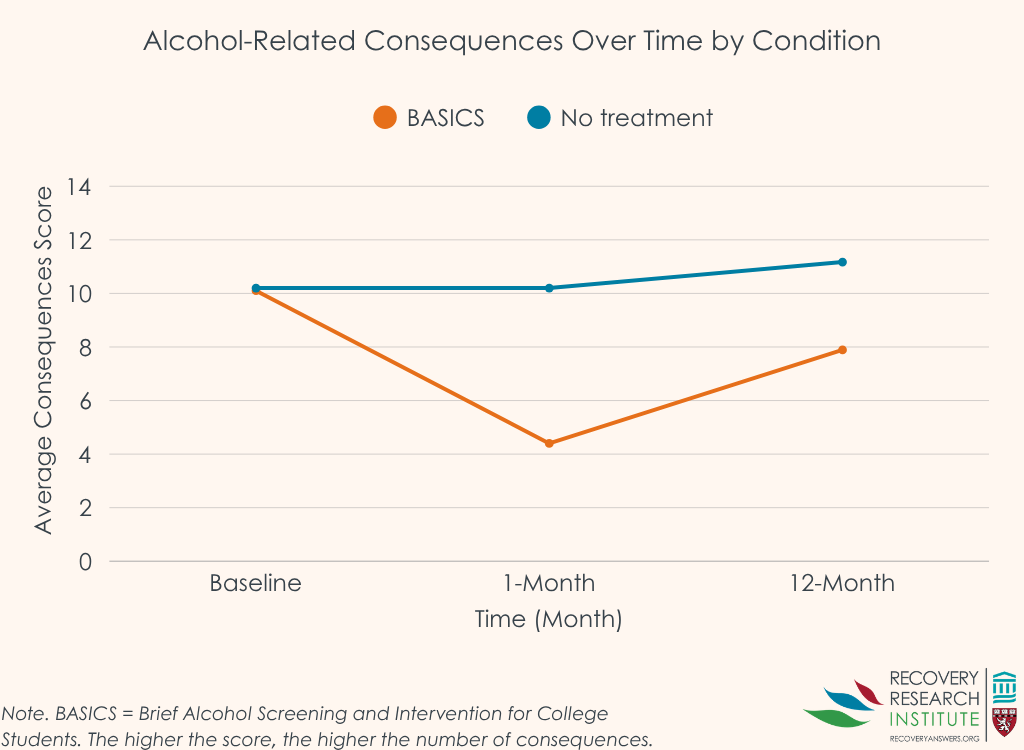
The intervention group reported consuming significantly fewer drinks per week compared to the control group at the 12-month follow-up (see graph below). Significant reductions were also observed in alcohol-related consequences (see graph below) and other alcohol consumption outcomes, reflecting decreases in both overall consumption and heavy drinking. Although the between-group differences were somewhat larger at the 1-month follow-up, they remained statistically significant, indicating that the benefits of BASICS were sustained approximately a year after the intervention.
Initial improvements in motivation persisted, but self-efficacy took longer to build
The intervention group was significantly more motivated to drink less alcohol at the 1-month follow-up, and this effect strengthened over time, with larger between-group differences observed at the 12-month follow-up. In contrast, short-term gains in self-efficacy were modest and non-significant but increased over time, with the intervention group reporting significantly higher self-efficacy than the comparison group at the 12-month follow-up.
WHAT ARE THE IMPLICATIONS OF THE STUDY FINDINGS?
Participating in a single-session, peer-led BASICS intervention had long-term reductions in alcohol consumption relative to receiving no intervention. While these reductions in drinking were somewhat larger at the 1-month follow-up, they remained statistically significant at the 12-month follow-up, suggesting that the benefits derived from BASICS were maintained approximately 1 year after the intervention. BASICS also improved motivation and self-efficacy, two underlying mechanisms of behavior change. Notably, motivation to reduce drinking grew over time, whereas significant increases in self-efficacy only emerged at the 12-month follow-up. These patterns could reflect how short-term reductions in drinking increased students’ motivation to continue making those behavior changes, while self-efficacy gradually developed as they gained more experience managing their alcohol use. Although these findings are indeed promising, because only 13.8% of the invited students volunteered to participate in the study, these results may partly reflect self-selection bias. In other words, the subset of students who volunteered for the study may be characteristically different from those who chose not to participate (e.g., being more motivated to change their alcohol use), which may limit the generalizability of these results to broader student populations. Also, comparison participants received no services whatsoever. That said, nothing, is probably what happens at most universities. Despite these limitations, findings extend the evidence base of BASICS by demonstrating that this single-session, peer-led intervention can have long-term meaningful benefits compared to doing nothing while also supporting the value of implementing the intervention at Spanish universities.
A question remains as to how such an intervention would be implemented in college settings. For example, would students merely volunteer to participate in such an intervention? Or would there need to be a college infraction that would result in a referral as has been done in prior studies? We also don’t know from this study whether the peer is better than a trained counselor in conferring benefits. This should be tested in future work as if results are similar peers might be more cost effective.
BOTTOM LINE
Peer-led BASICS could have long-term beneficial effects on alcohol consumption, related consequences, and mechanisms of behavior change in university students who drink heavily. Because BASICS consists of a single, 1-hour long session, the brevity of the intervention may be ideal for students who are contemplating drinking less, but who do not want to participate in a lengthy intervention. The real-world impact of this intervention also depends on how it would be implemented in college settings, for example, whether engagement would rely on students volunteering to participate or if a college infraction would lead to required participation.
- For individuals and families seeking recovery: For students who are contemplating reducing their alcohol use, participating in a peer-led brief intervention like BASICS may lead to meaningful and sustained improvements. Even beyond university students, brief interventions that use motivational interviewing and personalized feedback—two core components of BASICS—may be particularly useful for supporting these changes.
- For treatment professionals and treatment systems: Treatment systems and clinicians aiming to maximize resources could benefit from embedding brief alcohol interventions like BASICS into their services given the scalability, low cost, and potential benefits. Incorporating routine alcohol screening can help identify individuals who may benefit most from these interventions, particularly in clinical settings that serve populations at greater risk for heavy alcohol use, such as university students and veterans.
- For scientists: Future research should test whether these findings can be replicated in other populations and educational settings, such as students with an alcohol use disorder and community colleges. Specifically evaluating the effect of using a peer facilitator versus a non-peer could also be beneficial for informing similar interventions. Studies with extended follow-ups are also needed to assess whether these beneficial effects can be maintained over longer periods.
- For policy makers: Broadly, investing in the development and evaluation of brief alcohol interventions is needed to better support implementation across a variety of cultures, contexts, and settings. At the university level, pairing individual-level interventions like BASICS with policies that target the broader alcohol environment—such as prohibiting alcohol sales and consumption at sporting and other campus events—may be particularly effective for addressing alcohol use among students.
CITATIONS
Lavilla‐Gracia, M., Pueyo‐Garrigues, M., Alfaro‐Díaz, C., & Canga‐Armayor, N. (2026). Long‐term effects of a peer‐led Brief Alcohol Screening and Intervention for College Students (BASICS) intervention to reduce alcohol consumption among Spanish university students: A 12‐month randomised controlled trial. Addiction. doi: 10.1111/add.70365.
 Heavy drinking is often seen as a common part of university life, but it can lead to serious health and psychosocial consequences. Although some brief alcohol interventions have demonstrated short-term reductions in drinking among university students, additional evidence of long-term benefits is needed. This study evaluated whether a single-session, peer-led intervention reduced long-term alcohol use in Spanish university students.