Drug checking services can reduce the risk of accidental overdoses. While intention to use these services is high, actual use remains low. Understanding the perspectives of employees who might provide drug checking services can influence how successfully they are implemented and ultimately increase service engagement. In this qualitative study, researchers in Australia explored the perspectives of employees who provide drug checking services.
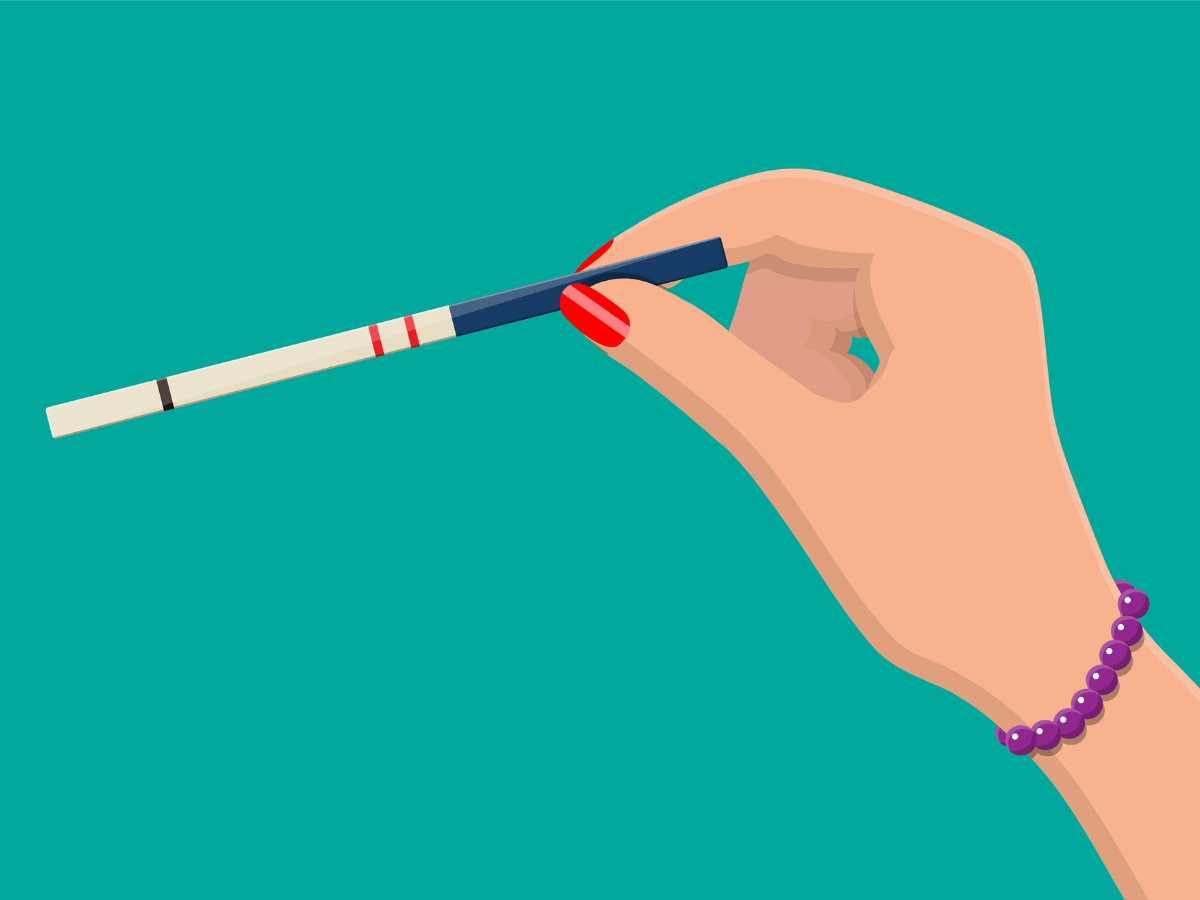
Drug checking is a tool intended to prevent drug use-related harms that offers people who use drugs an opportunity to screen their drugs for substances they do not wish to consume. Given that the drug market is unregulated, screening drugs for unwanted and potentially harmful substances, such as fentanyl and xylazine, can help reduce the risk of accidental overdose and improve public health. This process involves submitting a very small amount of a drug (e.g., a scraping or one-tenth of a gram) for analysis of the contents and the results are then returned to the service user, which allows them to make an informed decision about whether they still wish to consume the drug.
Despite the potential public health benefits and research showing that as many as 94% of people who use drugs had the intention of using drug checking services if available, actual use remains low. The perspectives of employees who provide drug checking services can influence how they are implemented, which in turn can influence their use by people who use drugs. Accordingly, understanding their perspectives can help promote successful implementation of drug checking services and ultimately increase frequency of their use. Researchers in this study interviewed employees of Australian drug and alcohol organizations to explore their perspectives on drug checking. Such research can help identify who is most likely to use these services, as well as barriers and facilitators to use, which can help inform implementation efforts.
HOW WAS THIS STUDY CONDUCTED?
In this qualitative study, the researchers conducted interviews with staff employed at addiction treatment centers and programs designed to reduce drug use harms in Australia to examine their perspectives regarding the barriers and facilitators to the use of drug checking services by people who use drugs. Responses were qualitatively analyzed and categorized into themes.
Interviews were conducted between February and August 2023. During this time, there was 1 fixed-site drug checking service in operation and 2 trials that were being conducted at music festivals, all in the state of Canberra. Of note, drug checking services were legalized in Queensland in February 2023, but no sites had been opened yet in the state during the study period.
Participants were recruited via email from 3 non-profit organizations that provided either alcohol and drug addiction treatment or services to reduce the harms associated with substance use and other health services (e.g., syringe exchanges, naloxone distribution, drug checking) to people who use drugs. Employees were eligible to participate in the study if they worked directly with clients or have delivered drug checking services.
Participants first completed a survey online that lasted 15 minutes. They were then invited to participate in a longer semi-structured interview that ranged between approximately 20 and 50 minutes. During the interview, participants were asked about their work and experiences, their views on the likelihood that different types of people who use drugs would use drug checking services, their perspectives on barriers and facilitators to using drug checking services, and their feelings on drug checking services being located at different places than treatment services. Participants were compensated $20 for their time.
Interviews were recorded and transcribed. Data were then analyzed using standard qualitative methods and a codebook that was developed by one of the study team members, who then categorized the data into preliminary themes. These themes were reviewed and revised by 2 other study team members to develop the final themes.
In total, 23 employees were interviewed. Among these, 14 identified as women and their average age was 39 years old. Approximately half held a bachelor’s degree, and 9 participants held a post-graduate degree. Three participants reported that they had professional experience with drug checking.
WHAT DID THIS STUDY FIND?
People who use drugs infrequently and who sell drugs are likely to use drug services
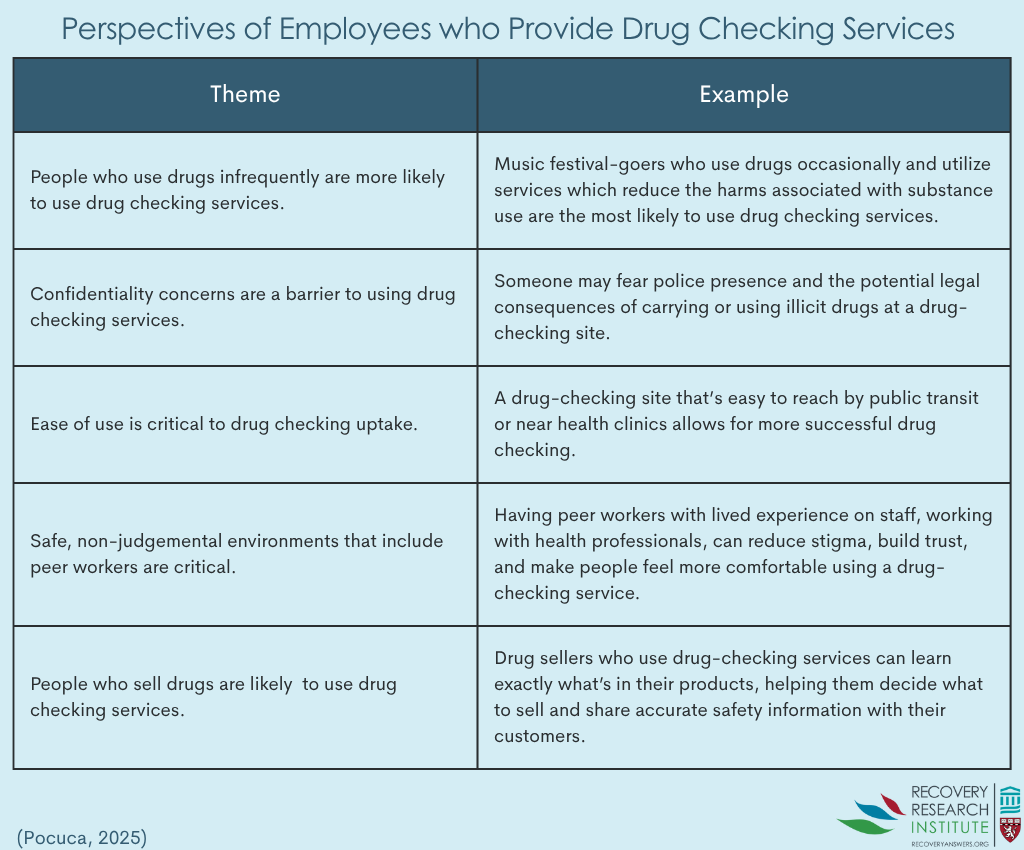
The study team identified 5 themes from coding the interviews (see graphic below). Two of the 5 themes involved who was more likely to use drug checking services – people who use drugs infrequently and people who sell drugs.
Participants consistently reported that people who use drugs infrequently, such as people who may use them recreationally at music festivals, were more likely to use drug checking services, as compared to people with drug use disorder. The prevalence and acceptance of services to reduce the harms associated with substance use in general and of drug checking in particular among people who use drugs at music festivals were discussed as possible explanations for this finding. Other possible explanations discussed by participants included (as compared to people who are dependent on drugs): (1) not having a consistent, reliable person to obtain drugs from, which may decrease their confidence and trust in the content and quality of the drugs; (2) having a lower tolerance, which may make them more susceptible to harmful consequences of consuming contaminated drugs; (3) having less experience and knowledge about drug use overall, which may prompt them to take more precautions; and (4) having more financial resources, which may increase the likelihood that they are willing to sacrifice a portion of their drugs for checking.
Further, participants noted that people who are dependent on drugs may have a higher urgency to use drugs to avoid withdrawal symptoms, which may make them less likely to delay use for checking. However, they also suggested that people who are dependent on drugs may be more likely to use drug checking services if certain barriers were removed, such as having them located as part of other services that they currently use.
People who sell drugs were also mentioned as a population who would be likely to use drug checking services, although this was not asked about specifically. Participants suggested this may be because such services would enable them to be informed about what they are selling and provide that information to their customers. This, in turn, can enable customers to make more informed decisions about what they are buying and consuming, and potentially improve the illicit drug market. Conversely, other participants thought that some people who sell drugs may use drug checking services to their own advantage, rather than their customers, by increasing the price of drugs that are pure and maximizing their profits.
Confidentiality concerns were a major barrier
The third theme identified by the study team involved confidentiality concerns as a major barrier to using drug checking services, with 20 of the 23 participants mentioning this barrier. They discussed how people who use drug checking services are primarily concerned about being targeted by the police and facing legal consequences. This was especially true for people who have had prior negative experiences with the police or have a history of frequent or dependent drug use. Participants also cited that people who use drug checking services fear being seen by other people using the services, particularly among people who use drugs less frequently.
Several participants, however, offered suggestions on how to address such confidentiality concerns. These included: (1) limiting the number of questions people accessing drug checking services are asked, or allowing them to use the services anonymously; (2) having private waiting areas and testing cubicles where people can enter in one door and leave through another, which would limit the amount of contact people using the services have with others; and (3) having drug checking services be located in a place where other health services are offered, so that there may be other reasons why someone is there.
Ease of use and providing a safe, non-judgmental environment were key facilitators
The remaining 2 themes identified by the study team involved the kind of the environments that facilitated the use of drug checking services – easy to use and safe/non-judgmental.
Participants discussed how ease of use was critical for facilitating the use of drug checking services. This included the importance of wait times, with 1 participant suggesting that the results would have to be instant because people will not want to wait to take the drugs. This also included having locations that were convenient, such as mobile sites near music festivals or fixed sites at locations where other health services are offered, and having locations that are easily accessible by public transportation or in places where people who use drugs go frequently.
Some participants further elaborated on having drug checking services located in places where other health services are offered. For instance, participants mentioned that having them located in places where other services to reduce the harms associated with substance use are offered, such as needle exchange services, would be appropriate. One benefit of this would be that people who are using drug checking services can also easily engage with these other services. However, there was also a concern raised that involved the stigma associated with injection drug use – people who do not inject drugs and only use drugs through other administration routes may not wish to be seen entering a facility where needle exchange services are offered.
The benefits and concerns of having drug checking services located within alcohol and drug addiction treatment centers were also discussed. While a benefit could be that it may make it easier for people who use drugs to access treatment programs, there was concern about the focus on abstinence that is typical of most treatment programs. Abstinence may not be the focus of people who want to use drug checking services and may therefore deter them.
Finally, participants discussed how ensuring that drug checking services are provided in a safe and non-judgmental environment is also critical for facilitating the use of these services. This included employing peer workers who have lived experience, which may reduce the amount of stigma and judgement that people who are accessing services may experience, increase their trust, and make them feel more comfortable. Given that people who use drugs may have had negative experiences with other healthcare workers, being able to engage with peers who have had similar experiences may be especially welcoming.
WHAT ARE THE IMPLICATIONS OF THE STUDY FINDINGS?
In this qualitative study, the research team interviewed employees of drug and alcohol organizations in Australia to explore their perspectives on drug checking services and categorized their responses into 5 themes. These themes involved the kind of people who are most likely to use drug checking services (i.e., people who use drugs infrequently and people who sell drugs); confidentiality concerns as a primary barrier to using drug checking services; and ease of use and providing a non-judgmental environment with peer workers as key facilitators.
These findings can help to improve implementation of drug checking services. For instance, understanding who is most likely to use drug checking services informs who service providers need to target more (e.g., people who are dependent on drugs). Further, addressing confidentiality concerns by, for example, allowing people to use services anonymously and providing services at a location where other health services are offered, would remove that barrier and improve access. Finally, ensuring ease of use (e.g., limiting wait times, having convenient locations accessible by public transportation) and a safe, non-judgmental environment (e.g., employing peer workers) can improve the likelihood of people who use drugs accessing drug checking services.
Additionally, this research builds on prior research that investigated how both clients and providers of drug checking services value and use drug checking services in the US. Findings of that study showed that clients and providers expressed uncertainty over how the results of drug checking would be used and other concerns, such as legal consequences, ease of use, and whether such services can make wide-scale impact. However, they both agreed that drug checking services offers people who use drugs valuable information about what is in their drugs, which fills a policy void by providing some regulation in the US that is otherwise absent.
The study was conducted among employees from 3 organizations in the Australian state of Canberra. Results may not generalize to other states in Australia where services to reduce the harms associated with substance use have not yet been legalized or are not yet mainstream, as well as other countries, especially those with more negative views on these services.
As with many qualitative studies, the study sample was small with just 23 participants, which further limits generalizability since the views expressed were from a small number of service providers.
Many of the participants did not have direct professional experience with drug checking services, although they had experience with other services to reduce the harms associated with substance use or treatment. The researchers provided participants with a description of drug checking services to help remedy this limitation.
BOTTOM LINE
People who use drugs infrequently and people who sell drugs were identified as groups of people who were most likely to use drug checking services. Confidentiality concerns were identified as a primary barrier to using drug checking services, while ease of use and providing a non-judgmental environment with peer workers were identified as key facilitators. These results help inform implementation of drug checking services, which may lead to increased access and could help save lives.
For individuals and families seeking recovery: This study showed that people who use drugs infrequently and people who sell drugs were most likely to use drug checking services, which suggests that people with drug use disorder may be less likely. Accordingly, friends and families of people with drug use disorder that encourage them to use drugs in less risky ways by taking advantage of drug checking services may help fill this access gap. Further, confidentiality concerns were a primary barrier to using drug checking services, while ease of use and providing a non-judgmental environment with peer workers were key facilitators. Friends and families of people who use drugs that are aware of these barriers and facilitators can either help their loved ones find ways around the confidentiality concern or locate services that this research has shown can increase the likelihood that they will access them.
For treatment professionals and treatment systems: The results from this study identified people who use drugs infrequently and people who sell drugs as groups of people who were most likely to use drug checking services, confidentiality concerns as a primary barrier to using these services, and ease of use and providing a non-judgmental environment with peer workers as key facilitators. These findings offer treatment professionals and systems actionable suggestions on how to improve the implementation of drug checking services. Accordingly, professionals who implement strategies suggested by the current study, such as targeting people who are less likely to use drug checking services (e.g., those with drug use disorder), addressing confidentiality concerns, and ensuring ease of use and a safe, non-judgmental environment may improve implementation, potentially increasing access and saving lives.
For scientists: Because the current study was small and constrained to 3 organizations in Australia, future research with larger samples and in other locations would shed light on the extent to which the results generalize. Additionally, the current study was qualitative, which limits any statistical inferences that can be made. While qualitative studies provide important insights that quantitative studies cannot, quantitative studies would help to further substantiate the findings with statistical conclusions. Finally, future studies with direct providers of drug checking services would help inform whether the results differ among providers who are more familiar with the intervention.
For policy makers: This study identified people who use drugs infrequently and people who sell drugs as groups of people who were most likely to use drug checking services, confidentiality concerns as a primary barrier to using these services, and ease of use and providing a non-judgmental environment with peer workers as key facilitators. Accordingly, policymakers who support policies that target people who may be less likely to use drug checking services (e.g., those with drug use disorder) may help expand access to a broader group of people who use drugs. Additionally, policymakers who support policies that address confidentiality concerns and promote ease of use along with a safe, non-judgmental environment may also increase the likelihood that drug checking services will be used. Finally, because fear of legal consequences were cited as part of the primary reason for confidentiality concerns, policymakers who support policies that promote legalization of approaches to reduce the harms associated with substance use may help address this barrier, potentially increasing access to drug checking services and saving lives.
Drug checking is a tool intended to prevent drug use-related harms that offers people who use drugs an opportunity to screen their drugs for substances they do not wish to consume. Given that the drug market is unregulated, screening drugs for unwanted and potentially harmful substances, such as fentanyl and xylazine, can help reduce the risk of accidental overdose and improve public health. This process involves submitting a very small amount of a drug (e.g., a scraping or one-tenth of a gram) for analysis of the contents and the results are then returned to the service user, which allows them to make an informed decision about whether they still wish to consume the drug.
Despite the potential public health benefits and research showing that as many as 94% of people who use drugs had the intention of using drug checking services if available, actual use remains low. The perspectives of employees who provide drug checking services can influence how they are implemented, which in turn can influence their use by people who use drugs. Accordingly, understanding their perspectives can help promote successful implementation of drug checking services and ultimately increase frequency of their use. Researchers in this study interviewed employees of Australian drug and alcohol organizations to explore their perspectives on drug checking. Such research can help identify who is most likely to use these services, as well as barriers and facilitators to use, which can help inform implementation efforts.
HOW WAS THIS STUDY CONDUCTED?
In this qualitative study, the researchers conducted interviews with staff employed at addiction treatment centers and programs designed to reduce drug use harms in Australia to examine their perspectives regarding the barriers and facilitators to the use of drug checking services by people who use drugs. Responses were qualitatively analyzed and categorized into themes.
Interviews were conducted between February and August 2023. During this time, there was 1 fixed-site drug checking service in operation and 2 trials that were being conducted at music festivals, all in the state of Canberra. Of note, drug checking services were legalized in Queensland in February 2023, but no sites had been opened yet in the state during the study period.
Participants were recruited via email from 3 non-profit organizations that provided either alcohol and drug addiction treatment or services to reduce the harms associated with substance use and other health services (e.g., syringe exchanges, naloxone distribution, drug checking) to people who use drugs. Employees were eligible to participate in the study if they worked directly with clients or have delivered drug checking services.
Participants first completed a survey online that lasted 15 minutes. They were then invited to participate in a longer semi-structured interview that ranged between approximately 20 and 50 minutes. During the interview, participants were asked about their work and experiences, their views on the likelihood that different types of people who use drugs would use drug checking services, their perspectives on barriers and facilitators to using drug checking services, and their feelings on drug checking services being located at different places than treatment services. Participants were compensated $20 for their time.
Interviews were recorded and transcribed. Data were then analyzed using standard qualitative methods and a codebook that was developed by one of the study team members, who then categorized the data into preliminary themes. These themes were reviewed and revised by 2 other study team members to develop the final themes.
In total, 23 employees were interviewed. Among these, 14 identified as women and their average age was 39 years old. Approximately half held a bachelor’s degree, and 9 participants held a post-graduate degree. Three participants reported that they had professional experience with drug checking.
WHAT DID THIS STUDY FIND?
People who use drugs infrequently and who sell drugs are likely to use drug services
The study team identified 5 themes from coding the interviews (see graphic below). Two of the 5 themes involved who was more likely to use drug checking services – people who use drugs infrequently and people who sell drugs.
Participants consistently reported that people who use drugs infrequently, such as people who may use them recreationally at music festivals, were more likely to use drug checking services, as compared to people with drug use disorder. The prevalence and acceptance of services to reduce the harms associated with substance use in general and of drug checking in particular among people who use drugs at music festivals were discussed as possible explanations for this finding. Other possible explanations discussed by participants included (as compared to people who are dependent on drugs): (1) not having a consistent, reliable person to obtain drugs from, which may decrease their confidence and trust in the content and quality of the drugs; (2) having a lower tolerance, which may make them more susceptible to harmful consequences of consuming contaminated drugs; (3) having less experience and knowledge about drug use overall, which may prompt them to take more precautions; and (4) having more financial resources, which may increase the likelihood that they are willing to sacrifice a portion of their drugs for checking.
Further, participants noted that people who are dependent on drugs may have a higher urgency to use drugs to avoid withdrawal symptoms, which may make them less likely to delay use for checking. However, they also suggested that people who are dependent on drugs may be more likely to use drug checking services if certain barriers were removed, such as having them located as part of other services that they currently use.
People who sell drugs were also mentioned as a population who would be likely to use drug checking services, although this was not asked about specifically. Participants suggested this may be because such services would enable them to be informed about what they are selling and provide that information to their customers. This, in turn, can enable customers to make more informed decisions about what they are buying and consuming, and potentially improve the illicit drug market. Conversely, other participants thought that some people who sell drugs may use drug checking services to their own advantage, rather than their customers, by increasing the price of drugs that are pure and maximizing their profits.
Confidentiality concerns were a major barrier
The third theme identified by the study team involved confidentiality concerns as a major barrier to using drug checking services, with 20 of the 23 participants mentioning this barrier. They discussed how people who use drug checking services are primarily concerned about being targeted by the police and facing legal consequences. This was especially true for people who have had prior negative experiences with the police or have a history of frequent or dependent drug use. Participants also cited that people who use drug checking services fear being seen by other people using the services, particularly among people who use drugs less frequently.
Several participants, however, offered suggestions on how to address such confidentiality concerns. These included: (1) limiting the number of questions people accessing drug checking services are asked, or allowing them to use the services anonymously; (2) having private waiting areas and testing cubicles where people can enter in one door and leave through another, which would limit the amount of contact people using the services have with others; and (3) having drug checking services be located in a place where other health services are offered, so that there may be other reasons why someone is there.
Ease of use and providing a safe, non-judgmental environment were key facilitators
The remaining 2 themes identified by the study team involved the kind of the environments that facilitated the use of drug checking services – easy to use and safe/non-judgmental.
Participants discussed how ease of use was critical for facilitating the use of drug checking services. This included the importance of wait times, with 1 participant suggesting that the results would have to be instant because people will not want to wait to take the drugs. This also included having locations that were convenient, such as mobile sites near music festivals or fixed sites at locations where other health services are offered, and having locations that are easily accessible by public transportation or in places where people who use drugs go frequently.
Some participants further elaborated on having drug checking services located in places where other health services are offered. For instance, participants mentioned that having them located in places where other services to reduce the harms associated with substance use are offered, such as needle exchange services, would be appropriate. One benefit of this would be that people who are using drug checking services can also easily engage with these other services. However, there was also a concern raised that involved the stigma associated with injection drug use – people who do not inject drugs and only use drugs through other administration routes may not wish to be seen entering a facility where needle exchange services are offered.
The benefits and concerns of having drug checking services located within alcohol and drug addiction treatment centers were also discussed. While a benefit could be that it may make it easier for people who use drugs to access treatment programs, there was concern about the focus on abstinence that is typical of most treatment programs. Abstinence may not be the focus of people who want to use drug checking services and may therefore deter them.
Finally, participants discussed how ensuring that drug checking services are provided in a safe and non-judgmental environment is also critical for facilitating the use of these services. This included employing peer workers who have lived experience, which may reduce the amount of stigma and judgement that people who are accessing services may experience, increase their trust, and make them feel more comfortable. Given that people who use drugs may have had negative experiences with other healthcare workers, being able to engage with peers who have had similar experiences may be especially welcoming.
WHAT ARE THE IMPLICATIONS OF THE STUDY FINDINGS?
In this qualitative study, the research team interviewed employees of drug and alcohol organizations in Australia to explore their perspectives on drug checking services and categorized their responses into 5 themes. These themes involved the kind of people who are most likely to use drug checking services (i.e., people who use drugs infrequently and people who sell drugs); confidentiality concerns as a primary barrier to using drug checking services; and ease of use and providing a non-judgmental environment with peer workers as key facilitators.
These findings can help to improve implementation of drug checking services. For instance, understanding who is most likely to use drug checking services informs who service providers need to target more (e.g., people who are dependent on drugs). Further, addressing confidentiality concerns by, for example, allowing people to use services anonymously and providing services at a location where other health services are offered, would remove that barrier and improve access. Finally, ensuring ease of use (e.g., limiting wait times, having convenient locations accessible by public transportation) and a safe, non-judgmental environment (e.g., employing peer workers) can improve the likelihood of people who use drugs accessing drug checking services.
Additionally, this research builds on prior research that investigated how both clients and providers of drug checking services value and use drug checking services in the US. Findings of that study showed that clients and providers expressed uncertainty over how the results of drug checking would be used and other concerns, such as legal consequences, ease of use, and whether such services can make wide-scale impact. However, they both agreed that drug checking services offers people who use drugs valuable information about what is in their drugs, which fills a policy void by providing some regulation in the US that is otherwise absent.
The study was conducted among employees from 3 organizations in the Australian state of Canberra. Results may not generalize to other states in Australia where services to reduce the harms associated with substance use have not yet been legalized or are not yet mainstream, as well as other countries, especially those with more negative views on these services.
As with many qualitative studies, the study sample was small with just 23 participants, which further limits generalizability since the views expressed were from a small number of service providers.
Many of the participants did not have direct professional experience with drug checking services, although they had experience with other services to reduce the harms associated with substance use or treatment. The researchers provided participants with a description of drug checking services to help remedy this limitation.
BOTTOM LINE
People who use drugs infrequently and people who sell drugs were identified as groups of people who were most likely to use drug checking services. Confidentiality concerns were identified as a primary barrier to using drug checking services, while ease of use and providing a non-judgmental environment with peer workers were identified as key facilitators. These results help inform implementation of drug checking services, which may lead to increased access and could help save lives.
For individuals and families seeking recovery: This study showed that people who use drugs infrequently and people who sell drugs were most likely to use drug checking services, which suggests that people with drug use disorder may be less likely. Accordingly, friends and families of people with drug use disorder that encourage them to use drugs in less risky ways by taking advantage of drug checking services may help fill this access gap. Further, confidentiality concerns were a primary barrier to using drug checking services, while ease of use and providing a non-judgmental environment with peer workers were key facilitators. Friends and families of people who use drugs that are aware of these barriers and facilitators can either help their loved ones find ways around the confidentiality concern or locate services that this research has shown can increase the likelihood that they will access them.
For treatment professionals and treatment systems: The results from this study identified people who use drugs infrequently and people who sell drugs as groups of people who were most likely to use drug checking services, confidentiality concerns as a primary barrier to using these services, and ease of use and providing a non-judgmental environment with peer workers as key facilitators. These findings offer treatment professionals and systems actionable suggestions on how to improve the implementation of drug checking services. Accordingly, professionals who implement strategies suggested by the current study, such as targeting people who are less likely to use drug checking services (e.g., those with drug use disorder), addressing confidentiality concerns, and ensuring ease of use and a safe, non-judgmental environment may improve implementation, potentially increasing access and saving lives.
For scientists: Because the current study was small and constrained to 3 organizations in Australia, future research with larger samples and in other locations would shed light on the extent to which the results generalize. Additionally, the current study was qualitative, which limits any statistical inferences that can be made. While qualitative studies provide important insights that quantitative studies cannot, quantitative studies would help to further substantiate the findings with statistical conclusions. Finally, future studies with direct providers of drug checking services would help inform whether the results differ among providers who are more familiar with the intervention.
For policy makers: This study identified people who use drugs infrequently and people who sell drugs as groups of people who were most likely to use drug checking services, confidentiality concerns as a primary barrier to using these services, and ease of use and providing a non-judgmental environment with peer workers as key facilitators. Accordingly, policymakers who support policies that target people who may be less likely to use drug checking services (e.g., those with drug use disorder) may help expand access to a broader group of people who use drugs. Additionally, policymakers who support policies that address confidentiality concerns and promote ease of use along with a safe, non-judgmental environment may also increase the likelihood that drug checking services will be used. Finally, because fear of legal consequences were cited as part of the primary reason for confidentiality concerns, policymakers who support policies that promote legalization of approaches to reduce the harms associated with substance use may help address this barrier, potentially increasing access to drug checking services and saving lives.
Drug checking is a tool intended to prevent drug use-related harms that offers people who use drugs an opportunity to screen their drugs for substances they do not wish to consume. Given that the drug market is unregulated, screening drugs for unwanted and potentially harmful substances, such as fentanyl and xylazine, can help reduce the risk of accidental overdose and improve public health. This process involves submitting a very small amount of a drug (e.g., a scraping or one-tenth of a gram) for analysis of the contents and the results are then returned to the service user, which allows them to make an informed decision about whether they still wish to consume the drug.
Despite the potential public health benefits and research showing that as many as 94% of people who use drugs had the intention of using drug checking services if available, actual use remains low. The perspectives of employees who provide drug checking services can influence how they are implemented, which in turn can influence their use by people who use drugs. Accordingly, understanding their perspectives can help promote successful implementation of drug checking services and ultimately increase frequency of their use. Researchers in this study interviewed employees of Australian drug and alcohol organizations to explore their perspectives on drug checking. Such research can help identify who is most likely to use these services, as well as barriers and facilitators to use, which can help inform implementation efforts.
HOW WAS THIS STUDY CONDUCTED?
In this qualitative study, the researchers conducted interviews with staff employed at addiction treatment centers and programs designed to reduce drug use harms in Australia to examine their perspectives regarding the barriers and facilitators to the use of drug checking services by people who use drugs. Responses were qualitatively analyzed and categorized into themes.
Interviews were conducted between February and August 2023. During this time, there was 1 fixed-site drug checking service in operation and 2 trials that were being conducted at music festivals, all in the state of Canberra. Of note, drug checking services were legalized in Queensland in February 2023, but no sites had been opened yet in the state during the study period.
Participants were recruited via email from 3 non-profit organizations that provided either alcohol and drug addiction treatment or services to reduce the harms associated with substance use and other health services (e.g., syringe exchanges, naloxone distribution, drug checking) to people who use drugs. Employees were eligible to participate in the study if they worked directly with clients or have delivered drug checking services.
Participants first completed a survey online that lasted 15 minutes. They were then invited to participate in a longer semi-structured interview that ranged between approximately 20 and 50 minutes. During the interview, participants were asked about their work and experiences, their views on the likelihood that different types of people who use drugs would use drug checking services, their perspectives on barriers and facilitators to using drug checking services, and their feelings on drug checking services being located at different places than treatment services. Participants were compensated $20 for their time.
Interviews were recorded and transcribed. Data were then analyzed using standard qualitative methods and a codebook that was developed by one of the study team members, who then categorized the data into preliminary themes. These themes were reviewed and revised by 2 other study team members to develop the final themes.
In total, 23 employees were interviewed. Among these, 14 identified as women and their average age was 39 years old. Approximately half held a bachelor’s degree, and 9 participants held a post-graduate degree. Three participants reported that they had professional experience with drug checking.
WHAT DID THIS STUDY FIND?
People who use drugs infrequently and who sell drugs are likely to use drug services
The study team identified 5 themes from coding the interviews (see graphic below). Two of the 5 themes involved who was more likely to use drug checking services – people who use drugs infrequently and people who sell drugs.
Participants consistently reported that people who use drugs infrequently, such as people who may use them recreationally at music festivals, were more likely to use drug checking services, as compared to people with drug use disorder. The prevalence and acceptance of services to reduce the harms associated with substance use in general and of drug checking in particular among people who use drugs at music festivals were discussed as possible explanations for this finding. Other possible explanations discussed by participants included (as compared to people who are dependent on drugs): (1) not having a consistent, reliable person to obtain drugs from, which may decrease their confidence and trust in the content and quality of the drugs; (2) having a lower tolerance, which may make them more susceptible to harmful consequences of consuming contaminated drugs; (3) having less experience and knowledge about drug use overall, which may prompt them to take more precautions; and (4) having more financial resources, which may increase the likelihood that they are willing to sacrifice a portion of their drugs for checking.
Further, participants noted that people who are dependent on drugs may have a higher urgency to use drugs to avoid withdrawal symptoms, which may make them less likely to delay use for checking. However, they also suggested that people who are dependent on drugs may be more likely to use drug checking services if certain barriers were removed, such as having them located as part of other services that they currently use.
People who sell drugs were also mentioned as a population who would be likely to use drug checking services, although this was not asked about specifically. Participants suggested this may be because such services would enable them to be informed about what they are selling and provide that information to their customers. This, in turn, can enable customers to make more informed decisions about what they are buying and consuming, and potentially improve the illicit drug market. Conversely, other participants thought that some people who sell drugs may use drug checking services to their own advantage, rather than their customers, by increasing the price of drugs that are pure and maximizing their profits.
Confidentiality concerns were a major barrier
The third theme identified by the study team involved confidentiality concerns as a major barrier to using drug checking services, with 20 of the 23 participants mentioning this barrier. They discussed how people who use drug checking services are primarily concerned about being targeted by the police and facing legal consequences. This was especially true for people who have had prior negative experiences with the police or have a history of frequent or dependent drug use. Participants also cited that people who use drug checking services fear being seen by other people using the services, particularly among people who use drugs less frequently.
Several participants, however, offered suggestions on how to address such confidentiality concerns. These included: (1) limiting the number of questions people accessing drug checking services are asked, or allowing them to use the services anonymously; (2) having private waiting areas and testing cubicles where people can enter in one door and leave through another, which would limit the amount of contact people using the services have with others; and (3) having drug checking services be located in a place where other health services are offered, so that there may be other reasons why someone is there.
Ease of use and providing a safe, non-judgmental environment were key facilitators
The remaining 2 themes identified by the study team involved the kind of the environments that facilitated the use of drug checking services – easy to use and safe/non-judgmental.
Participants discussed how ease of use was critical for facilitating the use of drug checking services. This included the importance of wait times, with 1 participant suggesting that the results would have to be instant because people will not want to wait to take the drugs. This also included having locations that were convenient, such as mobile sites near music festivals or fixed sites at locations where other health services are offered, and having locations that are easily accessible by public transportation or in places where people who use drugs go frequently.
Some participants further elaborated on having drug checking services located in places where other health services are offered. For instance, participants mentioned that having them located in places where other services to reduce the harms associated with substance use are offered, such as needle exchange services, would be appropriate. One benefit of this would be that people who are using drug checking services can also easily engage with these other services. However, there was also a concern raised that involved the stigma associated with injection drug use – people who do not inject drugs and only use drugs through other administration routes may not wish to be seen entering a facility where needle exchange services are offered.
The benefits and concerns of having drug checking services located within alcohol and drug addiction treatment centers were also discussed. While a benefit could be that it may make it easier for people who use drugs to access treatment programs, there was concern about the focus on abstinence that is typical of most treatment programs. Abstinence may not be the focus of people who want to use drug checking services and may therefore deter them.
Finally, participants discussed how ensuring that drug checking services are provided in a safe and non-judgmental environment is also critical for facilitating the use of these services. This included employing peer workers who have lived experience, which may reduce the amount of stigma and judgement that people who are accessing services may experience, increase their trust, and make them feel more comfortable. Given that people who use drugs may have had negative experiences with other healthcare workers, being able to engage with peers who have had similar experiences may be especially welcoming.
WHAT ARE THE IMPLICATIONS OF THE STUDY FINDINGS?
In this qualitative study, the research team interviewed employees of drug and alcohol organizations in Australia to explore their perspectives on drug checking services and categorized their responses into 5 themes. These themes involved the kind of people who are most likely to use drug checking services (i.e., people who use drugs infrequently and people who sell drugs); confidentiality concerns as a primary barrier to using drug checking services; and ease of use and providing a non-judgmental environment with peer workers as key facilitators.
These findings can help to improve implementation of drug checking services. For instance, understanding who is most likely to use drug checking services informs who service providers need to target more (e.g., people who are dependent on drugs). Further, addressing confidentiality concerns by, for example, allowing people to use services anonymously and providing services at a location where other health services are offered, would remove that barrier and improve access. Finally, ensuring ease of use (e.g., limiting wait times, having convenient locations accessible by public transportation) and a safe, non-judgmental environment (e.g., employing peer workers) can improve the likelihood of people who use drugs accessing drug checking services.
Additionally, this research builds on prior research that investigated how both clients and providers of drug checking services value and use drug checking services in the US. Findings of that study showed that clients and providers expressed uncertainty over how the results of drug checking would be used and other concerns, such as legal consequences, ease of use, and whether such services can make wide-scale impact. However, they both agreed that drug checking services offers people who use drugs valuable information about what is in their drugs, which fills a policy void by providing some regulation in the US that is otherwise absent.
The study was conducted among employees from 3 organizations in the Australian state of Canberra. Results may not generalize to other states in Australia where services to reduce the harms associated with substance use have not yet been legalized or are not yet mainstream, as well as other countries, especially those with more negative views on these services.
As with many qualitative studies, the study sample was small with just 23 participants, which further limits generalizability since the views expressed were from a small number of service providers.
Many of the participants did not have direct professional experience with drug checking services, although they had experience with other services to reduce the harms associated with substance use or treatment. The researchers provided participants with a description of drug checking services to help remedy this limitation.
BOTTOM LINE
People who use drugs infrequently and people who sell drugs were identified as groups of people who were most likely to use drug checking services. Confidentiality concerns were identified as a primary barrier to using drug checking services, while ease of use and providing a non-judgmental environment with peer workers were identified as key facilitators. These results help inform implementation of drug checking services, which may lead to increased access and could help save lives.
For individuals and families seeking recovery: This study showed that people who use drugs infrequently and people who sell drugs were most likely to use drug checking services, which suggests that people with drug use disorder may be less likely. Accordingly, friends and families of people with drug use disorder that encourage them to use drugs in less risky ways by taking advantage of drug checking services may help fill this access gap. Further, confidentiality concerns were a primary barrier to using drug checking services, while ease of use and providing a non-judgmental environment with peer workers were key facilitators. Friends and families of people who use drugs that are aware of these barriers and facilitators can either help their loved ones find ways around the confidentiality concern or locate services that this research has shown can increase the likelihood that they will access them.
For treatment professionals and treatment systems: The results from this study identified people who use drugs infrequently and people who sell drugs as groups of people who were most likely to use drug checking services, confidentiality concerns as a primary barrier to using these services, and ease of use and providing a non-judgmental environment with peer workers as key facilitators. These findings offer treatment professionals and systems actionable suggestions on how to improve the implementation of drug checking services. Accordingly, professionals who implement strategies suggested by the current study, such as targeting people who are less likely to use drug checking services (e.g., those with drug use disorder), addressing confidentiality concerns, and ensuring ease of use and a safe, non-judgmental environment may improve implementation, potentially increasing access and saving lives.
For scientists: Because the current study was small and constrained to 3 organizations in Australia, future research with larger samples and in other locations would shed light on the extent to which the results generalize. Additionally, the current study was qualitative, which limits any statistical inferences that can be made. While qualitative studies provide important insights that quantitative studies cannot, quantitative studies would help to further substantiate the findings with statistical conclusions. Finally, future studies with direct providers of drug checking services would help inform whether the results differ among providers who are more familiar with the intervention.
For policy makers: This study identified people who use drugs infrequently and people who sell drugs as groups of people who were most likely to use drug checking services, confidentiality concerns as a primary barrier to using these services, and ease of use and providing a non-judgmental environment with peer workers as key facilitators. Accordingly, policymakers who support policies that target people who may be less likely to use drug checking services (e.g., those with drug use disorder) may help expand access to a broader group of people who use drugs. Additionally, policymakers who support policies that address confidentiality concerns and promote ease of use along with a safe, non-judgmental environment may also increase the likelihood that drug checking services will be used. Finally, because fear of legal consequences were cited as part of the primary reason for confidentiality concerns, policymakers who support policies that promote legalization of approaches to reduce the harms associated with substance use may help address this barrier, potentially increasing access to drug checking services and saving lives.