Just breathe: Heart rate variability biofeedback may help prevent relapse to substance use among those seeking treatment
Stress and other negative emotions can increase risk for relapse, in part because they may cause reactions in the body that bypass someone’s awareness. Can a simple breathing technique called “heart rate variability biofeedback” reduce the impact of negative emotional experience and craving on substance use among people attempting remission from a substance use disorder?
For people with substance use disorder trying to stop or cut down, unpleasant emotional states such as sadness, anxiety, or stress may serve as potent triggers that could lead to return to substance use. In some cases, these triggers may lead to substance use in a way that seems almost automatic, bypassing the individual’s awareness and ability to cope. This is in part because negative affective states can lead to automatic reactions in the body at the biological level that bypass psychological awareness.
Researchers have begun to explore the possibility that interventions which can influence these reactions may help reduce rates of return to use among people making a change. One such intervention is conceptually simple: a slow, rhythmic breathing, typically around 5-6 breathes per minute, known as resonance frequency breathing. This breathing strategy is thought to align one’s heart rate and breathing to maximize heart rate variability, a biological indicator of good cardiovascular fitness and resilience against stress. In a therapeutic approach known as heart rate variability biofeedback, a person can learn proper resonance frequency breathing by observing changes to their heart rate variability.
Advances in technology have led to lightweight biosensors that can measure heart rate variability and show the results on a phone, making this easier to practice in everyday life and during situations in which body reactions are most likely, such as during moments of high intensity stress.
In the current study, researchers tested the efficacy of a wearable heart rate variability device to reduce negative emotion, craving, and substance use within a sample of people attempting remission from a substance use disorder.
HOW WAS THIS STUDY CONDUCTED?
The current study was a Phase 2 randomized clinical trial testing the efficacy of heart rate variability biofeedback among 115 people who were in their first year of a recovery attempt focused on stopping alcohol or other drug use completely. Participants were US residents over the age of 18 who wanted to stop drinking/using drugs. They were recruited and randomized to one of two conditions. In the first condition, heart rate variability biofeedback, participants were asked to wear a “Smart Patch” for at least 8 hours per day for 8 weeks. Participants were asked to practice resonance frequency breathing using the heart rate variability biofeedback at least twice a day for at least 5 minutes during each practice session. Participants were then asked to use it for 5 minutes in response to craving or unpleasant emotions such as stress, and as needed. In the second condition, they did not receive the “Smart Patch” or instructions to practice resonance frequency breathing (i.e., no heart rate variability biofeedback). Participants could be attending professional treatment and/or recovery support services independently, though this was not part of the trial. For example, 5% of participants in the biofeedback condition, and 15% of participants in the no biofeedback condition, were taking an alcohol use disorder medication during the trial. Analyses did not control statistically for these differences in treatments received across conditions.
All participants completed a baseline survey prior to randomization and then completed brief surveys twice per day during the 8 weeks of treatment. Surveys included questions about negative emotional experience (i.e., negative affect), positive emotional experience (i.e., positive affect), craving, and alcohol or other drug use. Heart rate variability biofeedback practice was automatically logged by the device. The researchers wanted to know how positive affect (0 to 10), negative affect (0 to 10), and craving (0 to 10) changed over time across each of the two study groups. The researchers also wanted to know whether treatment condition moderated the association between craving and alcohol or other drug use later in the day. In other words, the researchers were interested in knowing if the heart rate variability biofeedback procedures reduced craving and risk of relapse to alcohol/drug use compared to the group that did not receive biofeedback.
The sample was approximately 46 years of age, on average, and mostly female (60%). The sample was primarily White (82.6%), most were employed (72.2%), and only 4.4% had less than a high school degree. Most participants met criteria for severe substance use disorder (94.8%). Alcohol was the primary substance for just over half of the sample (61%).
WHAT DID THIS STUDY FIND?
Participants engaged moderately with the heart rate variability biofeedback intervention
Participants practiced for an average of 9 minutes per day, with approximately 7 minutes representing self-initiated practice, and 2 minutes representing practice initiated by the device when autonomic arousal was detected. Participants completed the recommended 15 minutes of practice for almost 2 of the 8 weeks, and 24% of all participants completed 15 minutes of practice on at least half of the days. The researchers did not find an effect of the amount of practice on frequency of alcohol or other drug use.
Craving and negative affect reduced in the heart rate variability biofeedback condition
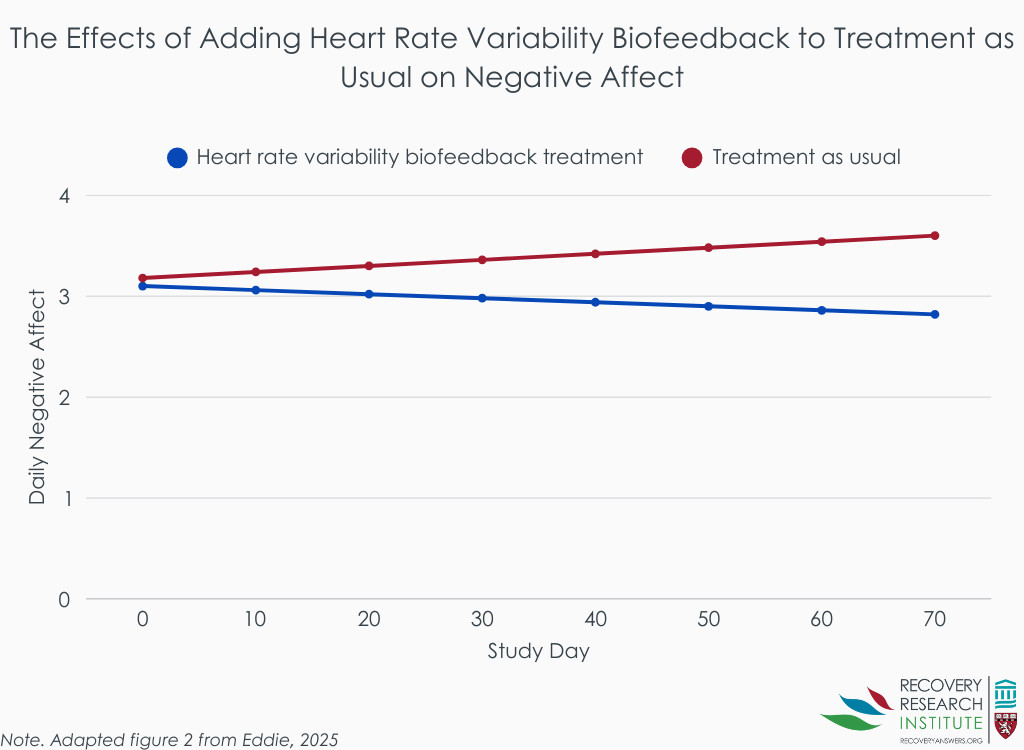
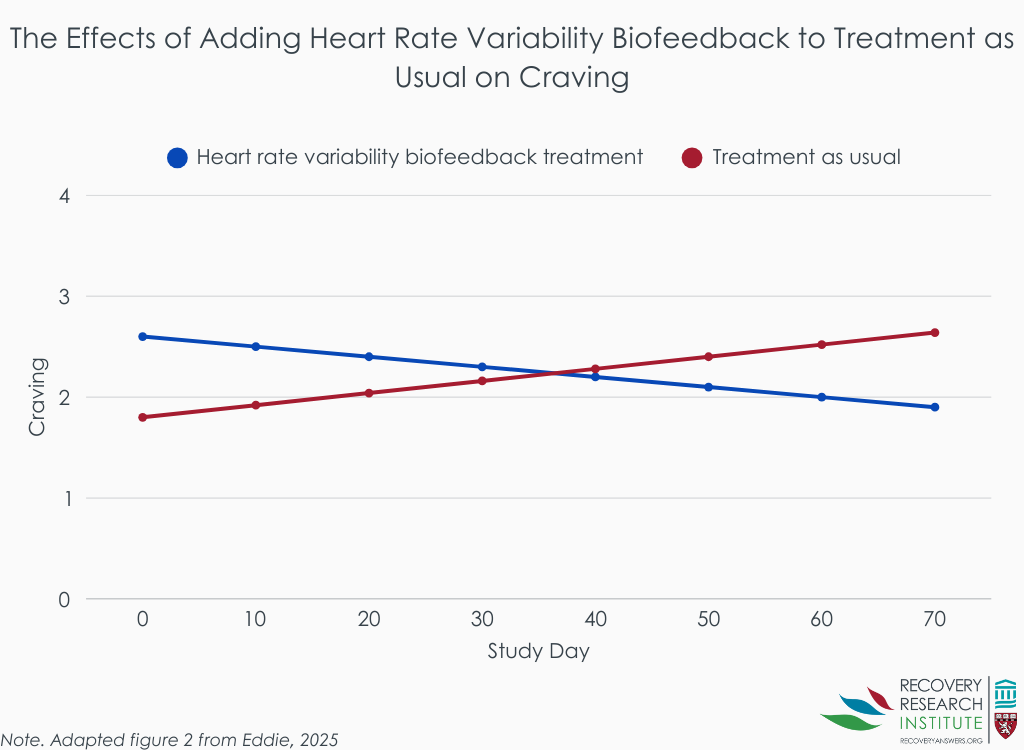
As shown in the graph below, in the comparison condition, negative affect increased over the course of the study. However, negative affect decreased in the heart rate variability biofeedback condition. Likewise, as shown in the second graph below, craving increased in the comparison condition across the study period but decreased in the heart rate variability biofeedback condition. Participants in the heart rate variability biofeedback group reported lower alcohol or other drug use overall across the study period compared to those in the comparison condition; however, this was not found to change over time, suggesting that those in the heart rate variability biofeedback group started the study using less alcohol or other drugs than participants in the other group and that this difference remained across the study period. There was no association between condition and positive affect.
Heart rate variability biofeedback interrupted the impact of craving on later drug use
The researchers also examined if the impact of craving on alcohol or other drug use later in the day was different between each group. The researchers examined this because heart rate variability biofeedback is hypothesized to reduce the body’s reaction to stress such that the individual has greater cognitive control. The researchers found that, in the heart rate variability biofeedback condition, higher craving was associated with a lower likelihood of future drinking compared to those in the comparison group. The association between craving and later alcohol or other drug use did not depend on amount of heart rate variability biofeedback practice time.
WHAT ARE THE IMPLICATIONS OF THE STUDY FINDINGS?
This was a study of people in their first year of recovery receiving a variety of services (or no services) randomized to receive heart rate variability biofeedback or not. The heart rate variability biofeedback group reduced their craving and negative affect; the intervention may interrupt the pathway from craving to substance use. This is promising because individuals only practiced for approximately 10 minutes per day yet experienced less craving and negative affect over time. It is unclear why the intervention reduced negative affect and stress over the course of the trial, but not substance use – this was lower in the intervention but started out that way and did not change during the trial. Because there was no breathing placebo condition, we do not know whether the presumed active ingredient of the intervention – the specific breathing technique – caused the better outcomes or if any breathing technique would serve that purpose. Nevertheless, this low barrier intervention thus may be a useful tool for individuals in recovery. In particular, training intended for use of resonance frequency breathing during acute moments of craving may lead to reductions in substance use. The heart rate variability biofeedback did not, however, impact positive affect, suggesting that those who use substances to increase positive affect, rather than to decrease negative affect, may receive less benefit. Even so, these results highlight a promising new clinical approach that is accessible via smartphone, and available for use outside of the clinic in real world situations of stress that can reduce the impact stress may have on cravings and subsequent alcohol and other drug use.
The smaller sample size limits the amount of sub-group analyses that can be conducted, and we don’t know whether these effects are the same across all people or if some people may benefit more than others.
There was no breathing placebo (i.e., another breathing technique), so it is not possible to tell whether the changes are due to the biofeedback or the strategy to calm oneself down with paced breathing more generally.
BOTTOM LINE
Among people meeting criteria for substance use disorder who are trying to quit, heart rate variability biofeedback appears to be somewhat helpful in reducing craving and negative affect, and possibly alcohol and other drug use, and may interrupt the pathway from craving to substance use. This is promising because it did not seem to take much engagement in doing this to see this benefit – individuals only practiced for approximately 10 minutes per day, yet experienced less craving and negative affect over time. This low barrier intervention thus may be a useful tool for individuals in recovery. In particular, training intended for use of resonance frequency breathing during acute moments of craving may lead to reductions in substance use. The heart rate variability biofeedback did not, however, impact positive affect, suggesting that those who use substances to increase positive affect, rather than to decrease negative affect, may receive less benefit.
For individuals and families seeking recovery: If you are looking for additional tools to help you on your recovery journey, you may consider exploring options such as heart rate variability biofeedback. If you cannot find a provider who can train you in this approach, it may be possible to start this journey by learning resonance frequency breathing. Breathing techniques alone may improve your awareness of negative affect and craving and create space to find a more productive coping mechanism. However, heart rate variability biofeedback may ensure that the resonance frequency breathing is effectively impacting your heart rate variability, and as such may be slightly more impactful than breath work alone.
For treatment professionals and treatment systems: In some cases, your patients may experience high levels of stress or negative affect that have the potential to lead to automatic reactions in the body that ultimately cause alcohol or other drug use. Heart rate variability biofeedback may be a novel tool to deploy for populations who are most likely to experience this. Even if biofeedback is not available, practicing resonance frequency breathing or using other deep breathing relaxation strategies may provide patients with a new technique to try in stressful moments.
For scientists: Although these initial results are promising, it is unclear whether this intervention may work equally well for all people. For example, those who use substances to increase positive affect, or for some reason other than to manage negative affect, may not experience as many benefits from engaging in heart rate variability biofeedback. Future studies with a larger sample may investigate these types of questions, specifically focusing on moderation effects to determine when these interventions work and for whom.
For policy makers: Heart-rate variability biofeedback is a low barrier intervention accessible via smartphone and may be a useful adjunct for people trying to cut down or quit substance use. Policies that fund research on this novel approach, or create legislation that make access easier to approaches like these, may result in substantive public health benefits over time.
For people with substance use disorder trying to stop or cut down, unpleasant emotional states such as sadness, anxiety, or stress may serve as potent triggers that could lead to return to substance use. In some cases, these triggers may lead to substance use in a way that seems almost automatic, bypassing the individual’s awareness and ability to cope. This is in part because negative affective states can lead to automatic reactions in the body at the biological level that bypass psychological awareness.
Researchers have begun to explore the possibility that interventions which can influence these reactions may help reduce rates of return to use among people making a change. One such intervention is conceptually simple: a slow, rhythmic breathing, typically around 5-6 breathes per minute, known as resonance frequency breathing. This breathing strategy is thought to align one’s heart rate and breathing to maximize heart rate variability, a biological indicator of good cardiovascular fitness and resilience against stress. In a therapeutic approach known as heart rate variability biofeedback, a person can learn proper resonance frequency breathing by observing changes to their heart rate variability.
Advances in technology have led to lightweight biosensors that can measure heart rate variability and show the results on a phone, making this easier to practice in everyday life and during situations in which body reactions are most likely, such as during moments of high intensity stress.
In the current study, researchers tested the efficacy of a wearable heart rate variability device to reduce negative emotion, craving, and substance use within a sample of people attempting remission from a substance use disorder.
HOW WAS THIS STUDY CONDUCTED?
The current study was a Phase 2 randomized clinical trial testing the efficacy of heart rate variability biofeedback among 115 people who were in their first year of a recovery attempt focused on stopping alcohol or other drug use completely. Participants were US residents over the age of 18 who wanted to stop drinking/using drugs. They were recruited and randomized to one of two conditions. In the first condition, heart rate variability biofeedback, participants were asked to wear a “Smart Patch” for at least 8 hours per day for 8 weeks. Participants were asked to practice resonance frequency breathing using the heart rate variability biofeedback at least twice a day for at least 5 minutes during each practice session. Participants were then asked to use it for 5 minutes in response to craving or unpleasant emotions such as stress, and as needed. In the second condition, they did not receive the “Smart Patch” or instructions to practice resonance frequency breathing (i.e., no heart rate variability biofeedback). Participants could be attending professional treatment and/or recovery support services independently, though this was not part of the trial. For example, 5% of participants in the biofeedback condition, and 15% of participants in the no biofeedback condition, were taking an alcohol use disorder medication during the trial. Analyses did not control statistically for these differences in treatments received across conditions.
All participants completed a baseline survey prior to randomization and then completed brief surveys twice per day during the 8 weeks of treatment. Surveys included questions about negative emotional experience (i.e., negative affect), positive emotional experience (i.e., positive affect), craving, and alcohol or other drug use. Heart rate variability biofeedback practice was automatically logged by the device. The researchers wanted to know how positive affect (0 to 10), negative affect (0 to 10), and craving (0 to 10) changed over time across each of the two study groups. The researchers also wanted to know whether treatment condition moderated the association between craving and alcohol or other drug use later in the day. In other words, the researchers were interested in knowing if the heart rate variability biofeedback procedures reduced craving and risk of relapse to alcohol/drug use compared to the group that did not receive biofeedback.
The sample was approximately 46 years of age, on average, and mostly female (60%). The sample was primarily White (82.6%), most were employed (72.2%), and only 4.4% had less than a high school degree. Most participants met criteria for severe substance use disorder (94.8%). Alcohol was the primary substance for just over half of the sample (61%).
WHAT DID THIS STUDY FIND?
Participants engaged moderately with the heart rate variability biofeedback intervention
Participants practiced for an average of 9 minutes per day, with approximately 7 minutes representing self-initiated practice, and 2 minutes representing practice initiated by the device when autonomic arousal was detected. Participants completed the recommended 15 minutes of practice for almost 2 of the 8 weeks, and 24% of all participants completed 15 minutes of practice on at least half of the days. The researchers did not find an effect of the amount of practice on frequency of alcohol or other drug use.
Craving and negative affect reduced in the heart rate variability biofeedback condition
As shown in the graph below, in the comparison condition, negative affect increased over the course of the study. However, negative affect decreased in the heart rate variability biofeedback condition. Likewise, as shown in the second graph below, craving increased in the comparison condition across the study period but decreased in the heart rate variability biofeedback condition. Participants in the heart rate variability biofeedback group reported lower alcohol or other drug use overall across the study period compared to those in the comparison condition; however, this was not found to change over time, suggesting that those in the heart rate variability biofeedback group started the study using less alcohol or other drugs than participants in the other group and that this difference remained across the study period. There was no association between condition and positive affect.
Heart rate variability biofeedback interrupted the impact of craving on later drug use
The researchers also examined if the impact of craving on alcohol or other drug use later in the day was different between each group. The researchers examined this because heart rate variability biofeedback is hypothesized to reduce the body’s reaction to stress such that the individual has greater cognitive control. The researchers found that, in the heart rate variability biofeedback condition, higher craving was associated with a lower likelihood of future drinking compared to those in the comparison group. The association between craving and later alcohol or other drug use did not depend on amount of heart rate variability biofeedback practice time.
WHAT ARE THE IMPLICATIONS OF THE STUDY FINDINGS?
This was a study of people in their first year of recovery receiving a variety of services (or no services) randomized to receive heart rate variability biofeedback or not. The heart rate variability biofeedback group reduced their craving and negative affect; the intervention may interrupt the pathway from craving to substance use. This is promising because individuals only practiced for approximately 10 minutes per day yet experienced less craving and negative affect over time. It is unclear why the intervention reduced negative affect and stress over the course of the trial, but not substance use – this was lower in the intervention but started out that way and did not change during the trial. Because there was no breathing placebo condition, we do not know whether the presumed active ingredient of the intervention – the specific breathing technique – caused the better outcomes or if any breathing technique would serve that purpose. Nevertheless, this low barrier intervention thus may be a useful tool for individuals in recovery. In particular, training intended for use of resonance frequency breathing during acute moments of craving may lead to reductions in substance use. The heart rate variability biofeedback did not, however, impact positive affect, suggesting that those who use substances to increase positive affect, rather than to decrease negative affect, may receive less benefit. Even so, these results highlight a promising new clinical approach that is accessible via smartphone, and available for use outside of the clinic in real world situations of stress that can reduce the impact stress may have on cravings and subsequent alcohol and other drug use.
The smaller sample size limits the amount of sub-group analyses that can be conducted, and we don’t know whether these effects are the same across all people or if some people may benefit more than others.
There was no breathing placebo (i.e., another breathing technique), so it is not possible to tell whether the changes are due to the biofeedback or the strategy to calm oneself down with paced breathing more generally.
BOTTOM LINE
Among people meeting criteria for substance use disorder who are trying to quit, heart rate variability biofeedback appears to be somewhat helpful in reducing craving and negative affect, and possibly alcohol and other drug use, and may interrupt the pathway from craving to substance use. This is promising because it did not seem to take much engagement in doing this to see this benefit – individuals only practiced for approximately 10 minutes per day, yet experienced less craving and negative affect over time. This low barrier intervention thus may be a useful tool for individuals in recovery. In particular, training intended for use of resonance frequency breathing during acute moments of craving may lead to reductions in substance use. The heart rate variability biofeedback did not, however, impact positive affect, suggesting that those who use substances to increase positive affect, rather than to decrease negative affect, may receive less benefit.
For individuals and families seeking recovery: If you are looking for additional tools to help you on your recovery journey, you may consider exploring options such as heart rate variability biofeedback. If you cannot find a provider who can train you in this approach, it may be possible to start this journey by learning resonance frequency breathing. Breathing techniques alone may improve your awareness of negative affect and craving and create space to find a more productive coping mechanism. However, heart rate variability biofeedback may ensure that the resonance frequency breathing is effectively impacting your heart rate variability, and as such may be slightly more impactful than breath work alone.
For treatment professionals and treatment systems: In some cases, your patients may experience high levels of stress or negative affect that have the potential to lead to automatic reactions in the body that ultimately cause alcohol or other drug use. Heart rate variability biofeedback may be a novel tool to deploy for populations who are most likely to experience this. Even if biofeedback is not available, practicing resonance frequency breathing or using other deep breathing relaxation strategies may provide patients with a new technique to try in stressful moments.
For scientists: Although these initial results are promising, it is unclear whether this intervention may work equally well for all people. For example, those who use substances to increase positive affect, or for some reason other than to manage negative affect, may not experience as many benefits from engaging in heart rate variability biofeedback. Future studies with a larger sample may investigate these types of questions, specifically focusing on moderation effects to determine when these interventions work and for whom.
For policy makers: Heart-rate variability biofeedback is a low barrier intervention accessible via smartphone and may be a useful adjunct for people trying to cut down or quit substance use. Policies that fund research on this novel approach, or create legislation that make access easier to approaches like these, may result in substantive public health benefits over time.
For people with substance use disorder trying to stop or cut down, unpleasant emotional states such as sadness, anxiety, or stress may serve as potent triggers that could lead to return to substance use. In some cases, these triggers may lead to substance use in a way that seems almost automatic, bypassing the individual’s awareness and ability to cope. This is in part because negative affective states can lead to automatic reactions in the body at the biological level that bypass psychological awareness.
Researchers have begun to explore the possibility that interventions which can influence these reactions may help reduce rates of return to use among people making a change. One such intervention is conceptually simple: a slow, rhythmic breathing, typically around 5-6 breathes per minute, known as resonance frequency breathing. This breathing strategy is thought to align one’s heart rate and breathing to maximize heart rate variability, a biological indicator of good cardiovascular fitness and resilience against stress. In a therapeutic approach known as heart rate variability biofeedback, a person can learn proper resonance frequency breathing by observing changes to their heart rate variability.
Advances in technology have led to lightweight biosensors that can measure heart rate variability and show the results on a phone, making this easier to practice in everyday life and during situations in which body reactions are most likely, such as during moments of high intensity stress.
In the current study, researchers tested the efficacy of a wearable heart rate variability device to reduce negative emotion, craving, and substance use within a sample of people attempting remission from a substance use disorder.
HOW WAS THIS STUDY CONDUCTED?
The current study was a Phase 2 randomized clinical trial testing the efficacy of heart rate variability biofeedback among 115 people who were in their first year of a recovery attempt focused on stopping alcohol or other drug use completely. Participants were US residents over the age of 18 who wanted to stop drinking/using drugs. They were recruited and randomized to one of two conditions. In the first condition, heart rate variability biofeedback, participants were asked to wear a “Smart Patch” for at least 8 hours per day for 8 weeks. Participants were asked to practice resonance frequency breathing using the heart rate variability biofeedback at least twice a day for at least 5 minutes during each practice session. Participants were then asked to use it for 5 minutes in response to craving or unpleasant emotions such as stress, and as needed. In the second condition, they did not receive the “Smart Patch” or instructions to practice resonance frequency breathing (i.e., no heart rate variability biofeedback). Participants could be attending professional treatment and/or recovery support services independently, though this was not part of the trial. For example, 5% of participants in the biofeedback condition, and 15% of participants in the no biofeedback condition, were taking an alcohol use disorder medication during the trial. Analyses did not control statistically for these differences in treatments received across conditions.
All participants completed a baseline survey prior to randomization and then completed brief surveys twice per day during the 8 weeks of treatment. Surveys included questions about negative emotional experience (i.e., negative affect), positive emotional experience (i.e., positive affect), craving, and alcohol or other drug use. Heart rate variability biofeedback practice was automatically logged by the device. The researchers wanted to know how positive affect (0 to 10), negative affect (0 to 10), and craving (0 to 10) changed over time across each of the two study groups. The researchers also wanted to know whether treatment condition moderated the association between craving and alcohol or other drug use later in the day. In other words, the researchers were interested in knowing if the heart rate variability biofeedback procedures reduced craving and risk of relapse to alcohol/drug use compared to the group that did not receive biofeedback.
The sample was approximately 46 years of age, on average, and mostly female (60%). The sample was primarily White (82.6%), most were employed (72.2%), and only 4.4% had less than a high school degree. Most participants met criteria for severe substance use disorder (94.8%). Alcohol was the primary substance for just over half of the sample (61%).
WHAT DID THIS STUDY FIND?
Participants engaged moderately with the heart rate variability biofeedback intervention
Participants practiced for an average of 9 minutes per day, with approximately 7 minutes representing self-initiated practice, and 2 minutes representing practice initiated by the device when autonomic arousal was detected. Participants completed the recommended 15 minutes of practice for almost 2 of the 8 weeks, and 24% of all participants completed 15 minutes of practice on at least half of the days. The researchers did not find an effect of the amount of practice on frequency of alcohol or other drug use.
Craving and negative affect reduced in the heart rate variability biofeedback condition
As shown in the graph below, in the comparison condition, negative affect increased over the course of the study. However, negative affect decreased in the heart rate variability biofeedback condition. Likewise, as shown in the second graph below, craving increased in the comparison condition across the study period but decreased in the heart rate variability biofeedback condition. Participants in the heart rate variability biofeedback group reported lower alcohol or other drug use overall across the study period compared to those in the comparison condition; however, this was not found to change over time, suggesting that those in the heart rate variability biofeedback group started the study using less alcohol or other drugs than participants in the other group and that this difference remained across the study period. There was no association between condition and positive affect.
Heart rate variability biofeedback interrupted the impact of craving on later drug use
The researchers also examined if the impact of craving on alcohol or other drug use later in the day was different between each group. The researchers examined this because heart rate variability biofeedback is hypothesized to reduce the body’s reaction to stress such that the individual has greater cognitive control. The researchers found that, in the heart rate variability biofeedback condition, higher craving was associated with a lower likelihood of future drinking compared to those in the comparison group. The association between craving and later alcohol or other drug use did not depend on amount of heart rate variability biofeedback practice time.
WHAT ARE THE IMPLICATIONS OF THE STUDY FINDINGS?
This was a study of people in their first year of recovery receiving a variety of services (or no services) randomized to receive heart rate variability biofeedback or not. The heart rate variability biofeedback group reduced their craving and negative affect; the intervention may interrupt the pathway from craving to substance use. This is promising because individuals only practiced for approximately 10 minutes per day yet experienced less craving and negative affect over time. It is unclear why the intervention reduced negative affect and stress over the course of the trial, but not substance use – this was lower in the intervention but started out that way and did not change during the trial. Because there was no breathing placebo condition, we do not know whether the presumed active ingredient of the intervention – the specific breathing technique – caused the better outcomes or if any breathing technique would serve that purpose. Nevertheless, this low barrier intervention thus may be a useful tool for individuals in recovery. In particular, training intended for use of resonance frequency breathing during acute moments of craving may lead to reductions in substance use. The heart rate variability biofeedback did not, however, impact positive affect, suggesting that those who use substances to increase positive affect, rather than to decrease negative affect, may receive less benefit. Even so, these results highlight a promising new clinical approach that is accessible via smartphone, and available for use outside of the clinic in real world situations of stress that can reduce the impact stress may have on cravings and subsequent alcohol and other drug use.
The smaller sample size limits the amount of sub-group analyses that can be conducted, and we don’t know whether these effects are the same across all people or if some people may benefit more than others.
There was no breathing placebo (i.e., another breathing technique), so it is not possible to tell whether the changes are due to the biofeedback or the strategy to calm oneself down with paced breathing more generally.
BOTTOM LINE
Among people meeting criteria for substance use disorder who are trying to quit, heart rate variability biofeedback appears to be somewhat helpful in reducing craving and negative affect, and possibly alcohol and other drug use, and may interrupt the pathway from craving to substance use. This is promising because it did not seem to take much engagement in doing this to see this benefit – individuals only practiced for approximately 10 minutes per day, yet experienced less craving and negative affect over time. This low barrier intervention thus may be a useful tool for individuals in recovery. In particular, training intended for use of resonance frequency breathing during acute moments of craving may lead to reductions in substance use. The heart rate variability biofeedback did not, however, impact positive affect, suggesting that those who use substances to increase positive affect, rather than to decrease negative affect, may receive less benefit.
For individuals and families seeking recovery: If you are looking for additional tools to help you on your recovery journey, you may consider exploring options such as heart rate variability biofeedback. If you cannot find a provider who can train you in this approach, it may be possible to start this journey by learning resonance frequency breathing. Breathing techniques alone may improve your awareness of negative affect and craving and create space to find a more productive coping mechanism. However, heart rate variability biofeedback may ensure that the resonance frequency breathing is effectively impacting your heart rate variability, and as such may be slightly more impactful than breath work alone.
For treatment professionals and treatment systems: In some cases, your patients may experience high levels of stress or negative affect that have the potential to lead to automatic reactions in the body that ultimately cause alcohol or other drug use. Heart rate variability biofeedback may be a novel tool to deploy for populations who are most likely to experience this. Even if biofeedback is not available, practicing resonance frequency breathing or using other deep breathing relaxation strategies may provide patients with a new technique to try in stressful moments.
For scientists: Although these initial results are promising, it is unclear whether this intervention may work equally well for all people. For example, those who use substances to increase positive affect, or for some reason other than to manage negative affect, may not experience as many benefits from engaging in heart rate variability biofeedback. Future studies with a larger sample may investigate these types of questions, specifically focusing on moderation effects to determine when these interventions work and for whom.
For policy makers: Heart-rate variability biofeedback is a low barrier intervention accessible via smartphone and may be a useful adjunct for people trying to cut down or quit substance use. Policies that fund research on this novel approach, or create legislation that make access easier to approaches like these, may result in substantive public health benefits over time.