Oxytocin is a hormone known for facilitating human social bonding. Strengthening connection between partners is one goal of alcohol behavioral couple therapy. Can adding oxytocin to this therapy improve alcohol use and relationship outcomes?

Oxytocin is a hormone known for facilitating human social bonding. Strengthening connection between partners is one goal of alcohol behavioral couple therapy. Can adding oxytocin to this therapy improve alcohol use and relationship outcomes?
Concerned significant others, such as romantic partners, can have both a positive or negative impact on their partners’ substance use, and pathways to treatment and recovery from substance use disorder. For this reason, scientists and clinicians have long considered alcohol behavioral couple therapy as an important treatment option for couples in which at least one partner is considering making a change to their drinking behavior. Alcohol behavioral couple therapy is a cognitive behavioral treatment that addresses both alcohol use disorder and relationship functioning and how they reciprocally impact one another. Research suggests that this treatment can help partners reduce their alcohol use, with greater effects than individual treatment, while also improving relationship functioning. One of the proposed mechanisms of change in alcohol behavioral couple therapy is enhancements in relational connection, such as trust, empathy, and warmth. These connection processes are thought to be partially driven by oxytocin, a natural hormone that helps to facilitate social bonding that can also be manufactured in a synthetic form and administered as a nasal spray. The researchers tested whether administering oxytocin before each alcohol behavioral couple therapy session improved treatment outcomes.
This was a randomized, double-blind, placebo-controlled, longitudinal study. A total of 96 romantic couples (a total of 192 people) were recruited to engage in a 12-week alcohol behavioral couple therapy program. For each couple, at least one person met criteria for alcohol use disorder, and half of the partners also met criteria for alcohol use disorder. Prior to beginning the treatment, couples were randomized to receive either intranasal oxytocin or a placebo saline spray. The medication or placebo was administered 30 minutes before the start of each alcohol behavioral couple therapy session. The study staff, therapists, and couples were blind to study condition, meaning they didn’t know who received oxytocin and who got placebo. Both members of each couple completed measures of alcohol consumption and relationship functioning at the beginning of treatment, and after 12 weeks of therapy. The study also collected follow-up data 3 and 6 months after treatment ended, but those results were not analyzed in this paper. Most of the identified patients were men (73%), and few were people of color, same-sex couples, or gender-diverse, which limits how broadly these findings apply. Because everyone in the study received alcohol behavioral couple therapy, this trial can tell us whether oxytocin added extra benefit, but it cannot tell us how much benefit came from the therapy itself versus other factors, since both groups received the same treatment.
Oxytocin was well tolerated, and most couples completed most of the couples therapy sessions
Couples completed an average of 10.2 out of 12 alcohol behavioral couple therapy sessions, suggesting high acceptability of the intervention. Almost 3 out of 4 (73.5%) of all couples in the oxytocin condition completed all 12 sessions, a similar rate that completed sessions in the placebo condition (76.6%). There were no differences between groups in doses administered, and 9 serious adverse events that occurred during the trial were reviewed and judged to be unrelated to study procedures.
Oxytocin did not improve treatment outcomes
As shown in the figure below, for both members of each couple, percent days drinking and percent days heavy drinking declined from baseline to the end of the alcohol behavioral couple therapy program. However, there were no between-group differences, indicating that couples in both the oxytocin and placebo conditions demonstrated similar reductions across the study period. There were also no improvements in relationship functioning in either condition, and there were no differences in outcomes based on whether the partner had alcohol use disorder.
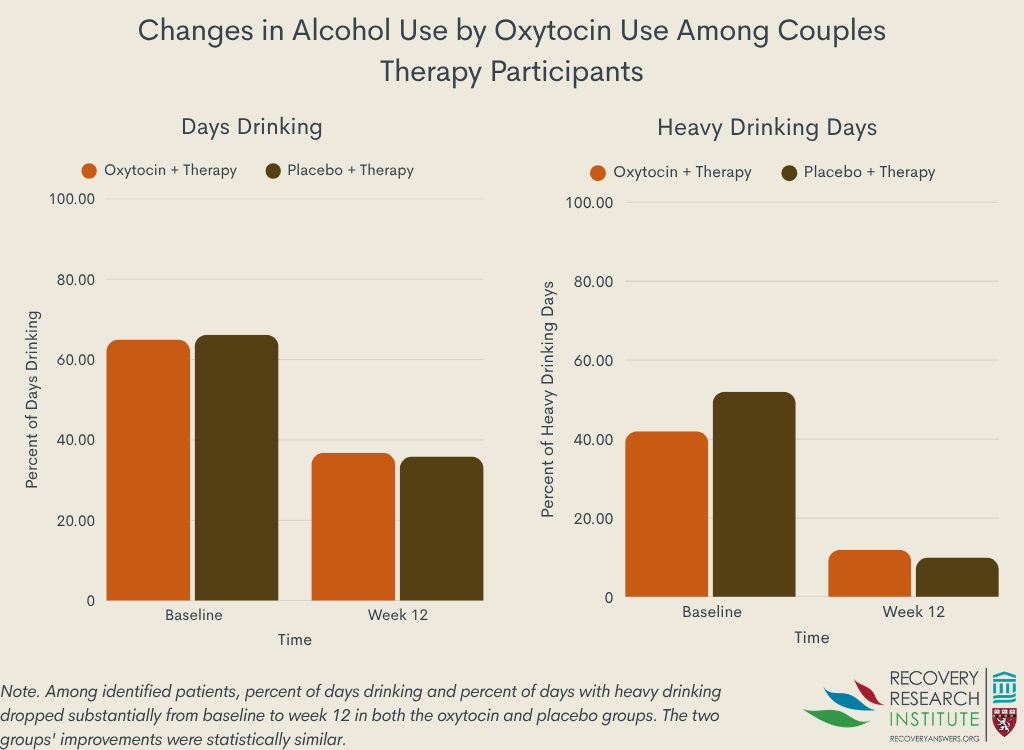
Adding oxytocin to alcohol behavioral couple therapy provided no clear additional benefit over placebo. Drinking declined in both groups, but neither group showed clear improvement in relationship functioning from baseline to the end of treatment. The authors describe drinking reductions as comparable to those in previous couples-therapy trials without medication. Prior research suggests this therapy can improve both drinking and relationship outcomes. One trial involving 102 women found a moderate advantage over individual behavioral therapy in increasing alcohol-free days and a moderate-to-large advantage in reducing heavy-drinking days during treatment.
Why oxytocin did not add benefit is uncertain. The authors suggest that the substantial drinking improvements typically achieved with couples therapy may make additional benefits difficult to demonstrate. Another possibility comes from the broader literature; oxytocin may increase attention to social cues rather than consistently promote connection. Its effects may also depend on individual characteristics, such as personality and mental health symptoms, and whether interactions are cooperative or competitive, however, this study did not establish whether these factors explain its findings. Expectations about receiving a helpful medication could also have contributed to improvement in either group, but without a therapy-only group receiving no nasal spray, the study cannot isolate a placebo effect or establish that previously reported oxytocin benefits were attributable to one.
The lack of clear relationship improvement contrasts with benefits reported in some previous couples-therapy trials. Improving partners’ interactions is one proposed way this therapy helps reduce drinking, but research has not consistently established that pathway. This study did not establish why relationship functioning failed to improve, whether relationship changes contributed to drinking reductions, or whether the absence of clear relationship improvement explains oxytocin’s lack of added benefit.
Adding oxytocin to alcohol behavioral couple therapy provided no clear additional benefit over placebo. People in both groups drank less by the end of treatment, but neither group showed clear improvement in relationship functioning.
Flanagan, J. C., Nietert, P. J., McCrady, B. S., Sellers, S., Yates-Johnson, A., Giff, S. T., & Forkus, S. R. (2025). Results of a randomized controlled trial examining the efficacy of intranasal oxytocin to enhance alcohol behavioral couple therapy. The Journal of Clinical Psychiatry, 86(2). doi: 10.4088/JCP.24m15627.
Concerned significant others, such as romantic partners, can have both a positive or negative impact on their partners’ substance use, and pathways to treatment and recovery from substance use disorder. For this reason, scientists and clinicians have long considered alcohol behavioral couple therapy as an important treatment option for couples in which at least one partner is considering making a change to their drinking behavior. Alcohol behavioral couple therapy is a cognitive behavioral treatment that addresses both alcohol use disorder and relationship functioning and how they reciprocally impact one another. Research suggests that this treatment can help partners reduce their alcohol use, with greater effects than individual treatment, while also improving relationship functioning. One of the proposed mechanisms of change in alcohol behavioral couple therapy is enhancements in relational connection, such as trust, empathy, and warmth. These connection processes are thought to be partially driven by oxytocin, a natural hormone that helps to facilitate social bonding that can also be manufactured in a synthetic form and administered as a nasal spray. The researchers tested whether administering oxytocin before each alcohol behavioral couple therapy session improved treatment outcomes.
This was a randomized, double-blind, placebo-controlled, longitudinal study. A total of 96 romantic couples (a total of 192 people) were recruited to engage in a 12-week alcohol behavioral couple therapy program. For each couple, at least one person met criteria for alcohol use disorder, and half of the partners also met criteria for alcohol use disorder. Prior to beginning the treatment, couples were randomized to receive either intranasal oxytocin or a placebo saline spray. The medication or placebo was administered 30 minutes before the start of each alcohol behavioral couple therapy session. The study staff, therapists, and couples were blind to study condition, meaning they didn’t know who received oxytocin and who got placebo. Both members of each couple completed measures of alcohol consumption and relationship functioning at the beginning of treatment, and after 12 weeks of therapy. The study also collected follow-up data 3 and 6 months after treatment ended, but those results were not analyzed in this paper. Most of the identified patients were men (73%), and few were people of color, same-sex couples, or gender-diverse, which limits how broadly these findings apply. Because everyone in the study received alcohol behavioral couple therapy, this trial can tell us whether oxytocin added extra benefit, but it cannot tell us how much benefit came from the therapy itself versus other factors, since both groups received the same treatment.
Oxytocin was well tolerated, and most couples completed most of the couples therapy sessions
Couples completed an average of 10.2 out of 12 alcohol behavioral couple therapy sessions, suggesting high acceptability of the intervention. Almost 3 out of 4 (73.5%) of all couples in the oxytocin condition completed all 12 sessions, a similar rate that completed sessions in the placebo condition (76.6%). There were no differences between groups in doses administered, and 9 serious adverse events that occurred during the trial were reviewed and judged to be unrelated to study procedures.
Oxytocin did not improve treatment outcomes
As shown in the figure below, for both members of each couple, percent days drinking and percent days heavy drinking declined from baseline to the end of the alcohol behavioral couple therapy program. However, there were no between-group differences, indicating that couples in both the oxytocin and placebo conditions demonstrated similar reductions across the study period. There were also no improvements in relationship functioning in either condition, and there were no differences in outcomes based on whether the partner had alcohol use disorder.
Adding oxytocin to alcohol behavioral couple therapy provided no clear additional benefit over placebo. Drinking declined in both groups, but neither group showed clear improvement in relationship functioning from baseline to the end of treatment. The authors describe drinking reductions as comparable to those in previous couples-therapy trials without medication. Prior research suggests this therapy can improve both drinking and relationship outcomes. One trial involving 102 women found a moderate advantage over individual behavioral therapy in increasing alcohol-free days and a moderate-to-large advantage in reducing heavy-drinking days during treatment.
Why oxytocin did not add benefit is uncertain. The authors suggest that the substantial drinking improvements typically achieved with couples therapy may make additional benefits difficult to demonstrate. Another possibility comes from the broader literature; oxytocin may increase attention to social cues rather than consistently promote connection. Its effects may also depend on individual characteristics, such as personality and mental health symptoms, and whether interactions are cooperative or competitive, however, this study did not establish whether these factors explain its findings. Expectations about receiving a helpful medication could also have contributed to improvement in either group, but without a therapy-only group receiving no nasal spray, the study cannot isolate a placebo effect or establish that previously reported oxytocin benefits were attributable to one.
The lack of clear relationship improvement contrasts with benefits reported in some previous couples-therapy trials. Improving partners’ interactions is one proposed way this therapy helps reduce drinking, but research has not consistently established that pathway. This study did not establish why relationship functioning failed to improve, whether relationship changes contributed to drinking reductions, or whether the absence of clear relationship improvement explains oxytocin’s lack of added benefit.
Adding oxytocin to alcohol behavioral couple therapy provided no clear additional benefit over placebo. People in both groups drank less by the end of treatment, but neither group showed clear improvement in relationship functioning.
Flanagan, J. C., Nietert, P. J., McCrady, B. S., Sellers, S., Yates-Johnson, A., Giff, S. T., & Forkus, S. R. (2025). Results of a randomized controlled trial examining the efficacy of intranasal oxytocin to enhance alcohol behavioral couple therapy. The Journal of Clinical Psychiatry, 86(2). doi: 10.4088/JCP.24m15627.




Concerned significant others, such as romantic partners, can have both a positive or negative impact on their partners’ substance use, and pathways to treatment and recovery from substance use disorder. For this reason, scientists and clinicians have long considered alcohol behavioral couple therapy as an important treatment option for couples in which at least one partner is considering making a change to their drinking behavior. Alcohol behavioral couple therapy is a cognitive behavioral treatment that addresses both alcohol use disorder and relationship functioning and how they reciprocally impact one another. Research suggests that this treatment can help partners reduce their alcohol use, with greater effects than individual treatment, while also improving relationship functioning. One of the proposed mechanisms of change in alcohol behavioral couple therapy is enhancements in relational connection, such as trust, empathy, and warmth. These connection processes are thought to be partially driven by oxytocin, a natural hormone that helps to facilitate social bonding that can also be manufactured in a synthetic form and administered as a nasal spray. The researchers tested whether administering oxytocin before each alcohol behavioral couple therapy session improved treatment outcomes.
This was a randomized, double-blind, placebo-controlled, longitudinal study. A total of 96 romantic couples (a total of 192 people) were recruited to engage in a 12-week alcohol behavioral couple therapy program. For each couple, at least one person met criteria for alcohol use disorder, and half of the partners also met criteria for alcohol use disorder. Prior to beginning the treatment, couples were randomized to receive either intranasal oxytocin or a placebo saline spray. The medication or placebo was administered 30 minutes before the start of each alcohol behavioral couple therapy session. The study staff, therapists, and couples were blind to study condition, meaning they didn’t know who received oxytocin and who got placebo. Both members of each couple completed measures of alcohol consumption and relationship functioning at the beginning of treatment, and after 12 weeks of therapy. The study also collected follow-up data 3 and 6 months after treatment ended, but those results were not analyzed in this paper. Most of the identified patients were men (73%), and few were people of color, same-sex couples, or gender-diverse, which limits how broadly these findings apply. Because everyone in the study received alcohol behavioral couple therapy, this trial can tell us whether oxytocin added extra benefit, but it cannot tell us how much benefit came from the therapy itself versus other factors, since both groups received the same treatment.
Oxytocin was well tolerated, and most couples completed most of the couples therapy sessions
Couples completed an average of 10.2 out of 12 alcohol behavioral couple therapy sessions, suggesting high acceptability of the intervention. Almost 3 out of 4 (73.5%) of all couples in the oxytocin condition completed all 12 sessions, a similar rate that completed sessions in the placebo condition (76.6%). There were no differences between groups in doses administered, and 9 serious adverse events that occurred during the trial were reviewed and judged to be unrelated to study procedures.
Oxytocin did not improve treatment outcomes
As shown in the figure below, for both members of each couple, percent days drinking and percent days heavy drinking declined from baseline to the end of the alcohol behavioral couple therapy program. However, there were no between-group differences, indicating that couples in both the oxytocin and placebo conditions demonstrated similar reductions across the study period. There were also no improvements in relationship functioning in either condition, and there were no differences in outcomes based on whether the partner had alcohol use disorder.
Adding oxytocin to alcohol behavioral couple therapy provided no clear additional benefit over placebo. Drinking declined in both groups, but neither group showed clear improvement in relationship functioning from baseline to the end of treatment. The authors describe drinking reductions as comparable to those in previous couples-therapy trials without medication. Prior research suggests this therapy can improve both drinking and relationship outcomes. One trial involving 102 women found a moderate advantage over individual behavioral therapy in increasing alcohol-free days and a moderate-to-large advantage in reducing heavy-drinking days during treatment.
Why oxytocin did not add benefit is uncertain. The authors suggest that the substantial drinking improvements typically achieved with couples therapy may make additional benefits difficult to demonstrate. Another possibility comes from the broader literature; oxytocin may increase attention to social cues rather than consistently promote connection. Its effects may also depend on individual characteristics, such as personality and mental health symptoms, and whether interactions are cooperative or competitive, however, this study did not establish whether these factors explain its findings. Expectations about receiving a helpful medication could also have contributed to improvement in either group, but without a therapy-only group receiving no nasal spray, the study cannot isolate a placebo effect or establish that previously reported oxytocin benefits were attributable to one.
The lack of clear relationship improvement contrasts with benefits reported in some previous couples-therapy trials. Improving partners’ interactions is one proposed way this therapy helps reduce drinking, but research has not consistently established that pathway. This study did not establish why relationship functioning failed to improve, whether relationship changes contributed to drinking reductions, or whether the absence of clear relationship improvement explains oxytocin’s lack of added benefit.
Adding oxytocin to alcohol behavioral couple therapy provided no clear additional benefit over placebo. People in both groups drank less by the end of treatment, but neither group showed clear improvement in relationship functioning.
Flanagan, J. C., Nietert, P. J., McCrady, B. S., Sellers, S., Yates-Johnson, A., Giff, S. T., & Forkus, S. R. (2025). Results of a randomized controlled trial examining the efficacy of intranasal oxytocin to enhance alcohol behavioral couple therapy. The Journal of Clinical Psychiatry, 86(2). doi: 10.4088/JCP.24m15627.