Can telehealth-delivered CRAFT improve the well-being of friends and families affected by addiction in rural areas?

  • Home
  • Research
  • Can telehealth-delivered CRAFT improve the well-being of friends and families affected by addiction in rural areas?

Friends and families of individuals with a substance use disorder (i.e., concerned significant others) often experience significant stress and mental health challenges, yet supportive services specifically designed for this population are limited. This critical gap is especially pronounced in rural communities, where services are more difficult to access. This study builds upon prior research by examining whether an online, practitioner-led Community Reinforcement and Family Training (CRAFT) intervention can improve the well-being of concerned significant others in rural Australia.

Stay on the frontiers of
recovery science
with the free, monthly
Recovery Bulletin

l

WHAT PROBLEM DOES THIS STUDY ADDRESS?

Friends and family members of individuals with a substance use disorder, known as concerned significant others, often report high levels of stress and mental health challenges. Despite these needs, support services designed specifically for concerned significant others are limited. Also, because mental health services are heavily concentrated in urban areas, those residing in rural areas face substantial unmet needs and thus are a priority group for intervention. Community Reinforcement and Family Training (CRAFT) was designed principally to help concerned significant others facilitate their loved one’s entry into treatment. Though it is also one of the few interventions designed, in part, to improve the psychological well-being of concerned significant others through structured, personalized training and support.

Prior studies evaluating in-person CRAFT have found beneficial effects on concerned significant others’ mental health and quality of life, but findings on the effectiveness of online-delivered CRAFT are mixed. One such study found that participants in online CRAFT showed short-term improvements in depression, quality of life, and relationship satisfaction that did not persist beyond a 6-week follow-up period, whereas another study found no beneficial effects on well-being outcomes. However, because both studies evaluated self-guided online versions of CRAFT (i.e., without a therapist), it is unclear whether adding practitioner support could lead to better outcomes. In contrast to many prior studies that examined the effect of CRAFT on getting the loved one into treatment, this study focused purely on whether CRAFT improved well-being of the concerned significant other.


HOW WAS THIS STUDY CONDUCTED?

This randomized controlled trial evaluated whether an online, practitioner-led CRAFT intervention improved psychological well-being among concerned significant others of individuals with substance use disorder. The CRAFT intervention consisted of six 60-minute sessions delivered over 6 weeks and included access to 2 optional sessions focused on additional support and skill consolidation; the intervention and data collection were extended beyond 6 weeks for any participants who took longer to complete the sessions. The sample consisted of 126 adults who resided in rural Australia and identified as family members or friends of someone with a substance use problem. Approximately 92% of participants were female, which limits generalizability to males and gender-diverse populations. More than 40% were a parent, 31% was a partner/spouse, 13% a child, and 8% a sibling of someone with an alcohol/drug problem.

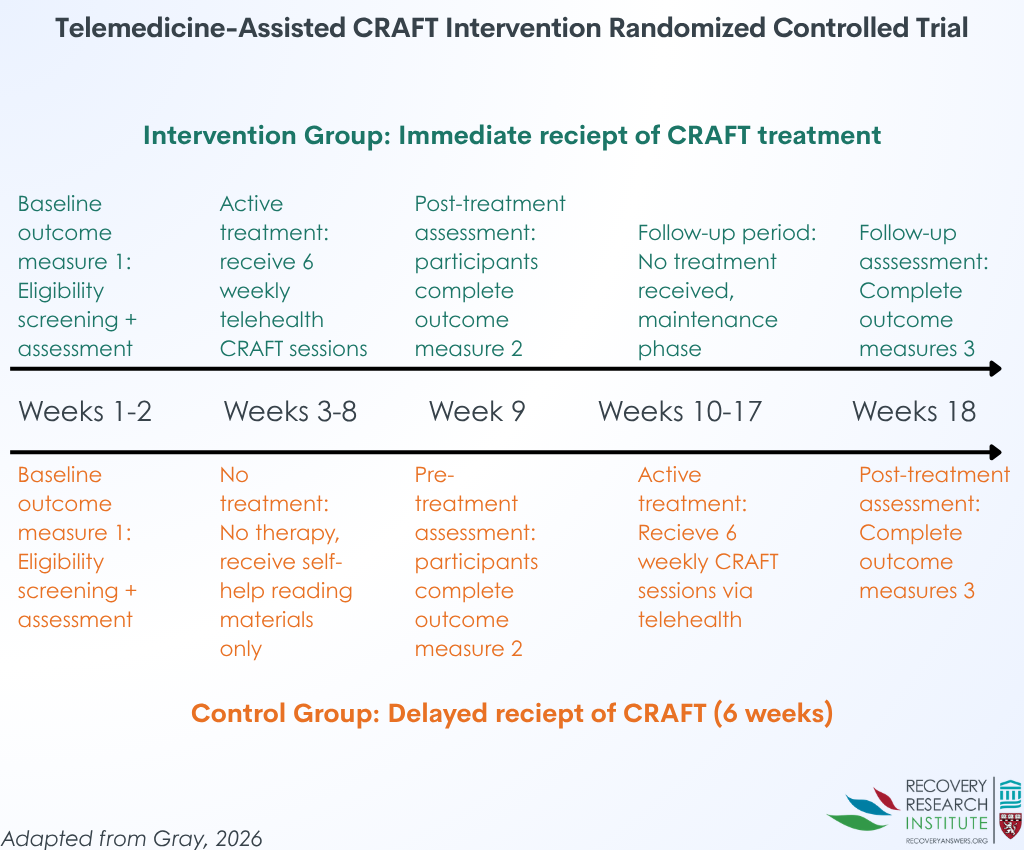
Sixty-four participants were assigned to the intervention group, which immediately began the intervention, while 62 participants were assigned to a waitlist control group, which initially received related reading materials and then subsequently began the same intervention after a 6-week delay. Groups were similar when starting the study on demographic characteristics. The primary outcome was psychological well-being of the concerned significant other, which included measures of depression, anxiety, stress, life satisfaction, and flourishing. The secondary outcome was coping style, which included problem-focused coping, emotion-focused coping, and avoidant coping. As shown in the graphic below, data were collected from each group at baseline, after the initial intervention period, and after the delayed intervention period. Between-group differences at the first follow-up were compared to evaluate the immediate effects of the intervention, and again at the second follow-up after both groups received the intervention to assess whether any initial improvements in the intervention group were maintained through 6-weeks post-intervention.

WHAT DID THIS STUDY FIND?

CRAFT had some short-term beneficial effects on psychological well-being

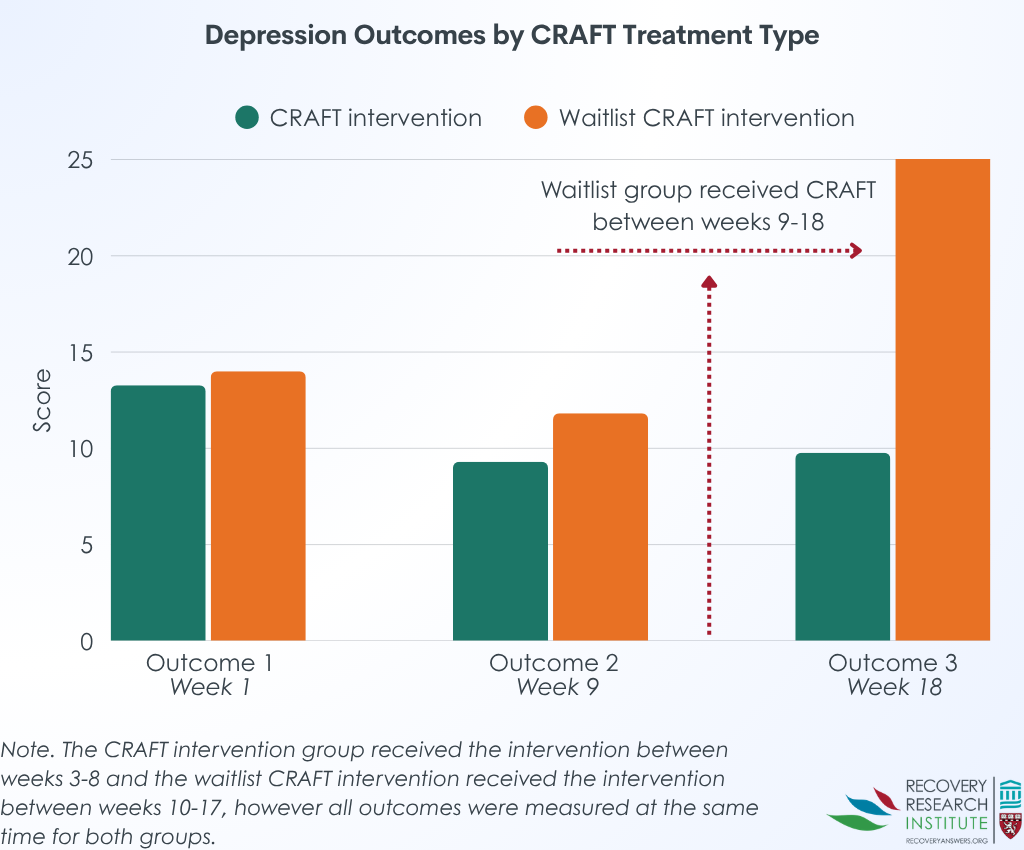
At baseline, both groups reported depression scores in the “extremely severe” range and were “slightly dissatisfied” with life. At the first follow-up, the intervention group showed significantly larger improvements in both outcomes than the waitlist group, reporting depression scores in the “moderate” range and life satisfaction in the “neutral” range (see graphic below). These improvements were generally sustained at the second follow-up, with no significant differences between the groups after the waitlist participants received the delayed intervention. There were no significant changes in anxiety, stress, or flourishing.
Initial improvements in problem-focused coping were not maintained

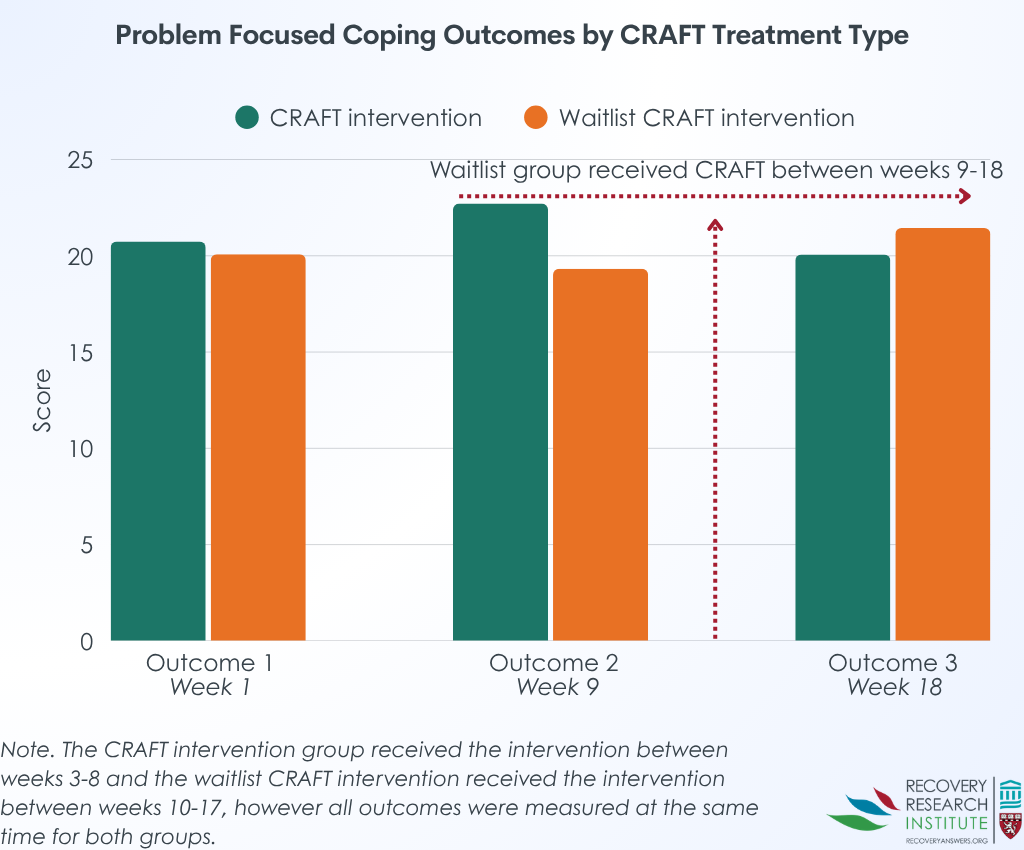
At the first follow-up, the intervention group showed a significantly larger increase in problem-focused coping (a positive, solution-focused coping strategy) than the waitlist group – see graph below. Although the waitlist group showed a similar improvement at the second follow-up, the initial improvement was not maintained in the intervention group as problem-focused coping levels dropped below baseline. There were no significant changes in emotion-focused coping or avoidant coping.

WHAT ARE THE IMPLICATIONS OF THE STUDY FINDINGS?

Concerned significant others of individuals with substance use disorder reported low life satisfaction and high stress, anxiety, and depression at baseline, highlighting the significant mental health challenges this population faces and the need for interventions that can address them. The results of this study suggest that an online, practitioner-led CRAFT intervention may be a promising option for improving psychological well-being in this population, particularly in rural areas where access to in-person mental healthcare is limited. Moreover, because prior trials evaluating CRAFT have only been conducted in the United States and Europe, this study further extends the evidence base by supporting its value in the Australian context. The observed improvements in depression, life satisfaction, and problem-focused coping suggest that online CRAFT may help more than self-directed reading materials, which is notable as the prior studies reporting weaker outcomes for CRAFT delivered used automated formats without practitioner support. Indeed, given that these improvements were not observed in the waitlist group until they received the intervention further supports that such an approach is better suited for improving well-being and building positive coping skills than self-guided reading. Although improvements in depression and life satisfaction were generally maintained over several weeks through the second follow-up, this was not the case for problem-focused coping, which declined below baseline levels at the second follow-up. It is possible that the intervention is sufficient for short-term, modest levels of behavior change but additional support after the program – e.g., via booster sessions –may be needed to sustain longer-term changes. Also notable is that the study did not examine whether and when (if at all) CRAFT helped the concerned significant other facilitate their loved one’s entry into treatment. These important outcomes could covary with the outcomes measured in this study. Further research is needed to evaluate long-term effects as well as whether these findings can be replicated in gender-diverse samples and other rural populations.


BOTTOM LINE

Friends and family members of individuals with a substance use disorder face significant mental health challenges. For these concerned significant others, an online, practitioner-led CRAFT interventions may be a helpful and accessible way to improve psychological well-being, particularly in rural areas where in-person services are limited. However, continued or extended support may be needed to maintain improvements in positive coping behaviors.


  • For individuals and families seeking recovery: For concerned significant others who are facing mental health challenges due to a loved-one’s alcohol/drug use, participating in CRAFT may help improve psychological well-being and coping skills. While online delivery of CRAFT allows for greater accessibility, opting for a practitioner-led online version may be more beneficial than a self-guided format. Additional information and supports for family and friends can be found here.
  • For treatment professionals and treatment systems: Online CRAFT may be a feasible and scalable model to reach concerned significant others who have limited access to in-person mental health services. To support implementation, treatment systems should consider embedding CRAFT within existing rural telehealth services and providing specialized training to support high-fidelity online delivery.
  • For scientists: Given that this study used a waitlist control, future trials should compare online CRAFT with in-person delivery to more fully assess the effectiveness of the online format. Extended follow-up periods are needed to evaluate whether improvements are maintained over longer periods of time. Researchers should also attempt to replicate these results in larger samples with more gender diversity and examine how concerned significant other outcomes covary over time with successful treatment entry of their loved one. In addition, because rural populations are not homogeneous, future research should explore cultural adaptations to tailor online CRAFT to specific groups, such as First Nations communities.
  • For policy makers: Policies that support telehealth are critical for expanding access to CRAFT and other online behavioral health interventions. Reimbursement policies that ensure both public and private insurance coverage for online CRAFT will be essential for sustainable scale-up. Funding broadband infrastructure to improve reliable and affordable internet access as well as subsidy programs are also needed to reduce disparities and ensure equitable access to online mental health services.

CITATIONS

Gray, H., Ivory, N., Snowdon, N., Ahmed, K., Thomas, M., & Allan, J. (2026). Online community reinforcement and family training (CRAFT) for rural concerned significant others: A randomized controlled trial. Journal of Substance Use and Addiction Treatment, 182. doi: 10.1016/j.josat.2025.209867.


Stay on the Frontiers of
recovery science
with the free, monthly
Recovery Bulletin

l

WHAT PROBLEM DOES THIS STUDY ADDRESS?

Friends and family members of individuals with a substance use disorder, known as concerned significant others, often report high levels of stress and mental health challenges. Despite these needs, support services designed specifically for concerned significant others are limited. Also, because mental health services are heavily concentrated in urban areas, those residing in rural areas face substantial unmet needs and thus are a priority group for intervention. Community Reinforcement and Family Training (CRAFT) was designed principally to help concerned significant others facilitate their loved one’s entry into treatment. Though it is also one of the few interventions designed, in part, to improve the psychological well-being of concerned significant others through structured, personalized training and support.

Prior studies evaluating in-person CRAFT have found beneficial effects on concerned significant others’ mental health and quality of life, but findings on the effectiveness of online-delivered CRAFT are mixed. One such study found that participants in online CRAFT showed short-term improvements in depression, quality of life, and relationship satisfaction that did not persist beyond a 6-week follow-up period, whereas another study found no beneficial effects on well-being outcomes. However, because both studies evaluated self-guided online versions of CRAFT (i.e., without a therapist), it is unclear whether adding practitioner support could lead to better outcomes. In contrast to many prior studies that examined the effect of CRAFT on getting the loved one into treatment, this study focused purely on whether CRAFT improved well-being of the concerned significant other.


HOW WAS THIS STUDY CONDUCTED?

This randomized controlled trial evaluated whether an online, practitioner-led CRAFT intervention improved psychological well-being among concerned significant others of individuals with substance use disorder. The CRAFT intervention consisted of six 60-minute sessions delivered over 6 weeks and included access to 2 optional sessions focused on additional support and skill consolidation; the intervention and data collection were extended beyond 6 weeks for any participants who took longer to complete the sessions. The sample consisted of 126 adults who resided in rural Australia and identified as family members or friends of someone with a substance use problem. Approximately 92% of participants were female, which limits generalizability to males and gender-diverse populations. More than 40% were a parent, 31% was a partner/spouse, 13% a child, and 8% a sibling of someone with an alcohol/drug problem.

Sixty-four participants were assigned to the intervention group, which immediately began the intervention, while 62 participants were assigned to a waitlist control group, which initially received related reading materials and then subsequently began the same intervention after a 6-week delay. Groups were similar when starting the study on demographic characteristics. The primary outcome was psychological well-being of the concerned significant other, which included measures of depression, anxiety, stress, life satisfaction, and flourishing. The secondary outcome was coping style, which included problem-focused coping, emotion-focused coping, and avoidant coping. As shown in the graphic below, data were collected from each group at baseline, after the initial intervention period, and after the delayed intervention period. Between-group differences at the first follow-up were compared to evaluate the immediate effects of the intervention, and again at the second follow-up after both groups received the intervention to assess whether any initial improvements in the intervention group were maintained through 6-weeks post-intervention.


WHAT DID THIS STUDY FIND?

CRAFT had some short-term beneficial effects on psychological well-being

At baseline, both groups reported depression scores in the “extremely severe” range and were “slightly dissatisfied” with life. At the first follow-up, the intervention group showed significantly larger improvements in both outcomes than the waitlist group, reporting depression scores in the “moderate” range and life satisfaction in the “neutral” range (see graphic below). These improvements were generally sustained at the second follow-up, with no significant differences between the groups after the waitlist participants received the delayed intervention. There were no significant changes in anxiety, stress, or flourishing.

Initial improvements in problem-focused coping were not maintained

At the first follow-up, the intervention group showed a significantly larger increase in problem-focused coping (a positive, solution-focused coping strategy) than the waitlist group – see graph below. Although the waitlist group showed a similar improvement at the second follow-up, the initial improvement was not maintained in the intervention group as problem-focused coping levels dropped below baseline. There were no significant changes in emotion-focused coping or avoidant coping.


WHAT ARE THE IMPLICATIONS OF THE STUDY FINDINGS?

Concerned significant others of individuals with substance use disorder reported low life satisfaction and high stress, anxiety, and depression at baseline, highlighting the significant mental health challenges this population faces and the need for interventions that can address them. The results of this study suggest that an online, practitioner-led CRAFT intervention may be a promising option for improving psychological well-being in this population, particularly in rural areas where access to in-person mental healthcare is limited. Moreover, because prior trials evaluating CRAFT have only been conducted in the United States and Europe, this study further extends the evidence base by supporting its value in the Australian context. The observed improvements in depression, life satisfaction, and problem-focused coping suggest that online CRAFT may help more than self-directed reading materials, which is notable as the prior studies reporting weaker outcomes for CRAFT delivered used automated formats without practitioner support. Indeed, given that these improvements were not observed in the waitlist group until they received the intervention further supports that such an approach is better suited for improving well-being and building positive coping skills than self-guided reading. Although improvements in depression and life satisfaction were generally maintained over several weeks through the second follow-up, this was not the case for problem-focused coping, which declined below baseline levels at the second follow-up. It is possible that the intervention is sufficient for short-term, modest levels of behavior change but additional support after the program – e.g., via booster sessions –may be needed to sustain longer-term changes. Also notable is that the study did not examine whether and when (if at all) CRAFT helped the concerned significant other facilitate their loved one’s entry into treatment. These important outcomes could covary with the outcomes measured in this study. Further research is needed to evaluate long-term effects as well as whether these findings can be replicated in gender-diverse samples and other rural populations.


BOTTOM LINE

Friends and family members of individuals with a substance use disorder face significant mental health challenges. For these concerned significant others, an online, practitioner-led CRAFT interventions may be a helpful and accessible way to improve psychological well-being, particularly in rural areas where in-person services are limited. However, continued or extended support may be needed to maintain improvements in positive coping behaviors.


  • For individuals and families seeking recovery: For concerned significant others who are facing mental health challenges due to a loved-one’s alcohol/drug use, participating in CRAFT may help improve psychological well-being and coping skills. While online delivery of CRAFT allows for greater accessibility, opting for a practitioner-led online version may be more beneficial than a self-guided format. Additional information and supports for family and friends can be found here.
  • For treatment professionals and treatment systems: Online CRAFT may be a feasible and scalable model to reach concerned significant others who have limited access to in-person mental health services. To support implementation, treatment systems should consider embedding CRAFT within existing rural telehealth services and providing specialized training to support high-fidelity online delivery.
  • For scientists: Given that this study used a waitlist control, future trials should compare online CRAFT with in-person delivery to more fully assess the effectiveness of the online format. Extended follow-up periods are needed to evaluate whether improvements are maintained over longer periods of time. Researchers should also attempt to replicate these results in larger samples with more gender diversity and examine how concerned significant other outcomes covary over time with successful treatment entry of their loved one. In addition, because rural populations are not homogeneous, future research should explore cultural adaptations to tailor online CRAFT to specific groups, such as First Nations communities.
  • For policy makers: Policies that support telehealth are critical for expanding access to CRAFT and other online behavioral health interventions. Reimbursement policies that ensure both public and private insurance coverage for online CRAFT will be essential for sustainable scale-up. Funding broadband infrastructure to improve reliable and affordable internet access as well as subsidy programs are also needed to reduce disparities and ensure equitable access to online mental health services.

CITATIONS

Gray, H., Ivory, N., Snowdon, N., Ahmed, K., Thomas, M., & Allan, J. (2026). Online community reinforcement and family training (CRAFT) for rural concerned significant others: A randomized controlled trial. Journal of Substance Use and Addiction Treatment, 182. doi: 10.1016/j.josat.2025.209867.


Share this article

l

WHAT PROBLEM DOES THIS STUDY ADDRESS?

Friends and family members of individuals with a substance use disorder, known as concerned significant others, often report high levels of stress and mental health challenges. Despite these needs, support services designed specifically for concerned significant others are limited. Also, because mental health services are heavily concentrated in urban areas, those residing in rural areas face substantial unmet needs and thus are a priority group for intervention. Community Reinforcement and Family Training (CRAFT) was designed principally to help concerned significant others facilitate their loved one’s entry into treatment. Though it is also one of the few interventions designed, in part, to improve the psychological well-being of concerned significant others through structured, personalized training and support.

Prior studies evaluating in-person CRAFT have found beneficial effects on concerned significant others’ mental health and quality of life, but findings on the effectiveness of online-delivered CRAFT are mixed. One such study found that participants in online CRAFT showed short-term improvements in depression, quality of life, and relationship satisfaction that did not persist beyond a 6-week follow-up period, whereas another study found no beneficial effects on well-being outcomes. However, because both studies evaluated self-guided online versions of CRAFT (i.e., without a therapist), it is unclear whether adding practitioner support could lead to better outcomes. In contrast to many prior studies that examined the effect of CRAFT on getting the loved one into treatment, this study focused purely on whether CRAFT improved well-being of the concerned significant other.


HOW WAS THIS STUDY CONDUCTED?

This randomized controlled trial evaluated whether an online, practitioner-led CRAFT intervention improved psychological well-being among concerned significant others of individuals with substance use disorder. The CRAFT intervention consisted of six 60-minute sessions delivered over 6 weeks and included access to 2 optional sessions focused on additional support and skill consolidation; the intervention and data collection were extended beyond 6 weeks for any participants who took longer to complete the sessions. The sample consisted of 126 adults who resided in rural Australia and identified as family members or friends of someone with a substance use problem. Approximately 92% of participants were female, which limits generalizability to males and gender-diverse populations. More than 40% were a parent, 31% was a partner/spouse, 13% a child, and 8% a sibling of someone with an alcohol/drug problem.

Sixty-four participants were assigned to the intervention group, which immediately began the intervention, while 62 participants were assigned to a waitlist control group, which initially received related reading materials and then subsequently began the same intervention after a 6-week delay. Groups were similar when starting the study on demographic characteristics. The primary outcome was psychological well-being of the concerned significant other, which included measures of depression, anxiety, stress, life satisfaction, and flourishing. The secondary outcome was coping style, which included problem-focused coping, emotion-focused coping, and avoidant coping. As shown in the graphic below, data were collected from each group at baseline, after the initial intervention period, and after the delayed intervention period. Between-group differences at the first follow-up were compared to evaluate the immediate effects of the intervention, and again at the second follow-up after both groups received the intervention to assess whether any initial improvements in the intervention group were maintained through 6-weeks post-intervention.


WHAT DID THIS STUDY FIND?

CRAFT had some short-term beneficial effects on psychological well-being

At baseline, both groups reported depression scores in the “extremely severe” range and were “slightly dissatisfied” with life. At the first follow-up, the intervention group showed significantly larger improvements in both outcomes than the waitlist group, reporting depression scores in the “moderate” range and life satisfaction in the “neutral” range (see graphic below). These improvements were generally sustained at the second follow-up, with no significant differences between the groups after the waitlist participants received the delayed intervention. There were no significant changes in anxiety, stress, or flourishing.

Initial improvements in problem-focused coping were not maintained

At the first follow-up, the intervention group showed a significantly larger increase in problem-focused coping (a positive, solution-focused coping strategy) than the waitlist group – see graph below. Although the waitlist group showed a similar improvement at the second follow-up, the initial improvement was not maintained in the intervention group as problem-focused coping levels dropped below baseline. There were no significant changes in emotion-focused coping or avoidant coping.


WHAT ARE THE IMPLICATIONS OF THE STUDY FINDINGS?

Concerned significant others of individuals with substance use disorder reported low life satisfaction and high stress, anxiety, and depression at baseline, highlighting the significant mental health challenges this population faces and the need for interventions that can address them. The results of this study suggest that an online, practitioner-led CRAFT intervention may be a promising option for improving psychological well-being in this population, particularly in rural areas where access to in-person mental healthcare is limited. Moreover, because prior trials evaluating CRAFT have only been conducted in the United States and Europe, this study further extends the evidence base by supporting its value in the Australian context. The observed improvements in depression, life satisfaction, and problem-focused coping suggest that online CRAFT may help more than self-directed reading materials, which is notable as the prior studies reporting weaker outcomes for CRAFT delivered used automated formats without practitioner support. Indeed, given that these improvements were not observed in the waitlist group until they received the intervention further supports that such an approach is better suited for improving well-being and building positive coping skills than self-guided reading. Although improvements in depression and life satisfaction were generally maintained over several weeks through the second follow-up, this was not the case for problem-focused coping, which declined below baseline levels at the second follow-up. It is possible that the intervention is sufficient for short-term, modest levels of behavior change but additional support after the program – e.g., via booster sessions –may be needed to sustain longer-term changes. Also notable is that the study did not examine whether and when (if at all) CRAFT helped the concerned significant other facilitate their loved one’s entry into treatment. These important outcomes could covary with the outcomes measured in this study. Further research is needed to evaluate long-term effects as well as whether these findings can be replicated in gender-diverse samples and other rural populations.


BOTTOM LINE

Friends and family members of individuals with a substance use disorder face significant mental health challenges. For these concerned significant others, an online, practitioner-led CRAFT interventions may be a helpful and accessible way to improve psychological well-being, particularly in rural areas where in-person services are limited. However, continued or extended support may be needed to maintain improvements in positive coping behaviors.


  • For individuals and families seeking recovery: For concerned significant others who are facing mental health challenges due to a loved-one’s alcohol/drug use, participating in CRAFT may help improve psychological well-being and coping skills. While online delivery of CRAFT allows for greater accessibility, opting for a practitioner-led online version may be more beneficial than a self-guided format. Additional information and supports for family and friends can be found here.
  • For treatment professionals and treatment systems: Online CRAFT may be a feasible and scalable model to reach concerned significant others who have limited access to in-person mental health services. To support implementation, treatment systems should consider embedding CRAFT within existing rural telehealth services and providing specialized training to support high-fidelity online delivery.
  • For scientists: Given that this study used a waitlist control, future trials should compare online CRAFT with in-person delivery to more fully assess the effectiveness of the online format. Extended follow-up periods are needed to evaluate whether improvements are maintained over longer periods of time. Researchers should also attempt to replicate these results in larger samples with more gender diversity and examine how concerned significant other outcomes covary over time with successful treatment entry of their loved one. In addition, because rural populations are not homogeneous, future research should explore cultural adaptations to tailor online CRAFT to specific groups, such as First Nations communities.
  • For policy makers: Policies that support telehealth are critical for expanding access to CRAFT and other online behavioral health interventions. Reimbursement policies that ensure both public and private insurance coverage for online CRAFT will be essential for sustainable scale-up. Funding broadband infrastructure to improve reliable and affordable internet access as well as subsidy programs are also needed to reduce disparities and ensure equitable access to online mental health services.

CITATIONS

Gray, H., Ivory, N., Snowdon, N., Ahmed, K., Thomas, M., & Allan, J. (2026). Online community reinforcement and family training (CRAFT) for rural concerned significant others: A randomized controlled trial. Journal of Substance Use and Addiction Treatment, 182. doi: 10.1016/j.josat.2025.209867.


Share this article