Analyzing opioid content on TikTok: Competing narratives and limited public health messaging
With millions of people using the popular social media platform TikTok every day, many encounter videos about opioids. Yet little research has examined what these videos depict. This study analyzed opioid-related TikTok content to better understand how the platform portrays opioid use, treatment, and recovery.
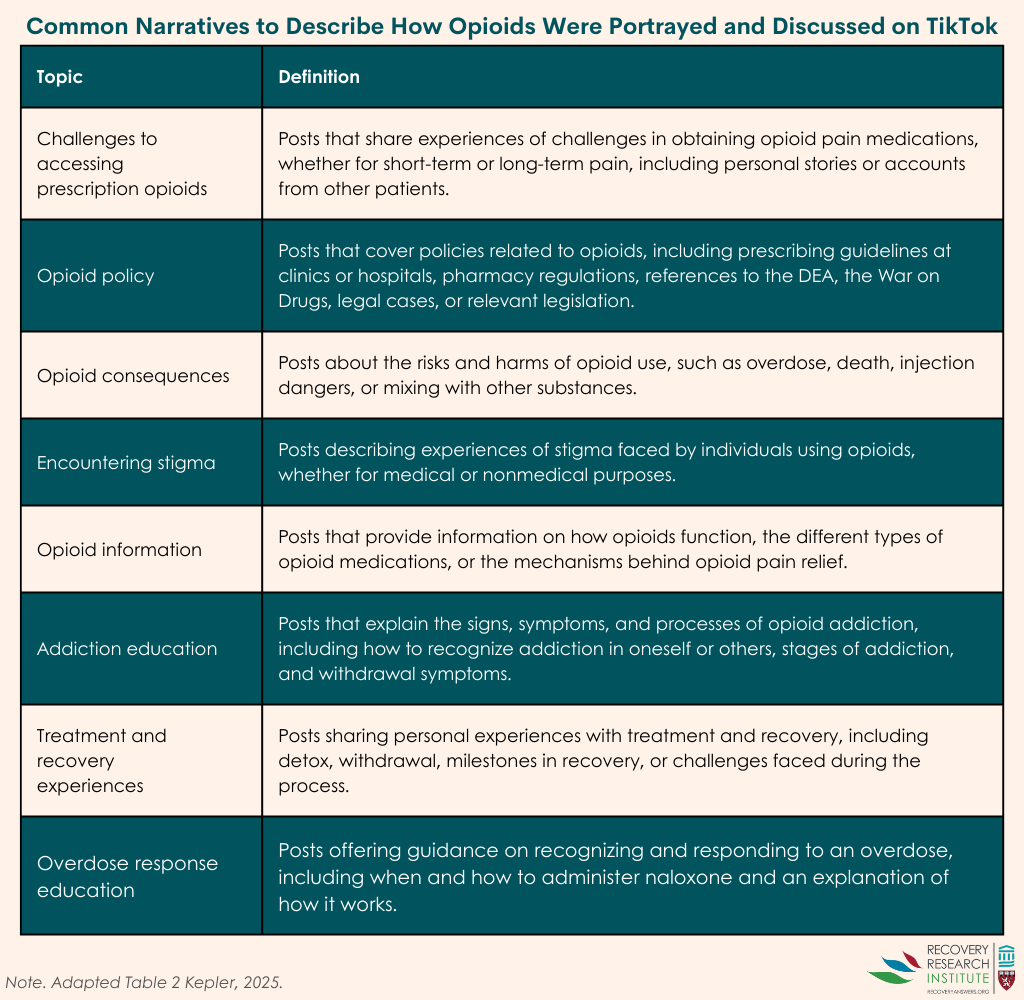
The researchers conducted a mixed-methods analysis of 115 TikTok videos tagged with #opioids, which collectively received more than 33 million views. Using a combination of quantitative and qualitative approaches, they examined both the frequency of specific topics and the broader narratives that emerged across videos. After reviewing an initial sample of eligible posts, the researchers developed a working codebook to capture recurring themes (see graphic below for detailed descriptions). Each video was also coded for mentions – instances where key topics such as overdose, pain management, prescription opioids, or treatment appeared in the video’s text, audio, or captions. These mentions allowed the researchers to quantify how often particular subjects were discussed across the dataset. Videos were further categorized by creator type (e.g., individuals with lived experience, healthcare providers, individuals with chronic pain, advocates). All videos were double-coded by at least 2 researchers, with discrepancies resolved through discussion until consensus was reached. The researchers also recorded engagement metrics (number of views, likes, comments, and shares) for each video as indicators of audience reach and interaction. The qualitative analysis involved synthesizing common narratives to describe how opioids were portrayed and discussed on TikTok.
WHAT DID THIS STUDY FIND?
Content reflected 2 dominant – and opposing – narratives
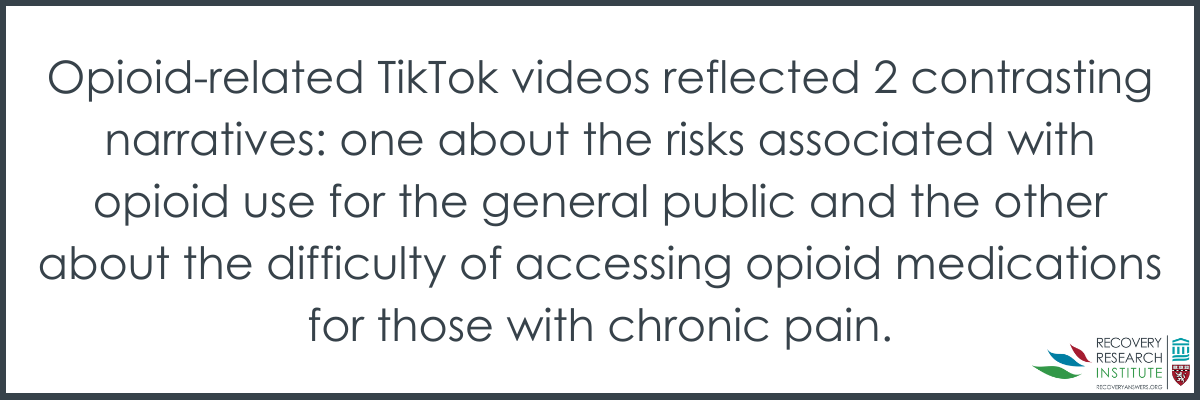
Opioid-related TikTok videos in this sample often reflected 2 contrasting narratives. One portrayed opioids as dangerous and inherently risky, emphasizing the dangers of nonmedical opioid use, overdose, and the growing threat of fentanyl. The other framed opioids as essential but over-restricted medications, focusing on the experiences of people with chronic pain who described difficulty accessing medications amid evolving opioid prescribing practices. The most frequent mentions were prescription opioids (58%), pain (47%), overdose (36%), and fentanyl (35%), while the most common topics discussed were challenges to accessing opioids (37%), opioid policy (37%), and negative consequences of opioid use (32%). Of the 45 unique content creators, the most common account types were health care providers (25%), individuals with lived experience (24%), and advocates (22%); however, the single largest category was “other” (40%), which included comedians, celebrities, and news organizations that may shape public perceptions of opioid use and policy.
Common themes included dangers of nonmedical opioid use, treatment and recovery, and barriers to prescription opioids
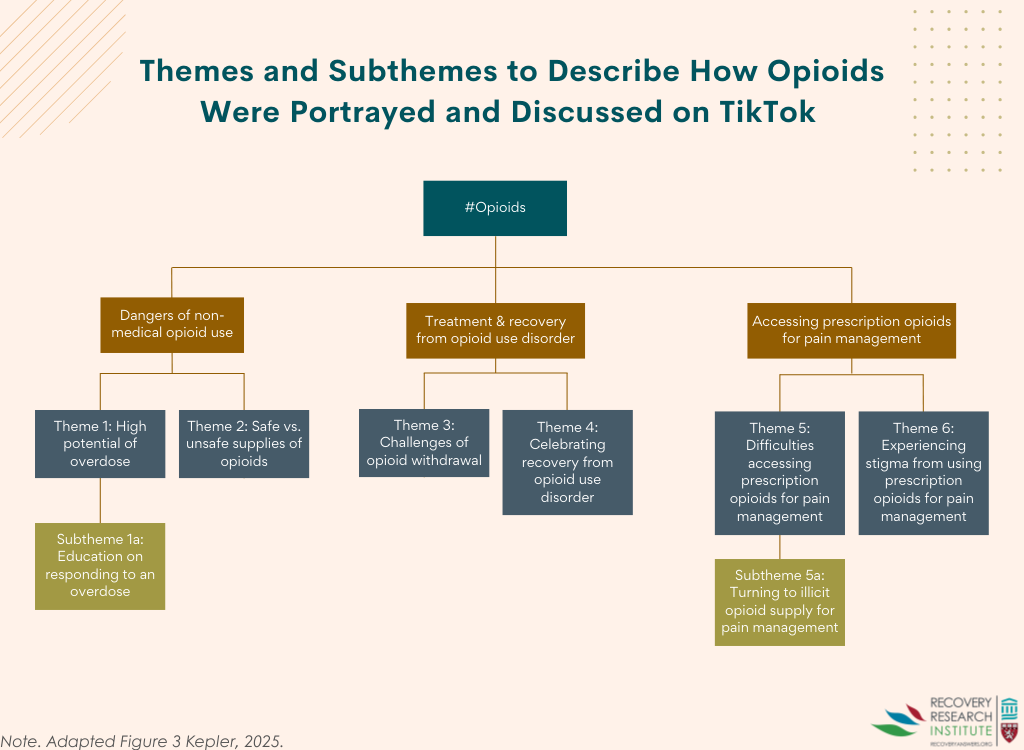
More than 30% of videos addressed overdose risk, and approximately 2/3 (68%) of those posts specifically mentioned fentanyl. Several discussed the idea of a safe supply, underscoring the dangers of unregulated and unpredictable illicit drug markets. Another common theme focused on treatment and recovery from opioid use disorder, featuring people with lived experience who celebrated recovery milestones such as days or years sober (28% of recovery posts) and described challenges related to withdrawal and early recovery. Barriers to obtaining prescribed opioids were noted in more than 1 in 3 videos (38%), with creators describing how opioid policies and prescribing practices affected their chronic pain management. Some linked these difficulties obtaining prescriptions to increased use of illicit drugs for pain relief, raising concerns about potential fentanyl exposure. About 1 in 5 videos (21%) also described experiences of perceived stigma from healthcare providers, particularly pharmacists. See graphic below for an organizational model of these themes.
Educational and harm reduction content was less common
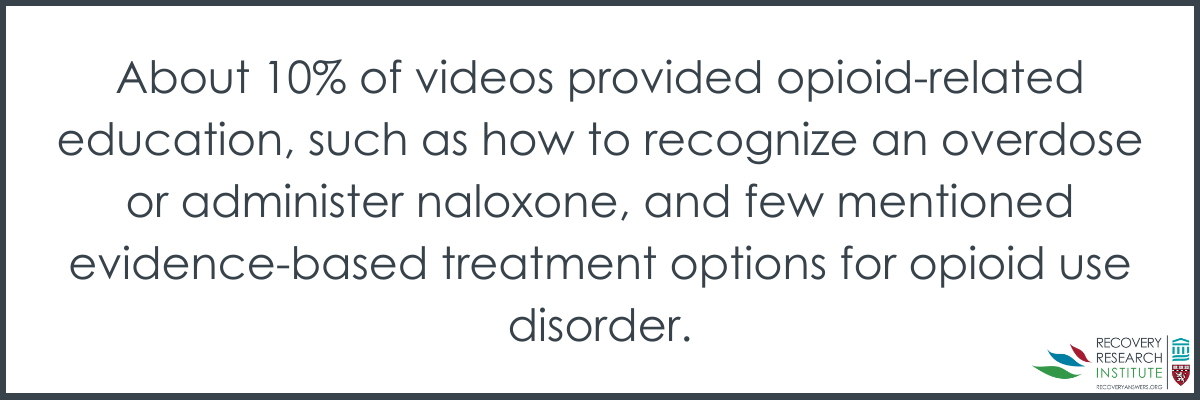
Despite frequent discussion of overdose and policy, educational content and information regarding reducing the harms of opioid use was rare. Only about 10% of videos provided opioid-related education, such as how to recognize an overdose or administer naloxone, and few mentioned evidence-based treatment options for opioid use disorder.
WHAT ARE THE IMPLICATIONS OF THE STUDY FINDINGS?
This study highlights how TikTok serves as a major platform for public conversation about opioids – with videos in this sample collectively receiving millions of views – but also underscores missed opportunities to educate the public. Videos commonly portrayed opioids either as substances associated with significant risks, including overdose and fentanyl exposure, or as essential medications that have become increasingly difficult for individuals with chronic pain to access. Few posts acknowledged both perspectives, and this divide may reflect broader tensions in public discourse around balancing safety and access in opioid-related policy and practice.
Educational messaging and information on how to reduce the harms of opioid use was limited. Unfortunately, the study did not provide information on which posts received the most views – for example, to determine how these types of public health posts may have performed, which might inform strategies to enhance engagement. Overall, few videos provided practical guidance on recognizing an overdose or administering naloxone. Importantly, prior research has identified more content on strategies that reduce harms on TikTok, suggesting that differences in sampling (i.e., hashtag selection) may partially explain these discrepancies. Even in prior research, however, most naloxone-related content focused on general awareness rather than providing clear information about where and how to obtain or administer naloxone during an overdose. Collectively, these findings suggest that while TikTok is a major venue for opioid-related discussion, it remains an underused platform for disseminating accurate, evidence-based information about overdose prevention.
Only a small number of posts mentioned treatment options for opioid use disorder, although recovery narratives (e.g., celebratory milestones) were common. This gap represents another opportunity to educate audiences on social media about evidence-based treatment and recovery support for opioid use disorder. Exposure to pro-treatment and recovery-oriented content could help to normalize help-seeking, reduce stigma, and encourage treatment and recovery engagement. Public health communication efforts could benefit from understanding which types of messages and messengers resonate most with specific audiences. For example, videos featuring clinicians may lend credibility, while those highlighting individuals with lived experience may foster relatability and hope. Further research is needed to identify how message framing and source influence perceptions and outcomes among different audiences.
This study analyzed videos tagged with a single hashtag (#opioids) on 1 social media platform (TikTok) at a single point in time (May 2023). Findings may not generalize to other opioid-related content on TikTok, to posts using different hashtags, to other social media platforms, or to different time periods.
Thematic coding was conducted manually, which is inherently subjective in nature. However, all videos were double-coded by at least 2 researchers, and discrepancies were resolved through discussion to enhance reliability.
The study provides a number of views across all posts, but not number of views by post, to see which types posts performed better than others.
BOTTOM LINE
TikTok reaches hundreds of millions of people worldwide and serves as an active space for public discussions about opioids. Opioid-related videos in this sample reflected 2 competing narratives – one emphasizing the dangers of nonmedical opioid use and overdose, and another highlighting barriers to accessing prescription opioids for chronic pain. Across this content, however, educational messaging was limited. There is a clear opportunity to use this widely popular social media platform to share evidence-based information, including how to recognize an overdose and administer naloxone, non-opioid approaches for managing chronic pain, and available treatment options for opioid use disorder. Leveraging TikTok for such education could help reduce stigma, correct misinformation, and connect people to resources that support prevention, treatment, and recovery.
For individuals and families seeking recovery: TikTok can raise awareness about opioid use and recovery experiences, but it is not always a reliable source of information. Individuals and families seeking guidance should rely on trusted sources – such as the National Institute on Drug Abuse (NIDA), the Centers for Disease Control and Prevention (CDC), and licensed health care professionals – for accurate information about treatment options, overdose prevention, and recovery support.
For treatment professionals and treatment systems: Clinicians and treatment organizations have an opportunity to use platforms like TikTok to help shape public narratives about opioids, opioid use disorder, treatment, and recovery. By promoting accurate information, correcting misinformation, and increasing awareness of evidence-based treatments, professionals can play a critical role in improving public understanding. Education about overdose response, treatment, and recovery support can reach broad audiences when delivered in accessible and engaging formats on popular social media platforms such as TikTok.
For scientists: This study underscores the need for continued research on how social media content shapes public perceptions of opioids, treatment, and recovery. It also highlights the importance of developing, evaluating, and disseminating evidence-based health communication campaigns aimed at educating the public, reducing stigma, and encouraging treatment and recovery engagement across diverse populations.
For policy makers: Social media platforms such as TikTok can amplify both accurate information and misinformation about opioids. Policymakers can play a key role by supporting initiatives that improve the quality of information shared in these spaces. Investing in public education campaigns and fostering partnerships between health agencies and credible content creators could help correct misinformation, reduce stigma, and promote treatment and recovery engagement.
The researchers conducted a mixed-methods analysis of 115 TikTok videos tagged with #opioids, which collectively received more than 33 million views. Using a combination of quantitative and qualitative approaches, they examined both the frequency of specific topics and the broader narratives that emerged across videos. After reviewing an initial sample of eligible posts, the researchers developed a working codebook to capture recurring themes (see graphic below for detailed descriptions). Each video was also coded for mentions – instances where key topics such as overdose, pain management, prescription opioids, or treatment appeared in the video’s text, audio, or captions. These mentions allowed the researchers to quantify how often particular subjects were discussed across the dataset. Videos were further categorized by creator type (e.g., individuals with lived experience, healthcare providers, individuals with chronic pain, advocates). All videos were double-coded by at least 2 researchers, with discrepancies resolved through discussion until consensus was reached. The researchers also recorded engagement metrics (number of views, likes, comments, and shares) for each video as indicators of audience reach and interaction. The qualitative analysis involved synthesizing common narratives to describe how opioids were portrayed and discussed on TikTok.
WHAT DID THIS STUDY FIND?
Content reflected 2 dominant – and opposing – narratives
Opioid-related TikTok videos in this sample often reflected 2 contrasting narratives. One portrayed opioids as dangerous and inherently risky, emphasizing the dangers of nonmedical opioid use, overdose, and the growing threat of fentanyl. The other framed opioids as essential but over-restricted medications, focusing on the experiences of people with chronic pain who described difficulty accessing medications amid evolving opioid prescribing practices. The most frequent mentions were prescription opioids (58%), pain (47%), overdose (36%), and fentanyl (35%), while the most common topics discussed were challenges to accessing opioids (37%), opioid policy (37%), and negative consequences of opioid use (32%). Of the 45 unique content creators, the most common account types were health care providers (25%), individuals with lived experience (24%), and advocates (22%); however, the single largest category was “other” (40%), which included comedians, celebrities, and news organizations that may shape public perceptions of opioid use and policy.
Common themes included dangers of nonmedical opioid use, treatment and recovery, and barriers to prescription opioids
More than 30% of videos addressed overdose risk, and approximately 2/3 (68%) of those posts specifically mentioned fentanyl. Several discussed the idea of a safe supply, underscoring the dangers of unregulated and unpredictable illicit drug markets. Another common theme focused on treatment and recovery from opioid use disorder, featuring people with lived experience who celebrated recovery milestones such as days or years sober (28% of recovery posts) and described challenges related to withdrawal and early recovery. Barriers to obtaining prescribed opioids were noted in more than 1 in 3 videos (38%), with creators describing how opioid policies and prescribing practices affected their chronic pain management. Some linked these difficulties obtaining prescriptions to increased use of illicit drugs for pain relief, raising concerns about potential fentanyl exposure. About 1 in 5 videos (21%) also described experiences of perceived stigma from healthcare providers, particularly pharmacists. See graphic below for an organizational model of these themes.
Educational and harm reduction content was less common
Despite frequent discussion of overdose and policy, educational content and information regarding reducing the harms of opioid use was rare. Only about 10% of videos provided opioid-related education, such as how to recognize an overdose or administer naloxone, and few mentioned evidence-based treatment options for opioid use disorder.
WHAT ARE THE IMPLICATIONS OF THE STUDY FINDINGS?
This study highlights how TikTok serves as a major platform for public conversation about opioids – with videos in this sample collectively receiving millions of views – but also underscores missed opportunities to educate the public. Videos commonly portrayed opioids either as substances associated with significant risks, including overdose and fentanyl exposure, or as essential medications that have become increasingly difficult for individuals with chronic pain to access. Few posts acknowledged both perspectives, and this divide may reflect broader tensions in public discourse around balancing safety and access in opioid-related policy and practice.
Educational messaging and information on how to reduce the harms of opioid use was limited. Unfortunately, the study did not provide information on which posts received the most views – for example, to determine how these types of public health posts may have performed, which might inform strategies to enhance engagement. Overall, few videos provided practical guidance on recognizing an overdose or administering naloxone. Importantly, prior research has identified more content on strategies that reduce harms on TikTok, suggesting that differences in sampling (i.e., hashtag selection) may partially explain these discrepancies. Even in prior research, however, most naloxone-related content focused on general awareness rather than providing clear information about where and how to obtain or administer naloxone during an overdose. Collectively, these findings suggest that while TikTok is a major venue for opioid-related discussion, it remains an underused platform for disseminating accurate, evidence-based information about overdose prevention.
Only a small number of posts mentioned treatment options for opioid use disorder, although recovery narratives (e.g., celebratory milestones) were common. This gap represents another opportunity to educate audiences on social media about evidence-based treatment and recovery support for opioid use disorder. Exposure to pro-treatment and recovery-oriented content could help to normalize help-seeking, reduce stigma, and encourage treatment and recovery engagement. Public health communication efforts could benefit from understanding which types of messages and messengers resonate most with specific audiences. For example, videos featuring clinicians may lend credibility, while those highlighting individuals with lived experience may foster relatability and hope. Further research is needed to identify how message framing and source influence perceptions and outcomes among different audiences.
This study analyzed videos tagged with a single hashtag (#opioids) on 1 social media platform (TikTok) at a single point in time (May 2023). Findings may not generalize to other opioid-related content on TikTok, to posts using different hashtags, to other social media platforms, or to different time periods.
Thematic coding was conducted manually, which is inherently subjective in nature. However, all videos were double-coded by at least 2 researchers, and discrepancies were resolved through discussion to enhance reliability.
The study provides a number of views across all posts, but not number of views by post, to see which types posts performed better than others.
BOTTOM LINE
TikTok reaches hundreds of millions of people worldwide and serves as an active space for public discussions about opioids. Opioid-related videos in this sample reflected 2 competing narratives – one emphasizing the dangers of nonmedical opioid use and overdose, and another highlighting barriers to accessing prescription opioids for chronic pain. Across this content, however, educational messaging was limited. There is a clear opportunity to use this widely popular social media platform to share evidence-based information, including how to recognize an overdose and administer naloxone, non-opioid approaches for managing chronic pain, and available treatment options for opioid use disorder. Leveraging TikTok for such education could help reduce stigma, correct misinformation, and connect people to resources that support prevention, treatment, and recovery.
For individuals and families seeking recovery: TikTok can raise awareness about opioid use and recovery experiences, but it is not always a reliable source of information. Individuals and families seeking guidance should rely on trusted sources – such as the National Institute on Drug Abuse (NIDA), the Centers for Disease Control and Prevention (CDC), and licensed health care professionals – for accurate information about treatment options, overdose prevention, and recovery support.
For treatment professionals and treatment systems: Clinicians and treatment organizations have an opportunity to use platforms like TikTok to help shape public narratives about opioids, opioid use disorder, treatment, and recovery. By promoting accurate information, correcting misinformation, and increasing awareness of evidence-based treatments, professionals can play a critical role in improving public understanding. Education about overdose response, treatment, and recovery support can reach broad audiences when delivered in accessible and engaging formats on popular social media platforms such as TikTok.
For scientists: This study underscores the need for continued research on how social media content shapes public perceptions of opioids, treatment, and recovery. It also highlights the importance of developing, evaluating, and disseminating evidence-based health communication campaigns aimed at educating the public, reducing stigma, and encouraging treatment and recovery engagement across diverse populations.
For policy makers: Social media platforms such as TikTok can amplify both accurate information and misinformation about opioids. Policymakers can play a key role by supporting initiatives that improve the quality of information shared in these spaces. Investing in public education campaigns and fostering partnerships between health agencies and credible content creators could help correct misinformation, reduce stigma, and promote treatment and recovery engagement.
The researchers conducted a mixed-methods analysis of 115 TikTok videos tagged with #opioids, which collectively received more than 33 million views. Using a combination of quantitative and qualitative approaches, they examined both the frequency of specific topics and the broader narratives that emerged across videos. After reviewing an initial sample of eligible posts, the researchers developed a working codebook to capture recurring themes (see graphic below for detailed descriptions). Each video was also coded for mentions – instances where key topics such as overdose, pain management, prescription opioids, or treatment appeared in the video’s text, audio, or captions. These mentions allowed the researchers to quantify how often particular subjects were discussed across the dataset. Videos were further categorized by creator type (e.g., individuals with lived experience, healthcare providers, individuals with chronic pain, advocates). All videos were double-coded by at least 2 researchers, with discrepancies resolved through discussion until consensus was reached. The researchers also recorded engagement metrics (number of views, likes, comments, and shares) for each video as indicators of audience reach and interaction. The qualitative analysis involved synthesizing common narratives to describe how opioids were portrayed and discussed on TikTok.
WHAT DID THIS STUDY FIND?
Content reflected 2 dominant – and opposing – narratives
Opioid-related TikTok videos in this sample often reflected 2 contrasting narratives. One portrayed opioids as dangerous and inherently risky, emphasizing the dangers of nonmedical opioid use, overdose, and the growing threat of fentanyl. The other framed opioids as essential but over-restricted medications, focusing on the experiences of people with chronic pain who described difficulty accessing medications amid evolving opioid prescribing practices. The most frequent mentions were prescription opioids (58%), pain (47%), overdose (36%), and fentanyl (35%), while the most common topics discussed were challenges to accessing opioids (37%), opioid policy (37%), and negative consequences of opioid use (32%). Of the 45 unique content creators, the most common account types were health care providers (25%), individuals with lived experience (24%), and advocates (22%); however, the single largest category was “other” (40%), which included comedians, celebrities, and news organizations that may shape public perceptions of opioid use and policy.
Common themes included dangers of nonmedical opioid use, treatment and recovery, and barriers to prescription opioids
More than 30% of videos addressed overdose risk, and approximately 2/3 (68%) of those posts specifically mentioned fentanyl. Several discussed the idea of a safe supply, underscoring the dangers of unregulated and unpredictable illicit drug markets. Another common theme focused on treatment and recovery from opioid use disorder, featuring people with lived experience who celebrated recovery milestones such as days or years sober (28% of recovery posts) and described challenges related to withdrawal and early recovery. Barriers to obtaining prescribed opioids were noted in more than 1 in 3 videos (38%), with creators describing how opioid policies and prescribing practices affected their chronic pain management. Some linked these difficulties obtaining prescriptions to increased use of illicit drugs for pain relief, raising concerns about potential fentanyl exposure. About 1 in 5 videos (21%) also described experiences of perceived stigma from healthcare providers, particularly pharmacists. See graphic below for an organizational model of these themes.
Educational and harm reduction content was less common
Despite frequent discussion of overdose and policy, educational content and information regarding reducing the harms of opioid use was rare. Only about 10% of videos provided opioid-related education, such as how to recognize an overdose or administer naloxone, and few mentioned evidence-based treatment options for opioid use disorder.
WHAT ARE THE IMPLICATIONS OF THE STUDY FINDINGS?
This study highlights how TikTok serves as a major platform for public conversation about opioids – with videos in this sample collectively receiving millions of views – but also underscores missed opportunities to educate the public. Videos commonly portrayed opioids either as substances associated with significant risks, including overdose and fentanyl exposure, or as essential medications that have become increasingly difficult for individuals with chronic pain to access. Few posts acknowledged both perspectives, and this divide may reflect broader tensions in public discourse around balancing safety and access in opioid-related policy and practice.
Educational messaging and information on how to reduce the harms of opioid use was limited. Unfortunately, the study did not provide information on which posts received the most views – for example, to determine how these types of public health posts may have performed, which might inform strategies to enhance engagement. Overall, few videos provided practical guidance on recognizing an overdose or administering naloxone. Importantly, prior research has identified more content on strategies that reduce harms on TikTok, suggesting that differences in sampling (i.e., hashtag selection) may partially explain these discrepancies. Even in prior research, however, most naloxone-related content focused on general awareness rather than providing clear information about where and how to obtain or administer naloxone during an overdose. Collectively, these findings suggest that while TikTok is a major venue for opioid-related discussion, it remains an underused platform for disseminating accurate, evidence-based information about overdose prevention.
Only a small number of posts mentioned treatment options for opioid use disorder, although recovery narratives (e.g., celebratory milestones) were common. This gap represents another opportunity to educate audiences on social media about evidence-based treatment and recovery support for opioid use disorder. Exposure to pro-treatment and recovery-oriented content could help to normalize help-seeking, reduce stigma, and encourage treatment and recovery engagement. Public health communication efforts could benefit from understanding which types of messages and messengers resonate most with specific audiences. For example, videos featuring clinicians may lend credibility, while those highlighting individuals with lived experience may foster relatability and hope. Further research is needed to identify how message framing and source influence perceptions and outcomes among different audiences.
This study analyzed videos tagged with a single hashtag (#opioids) on 1 social media platform (TikTok) at a single point in time (May 2023). Findings may not generalize to other opioid-related content on TikTok, to posts using different hashtags, to other social media platforms, or to different time periods.
Thematic coding was conducted manually, which is inherently subjective in nature. However, all videos were double-coded by at least 2 researchers, and discrepancies were resolved through discussion to enhance reliability.
The study provides a number of views across all posts, but not number of views by post, to see which types posts performed better than others.
BOTTOM LINE
TikTok reaches hundreds of millions of people worldwide and serves as an active space for public discussions about opioids. Opioid-related videos in this sample reflected 2 competing narratives – one emphasizing the dangers of nonmedical opioid use and overdose, and another highlighting barriers to accessing prescription opioids for chronic pain. Across this content, however, educational messaging was limited. There is a clear opportunity to use this widely popular social media platform to share evidence-based information, including how to recognize an overdose and administer naloxone, non-opioid approaches for managing chronic pain, and available treatment options for opioid use disorder. Leveraging TikTok for such education could help reduce stigma, correct misinformation, and connect people to resources that support prevention, treatment, and recovery.
For individuals and families seeking recovery: TikTok can raise awareness about opioid use and recovery experiences, but it is not always a reliable source of information. Individuals and families seeking guidance should rely on trusted sources – such as the National Institute on Drug Abuse (NIDA), the Centers for Disease Control and Prevention (CDC), and licensed health care professionals – for accurate information about treatment options, overdose prevention, and recovery support.
For treatment professionals and treatment systems: Clinicians and treatment organizations have an opportunity to use platforms like TikTok to help shape public narratives about opioids, opioid use disorder, treatment, and recovery. By promoting accurate information, correcting misinformation, and increasing awareness of evidence-based treatments, professionals can play a critical role in improving public understanding. Education about overdose response, treatment, and recovery support can reach broad audiences when delivered in accessible and engaging formats on popular social media platforms such as TikTok.
For scientists: This study underscores the need for continued research on how social media content shapes public perceptions of opioids, treatment, and recovery. It also highlights the importance of developing, evaluating, and disseminating evidence-based health communication campaigns aimed at educating the public, reducing stigma, and encouraging treatment and recovery engagement across diverse populations.
For policy makers: Social media platforms such as TikTok can amplify both accurate information and misinformation about opioids. Policymakers can play a key role by supporting initiatives that improve the quality of information shared in these spaces. Investing in public education campaigns and fostering partnerships between health agencies and credible content creators could help correct misinformation, reduce stigma, and promote treatment and recovery engagement.