Most youth deaths are from preventable causes and often involve alcohol or other drugs

  • Home
  • Research
  • Most youth deaths are from preventable causes and often involve alcohol or other drugs

Reports commonly classify deaths according to one underlying cause, which may not capture every contributing condition. The extent to which alcohol or other drugs may have been involved is often unclear, which stymies prevention efforts. This study looked beyond the immediate cause of death to also capture contributing factors like alcohol and drug involvement, comparing patterns between youth and adults.

Stay on the frontiers of
recovery science
with the free, monthly
Recovery Bulletin

l

WHAT PROBLEM DOES THIS STUDY ADDRESS?

Death is much less common among young people than among older adults and the types of deaths also differ substantially by age. Unintentional injuries and suicide account for large shares of deaths among young people, whereas chronic diseases such as heart disease and cancer account for larger shares among older adults. However, these causes are typically identified by the specific underlying cause, rather than examining additional contributing factors. The risk of only relying on the specific underlying cause is that it may miss the extent to which risk factors like alcohol and other drug use may have been involved in the cause of death (e.g., a death from a vehicle accident while driving under the influence of alcohol or other drugs). Death records from the US Centers for Disease Control and Prevention (CDC) include up to 20 fields that provide information on additional contributing factors. Known as the Multiple Cause of Death files, this data can help shed light on whether alcohol or other drugs were also involved, thereby informing prevention efforts. This study addresses the limitations of prior work examining mortality trends by scanning all 20 Multiple Cause of Death fields, which reveals contributing factors in addition to the specific underlying cause, to compare causes of death between youth and adults and investigate substance involvement.


HOW WAS THIS STUDY CONDUCTED?

This study analyzed national mortality data from 2022 among US youth (ages 10-24) and adults (ages 25 and older). Data was obtained from the CDC’s Multiple Cause of Death files. These are restricted use files maintained by the CDC that provide information on all causes of death listed on the death certificate, inclusive of underlying causes and contributing factors. Data on causes of death at the county level were collected and identified using ICD-10 diagnostic codes. Up to 20 causes per record were reviewed and extracted for analysis. Using the ICD-10 codes, the causes of death were then grouped into standard categories according to the National Vital Statistics System. These included deaths from unintentional injury, suicide, and chronic diseases (e.g., heart disease, cancer). Substance involvement was assessed by creating 4 exclusive groups from the Cause of Death fields: alcohol only, drugs other than alcohol only, both alcohol and other drugs, or neither.

Deaths were stratified based on age at death, with youth defined as ages of 10-24, and adults defined as 25 years old and older. Crude mortality rates per 100,000 individuals and proportional mortality (i.e., the percentage of deaths for each cause over the total population for the age group) were calculated. The analyses compared the likelihood that a death was from a given cause versus all other causes among youth relative to adults.

Of note, this study analyzed mortality data from 1 year only and not across time (i.e., a cross-sectional design). As such, the researchers couldn’t investigate trends across time in this study. Socioeconomic factors were also not considered, so the researchers were not able to examine whether such factors may have influenced their findings. Finally, toxicology testing and reporting of results vary substantially by state and medical examiner. For example, substance use tests may not have been done at all, or if done, may not have been recorded on the death certificate, both of which could result in an underestimation of substance involvement.


WHAT DID THIS STUDY FIND?

In 2022, there were overall 39,271 youth deaths and 3,222,599 adult deaths. This makes the rate 60 deaths per 100,000 youth and 1,403 deaths per 100,000 adults.

Among youth, the majority of deaths in 2022 were from unintentional injuries (40%; 24 deaths per 100,000) and suicide (17%; 10 deaths per 100,000). This was followed by deaths from cancer (4%; 2 per 100,000) and heart disease (4%; 2 per 100,000). Deaths from chronic conditions, including stroke, diabetes, respiratory disease, and influenza/pneumonia were rare. Among adults, the majority of deaths were from heart disease (22%) and cancer (19%).

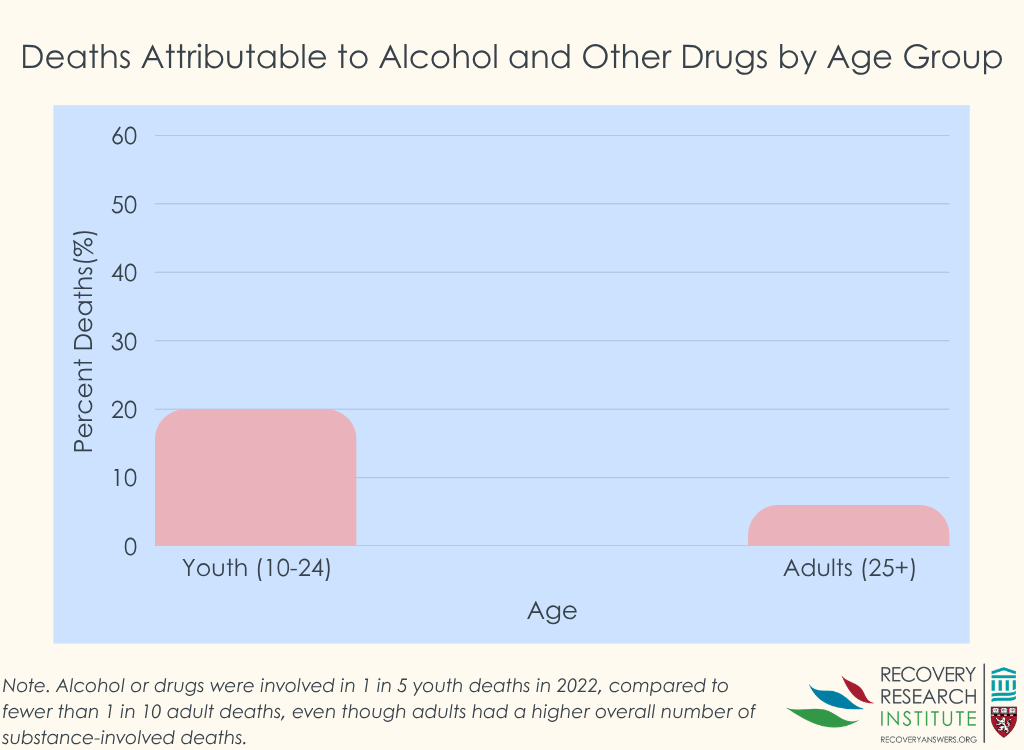
There were more deaths among youth in 2022, relative to adults, that involved alcohol or other drugs, with 20% of youth deaths involving substances (a rate of 12 per 100,000), compared to 6% of adult deaths (a rate of 90 per 100,000). Note that although substance-involved deaths occurred at a higher rate among adults than youth, they account for a much larger share of all deaths among young people because youth were less likely to die. This reflects an almost 4-fold higher odds of death involving substances among youth compared to adults, meaning substances make up a much larger slice of the youth mortality picture, even though this reflects the mix of causes of death rather than an individual young person’s risk. Substance involvement also ranked as the second-leading cause of death among youth, whereas it was 6th among adults.
Among youth deaths in 2022 involving substances, the majority were from drugs other than alcohol only, with 6,493 deaths and a rate of 10 per 100,000. Youth deaths involving alcohol only and both alcohol and another drug/s were rarer, with 515 alcohol-only deaths (rate of 1 per 100,000) and 829 deaths that involved both alcohol and other drugs (rate of 1 per 100,000).

When examining additional causes of death among youth when the specific causes were from accidents and liver disease, 40% and 48% also involved substances, respectively. When the specific cause of death was from a medical condition, such as hypertension, influenza/ pneumonia, respiratory disease, and diabetes, substance involvement was 2 to 4 times more prevalent in youth than adults.

Among deaths involving only drugs other than alcohol, the majority involved multiple drugs for both youth (86%) and adults (81%). Opioids and stimulants were common contributors to drug-only deaths in both age groups.


WHAT ARE THE IMPLICATIONS OF THE STUDY FINDINGS?

This study indicates that the majority of youth deaths in 2022 were from preventable causes, namely unintentional injuries and suicide, and often involve alcohol or other drugs. In contrast, the majority of deaths among adults aged 25 and older were from chronic diseases, such as heart disease and cancer. While adults accounted for more deaths involving alcohol and other drugs overall in absolute terms (i.e., they had a higher death rate than youth), the percentage or share of youth deaths involving substances was greater than adult substance-involved deaths (20% vs. 6%). Future research is needed to examine whether these trends remain consistent across time, but these findings are largely consistent with current CDC data showing that the majority of youth deaths are preventable. These findings underscore the need for tailored prevention and treatment strategies among youth to prevent substance use, injuries, and mental health conditions, which could include mental health support and expanded access to early intervention for substance use among adolescents.


BOTTOM LINE

The majority of youth deaths in 2022 were from preventable causes, namely unintentional injuries and suicide, and often involve alcohol or other drugs. These findings underscore the need for tailored prevention and intervention strategies to reduce substance use, injuries, and mental health conditions among youth.


  • For individuals and families seeking recovery:The high proportion of youth deaths involving preventable causes highlights the importance of addressing substance use and mental health concerns early. Families and young people may benefit from seeking support as soon as concerns arise, before they contribute to more serious health consequences.
  • For treatment professionals and treatment systems: These findings support continued screening and early intervention for substance use and mental health conditions among adolescents. Integrating prevention efforts across behavioral health, primary care, schools, and emergency settings may help identify youth at risk before preventable injuries or deaths occur.
  • For scientists: Because this study examined mortality data from a single year, future research that tracks these patterns over time would help determine whether the high proportion of preventable and substance-involved youth deaths is changing. Additional research examining differences across socioeconomic groups would help clarify whether these patterns vary across populations. Finally, studies using more consistent toxicology testing and reporting practices would improve understanding of the extent to which substances contribute to youth mortality.
  • For policy makers: These findings support continued investment in prevention efforts that address substance use, mental health, and injury prevention among adolescents. Policies that expand access to early intervention and strengthen youth behavioral health services may help reduce preventable deaths during this critical stage of development.

CITATIONS

Allen, C. B., Dennis, M., Mouton, C., & Grella, C. E. (2026). A comparative analysis of the most common causes of mortality and substance use by age. Public Health, 257. doi: 10.1016/j.puhe.2026.106306.



Stay on the Frontiers of
recovery science
with the free, monthly
Recovery Bulletin

l

WHAT PROBLEM DOES THIS STUDY ADDRESS?

Death is much less common among young people than among older adults and the types of deaths also differ substantially by age. Unintentional injuries and suicide account for large shares of deaths among young people, whereas chronic diseases such as heart disease and cancer account for larger shares among older adults. However, these causes are typically identified by the specific underlying cause, rather than examining additional contributing factors. The risk of only relying on the specific underlying cause is that it may miss the extent to which risk factors like alcohol and other drug use may have been involved in the cause of death (e.g., a death from a vehicle accident while driving under the influence of alcohol or other drugs). Death records from the US Centers for Disease Control and Prevention (CDC) include up to 20 fields that provide information on additional contributing factors. Known as the Multiple Cause of Death files, this data can help shed light on whether alcohol or other drugs were also involved, thereby informing prevention efforts. This study addresses the limitations of prior work examining mortality trends by scanning all 20 Multiple Cause of Death fields, which reveals contributing factors in addition to the specific underlying cause, to compare causes of death between youth and adults and investigate substance involvement.


HOW WAS THIS STUDY CONDUCTED?

This study analyzed national mortality data from 2022 among US youth (ages 10-24) and adults (ages 25 and older). Data was obtained from the CDC’s Multiple Cause of Death files. These are restricted use files maintained by the CDC that provide information on all causes of death listed on the death certificate, inclusive of underlying causes and contributing factors. Data on causes of death at the county level were collected and identified using ICD-10 diagnostic codes. Up to 20 causes per record were reviewed and extracted for analysis. Using the ICD-10 codes, the causes of death were then grouped into standard categories according to the National Vital Statistics System. These included deaths from unintentional injury, suicide, and chronic diseases (e.g., heart disease, cancer). Substance involvement was assessed by creating 4 exclusive groups from the Cause of Death fields: alcohol only, drugs other than alcohol only, both alcohol and other drugs, or neither.

Deaths were stratified based on age at death, with youth defined as ages of 10-24, and adults defined as 25 years old and older. Crude mortality rates per 100,000 individuals and proportional mortality (i.e., the percentage of deaths for each cause over the total population for the age group) were calculated. The analyses compared the likelihood that a death was from a given cause versus all other causes among youth relative to adults.

Of note, this study analyzed mortality data from 1 year only and not across time (i.e., a cross-sectional design). As such, the researchers couldn’t investigate trends across time in this study. Socioeconomic factors were also not considered, so the researchers were not able to examine whether such factors may have influenced their findings. Finally, toxicology testing and reporting of results vary substantially by state and medical examiner. For example, substance use tests may not have been done at all, or if done, may not have been recorded on the death certificate, both of which could result in an underestimation of substance involvement.


WHAT DID THIS STUDY FIND?

In 2022, there were overall 39,271 youth deaths and 3,222,599 adult deaths. This makes the rate 60 deaths per 100,000 youth and 1,403 deaths per 100,000 adults.

Among youth, the majority of deaths in 2022 were from unintentional injuries (40%; 24 deaths per 100,000) and suicide (17%; 10 deaths per 100,000). This was followed by deaths from cancer (4%; 2 per 100,000) and heart disease (4%; 2 per 100,000). Deaths from chronic conditions, including stroke, diabetes, respiratory disease, and influenza/pneumonia were rare. Among adults, the majority of deaths were from heart disease (22%) and cancer (19%).

There were more deaths among youth in 2022, relative to adults, that involved alcohol or other drugs, with 20% of youth deaths involving substances (a rate of 12 per 100,000), compared to 6% of adult deaths (a rate of 90 per 100,000). Note that although substance-involved deaths occurred at a higher rate among adults than youth, they account for a much larger share of all deaths among young people because youth were less likely to die. This reflects an almost 4-fold higher odds of death involving substances among youth compared to adults, meaning substances make up a much larger slice of the youth mortality picture, even though this reflects the mix of causes of death rather than an individual young person’s risk. Substance involvement also ranked as the second-leading cause of death among youth, whereas it was 6th among adults.

Among youth deaths in 2022 involving substances, the majority were from drugs other than alcohol only, with 6,493 deaths and a rate of 10 per 100,000. Youth deaths involving alcohol only and both alcohol and another drug/s were rarer, with 515 alcohol-only deaths (rate of 1 per 100,000) and 829 deaths that involved both alcohol and other drugs (rate of 1 per 100,000).

When examining additional causes of death among youth when the specific causes were from accidents and liver disease, 40% and 48% also involved substances, respectively. When the specific cause of death was from a medical condition, such as hypertension, influenza/ pneumonia, respiratory disease, and diabetes, substance involvement was 2 to 4 times more prevalent in youth than adults.

Among deaths involving only drugs other than alcohol, the majority involved multiple drugs for both youth (86%) and adults (81%). Opioids and stimulants were common contributors to drug-only deaths in both age groups.


WHAT ARE THE IMPLICATIONS OF THE STUDY FINDINGS?

This study indicates that the majority of youth deaths in 2022 were from preventable causes, namely unintentional injuries and suicide, and often involve alcohol or other drugs. In contrast, the majority of deaths among adults aged 25 and older were from chronic diseases, such as heart disease and cancer. While adults accounted for more deaths involving alcohol and other drugs overall in absolute terms (i.e., they had a higher death rate than youth), the percentage or share of youth deaths involving substances was greater than adult substance-involved deaths (20% vs. 6%). Future research is needed to examine whether these trends remain consistent across time, but these findings are largely consistent with current CDC data showing that the majority of youth deaths are preventable. These findings underscore the need for tailored prevention and treatment strategies among youth to prevent substance use, injuries, and mental health conditions, which could include mental health support and expanded access to early intervention for substance use among adolescents.


BOTTOM LINE

The majority of youth deaths in 2022 were from preventable causes, namely unintentional injuries and suicide, and often involve alcohol or other drugs. These findings underscore the need for tailored prevention and intervention strategies to reduce substance use, injuries, and mental health conditions among youth.


  • For individuals and families seeking recovery:The high proportion of youth deaths involving preventable causes highlights the importance of addressing substance use and mental health concerns early. Families and young people may benefit from seeking support as soon as concerns arise, before they contribute to more serious health consequences.
  • For treatment professionals and treatment systems: These findings support continued screening and early intervention for substance use and mental health conditions among adolescents. Integrating prevention efforts across behavioral health, primary care, schools, and emergency settings may help identify youth at risk before preventable injuries or deaths occur.
  • For scientists: Because this study examined mortality data from a single year, future research that tracks these patterns over time would help determine whether the high proportion of preventable and substance-involved youth deaths is changing. Additional research examining differences across socioeconomic groups would help clarify whether these patterns vary across populations. Finally, studies using more consistent toxicology testing and reporting practices would improve understanding of the extent to which substances contribute to youth mortality.
  • For policy makers: These findings support continued investment in prevention efforts that address substance use, mental health, and injury prevention among adolescents. Policies that expand access to early intervention and strengthen youth behavioral health services may help reduce preventable deaths during this critical stage of development.

CITATIONS

Allen, C. B., Dennis, M., Mouton, C., & Grella, C. E. (2026). A comparative analysis of the most common causes of mortality and substance use by age. Public Health, 257. doi: 10.1016/j.puhe.2026.106306.


Share this article

l

WHAT PROBLEM DOES THIS STUDY ADDRESS?

Death is much less common among young people than among older adults and the types of deaths also differ substantially by age. Unintentional injuries and suicide account for large shares of deaths among young people, whereas chronic diseases such as heart disease and cancer account for larger shares among older adults. However, these causes are typically identified by the specific underlying cause, rather than examining additional contributing factors. The risk of only relying on the specific underlying cause is that it may miss the extent to which risk factors like alcohol and other drug use may have been involved in the cause of death (e.g., a death from a vehicle accident while driving under the influence of alcohol or other drugs). Death records from the US Centers for Disease Control and Prevention (CDC) include up to 20 fields that provide information on additional contributing factors. Known as the Multiple Cause of Death files, this data can help shed light on whether alcohol or other drugs were also involved, thereby informing prevention efforts. This study addresses the limitations of prior work examining mortality trends by scanning all 20 Multiple Cause of Death fields, which reveals contributing factors in addition to the specific underlying cause, to compare causes of death between youth and adults and investigate substance involvement.


HOW WAS THIS STUDY CONDUCTED?

This study analyzed national mortality data from 2022 among US youth (ages 10-24) and adults (ages 25 and older). Data was obtained from the CDC’s Multiple Cause of Death files. These are restricted use files maintained by the CDC that provide information on all causes of death listed on the death certificate, inclusive of underlying causes and contributing factors. Data on causes of death at the county level were collected and identified using ICD-10 diagnostic codes. Up to 20 causes per record were reviewed and extracted for analysis. Using the ICD-10 codes, the causes of death were then grouped into standard categories according to the National Vital Statistics System. These included deaths from unintentional injury, suicide, and chronic diseases (e.g., heart disease, cancer). Substance involvement was assessed by creating 4 exclusive groups from the Cause of Death fields: alcohol only, drugs other than alcohol only, both alcohol and other drugs, or neither.

Deaths were stratified based on age at death, with youth defined as ages of 10-24, and adults defined as 25 years old and older. Crude mortality rates per 100,000 individuals and proportional mortality (i.e., the percentage of deaths for each cause over the total population for the age group) were calculated. The analyses compared the likelihood that a death was from a given cause versus all other causes among youth relative to adults.

Of note, this study analyzed mortality data from 1 year only and not across time (i.e., a cross-sectional design). As such, the researchers couldn’t investigate trends across time in this study. Socioeconomic factors were also not considered, so the researchers were not able to examine whether such factors may have influenced their findings. Finally, toxicology testing and reporting of results vary substantially by state and medical examiner. For example, substance use tests may not have been done at all, or if done, may not have been recorded on the death certificate, both of which could result in an underestimation of substance involvement.


WHAT DID THIS STUDY FIND?

In 2022, there were overall 39,271 youth deaths and 3,222,599 adult deaths. This makes the rate 60 deaths per 100,000 youth and 1,403 deaths per 100,000 adults.

Among youth, the majority of deaths in 2022 were from unintentional injuries (40%; 24 deaths per 100,000) and suicide (17%; 10 deaths per 100,000). This was followed by deaths from cancer (4%; 2 per 100,000) and heart disease (4%; 2 per 100,000). Deaths from chronic conditions, including stroke, diabetes, respiratory disease, and influenza/pneumonia were rare. Among adults, the majority of deaths were from heart disease (22%) and cancer (19%).

There were more deaths among youth in 2022, relative to adults, that involved alcohol or other drugs, with 20% of youth deaths involving substances (a rate of 12 per 100,000), compared to 6% of adult deaths (a rate of 90 per 100,000). Note that although substance-involved deaths occurred at a higher rate among adults than youth, they account for a much larger share of all deaths among young people because youth were less likely to die. This reflects an almost 4-fold higher odds of death involving substances among youth compared to adults, meaning substances make up a much larger slice of the youth mortality picture, even though this reflects the mix of causes of death rather than an individual young person’s risk. Substance involvement also ranked as the second-leading cause of death among youth, whereas it was 6th among adults.

Among youth deaths in 2022 involving substances, the majority were from drugs other than alcohol only, with 6,493 deaths and a rate of 10 per 100,000. Youth deaths involving alcohol only and both alcohol and another drug/s were rarer, with 515 alcohol-only deaths (rate of 1 per 100,000) and 829 deaths that involved both alcohol and other drugs (rate of 1 per 100,000).

When examining additional causes of death among youth when the specific causes were from accidents and liver disease, 40% and 48% also involved substances, respectively. When the specific cause of death was from a medical condition, such as hypertension, influenza/ pneumonia, respiratory disease, and diabetes, substance involvement was 2 to 4 times more prevalent in youth than adults.

Among deaths involving only drugs other than alcohol, the majority involved multiple drugs for both youth (86%) and adults (81%). Opioids and stimulants were common contributors to drug-only deaths in both age groups.


WHAT ARE THE IMPLICATIONS OF THE STUDY FINDINGS?

This study indicates that the majority of youth deaths in 2022 were from preventable causes, namely unintentional injuries and suicide, and often involve alcohol or other drugs. In contrast, the majority of deaths among adults aged 25 and older were from chronic diseases, such as heart disease and cancer. While adults accounted for more deaths involving alcohol and other drugs overall in absolute terms (i.e., they had a higher death rate than youth), the percentage or share of youth deaths involving substances was greater than adult substance-involved deaths (20% vs. 6%). Future research is needed to examine whether these trends remain consistent across time, but these findings are largely consistent with current CDC data showing that the majority of youth deaths are preventable. These findings underscore the need for tailored prevention and treatment strategies among youth to prevent substance use, injuries, and mental health conditions, which could include mental health support and expanded access to early intervention for substance use among adolescents.


BOTTOM LINE

The majority of youth deaths in 2022 were from preventable causes, namely unintentional injuries and suicide, and often involve alcohol or other drugs. These findings underscore the need for tailored prevention and intervention strategies to reduce substance use, injuries, and mental health conditions among youth.


  • For individuals and families seeking recovery:The high proportion of youth deaths involving preventable causes highlights the importance of addressing substance use and mental health concerns early. Families and young people may benefit from seeking support as soon as concerns arise, before they contribute to more serious health consequences.
  • For treatment professionals and treatment systems: These findings support continued screening and early intervention for substance use and mental health conditions among adolescents. Integrating prevention efforts across behavioral health, primary care, schools, and emergency settings may help identify youth at risk before preventable injuries or deaths occur.
  • For scientists: Because this study examined mortality data from a single year, future research that tracks these patterns over time would help determine whether the high proportion of preventable and substance-involved youth deaths is changing. Additional research examining differences across socioeconomic groups would help clarify whether these patterns vary across populations. Finally, studies using more consistent toxicology testing and reporting practices would improve understanding of the extent to which substances contribute to youth mortality.
  • For policy makers: These findings support continued investment in prevention efforts that address substance use, mental health, and injury prevention among adolescents. Policies that expand access to early intervention and strengthen youth behavioral health services may help reduce preventable deaths during this critical stage of development.

CITATIONS

Allen, C. B., Dennis, M., Mouton, C., & Grella, C. E. (2026). A comparative analysis of the most common causes of mortality and substance use by age. Public Health, 257. doi: 10.1016/j.puhe.2026.106306.


Share this article