Alcohol content on social media emphasizes positives and rarely mentions cancer risk

  • Home
  • Research
  • Alcohol content on social media emphasizes positives and rarely mentions cancer risk

Alcohol is a leading cause of preventable cancer, yet many people remain unaware of this link. Social media platforms like Instagram and TikTok are major sources of health information and may shape social norms around alcohol use. This study examined how often alcohol-related posts mention cancer risk.

Stay on the frontiers of
recovery science
with the free, monthly
Recovery Bulletin

l

WHAT PROBLEM DOES THIS STUDY ADDRESS?

Alcohol use is a well-established risk factor for several types of cancer (e.g., breast, liver, and colorectal), yet public awareness of alcohol-related cancer risks remains low. Many Americans continue to believe that moderate alcohol consumption (e.g., a glass of red wine a day) is harmless – or even beneficial – despite growing clearer evidence to the contrary. Increasing awareness of the link between alcohol consumption and cancer is an important public health priority, as beliefs about alcohol’s health effects are associated with how much people drink.

One way to reach large audiences with health information is through popular social media platforms like Instagram and TikTok, which have become common sources of health-related content and may shape social norms around alcohol use. However, prior research suggests that alcohol-related content on social media platforms is often pro-alcohol and rarely portrays potential harms. Greater exposure to pro-alcohol social media content has also been linked to higher levels of drinking. It remains unclear whether social media content reflects current scientific understanding of alcohol’s health risks, including its link to cancer. This study examined whether alcohol-related posts on Instagram and TikTok include information about cancer risk and what messages about drinking are most commonly portrayed.


HOW WAS THIS STUDY CONDUCTED?

Publicly available Instagram and TikTok posts tagged with common alcohol-related hashtags (#alcohol, #beer, #wine, #liquor, and #cocktail) were collected in May 2024. From a large data set (83,285 Instagram posts and 3,622 TikTok posts), the researchers randomly selected a 2% subsample of Instagram posts (n = 1,666) and a 20% subsample of TikTok posts (n = 725) for detailed review. Trained coders evaluated each post using a structured codebook to assess key features, including who created the post (e.g., individual, news organization, academic or medical institution, government, or commercial account), how alcohol was portrayed (e.g., positive, neutral, negative), whether alcohol products or intoxication were shown, and whether the post mentioned cancer risk. Coding was conducted by multiple reviewers, with differences resolved through discussion.  The study used both quantitative and qualitative approaches – summarizing how often different types of content appeared and identifying common themes across posts. The researchers also conducted an additional search across all collected posts to identify any mention of “cancer.”

Several aspects of the study design are important for interpreting the findings. The analysis included only a subset of posts from two social media platforms and focused on specific alcohol-related hashtags, meaning results may not reflect all alcohol or cancer-related content on social media. In addition, posts were collected in 2024, before widespread public attention to recent reports on alcohol and cancer risk, and content may have shifted since then. Finally, although structure coding procedures were used, interpreting social media content involves some subjectivity.


WHAT DID THIS STUDY FIND?

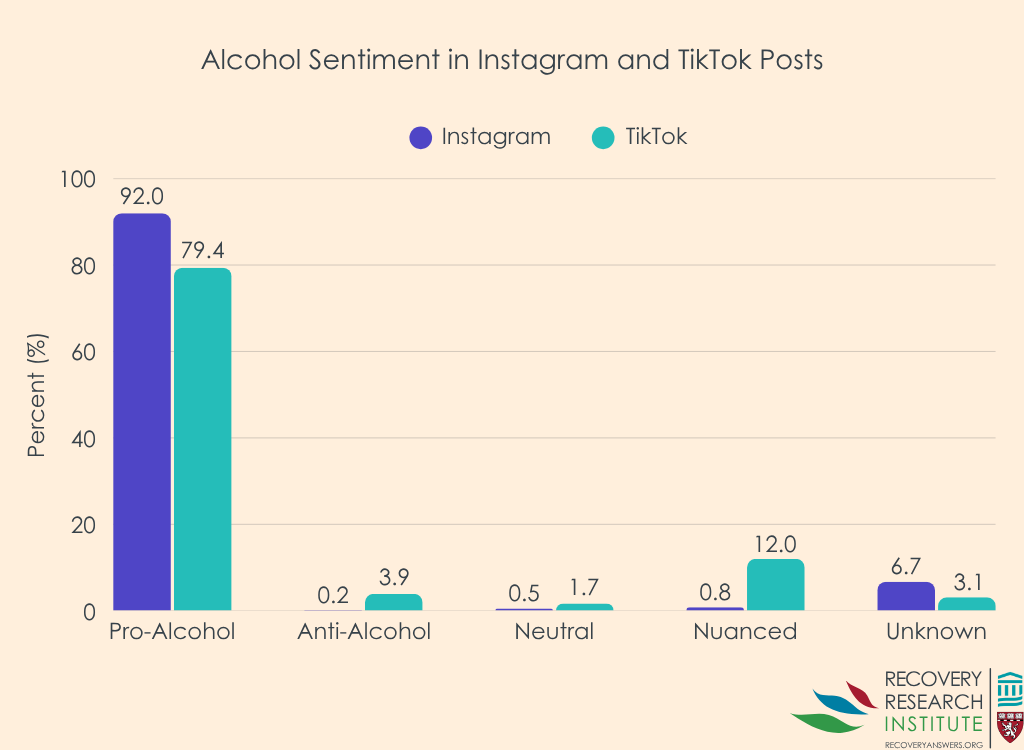
Alcohol-related cancer risk messaging in this sample of alcohol-related TikTok and Instagram posts was nearly non-existent – only one post across both platforms mentioned the link between alcohol use and cancer. In contrast, most content portrayed alcohol in a positive light (79% on TikTok and 92% on Instagram) – see graphs below.
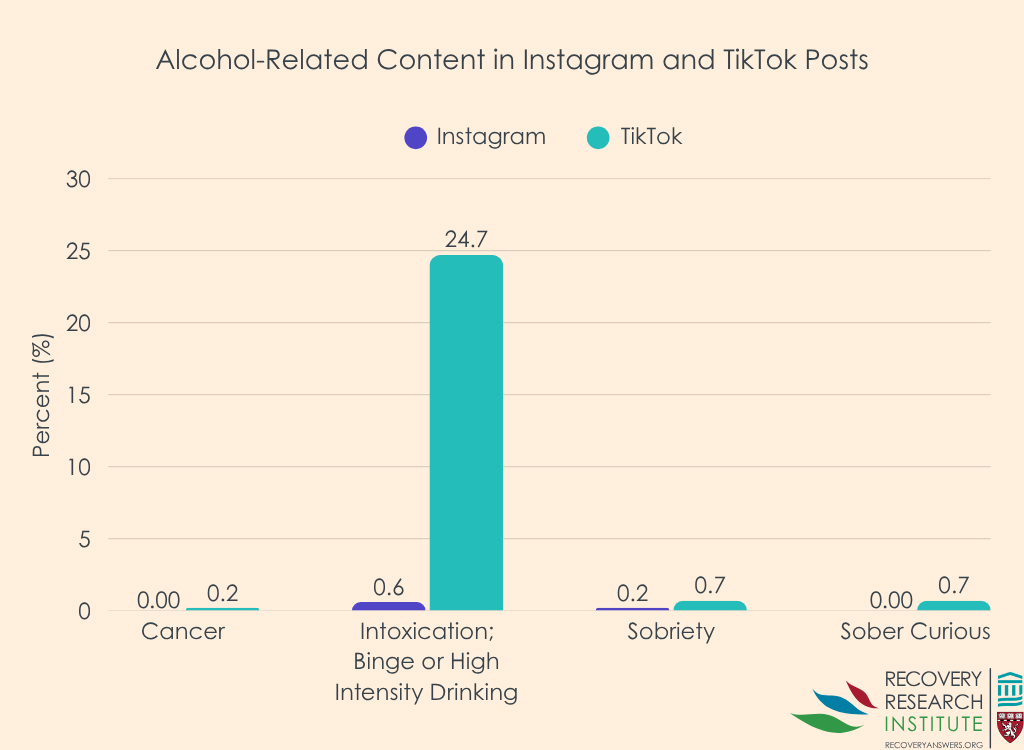
On Instagram, commercial or marketing accounts were responsible for nearly half (49%) of alcohol-related posts, and about 7 in 10 posts featured an alcohol product. On TikTok, influencers created the majority (68%) of alcohol-related posts. Across both platforms, only two posts (both on TikTok) were from medical professionals, and none were from government, academic, or medical institutions. Some content also normalized risky drinking behaviors. For example, about 1 in 4 TikTok posts portrayed intoxication or binge drinking. These posts sometimes portrayed large amounts of alcohol as a single drink, which may blur perceptions of what constitutes moderate versus binge drinking.

In an additional search of more than 85,000 posts across the full dataset, the term “cancer” appeared in 51 Instagram posts and 3 TikTok posts. However, upon further review, most of these posts were not related to alcohol-related cancer risk. On Instagram, many referenced general cancer awareness or fundraising events being held at breweries or wineries, and only one post explicitly discussed the link between alcohol use and cancer. None of the TikTok posts mentioning “cancer” addressed this link.


WHAT ARE THE IMPLICATIONS OF THE STUDY FINDINGS?

Findings from this study suggest that social media is currently underutilized as a platform for communicating alcohol-related cancer risks. This aligns with prior research indicating that popular platforms like TikTok are underutilized for public health messaging in the substance use space. Instead, alcohol-related content on Instagram and TikTok tends to emphasize positive aspects of drinking, which may contribute to low awareness of alcohol-related harms and reinforce beliefs that normalize drinking behaviors, including binge drinking and intoxication. Much of this content is created by influencers and the alcohol industry, with little representation from medical professionals, researchers, government agencies, or medical institutions. That said, beliefs that moderate drinking is bad for one’s health are at an all time high. It is possible that while content regarding the “wellbriety” movement is on the rise, these posts may not specifically mention alcohol-related risks including but not limited to its carcinogenic effects. Posts that focus on the benefits of sobriety may not be captured in studies like these.

In addition, alcohol-related content is often subtly embedded within lifestyle influencer posts rather than clearly labeled as advertising. Prior research suggests that exposure to this type of lifestyle influencer content – particularly when it includes subtle alcohol product placement – is associated with greater desire to drink among adolescents and young adults. Social media platforms also prioritize engaging and widely shared content, which may increase exposure to posts that portray alcohol positively while limiting the visibility of content that highlights potential risks. Together, these patterns may contribute to an incomplete or imbalanced picture of alcohol use and its health effects.

Given the widespread use of platforms like Instagram and TikTok, these findings point to an opportunity to develop, disseminate, and increase the visibility of clear, accessible information about alcohol and cancer risk on social media. Additional research is needed to better understand how different types of alcohol-related messaging – including messaging about alcohol and cancer risk – may influence alcohol-related knowledge, attitudes, and behavior.


BOTTOM LINE

This study found that alcohol-related content on Instagram and TikTok often portrays drinking positively and rarely mentions alcohol-related cancer risks. Social media may be an underused but potentially important tool for improving public awareness of alcohol’s harms, which, if leveraged, could help reduce alcohol-related harm at the population level.


  • For individuals and families seeking recovery: Alcohol-related content on social media often portrays drinking in a positive light, while rarely mentioning its potential health risks, including cancer. When seeking information about alcohol and its health effects, it is recommended to turn to trusted sources (e.g., National Institute on Alcohol Abuse and Alcoholism) rather than relying on social media, as these sources can provide a more balanced and evidence-based understanding of alcohol-related risks.
  • For treatment professionals and treatment systems: Patients may be regularly exposed to alcohol-related content on social media that emphasizes positive aspects of drinking while downplaying or omitting important health risks. Clinicians may want to consider discussing how social media influences perceptions of alcohol use and incorporating education about alcohol-related harms, including cancer risk, into treatment and prevention efforts. Findings also highlight opportunities for health professionals and systems to share accurate, accessible health information on social media, as such messaging is currently limited on Instagram and TikTok.
  • For scientists: This study highlights a gap between scientific evidence on alcohol-related cancer risk and how alcohol is portrayed on widely used social media platforms. Future research could examine how exposure to different types of alcohol-related content influences alcohol-related knowledge, attitudes, and behaviors, including public health campaigns designed to increase awareness of the link between alcohol and cancer.
  • For policy makers: There is increasing legal and social pressure on social media companies to enhance accountability and transparency regarding how their algorithms operate and alleged harms caused to platform users. Prior research has shown that pro-alcohol content proliferates on these platforms, reaching underage individuals, and that greater exposure to this content is linked to increased drinking. At the same time. the limited presence of content depicting alcohol-related consequences – including the link between alcohol and cancer – may contribute to an unrealistic picture of alcohol use and reinforce social norms that can lead to harm at both individual and societal levels. Greater oversight over how social media companies and the alcohol industry shape and promote content is crucial. In addition, funding for research to develop and evaluate social media-based health communication campaigns focused on alcohol-related cancer risk could help improve public awareness and inform more effective prevention efforts.

CITATIONS

Alejandro, J., Mair, C., Coulter, R. W. S., Chu, K. H., Pierce, A., Sawicki, K., Tripathi, A., & Sidani, J. E. (2026). Alcohol‐cancer risk communication on social media: A content analysis of alcohol‐related Instagram and TikTok posts. Alcohol: Clinical and Experimental Research, 50(2). doi: 10.1111/acer.70260.


Stay on the Frontiers of
recovery science
with the free, monthly
Recovery Bulletin

l

WHAT PROBLEM DOES THIS STUDY ADDRESS?

Alcohol use is a well-established risk factor for several types of cancer (e.g., breast, liver, and colorectal), yet public awareness of alcohol-related cancer risks remains low. Many Americans continue to believe that moderate alcohol consumption (e.g., a glass of red wine a day) is harmless – or even beneficial – despite growing clearer evidence to the contrary. Increasing awareness of the link between alcohol consumption and cancer is an important public health priority, as beliefs about alcohol’s health effects are associated with how much people drink.

One way to reach large audiences with health information is through popular social media platforms like Instagram and TikTok, which have become common sources of health-related content and may shape social norms around alcohol use. However, prior research suggests that alcohol-related content on social media platforms is often pro-alcohol and rarely portrays potential harms. Greater exposure to pro-alcohol social media content has also been linked to higher levels of drinking. It remains unclear whether social media content reflects current scientific understanding of alcohol’s health risks, including its link to cancer. This study examined whether alcohol-related posts on Instagram and TikTok include information about cancer risk and what messages about drinking are most commonly portrayed.


HOW WAS THIS STUDY CONDUCTED?

Publicly available Instagram and TikTok posts tagged with common alcohol-related hashtags (#alcohol, #beer, #wine, #liquor, and #cocktail) were collected in May 2024. From a large data set (83,285 Instagram posts and 3,622 TikTok posts), the researchers randomly selected a 2% subsample of Instagram posts (n = 1,666) and a 20% subsample of TikTok posts (n = 725) for detailed review. Trained coders evaluated each post using a structured codebook to assess key features, including who created the post (e.g., individual, news organization, academic or medical institution, government, or commercial account), how alcohol was portrayed (e.g., positive, neutral, negative), whether alcohol products or intoxication were shown, and whether the post mentioned cancer risk. Coding was conducted by multiple reviewers, with differences resolved through discussion.  The study used both quantitative and qualitative approaches – summarizing how often different types of content appeared and identifying common themes across posts. The researchers also conducted an additional search across all collected posts to identify any mention of “cancer.”

Several aspects of the study design are important for interpreting the findings. The analysis included only a subset of posts from two social media platforms and focused on specific alcohol-related hashtags, meaning results may not reflect all alcohol or cancer-related content on social media. In addition, posts were collected in 2024, before widespread public attention to recent reports on alcohol and cancer risk, and content may have shifted since then. Finally, although structure coding procedures were used, interpreting social media content involves some subjectivity.


WHAT DID THIS STUDY FIND?

Alcohol-related cancer risk messaging in this sample of alcohol-related TikTok and Instagram posts was nearly non-existent – only one post across both platforms mentioned the link between alcohol use and cancer. In contrast, most content portrayed alcohol in a positive light (79% on TikTok and 92% on Instagram) – see graphs below.

On Instagram, commercial or marketing accounts were responsible for nearly half (49%) of alcohol-related posts, and about 7 in 10 posts featured an alcohol product. On TikTok, influencers created the majority (68%) of alcohol-related posts. Across both platforms, only two posts (both on TikTok) were from medical professionals, and none were from government, academic, or medical institutions. Some content also normalized risky drinking behaviors. For example, about 1 in 4 TikTok posts portrayed intoxication or binge drinking. These posts sometimes portrayed large amounts of alcohol as a single drink, which may blur perceptions of what constitutes moderate versus binge drinking.

In an additional search of more than 85,000 posts across the full dataset, the term “cancer” appeared in 51 Instagram posts and 3 TikTok posts. However, upon further review, most of these posts were not related to alcohol-related cancer risk. On Instagram, many referenced general cancer awareness or fundraising events being held at breweries or wineries, and only one post explicitly discussed the link between alcohol use and cancer. None of the TikTok posts mentioning “cancer” addressed this link.


WHAT ARE THE IMPLICATIONS OF THE STUDY FINDINGS?

Findings from this study suggest that social media is currently underutilized as a platform for communicating alcohol-related cancer risks. This aligns with prior research indicating that popular platforms like TikTok are underutilized for public health messaging in the substance use space. Instead, alcohol-related content on Instagram and TikTok tends to emphasize positive aspects of drinking, which may contribute to low awareness of alcohol-related harms and reinforce beliefs that normalize drinking behaviors, including binge drinking and intoxication. Much of this content is created by influencers and the alcohol industry, with little representation from medical professionals, researchers, government agencies, or medical institutions. That said, beliefs that moderate drinking is bad for one’s health are at an all time high. It is possible that while content regarding the “wellbriety” movement is on the rise, these posts may not specifically mention alcohol-related risks including but not limited to its carcinogenic effects. Posts that focus on the benefits of sobriety may not be captured in studies like these.

In addition, alcohol-related content is often subtly embedded within lifestyle influencer posts rather than clearly labeled as advertising. Prior research suggests that exposure to this type of lifestyle influencer content – particularly when it includes subtle alcohol product placement – is associated with greater desire to drink among adolescents and young adults. Social media platforms also prioritize engaging and widely shared content, which may increase exposure to posts that portray alcohol positively while limiting the visibility of content that highlights potential risks. Together, these patterns may contribute to an incomplete or imbalanced picture of alcohol use and its health effects.

Given the widespread use of platforms like Instagram and TikTok, these findings point to an opportunity to develop, disseminate, and increase the visibility of clear, accessible information about alcohol and cancer risk on social media. Additional research is needed to better understand how different types of alcohol-related messaging – including messaging about alcohol and cancer risk – may influence alcohol-related knowledge, attitudes, and behavior.


BOTTOM LINE

This study found that alcohol-related content on Instagram and TikTok often portrays drinking positively and rarely mentions alcohol-related cancer risks. Social media may be an underused but potentially important tool for improving public awareness of alcohol’s harms, which, if leveraged, could help reduce alcohol-related harm at the population level.


  • For individuals and families seeking recovery: Alcohol-related content on social media often portrays drinking in a positive light, while rarely mentioning its potential health risks, including cancer. When seeking information about alcohol and its health effects, it is recommended to turn to trusted sources (e.g., National Institute on Alcohol Abuse and Alcoholism) rather than relying on social media, as these sources can provide a more balanced and evidence-based understanding of alcohol-related risks.
  • For treatment professionals and treatment systems: Patients may be regularly exposed to alcohol-related content on social media that emphasizes positive aspects of drinking while downplaying or omitting important health risks. Clinicians may want to consider discussing how social media influences perceptions of alcohol use and incorporating education about alcohol-related harms, including cancer risk, into treatment and prevention efforts. Findings also highlight opportunities for health professionals and systems to share accurate, accessible health information on social media, as such messaging is currently limited on Instagram and TikTok.
  • For scientists: This study highlights a gap between scientific evidence on alcohol-related cancer risk and how alcohol is portrayed on widely used social media platforms. Future research could examine how exposure to different types of alcohol-related content influences alcohol-related knowledge, attitudes, and behaviors, including public health campaigns designed to increase awareness of the link between alcohol and cancer.
  • For policy makers: There is increasing legal and social pressure on social media companies to enhance accountability and transparency regarding how their algorithms operate and alleged harms caused to platform users. Prior research has shown that pro-alcohol content proliferates on these platforms, reaching underage individuals, and that greater exposure to this content is linked to increased drinking. At the same time. the limited presence of content depicting alcohol-related consequences – including the link between alcohol and cancer – may contribute to an unrealistic picture of alcohol use and reinforce social norms that can lead to harm at both individual and societal levels. Greater oversight over how social media companies and the alcohol industry shape and promote content is crucial. In addition, funding for research to develop and evaluate social media-based health communication campaigns focused on alcohol-related cancer risk could help improve public awareness and inform more effective prevention efforts.

CITATIONS

Alejandro, J., Mair, C., Coulter, R. W. S., Chu, K. H., Pierce, A., Sawicki, K., Tripathi, A., & Sidani, J. E. (2026). Alcohol‐cancer risk communication on social media: A content analysis of alcohol‐related Instagram and TikTok posts. Alcohol: Clinical and Experimental Research, 50(2). doi: 10.1111/acer.70260.


Share this article

l

WHAT PROBLEM DOES THIS STUDY ADDRESS?

Alcohol use is a well-established risk factor for several types of cancer (e.g., breast, liver, and colorectal), yet public awareness of alcohol-related cancer risks remains low. Many Americans continue to believe that moderate alcohol consumption (e.g., a glass of red wine a day) is harmless – or even beneficial – despite growing clearer evidence to the contrary. Increasing awareness of the link between alcohol consumption and cancer is an important public health priority, as beliefs about alcohol’s health effects are associated with how much people drink.

One way to reach large audiences with health information is through popular social media platforms like Instagram and TikTok, which have become common sources of health-related content and may shape social norms around alcohol use. However, prior research suggests that alcohol-related content on social media platforms is often pro-alcohol and rarely portrays potential harms. Greater exposure to pro-alcohol social media content has also been linked to higher levels of drinking. It remains unclear whether social media content reflects current scientific understanding of alcohol’s health risks, including its link to cancer. This study examined whether alcohol-related posts on Instagram and TikTok include information about cancer risk and what messages about drinking are most commonly portrayed.


HOW WAS THIS STUDY CONDUCTED?

Publicly available Instagram and TikTok posts tagged with common alcohol-related hashtags (#alcohol, #beer, #wine, #liquor, and #cocktail) were collected in May 2024. From a large data set (83,285 Instagram posts and 3,622 TikTok posts), the researchers randomly selected a 2% subsample of Instagram posts (n = 1,666) and a 20% subsample of TikTok posts (n = 725) for detailed review. Trained coders evaluated each post using a structured codebook to assess key features, including who created the post (e.g., individual, news organization, academic or medical institution, government, or commercial account), how alcohol was portrayed (e.g., positive, neutral, negative), whether alcohol products or intoxication were shown, and whether the post mentioned cancer risk. Coding was conducted by multiple reviewers, with differences resolved through discussion.  The study used both quantitative and qualitative approaches – summarizing how often different types of content appeared and identifying common themes across posts. The researchers also conducted an additional search across all collected posts to identify any mention of “cancer.”

Several aspects of the study design are important for interpreting the findings. The analysis included only a subset of posts from two social media platforms and focused on specific alcohol-related hashtags, meaning results may not reflect all alcohol or cancer-related content on social media. In addition, posts were collected in 2024, before widespread public attention to recent reports on alcohol and cancer risk, and content may have shifted since then. Finally, although structure coding procedures were used, interpreting social media content involves some subjectivity.


WHAT DID THIS STUDY FIND?

Alcohol-related cancer risk messaging in this sample of alcohol-related TikTok and Instagram posts was nearly non-existent – only one post across both platforms mentioned the link between alcohol use and cancer. In contrast, most content portrayed alcohol in a positive light (79% on TikTok and 92% on Instagram) – see graphs below.

On Instagram, commercial or marketing accounts were responsible for nearly half (49%) of alcohol-related posts, and about 7 in 10 posts featured an alcohol product. On TikTok, influencers created the majority (68%) of alcohol-related posts. Across both platforms, only two posts (both on TikTok) were from medical professionals, and none were from government, academic, or medical institutions. Some content also normalized risky drinking behaviors. For example, about 1 in 4 TikTok posts portrayed intoxication or binge drinking. These posts sometimes portrayed large amounts of alcohol as a single drink, which may blur perceptions of what constitutes moderate versus binge drinking.

In an additional search of more than 85,000 posts across the full dataset, the term “cancer” appeared in 51 Instagram posts and 3 TikTok posts. However, upon further review, most of these posts were not related to alcohol-related cancer risk. On Instagram, many referenced general cancer awareness or fundraising events being held at breweries or wineries, and only one post explicitly discussed the link between alcohol use and cancer. None of the TikTok posts mentioning “cancer” addressed this link.


WHAT ARE THE IMPLICATIONS OF THE STUDY FINDINGS?

Findings from this study suggest that social media is currently underutilized as a platform for communicating alcohol-related cancer risks. This aligns with prior research indicating that popular platforms like TikTok are underutilized for public health messaging in the substance use space. Instead, alcohol-related content on Instagram and TikTok tends to emphasize positive aspects of drinking, which may contribute to low awareness of alcohol-related harms and reinforce beliefs that normalize drinking behaviors, including binge drinking and intoxication. Much of this content is created by influencers and the alcohol industry, with little representation from medical professionals, researchers, government agencies, or medical institutions. That said, beliefs that moderate drinking is bad for one’s health are at an all time high. It is possible that while content regarding the “wellbriety” movement is on the rise, these posts may not specifically mention alcohol-related risks including but not limited to its carcinogenic effects. Posts that focus on the benefits of sobriety may not be captured in studies like these.

In addition, alcohol-related content is often subtly embedded within lifestyle influencer posts rather than clearly labeled as advertising. Prior research suggests that exposure to this type of lifestyle influencer content – particularly when it includes subtle alcohol product placement – is associated with greater desire to drink among adolescents and young adults. Social media platforms also prioritize engaging and widely shared content, which may increase exposure to posts that portray alcohol positively while limiting the visibility of content that highlights potential risks. Together, these patterns may contribute to an incomplete or imbalanced picture of alcohol use and its health effects.

Given the widespread use of platforms like Instagram and TikTok, these findings point to an opportunity to develop, disseminate, and increase the visibility of clear, accessible information about alcohol and cancer risk on social media. Additional research is needed to better understand how different types of alcohol-related messaging – including messaging about alcohol and cancer risk – may influence alcohol-related knowledge, attitudes, and behavior.


BOTTOM LINE

This study found that alcohol-related content on Instagram and TikTok often portrays drinking positively and rarely mentions alcohol-related cancer risks. Social media may be an underused but potentially important tool for improving public awareness of alcohol’s harms, which, if leveraged, could help reduce alcohol-related harm at the population level.


  • For individuals and families seeking recovery: Alcohol-related content on social media often portrays drinking in a positive light, while rarely mentioning its potential health risks, including cancer. When seeking information about alcohol and its health effects, it is recommended to turn to trusted sources (e.g., National Institute on Alcohol Abuse and Alcoholism) rather than relying on social media, as these sources can provide a more balanced and evidence-based understanding of alcohol-related risks.
  • For treatment professionals and treatment systems: Patients may be regularly exposed to alcohol-related content on social media that emphasizes positive aspects of drinking while downplaying or omitting important health risks. Clinicians may want to consider discussing how social media influences perceptions of alcohol use and incorporating education about alcohol-related harms, including cancer risk, into treatment and prevention efforts. Findings also highlight opportunities for health professionals and systems to share accurate, accessible health information on social media, as such messaging is currently limited on Instagram and TikTok.
  • For scientists: This study highlights a gap between scientific evidence on alcohol-related cancer risk and how alcohol is portrayed on widely used social media platforms. Future research could examine how exposure to different types of alcohol-related content influences alcohol-related knowledge, attitudes, and behaviors, including public health campaigns designed to increase awareness of the link between alcohol and cancer.
  • For policy makers: There is increasing legal and social pressure on social media companies to enhance accountability and transparency regarding how their algorithms operate and alleged harms caused to platform users. Prior research has shown that pro-alcohol content proliferates on these platforms, reaching underage individuals, and that greater exposure to this content is linked to increased drinking. At the same time. the limited presence of content depicting alcohol-related consequences – including the link between alcohol and cancer – may contribute to an unrealistic picture of alcohol use and reinforce social norms that can lead to harm at both individual and societal levels. Greater oversight over how social media companies and the alcohol industry shape and promote content is crucial. In addition, funding for research to develop and evaluate social media-based health communication campaigns focused on alcohol-related cancer risk could help improve public awareness and inform more effective prevention efforts.

CITATIONS

Alejandro, J., Mair, C., Coulter, R. W. S., Chu, K. H., Pierce, A., Sawicki, K., Tripathi, A., & Sidani, J. E. (2026). Alcohol‐cancer risk communication on social media: A content analysis of alcohol‐related Instagram and TikTok posts. Alcohol: Clinical and Experimental Research, 50(2). doi: 10.1111/acer.70260.


Share this article